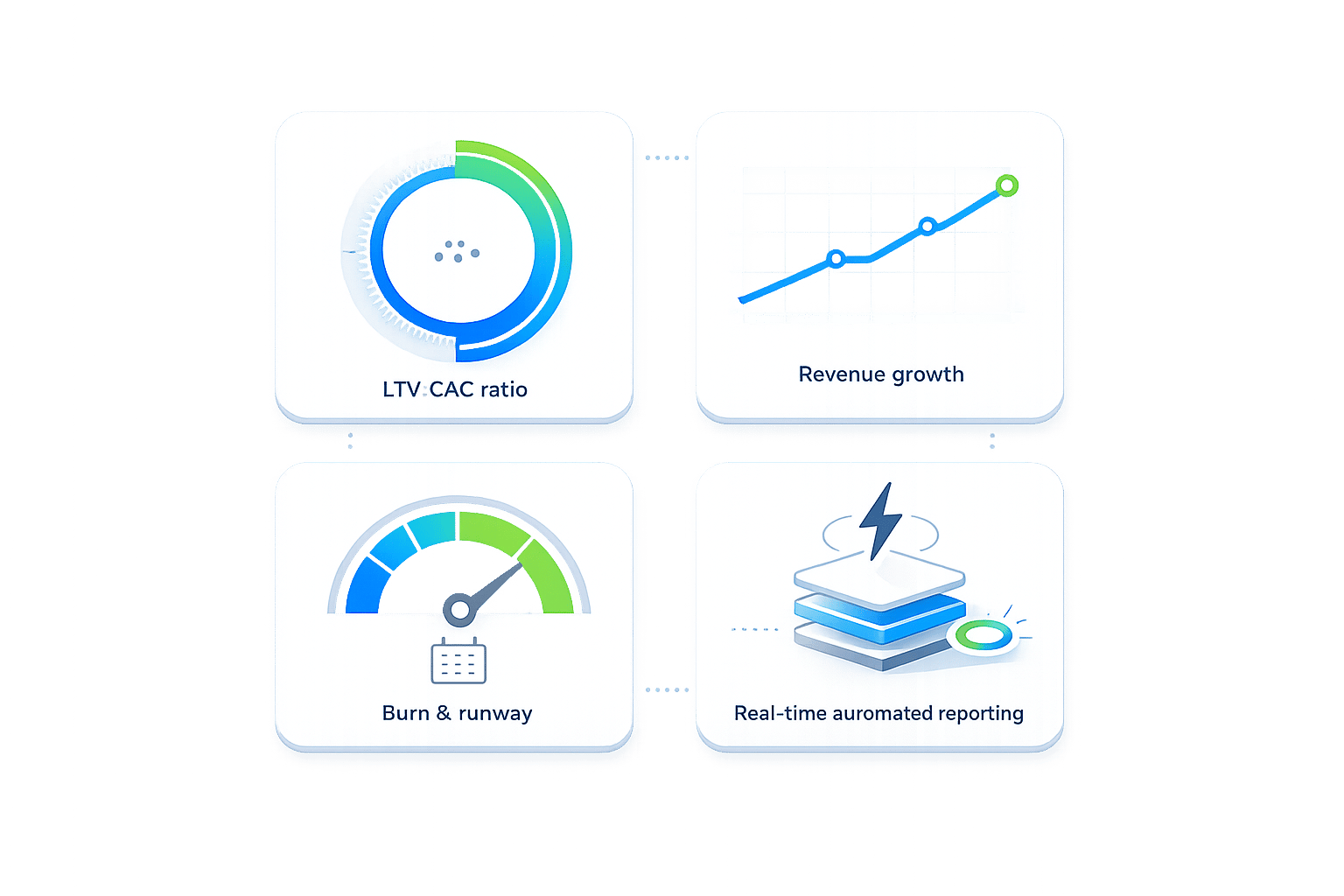
Most startups don’t run out of ideas. They run out of cash. If I were allocating resources for long-term growth, I’d start with four numbers: net burn, runway, LTV:CAC, and CAC payback. That gives me a simple way to decide what to fund, what to delay, and what to cut.
Here’s the short version:
- I’d build a clear financial baseline first
- I’d separate keeping the business running from growth bets
- I’d score new spend before approving it
- I’d review allocations every month and reset them every quarter
- I’d free up cash with tax credits, financing, and better reporting
A few numbers from the article make the point clear:
- Poor cash flow management is tied to about 82% of small business failures
- The five-year survival rate for employer businesses is 49.2%
- Unfocused teams can waste 30%–40% of capital
- A healthy LTV:CAC target is 3:1
- A solid CAC payback target is under 12 months
- Extra runway should often land around 12 to 18 months
If I had to boil the full piece down to one rule, it would be this: fund the few things that can move growth or protect cash, and make every dollar earn its place.
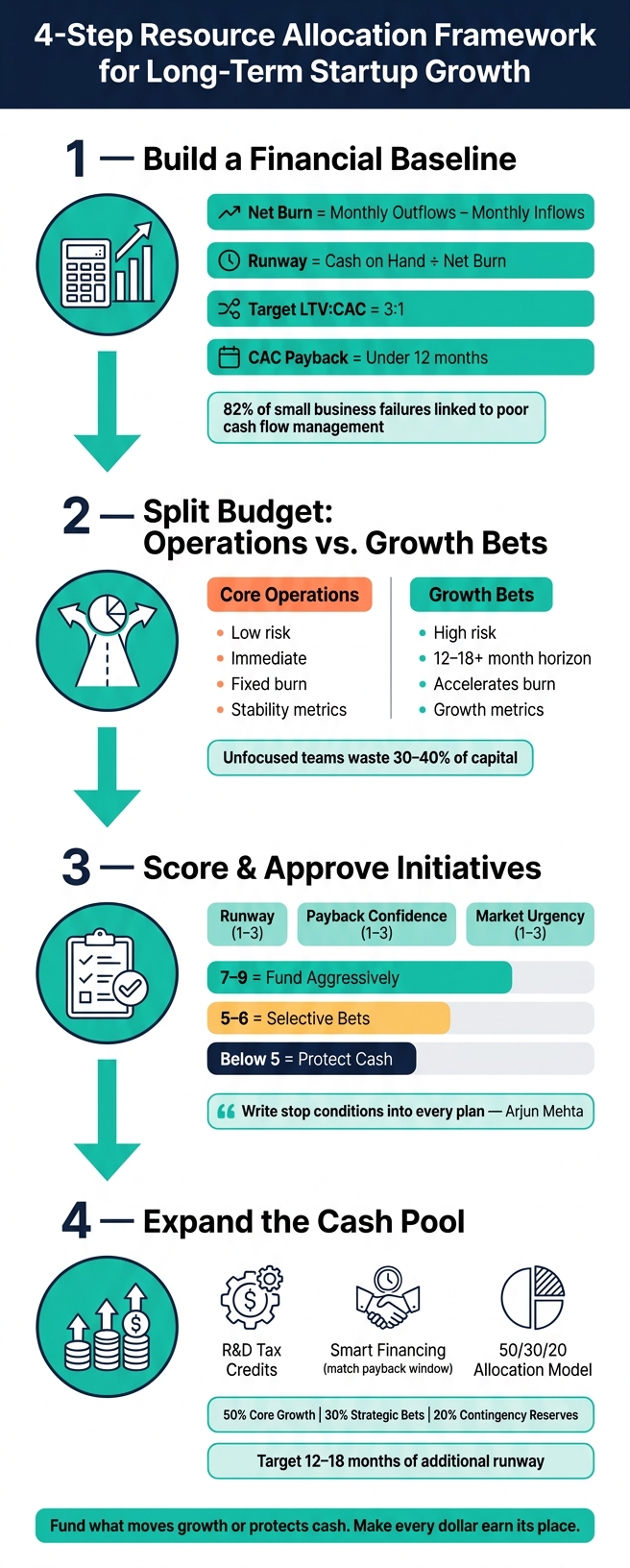
4-Step Resource Allocation Framework for Startup Growth
Lyft Was Burning $1B a Year - Here's How Resource Allocation Fixed It
sbb-itb-17e8ec9
Quick overview
| Area | What I’d focus on | Main check |
|---|---|---|
| Financial baseline | Net burn, runway, fixed vs. variable costs | How long cash lasts |
| Spend mix | Core business vs. growth bets | What keeps the company alive vs. what grows it |
| Approval process | Scoring and stop rules | Whether spend has a clear return |
| Review cycle | Monthly reviews, quarterly resets | Whether results still match the plan |
| Cash expansion | Tax credits, financing, reporting | Whether more cash can be freed up |
Below, I’ll walk through the article’s main ideas in plain English so the process is easy to use.
Step 1: Build a financial baseline before you allocate anything
Start with net burn and runway. Net burn is your monthly outflows minus monthly inflows. Runway is cash on hand divided by net burn. Those two numbers set the floor for every budget call that comes next.
First, map your fixed and variable costs so you know your minimum burn. Put every expense into four buckets: Product/R&D, Growth (Sales & Marketing), Operations (G&A/HR/Finance), and Reserves. Then split each bucket into fixed costs and variable costs.
Fixed costs include rent, base payroll, and committed software licenses. Variable costs include contractor hours, performance ad spend, and new headcount. That split matters. Fixed costs tell you the minimum cash you need each month. Variable costs are usually the first lever to pull if growth slows.
For SaaS companies, payroll and benefits alone usually make up 50–55% of total monthly cash outflow at the Series A and Series B stages. It also helps to model threshold costs. Cloud infrastructure and software seat pricing don’t always rise in a straight line. At certain usage points, costs can jump in a big way, so don’t assume they scale neatly month by month.
Use core financial metrics to decide where growth dollars should go
Once your baseline is clear, use it to guide where new dollars go. Track these four metrics:
| Metric | How to Calculate | What It Tells You |
|---|---|---|
| Net Burn (USD) | Monthly Outflows − Monthly Inflows | Monthly cash loss |
| Runway (Months) | Cash on Hand ÷ Net Burn | Time until cash depletion |
| LTV:CAC | Lifetime Value ÷ Customer Acquisition Cost | Long-term ROI of growth spend |
| Payback Period | CAC ÷ Monthly Contribution Margin | How fast you recover acquisition costs |
A good target is at least 3:1 LTV:CAC and a CAC payback period under 12 months. If you’re not there yet, putting more money into that channel usually just makes burn move faster. It doesn’t fix growth.
Use real-time reporting to keep the baseline current
These numbers can shift fast, so your reporting has to stay live. Hiring lag, deferred revenue from annual contracts, and accounts receivable aging can all make your cash position look better or worse than it is.
That’s why real-time reporting matters. Burn, runway, and receivables should stay current, not sit in last month’s spreadsheet. Lucid Financials keeps books clean in seven days and surfaces those numbers in Slack.
Step 2: Divide resources between operations and growth bets
Once burn, runway, and unit economics are set, the next call is simple in theory and hard in practice: decide what the business must keep funding to run today, and what it can fund to grow tomorrow.
Start by setting a runway floor. After that, split the rest of the budget between operations and growth bets. Get this split wrong, and you can preserve runway on paper while making little to no progress.
Fund core operations first, then rank growth investments
Operational spend keeps the company running. Growth spend is meant to expand it.
Fund the core business first. Then compare growth initiatives side by side instead of approving them one at a time in isolation. Score each one from 1–3 across three areas: runway, payback confidence, and market urgency. Fund initiatives scoring 7–9 aggressively, 5–6 selectively, and anything below 5 only if cash preservation is the main goal. That score should guide whether you hire now, wait, or roll out the spend in stages.
Tie budget decisions to milestones and OKRs
Every budget line should connect to one OKR and one measurable trigger, such as revenue, retention, or delivery.
Say your 12-month objective is to improve net revenue retention (NRR). In that case, more dollars should go to product reliability, onboarding, and customer success, not new customer acquisition. If the goal is ARR growth through a new segment, fund the sales and marketing motion needed to reach that segment, and define a clear stop condition.
The same logic applies to hiring. Tie each hire and each initiative to a trigger like a revenue milestone, a retention gain, or a product delivery date, rather than approving spend just because a new quarter starts.
Operational vs. growth investments: a comparison
Before approving any expense, put it in the right bucket. This table makes that call faster.
| Category | Purpose | Time Horizon | Risk | Effect on Runway | Success Metrics |
|---|---|---|---|---|---|
| Operational | Stability, safety, and compliance | Immediate / Ongoing | Low | Fixed, predictable burn | Stability metrics |
| Growth | Future value and revenue expansion | 12–18+ months | High | Accelerates burn | Growth metrics |
If an expense doesn't clearly protect the core business or move a measured growth bet forward, pause. Clarify the goal before you approve it. Once you set the split, review it on a fixed cadence so spending tracks results.
Step 3: Build a repeatable allocation process and update it regularly
A one-time budget usually falls apart once the business starts shifting. That’s why allocation needs a monthly review and a quarterly reset. The point isn’t to spend more or move faster. It’s to spend at the right time.
Use the baseline from Step 1 and the operations-growth split from Step 2 to decide what gets funded, what gets pushed back, and what gets cut.
Score initiatives before approving budget
Start each review the same way: rank initiatives against the same set of criteria. Score each one from 1 to 3 on:
- Runway: quarters remaining
- Payback Confidence: proof of return within 18 months
- Market Urgency: how fast the window is closing
This keeps capital pointed at the highest-return uses. A total score of 7–9 supports leaning into growth. Scores of 5–6 mean selective bets only, and only when confidence is high. Anything below 5 means protect cash.
Scoring helps, but it’s not enough on its own. Every initiative also needs pre-agreed kill criteria. In plain English, that means a written stop condition.
"Initiatives without pre-agreed failure conditions become zombies. Write 'we stop if X by date Y' into every plan - it makes both stopping and continuing a decision instead of a drift." - Arjun Mehta, Head of Performance, GrowwithBA
One marketplace company did this by setting a kill criterion of $90 CAC by day 45. When CAC hit $140, the team stopped right away and moved the budget elsewhere instead of letting a weak project keep burning cash.
Reallocate monthly and quarterly using forecast scenarios
Use monthly KPI reviews and quarterly forecast scenarios to check whether budget assumptions still match what’s happening in the business. If the numbers change, the budget should change too.
A simple way to handle this is with conditional commitments. For example: continue at the current burn rate unless pipeline coverage drops below 2.5x; if it does, defer planned Q3 hires.
At the quarterly reset, pause growth spend that does not show clear payback inside 18 months.
Resource allocation process checklist
Use this cadence to keep ownership and timing clear.
| Step | Key Inputs | Owner | Review Cadence | Output |
|---|---|---|---|---|
| Baseline Review | Fixed/Variable spend, Unit economics | CFO / Finance | Monthly | Current burn & runway multiple |
| Initiative Scoring | ROI models, Market urgency, Payback data | CEO / Dept. Heads | Quarterly | Prioritized initiative list |
| Budget Approval | Scored list, Cash constraints | CEO / Board | Quarterly | Funded initiatives & kill criteria |
| Monitoring | KPI tracking, Pipeline coverage | Ops / Finance | Monthly | Exceptions and triggers |
| Reallocation | Performance vs. forecast scenarios | CEO / CFO | Monthly / Quarterly | Reallocated capital or stop decision |
Step 4: Increase available resources through tax planning, financing, and better financial systems
Once you’ve set the allocation mix, the next move is simple: make the cash pool bigger. Step 4 does that by freeing up cash through tax savings, picking funding that fits your runway, and tightening up your financial systems.
Use R&D tax credits and tax planning to free up cash
If your startup spends money on product development or experimentation, check for tax credits like R&D credits and other tax planning moves that can free up cash. One of the easiest ways to do this well is to centralize bookkeeping and tax work, so eligible credits are found and claimed sooner.
That matters because any cash recovered here can go straight back into the priorities you set in the earlier steps.
Choose financing based on runway, risk, and flexibility
Funding shouldn’t be treated like one big pile of money. Match it to the payback window. Work with shorter payback can use tighter capital. Work that takes longer to pay back needs more runway and more room to breathe.
Use payback by function or channel so you’re not treating every dollar the same. Keep a reserve for surprises, and aim for 12 to 18 months of additional runway beyond your base-case projection.
Financing and spending mix: a side-by-side comparison
A simple way to keep spending in check is to use a fixed allocation model. One example is 50/30/20:
- 50% to core growth
- 30% to innovation or strategic bets
- 20% to contingency or optionality reserves
| Allocation bucket | Typical share | Use |
|---|---|---|
| Core growth | 50% | Ongoing growth work and execution |
| Strategic bets | 30% | Innovation and higher-upside initiatives |
| Contingency reserves | 20% | Flexibility for uncertainty and market shifts |
Track allocation by bucket, ROIC, and payback in one dashboard. For new requests, use zero-based budgeting: each one has to prove its return.
With more cash available and faster reporting, the final step is to keep allocation rules simple and disciplined.
Conclusion: A simple framework for allocating resources without burning through runway
Long-term growth comes from disciplined spending, not just spending more.
Put the pieces together, and you get a simple rhythm for running the business. Start with a baseline. Separate day-to-day operations from growth bets. Tie spend to clear milestones. Then review allocations on a set schedule each month.
Add smart tax planning and strong financial systems, and your cash goes further. That gives you a process you can repeat, trust, and improve over time. A structured approach cuts waste and helps protect runway.
Lucid Financials keeps your books current, gives you real-time reporting, and supports tax and forecasting work so your allocation decisions stay accurate.
The aim is simple: build an allocation process you can rely on and update monthly. When you use it consistently, allocation stops being a reactive chore and starts becoming an advantage for growth.
FAQs
How much runway should a startup keep?
There’s no single right number, but one thing is clear: you need enough runway.
That matters because 29% of startups fail after running out of cash. And that’s why founders can’t rely on monthly profit and loss statements alone. A P&L can look fine on paper while your actual cash balance tells a very different story.
A better move is to use rolling 12–18 month forecasts and update them every month or quarter. That gives you a clearer view of burn rate and helps you spot problems before they turn into a cash crunch.
Lucid Financials makes this easier by giving you real-time visibility into runway and burn rate. It also includes scenario modeling, so you can see how hiring plans and spending choices may affect your cash position.
What if our LTV:CAC is below 3:1?
If your LTV:CAC is below 3:1, that usually points to a growth plan that isn’t working well. You may be spending too much to win customers and not getting enough value back. In plain English: you’re burning cash instead of building a stronger business.
In most cases, that’s a good moment to slow down aggressive acquisition spend until your unit economics improve.
Don’t rely on blended averages alone. They can hide problems. Look at the data by customer segment and acquisition channel so you can see where things are going off track.
Lucid Financials can help you track these metrics in real time, which makes it easier to shift resources with confidence.
How do we set kill criteria for new spend?
Set kill criteria before funding starts. Define clear, measurable outcomes tied to growth milestones and financial triggers. Then review each initiative against four things: revenue impact, margin potential, strategic urgency, and past performance.
If an initiative misses its benchmarks, or runway drops below four quarters, pause growth spend unless there’s hard evidence it can pay back in the short term. Use zero-based budgeting principles so every dollar has a job and supports current priorities.