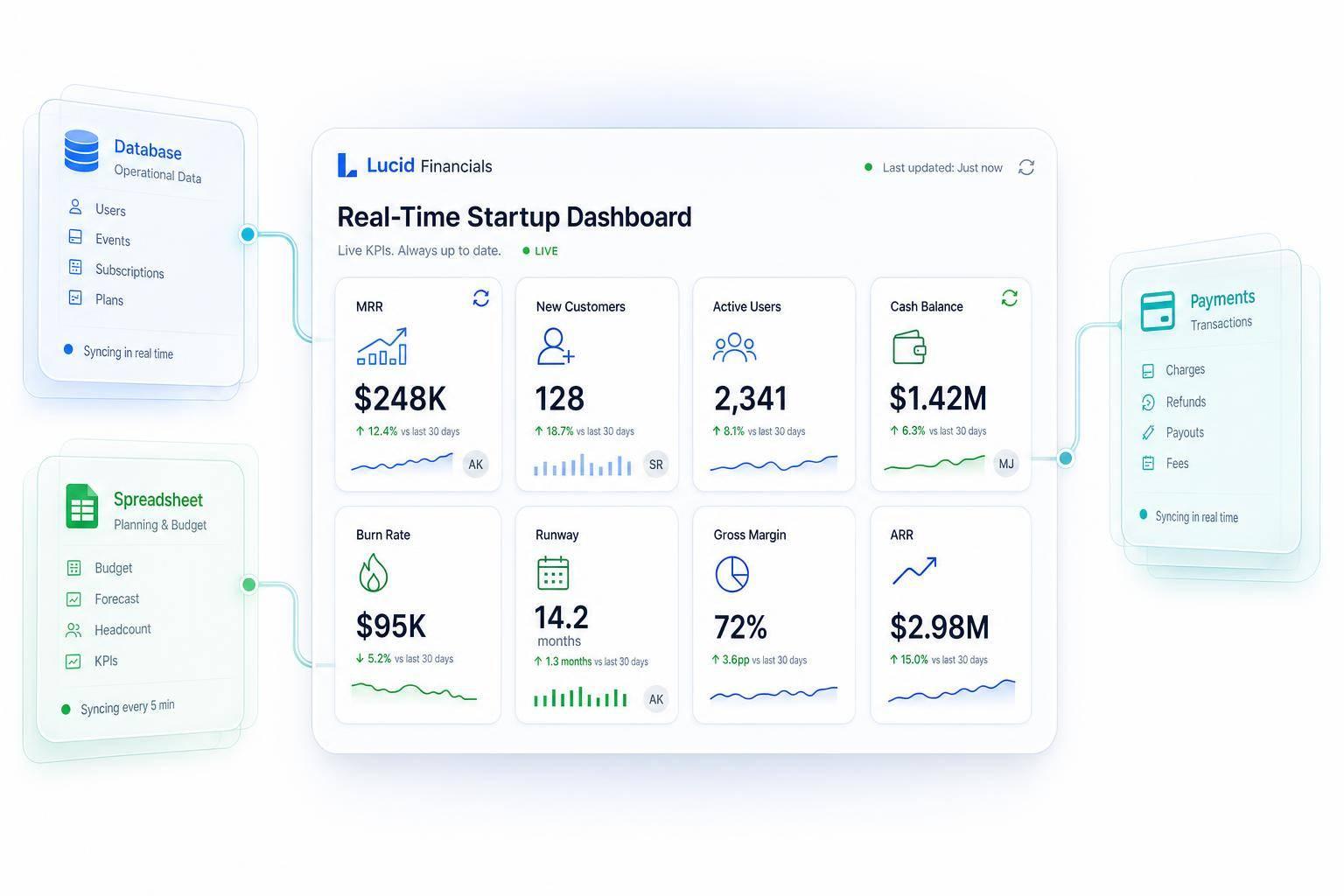
Startups are leveraging AI to transform cash flow management from a time-consuming, reactive process into a real-time, proactive advantage. The biggest challenge for startups is running out of cash, with 38% failing due to cash shortages. AI tools address this by providing instant financial visibility and alerts, helping founders make faster, data-driven decisions.
Key Takeaways:
- Real-time tracking: AI integrates with systems like banks, payroll, and billing tools to offer up-to-date cash flow insights.
- Anomaly detection: AI flags unusual financial activity, such as unexpected charges or late payments.
- Automated alerts: Founders receive actionable updates on burn rate, runway, overdue invoices, and upcoming obligations.
- Forecasting: AI analyzes historical and current data to project cash flow over weeks or months, offering practical ranges instead of rigid figures.
- Scenario modeling: Founders can simulate different financial outcomes, such as hiring delays or funding gaps, to plan effectively.
AI-powered platforms like Lucid Financials also integrate with tools like Slack, ensuring seamless updates and reports for daily operations and investor meetings. For startups, adopting AI in cash flow management isn't just helpful - it's becoming essential for staying ahead in a competitive landscape.
How AI Improves Cash Flow Monitoring
Real-Time Tracking and Anomaly Detection
AI-powered cash flow monitoring connects directly to key systems - bank accounts, corporate cards like Ramp or Brex, payroll platforms like Gusto or Rippling, billing tools such as Stripe or Chargebee, and accounting software. This integration allows founders to see their current cash balance, recent net movement, and anticipated inflows for the next 7–14 days, all without the need for spreadsheets.
One standout feature is anomaly detection. AI learns your typical financial patterns - vendor charges, recurring SaaS fees, weekly burn rates - and flags anything unusual. For instance, if your AWS bill averages $7,500 per month but a $19,800 charge appears on a Tuesday, the AI spots it immediately and flags it for review. The same applies to duplicate ACH payments, unexpected spikes in refunds or chargebacks, or an off-cycle payroll run that could quietly reduce your runway.
These real-time insights deliver actionable alerts, helping founders stay ahead of potential financial issues before they escalate.
Automated Alerts That Help Founders Act Fast
AI doesn't just monitor cash flow - it transforms raw data into clear, actionable alerts. These alerts highlight issues and their potential impact, giving founders the tools to address cash flow challenges proactively.
Some of the most helpful alerts for early-stage startups include:
- Burn rate and runway updates: For example, "Your average monthly net burn over the last 3 months is $145,000, up 18% from the prior period. At this rate, your runway is 9.2 months." This kind of alert helps you identify major outflows, reduce discretionary spending, or start fundraising sooner.
- Late receivables: "ACME Corp's $48,000 invoice is 15 days past due; their average payment time is 7 days." Alerts like this prompt immediate follow-ups, preventing surprises at the end of the month.
- Upcoming payment obligations: "You have $92,000 in vendor payments due in the next 7 days; projected bank balance on Friday is $61,000." This heads-up allows you to reschedule non-essential payments or negotiate terms to avoid a shortfall.
- Tax deadlines: "Quarterly federal tax payment of $12,000 is due 09/15/2026; state tax of $3,500 is due 09/20/2026." Catching these deadlines weeks in advance helps avoid last-minute financial strain.
By flagging these risks 1–4 weeks in advance, AI gives founders the breathing room to make adjustments instead of rushing to react. This keeps cash flow management steady and predictable.
Fitting AI Into Daily Startup Workflows
AI goes beyond alerts by integrating directly into the tools startups already use, making it easier to respond quickly. For instance, embedding AI updates into platforms like Slack ensures real-time updates are delivered without interrupting daily operations.
Imagine a dedicated #finance channel where a morning digest provides your current cash balance, net cash change, burn rate, and any flagged anomalies - all before your team’s daily standup. Critical alerts, such as a failed payment batch or a high-risk receivables issue, can be sent directly to the relevant team member to ensure nothing is overlooked.
Tools like Lucid Financials are designed with this workflow in mind. By delivering updates directly through Slack, they integrate seamlessly into your routine, eliminating the need for weekly finance reviews and ensuring cash flow insights are always just a click away.
sbb-itb-17e8ec9
How AI Is Revolutionizing Finance for Startups
How AI Builds and Delivers Cash Flow Forecasts
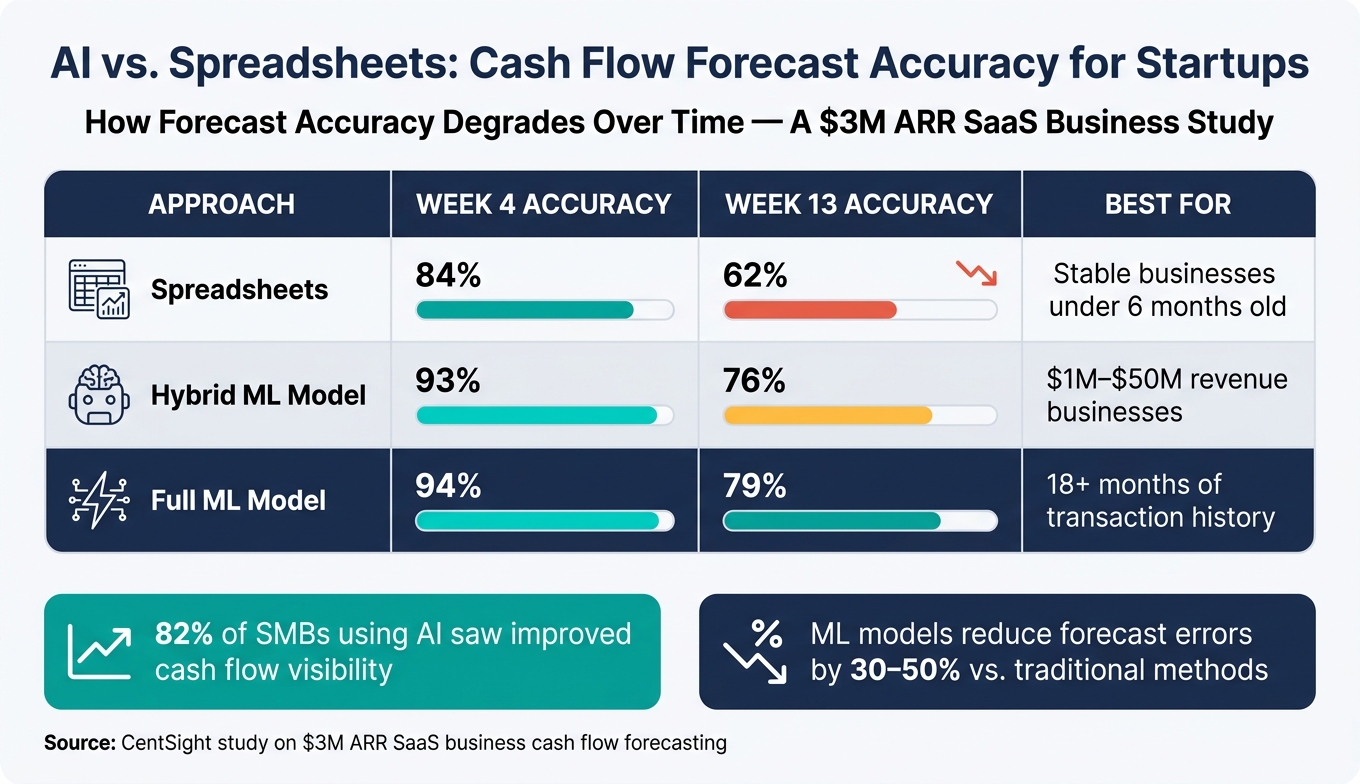
AI vs. Spreadsheets: Cash Flow Forecast Accuracy for Startups
How AI Generates a Cash Flow Forecast
AI-based forecasting takes a deep dive into your historical data - things like bank transactions, invoices, payroll, and subscription billing. From there, it identifies patterns such as fixed costs, seasonal trends, and common fluctuations. But it doesn’t stop there. AI also incorporates forward-looking signals like your sales pipeline, contract renewals, and upcoming vendor payments to project your cash flow over the next 4–13 weeks.
What makes AI stand out is its ability to spot details that might slip past a human eye. For example, it can detect gradual customer churn, delayed payments based on a client’s history, or a seasonal slowdown in new bookings. And instead of giving you one rigid number, AI delivers a range. For instance, it might project: "Your most likely ending cash balance on July 31 is $480,000–$510,000, assuming the current burn rate." That range is far more practical for planning than a single, overly precise figure.
"A forecast that says 'you will have $487,302 on June 15' is suspiciously precise. A forecast that says 'your most likely ending cash is $480,000–$510,000... is honest." - Gerald Hetrick, Founder, CentSight
This dynamic approach makes it clear why AI outshines traditional spreadsheet methods.
AI Forecasting vs. Manual Spreadsheets
Spreadsheets might work when you’re just starting out, but they can quickly become unreliable as your business grows or changes. A new pricing structure, unexpected churn, or a one-time large invoice can throw off even the most carefully built spreadsheet model.
AI, on the other hand, adapts in real time. It retrains itself daily by processing new transaction data, while spreadsheets often rely on weekly or monthly updates. Over time, this adaptability creates a noticeable difference in accuracy. For example, a study of a $3M ARR SaaS business found that spreadsheets were 92% accurate in Week 1 but dropped to just 62% by Week 13. Hybrid machine learning (ML) models - blending rule-based logic with statistical analysis - held steady at 76% accuracy by Week 13. Fully machine learning-based models performed even better, achieving up to 97% accuracy in the short-term 1–4 week range.
| Approach | Week 4 Accuracy | Week 13 Accuracy | Best For |
|---|---|---|---|
| Spreadsheets | ~84% | ~62% | Stable businesses under 6 months old |
| Hybrid ML Model | ~93% | ~76% | $1M–$50M revenue businesses |
| Full ML Model | ~94% | ~79% | 18+ months of transaction history |
"If you have eighteen months of clean data and you are still running the forecast in a spreadsheet, you are leaving accuracy on the table." - Gerald Hetrick, Founder, CentSight
What Affects Forecast Accuracy
The quality of your data plays a huge role in how accurate your forecasts will be. If your records are messy - think miscategorized expenses, missing entries, or unreconciled transactions - then the AI’s predictions will reflect those flaws. Most startups need at least 12 months of clean, well-organized transaction history before a hybrid AI model can outperform a carefully managed spreadsheet.
Stability in your business operations is another key factor. AI thrives on historical patterns, so if your pricing, revenue model, or costs shift dramatically, the forecast might lose some accuracy. For instance, switching from monthly to annual contracts or landing a one-off enterprise deal could disrupt the model’s learning process. That’s when human judgment becomes essential - AI can crunch the numbers, but a skilled CFO or financial advisor can interpret when the forecast needs context beyond the data. Tools like Lucid Financials combine AI-driven forecasts with expert financial guidance to ensure the numbers make sense, even during periods of change.
Using AI for Scenario Analysis and Financial Planning
Understanding how cash positions evolve under different scenarios can offer a clearer picture of financial health. AI makes it possible to perform multi-scenario planning quickly enough to influence everyday decisions - not just during quarterly reviews. Let’s explore how AI simplifies scenario adjustments and supports smarter financial planning.
Running What-If Scenarios With AI
AI allows you to instantly adjust cash flow forecasts in response to operational changes. Unlike traditional models that require painstaking spreadsheet updates for every assumption tweak, AI streamlines the process. For instance, if a senior hire is moved from Q4 to Q3, the model immediately recalculates key metrics like runway, burn rate, and ending cash balance for the entire forecast period.
Every detail matters. The financial impact of a new hire - salary, taxes, benefits, and onboarding - must be accounted for, especially since there’s typically a 30–90 day delay before they start contributing to revenue. AI calculates these cumulative effects in real time, giving you immediate insights.
This same adaptability applies to fundraising scenarios. A common mistake founders make is assuming funding will close on schedule. In fact, 70% of startups misjudge liquidity during fundraising due to delays or unforeseen expenses. AI helps you model scenarios where your Series A funding round takes four to six months longer than expected, showing whether this could force you into a weaker negotiating position.
Scenarios Every Startup Should Model
AI’s real-time monitoring and forecasting capabilities allow startups to simulate a variety of financial outcomes. A practical approach is to maintain three parallel models at all times:
| Scenario | Key Variables | Strategic Purpose |
|---|---|---|
| Base Case | Current sales pace, planned hires, expected collections | Standard operating and growth plan |
| Downside | Churn +15–25%, ARR growth –30–40%, deal slippage | Identifying survival triggers and cost-cutting needs |
| Upside | Early deal closes, expansion revenue, deferred hires | Planning for aggressive scaling or reinvestment |
The key to making these models actionable is incorporating decision triggers - predefined actions that kick in when certain metrics hit specific thresholds. For example: "If ARR growth drops below 40% by September 30, freeze Q4 hiring and cut paid acquisition spend by 50%." With these triggers built into your model, your team can respond immediately to downside scenarios without waiting for fresh analysis.
"A cash flow forecast that only shows one outcome is not a planning tool. It is a reporting exercise." - Fiscallion
Using AI Reports in Investor and Board Meetings
AI-generated reports go beyond showing cash balances - they also highlight trade-offs, enabling more strategic discussions with boards and investors. Instead of presenting a single cash figure, you can walk your board through scenarios like: "To extend our runway to 18 months, we need to maintain ARR growth above 60% or delay Q3 hiring." This shifts routine updates into meaningful conversations about strategy.
Tools like Lucid Financials can produce board-ready reports and investor-grade forecasts on demand. This ensures founders are always prepared for high-stakes discussions, enabling faster, more informed decision-making. These reports reinforce the importance of proactive cash flow management, as discussed earlier.
How to Start Using AI for Cash Flow Insights
To harness the power of real-time insights and forecasting, startups need a solid data foundation and a clear plan for implementation.
What to Prepare Before Using AI Tools
Before diving into AI-powered financial tools, it’s crucial to ensure your financial records are in top shape. This means keeping your books clean, up-to-date, and consistently categorized. Every bank account, credit card, and payroll account should be reconciled monthly. Make sure revenue, COGS (cost of goods sold), operating expenses, and non-operating items are clearly separated.
Centralizing all your financial accounts - business checking, savings, credit cards, and payment processors - is a must. Standardize your chart of accounts for clarity. For instance, separate SaaS subscription revenue from one-time services, and track R&D spending separately to simplify tax credit claims later.
You’ll also need 12–24 months of historical transaction data and monthly financial statements in USD. This data gives AI models the context they need to deliver accurate insights. Before activating any tools, plan a “cleanup sprint” (typically two to four weeks) to reconcile past periods and fix any miscategorized transactions. Skipping this step can lead to errors in your forecasts and alerts.
Define your key metrics upfront. Metrics like net cash burn, runway, DSO (days sales outstanding), MRR/ARR (monthly/annual recurring revenue), and CAC (customer acquisition cost) should be identified early. Once set, you can configure alerts such as "notify me when runway drops below nine months" or "flag invoices overdue past 45 days." These alerts help you stay proactive.
How to Choose the Right AI Financial Platform
Not all AI financial tools are created equally, so it’s important to focus on key features when selecting a platform. Start by evaluating integration depth. The platform should integrate seamlessly with your U.S.-based accounting system, major banks, payroll providers, and billing tools. Without strong integrations, you’ll be stuck with manual data exports and outdated information.
Next, assess forecast quality. A reliable platform should offer cash flow projections for 12–18 months, allow for multiple scenarios, and let you adjust key variables - like headcount or marketing spend - to see the impact instantly. Finally, prioritize real-time monitoring. Look for features like dashboards that update daily, automatic anomaly detection, and alerts that are sent through tools you already use.
It’s also helpful to have expert support to interpret the AI-generated insights. A professional with U.S. GAAP expertise and startup finance experience can help you make sense of the data and guide your decisions. For example, Lucid Financials combines AI-driven monitoring and forecasting with bookkeeping, tax support, and fractional CFO services. Integrated with Slack, it provides real-time answers without requiring you to switch platforms.
Once you’ve chosen a platform, adopt a phased approach to fully integrate AI into your financial processes.
A Phased Approach to AI Adoption
Rolling out AI gradually helps you maximize its benefits while keeping disruptions minimal.
| Phase | Focus | Benefits |
|---|---|---|
| Phase 1 | Automated bookkeeping and reconciliation | Accurate, investor-ready books; dependable cash dashboards |
| Phase 2 | Rolling cash flow forecasts | A 13-week cash view, long-term runway models, and forecast vs. actuals tracking |
| Phase 3 | Scenario analysis and planning | What-if modeling, board-ready reports, and detailed commentary |
| Phase 4 | Integrated FP&A workflows | AI insights embedded into regular cash reviews, monthly closes, and board meetings |
Begin with Phase 1 by automating your bookkeeping and reconciliation processes. According to a Float survey, 69% of finance leaders still rely on spreadsheets for cash flow management, meaning many startups are starting with manual systems. Once your books are clean and automated, move into forecasting, then add scenario modeling and full FP&A integration as your confidence in the AI grows.
This step-by-step approach builds trust in AI-generated insights over time. That trust becomes invaluable when founders need to act quickly on the numbers - a skill that often separates startups with strong cash management from those that struggle.
Conclusion: What AI Means for Startup Financial Decisions
Managing cash flow has always been a tough nut to crack for startups. But AI is flipping the script, turning what used to be a tedious, backward-looking task into a proactive, strategic advantage. With tools that offer real-time insights, accurate forecasting, and quick scenario analysis, startups can now approach cash management with a whole new level of precision.
A 2023 survey revealed that 82% of SMBs using AI in financial operations saw improved cash flow visibility, while 79% made faster decisions. Machine-learning models for forecasting have also been shown to reduce errors by 30–50% compared to traditional methods. These aren’t just small wins - they can mean the difference between scrambling to handle a cash crisis and avoiding one altogether. It’s clear that AI is reshaping how startups handle their finances.
Beyond cash flow, AI is stepping into the role of a fractional CFO and controller, offering high-quality financial insights without the need for a full finance team. As investor demands grow - think dynamic scenario planning and detailed runway projections - having AI-driven financials signals operational readiness and builds trust during fundraising efforts.
Take Lucid Financials as an example. They combine AI-powered bookkeeping and forecasting with expert financial guidance. Through tools like real-time Slack updates and access to seasoned accounting, tax, and CFO professionals, Lucid helps founders translate raw data into actionable decisions. The result? A fully integrated financial operation with clean records, up-to-date forecasts, and investor-ready reports. You can learn more about their approach at Lucid Financials.
For startups, adopting AI in cash flow management isn’t just a nice-to-have - it’s becoming a must. Founders who integrate these tools early and rely on them for hiring, budgeting, and fundraising decisions put themselves in the best position to stay ahead and grow with confidence.
FAQs
How much clean history is needed for accurate AI cash forecasts?
For optimal performance, it's recommended to provide 12 to 24 months of clean historical data. This allows the AI to detect seasonal trends and recurring patterns effectively. Once the system is up and running, it continuously improves forecasts by integrating new transaction data.
To make this process seamless, Lucid Financials takes care of bookkeeping and synchronizes real-time financial data. This ensures your cash flow insights remain precise and consistently updated.
What should I connect first to get real-time cash visibility?
To get a clear, real-time view of your cash flow, link your AI-driven financial tools directly to your bank accounts, accounting software (like QuickBooks), and payroll systems. This setup allows transactions, expenses, and cash flow updates to sync automatically, cutting out the need for manual data entry. Once connected, tools like Lucid Financials can deliver up-to-the-minute insights into your cash position and runway, empowering you to make smarter financial decisions without relying on end-of-month reports.
How do I set the best alert thresholds for burn and runway?
When setting alert thresholds, it's smart to include a safety buffer that allows room for strategic adjustments. Financial experts suggest maintaining 12–18 months of runway as a guideline. To stay proactive, set alerts for when your runway dips below 9 months - this way, you’ll have enough time to respond.
Additionally, configure notifications to flag any unexpected spikes in burn rate or low cash balances. These alerts help you act quickly before small issues become big problems. Tools like Lucid Financials can automate these notifications, saving you from the hassle of manual tracking while keeping you consistently informed.