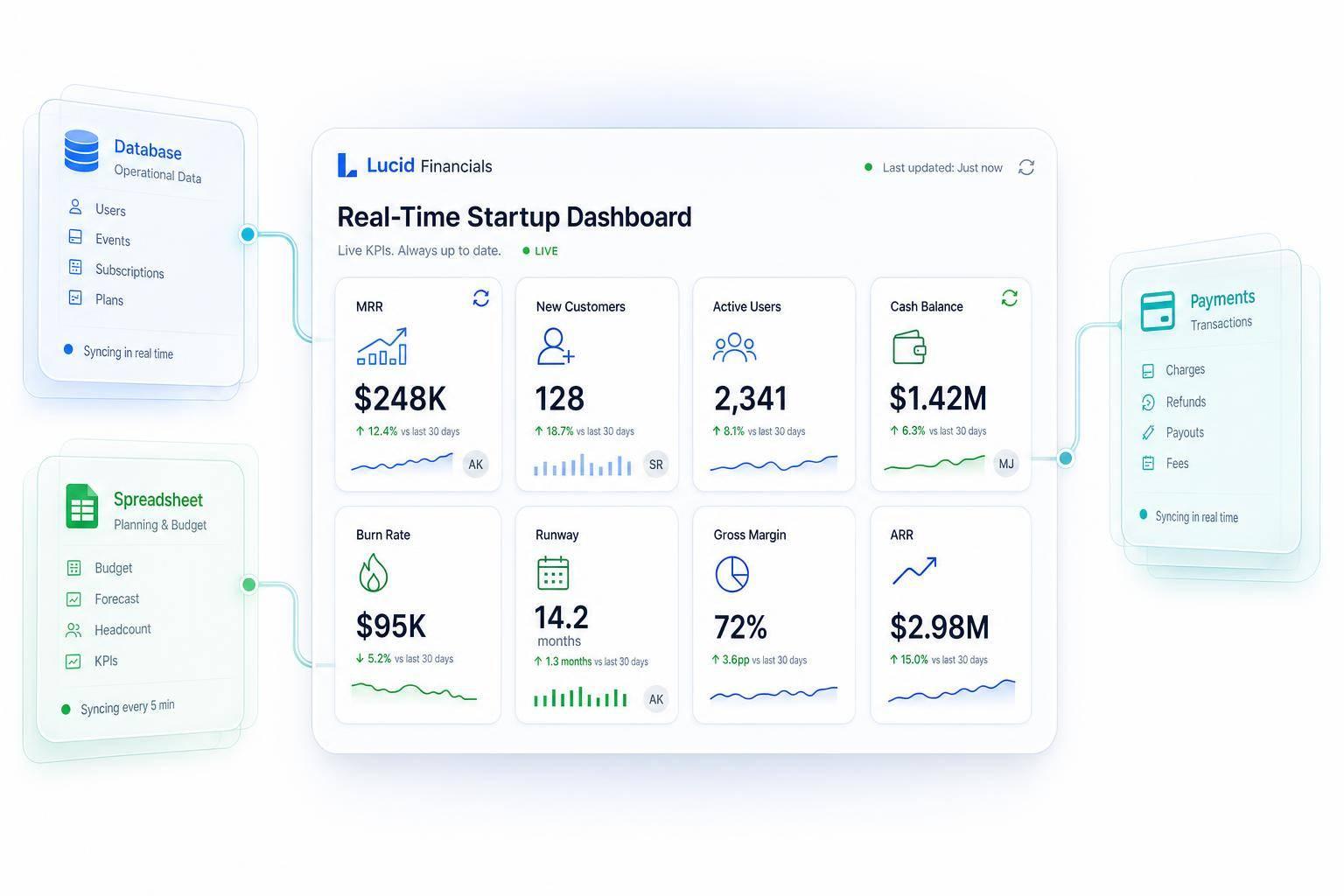
AI simplifies cash flow monitoring by automating tedious tasks, providing real-time financial insights, and improving forecasting accuracy. Here's how it works:
- Real-Time Data Integration: AI connects directly to your financial systems, consolidating data from bank accounts, credit cards, payroll, and accounting software into a single up-to-date view.
- Predictive Forecasting: AI analyzes historical trends to predict future cash flow, helping you anticipate potential shortfalls or surpluses.
- Error and Fraud Detection: By identifying irregular transactions or anomalies, AI protects your finances and ensures accurate reporting.
- Actionable Alerts: AI tools send notifications for critical financial events, like low balances or unusual expenses, enabling proactive decision-making.
For startups, where cash flow is often unpredictable, AI tools like Lucid Financials provide dashboards, forecasts, and alerts, making financial management more efficient and reducing risks associated with manual processes.
Core AI Capabilities in Cash Flow Monitoring
Real-Time Data Aggregation
AI-driven cash flow monitoring begins by consolidating live financial data into a single, up-to-date view. By directly integrating with systems like business accounts, corporate credit cards, payroll platforms, payment processors, and accounting software, AI ensures no detail is overlooked.
It goes beyond simple data collection by deduplicating, normalizing, and categorizing inputs from all financial sources. This process ensures you have an accurate cash position reflecting what happened yesterday - not last week. This immediacy empowers business leaders to make timely decisions about hiring, spending, or paying vendors with greater confidence.
Once real-time data is secured, AI doesn’t stop there - it uses historical trends to forecast what’s ahead.
Predictive Cash Flow Forecasting
With a clear, real-time snapshot of cash flow, AI shifts its focus to the future. Predictive forecasting analyzes historical transaction data, billing cycles, and customer payment habits to project future cash positions. These forecasts often include daily or weekly balances and key metrics like "projected runway: 7.2 months at current burn."
AI continuously refines its predictions by learning your company’s recurring financial patterns and adapting to new trends. This dynamic approach ensures that forecasts remain accurate and actionable. Tools like Lucid Financials take this a step further by combining AI’s analytics with expert human oversight, seamlessly linking current financial operations to long-term planning.
Anomaly and Fraud Detection
AI doesn’t just monitor and predict - it also protects. By building a model of your company’s typical financial behavior, AI can quickly identify irregularities that may signal errors or fraud.
For example, it flags deviations such as unusually large vendor payments or transactions nearing pre-set thresholds. These alerts ensure potential issues are caught within hours rather than days. Platforms like Lucid Financials add an extra layer of security by involving experienced accountants to review flagged anomalies. This approach minimizes false alarms while ensuring genuine concerns are escalated to the right person promptly, keeping your financial controls both efficient and secure.
sbb-itb-17e8ec9
Revolutionise Your Cash Flow Management with AI-Powered Forecasting
How to Set Up AI-Enabled Cash Flow Monitoring
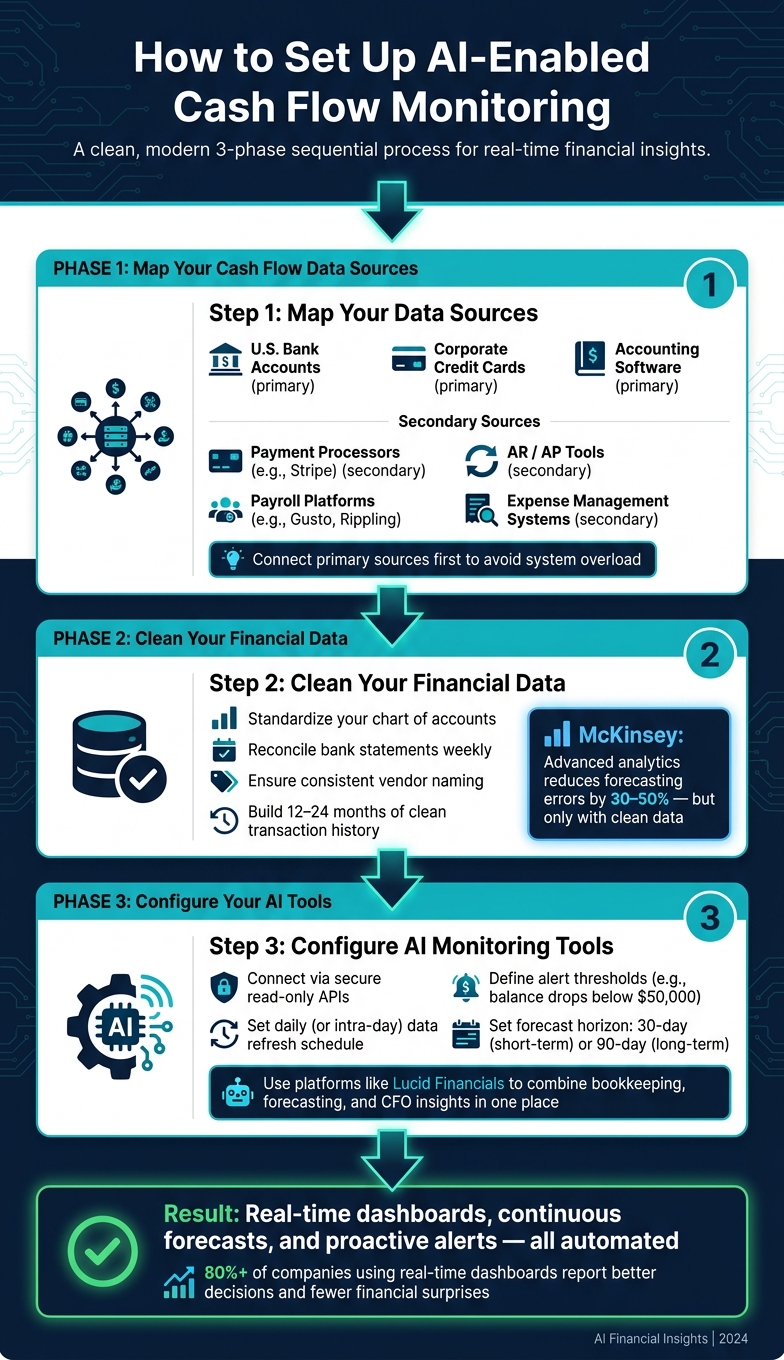
How AI-Powered Cash Flow Monitoring Works: A Step-by-Step Overview
Setting up AI-enabled cash flow monitoring means organizing your data sources, ensuring clean financial records, and configuring AI tools to suit your business needs.
Mapping Your Cash Flow Data Sources
To get started, identify every system that tracks your cash flow. This includes U.S. bank accounts, corporate credit cards, payment processors like Stripe, accounts receivable (AR) and payable (AP) tools, payroll platforms like Gusto or Rippling, and expense management systems. Prioritize connecting your primary data sources - bank accounts and accounting software - first, as these serve as the backbone of your financial records. Once those are in place, you can integrate secondary sources like AR, AP, payroll, and expense tools.
This phased approach prevents system overload and ensures that your initial setup captures the most critical cash flow data for accurate forecasting. Once your data sources are mapped, it’s time to focus on data quality.
Keeping Your Financial Data Clean
Clean financial data is essential for reliable AI predictions. Start by standardizing your chart of accounts, reconciling bank statements weekly, and ensuring consistency in vendor names. For example, if "client meals" are recorded under multiple categories or vendor names are inconsistent, your AI model will struggle to provide accurate insights.
To achieve meaningful forecasts, aim for 12–24 months of clean transaction history. This ensures the AI has enough context to identify trends like seasonal revenue shifts, payroll schedules, and recurring expenses. McKinsey highlights that companies leveraging advanced analytics for forecasting can reduce errors by 30–50%, but this level of precision depends on well-maintained, consistent data.
Configuring AI Tools for Monitoring
The final step is configuring your AI tools to provide timely and actionable insights. Connect these tools to your accounting and banking platforms through secure APIs, ideally with read-only access to minimize security risks. Set up a daily data refresh schedule for most businesses, or opt for intra-day updates if you handle high transaction volumes.
Next, establish cash flow thresholds to trigger alerts - such as notifications when balances drop below $50,000 or payments exceed typical amounts by 2–3 times. Adjust your forecast horizon to fit your needs: a 30-day view works well for short-term decisions, while a 90-day outlook is better for long-term planning, like hiring or extending your runway.
For smaller teams or those without dedicated finance staff, tools like Lucid Financials simplify the process. These platforms combine bookkeeping, real-time forecasting, and CFO-level insights into a single system, complete with Slack-based alerts. This eliminates the need to manually integrate multiple tools, making it easier to set up a robust cash monitoring system.
Improving Daily Cash Flow Visibility with AI
For startups, staying on top of cash flow is essential, especially when dealing with unpredictable financial dynamics. With tools like automated data aggregation and predictive forecasting, gaining a clearer picture of daily cash flow becomes much easier. Once set up, features like live dashboards, continuous forecasts, and timely alerts provide consistent, actionable insights.
Real-Time Dashboards and Insights
An AI-driven dashboard offers a real-time snapshot of your financial situation. It lays out key details like current cash balances, upcoming inflows and outflows, recent net changes, and even runway estimates (e.g., "Runway: 9.2 months – cash-out date: 03/15/2027").
But it’s not just about numbers. These dashboards also identify patterns that might otherwise go unnoticed. For instance, the system could flag a customer who usually pays 15 days late but now has three invoices overdue by 25 days. This kind of insight, buried in spreadsheets, becomes instantly visible, making daily monitoring far more effective.
Continuous Forecasting and Updates
AI-powered forecasting tools update automatically as new transactions come in, instantly recalculating cash balances, burn rates, and runway estimates. For example, after receiving a $150,000 payment, projections adjust without any manual effort.
The system also learns your financial rhythms, like seasonal revenue spikes, payroll schedules, or annual renewals, and incorporates these into its forecasts. Research shows that switching from spreadsheets to AI-based forecasting can boost accuracy by 20–40%, giving founders a much stronger foundation for daily decision-making. This constant updating ensures you're always aligned with your financial goals.
Alerts and Notifications for Financial Issues
Dashboards are only helpful if someone is actively monitoring them. That’s why AI tools include alerts and anomaly notifications. You can set triggers for specific indicators, such as cash levels dropping below a critical threshold, unusual vendor transactions, or overspending. When these triggers are activated, the system sends alerts directly to platforms like Slack or email.
Additionally, AI-powered anomaly detection saves time by prioritizing transactions that deviate significantly from historical trends. This can reduce the time spent investigating discrepancies by up to 50%, allowing your team to focus on the issues that matter most.
Using AI Insights to Make Better Cash Flow Decisions
AI is transforming how businesses manage cash flow by providing real-time insights and ongoing forecasts. These tools allow for smarter, proactive decisions - whether it’s adjusting vendor payments, addressing cash shortfalls, or planning new hires.
Optimizing Working Capital
AI-powered forecasting gives you a detailed view of your cash flow days - or even weeks - ahead, helping you make informed decisions about payables and receivables. For example, if your forecast predicts your balance will drop below $250,000 in the next three weeks, you can take action. You might delay non-essential vendor payments until closer to their due dates, prioritize collecting high-value invoices flagged as likely to be delayed, or even offer a small 1–2% discount to slow-paying customers to encourage quicker payments.
On the flip side, if your forecast shows a surplus over the next two months, you can take advantage of early-payment discounts from suppliers or prepay recurring expenses at a reduced rate. AI enables you to turn timing into a strategic advantage.
Scenario Planning and What-If Analysis
Before making major financial decisions, AI allows you to model their cash flow impacts. For instance, if you’re considering hiring a senior engineer at $180,000 per year starting October 1, AI tools can recalculate payroll outflows based on your bi-weekly pay schedule. You’ll see how this hire affects your burn rate and runway, both with and without the addition. Want to compare hiring two engineers now versus staggering them over six months? AI can generate side-by-side projections, showing you the cash flow curves for each option.
Similarly, a $150,000 conference sponsorship in October takes on new clarity when you see how it aligns with your payroll, rent, and vendor obligations. Financial planning and analysis (FP&A) teams often evaluate three to five scenarios - including base, best, worst, and stress cases - before committing to major expenditures. AI makes this process quick and accessible, allowing you to run these evaluations as part of your regular decision-making.
Adding AI Insights to Your Financial Routines
AI tools can seamlessly integrate into your financial workflows. For example:
- Use weekly reviews of your 13-week forecast and low-cash alerts to guide immediate decisions.
- Conduct monthly reviews to compare actual results against forecasts and adjust for any variances.
- Perform quarterly scenario planning to refine hiring, budgeting, and fundraising strategies.
Platforms like Lucid Financials are designed to streamline these processes. They combine AI-generated scenario models with expert guidance, delivered through tools like Slack, to help you interpret the data. This means your runway projections come with actionable context, ensuring your hiring and spending align with your funding stage. AI doesn’t just crunch numbers - it gives you the insights to act with confidence.
Conclusion: Taking Control of Cash Flow with AI
Managing cash flow is one of the toughest hurdles for startups, but AI offers tools that can make it far more manageable. With features like real-time data aggregation, predictive forecasting, and anomaly detection, AI gives you a much clearer view of your financial health - both in the present and what’s coming down the road.
The real game-changer here is speed. Imagine being alerted to a potential cash shortfall weeks in advance or catching an unusual transaction the moment it happens. That ability to act quickly - before small issues become major crises - is where AI shines, especially for early-stage companies. On top of that, AI improves the accuracy of your financial data, giving you the confidence to make smarter decisions.
Automated processes like reconciliation and error reduction ensure your forecasts are precise. This means you can make informed calls on spending, hiring, and managing vendors without second-guessing. According to industry data, over 80% of companies using real-time cash flow dashboards report better decision-making and fewer financial surprises. Together, these tools create a system that keeps cash flow management running smoothly.
To get the most out of AI-driven cash flow tools, it’s key to make them part of your regular routine. Reviewing alerts, updating forecasts, and running scenario analyses should be ongoing habits - not one-off tasks. This approach turns cash flow management into a continuous, reliable process.
For startups without a full finance team, platforms like Lucid Financials make it even easier. By combining bookkeeping, tax services, tax credits, and CFO support with real-time Slack alerts and investor-ready reports, Lucid Financials streamlines the entire process. AI-powered monitoring gives startups the clarity and agility they need to grow sustainably.
FAQs
How much history do I need for accurate AI cash forecasts?
For the best cash flow forecasts, it's crucial to provide 12–24 months of clean historical data. This allows the AI to detect seasonal trends and financial patterns effectively. While some models might require at least 18 months of data to perform at their best, Lucid Financials adapts and improves over time as new data is integrated. It can achieve up to 95% accuracy, offering a clear picture of your financial health.
What should I connect first for AI cash monitoring?
To get started with AI for cash flow monitoring, link your main banking systems and accounting software, such as QuickBooks. This connection enables the AI to automatically sync transactions and payroll, ensuring your records stay up-to-date in real time. After this initial setup, you can also integrate tools like payment processors, ERP systems, and even Slack to receive instant updates and actionable insights directly within your workflow.
How do I set safe alert thresholds for cash and anomalies?
Tracking critical financial metrics like cash runway, burn rate spikes, overdue receivables, and payroll deadlines is essential for staying ahead of potential financial issues. Leveraging AI tools can make this process more efficient by monitoring these metrics in real time.
With AI, you can set up alerts that trigger when specific thresholds are crossed - like when account balances dip below a certain amount or spending patterns deviate from the norm. These early warnings give you the chance to take action promptly, whether by adjusting expenses, renegotiating contracts, or addressing overdue payments. This proactive approach can prevent minor financial hiccups from snowballing into serious problems.