Keeping up with global regulations is overwhelming. Startups face over 230 daily alerts from 1,374 regulators across 190 countries. Missing updates can lead to costly fines - like the $4.6 billion imposed by U.S. regulators in 2024 alone.
AI offers a solution. By automating regulatory tracking, AI systems provide real-time insights, classify legal updates, and map them to compliance processes. This reduces manual work, speeds up decision-making, and ensures financial records stay accurate. Key technologies like NLP, machine learning, and rule-based engines power these tools, making compliance manageable even for startups with lean teams.
Key takeaways:
- AI scans global regulatory updates in real-time and identifies risks.
- It translates complex rules into actionable steps for compliance teams.
- U.S.-specific requirements, like new 1099 reporting thresholds, are also automated.
- Startups report 40% faster decisions and 75% less audit prep time with AI.
AI bridges the regulatory gap, helping startups expand internationally while staying compliant.
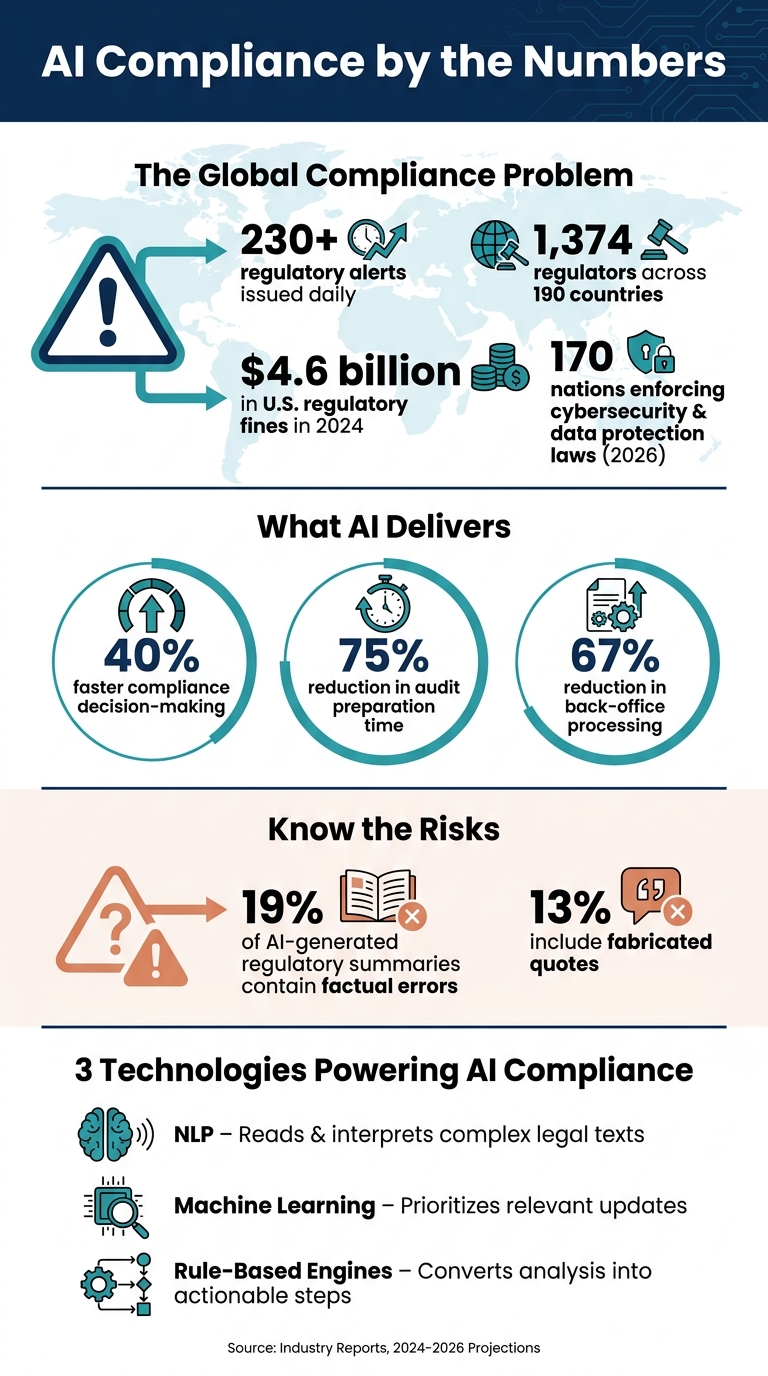
AI Compliance by the Numbers: How AI Transforms Global Regulatory Management
AI RegTech: Automating Financial Compliance and Regulation | Uplatz

sbb-itb-17e8ec9
What Is AI Regulatory Intelligence?
AI regulatory intelligence is a specialized area of regulatory technology (regtech) designed to automate how businesses handle compliance requirements. Instead of replacing manual efforts entirely, these systems continuously scan, interpret, and organize regulatory updates. This shift transforms the cumbersome task of manual tracking into a streamlined process powered by AI.
Paul McKay of Forrester explains it well:
"Regulatory intelligence solutions automate the discovery, review, and analysis of regulatory obligations, highlighting regulatory developments and supporting the ongoing maintenance of compliance."
For startups operating across multiple countries, this is a game-changer. With 170 nations enforcing cybersecurity and data protection laws as of 2026, managing this growing web of regulations manually is no longer practical. Automation is now a necessity.
From Manual Tracking to Automated Systems
In the past, compliance teams relied on outdated tools like emails, PDFs, and spreadsheets. This manual approach was slow and prone to errors, making it difficult to keep up with ever-changing regulations.
AI-powered platforms revolutionize this process. These systems provide real-time updates, create structured lists of compliance obligations, and even allow users to ask plain-language questions through AI chatbots to clarify new rules.
Core Technologies Behind AI Regulatory Systems
Three key technologies drive these systems:
- Natural Language Processing (NLP): This technology reads and interprets complex legal texts, identifying context, intent, and specific compliance obligations.
- Machine Learning: By learning from past interactions, machine learning fine-tunes the system to prioritize updates most relevant to a company’s operations.
- Rule-Based Engines: These engines convert regulatory analysis into actionable steps that align with the company’s internal policies.
Together, these technologies elevate AI regulatory systems beyond simple monitoring. Advanced platforms now analyze risk signals - like enforcement actions and regulatory communications - to help businesses anticipate areas where regulators may focus their attention.
Global Data Sources and the Importance of Coverage
AI platforms rely on extensive global data sources to provide actionable regulatory insights. These systems pull information from entities such as the IRS, international accounting standards boards, industry regulators, and enforcement reports. The range of data sources directly impacts how effective the system is, especially for startups operating internationally.
For U.S.-based startups with global ambitions, robust data coverage is critical. Modern platforms support multiple languages and track emerging markets, significantly reducing the need for manual research. For example, a U.S. startup expanding into Southeast Asia or Latin America benefits immensely from a system that monitors local regulators in addition to U.S. federal agencies. This can be the difference between staying compliant and facing costly penalties.
How AI Keeps Financial Reporting Compliant
Financial teams don’t just need AI to identify regulatory changes - they need these insights translated into actionable updates. Here’s a closer look at how AI systems streamline compliance, from detecting new rules to updating financial records.
How AI Detects and Monitors Regulatory Changes
AI systems constantly pull data from official regulatory sources like the FCA Handbook, EUR-Lex, and EBA registers, capturing updates in real time. This ensures organizations stay ahead of changes as they happen.
Once an update is detected, natural language processing (NLP) steps in to classify it based on jurisdiction, entity type, and relevant regulatory framework (e.g., Basel III, DORA). This classification ensures no overlapping frameworks are missed. The system then maps these changes to the organization’s control library using confidence scores. High-confidence matches are processed automatically, while low-confidence ones are flagged for human review, balancing efficiency with oversight.
"Too many teams are treating feed coverage as a setup question rather than an ongoing one. They audit their regulatory feeds at go-live, the system runs reliably for six months, and then a new feed becomes relevant or an existing one changes its publication format. By the time anyone notices, the agent has been quietly missing publications for weeks." - Matt Davies, Chief Product Officer, SureCloud
Turning Complex Regulations into Actionable Insights
AI simplifies the review of dense regulatory updates by creating structured impact assessments. These summaries include the change details, effective date, affected controls, and suggested actions - like updating policies or adjusting reporting processes. This allows compliance professionals to focus on strategic decisions rather than sifting through lengthy legal texts. A compliance expert then reviews and finalizes these drafts, ensuring the operational context is accurately reflected.
"The boundary between classification and interpretation is where human compliance expertise carries the work." - Gabriel Few-Wiegratz, SureCloud
Organizations leveraging AI for regulatory change management have reported a 40% boost in decision-making speed and a 75% reduction in audit preparation time.
Pushing Regulatory Updates Into Financial Systems
Once the impact is confirmed, AI assigns tasks within GRC platforms, setting deadlines that align with regulatory effective dates. This ensures a seamless transition from compliance awareness to actionable steps. By syncing ledger entries, tax calculations, and reporting policies with these timelines, startups can maintain investor-ready financial records. Every step of the process - from data ingestion to final analyst approval - is timestamped, providing a clear audit trail.
For startups using platforms like Lucid Financials, this type of compliance infrastructure integrates perfectly with real-time financial reporting. It ensures that financial records stay accurate and ready for investors, even as regulations shift.
Best Practices for AI-Powered Compliance Systems
Creating an effective AI compliance system isn't just about selecting the right software - it’s about building a governance framework that ensures the system operates effectively. These practices help AI manage data efficiently while keeping financial reports in line with both U.S. and global regulations.
Keeping Humans in the Loop
While automation excels at speed and scale, human judgment remains essential. The two must complement each other rather than compete.
AI can quickly classify payments, flag regulatory updates, or generate compliance summaries. But when critical decisions are at stake, professionals need to validate the AI’s reasoning before finalizing actions. As Rafael from Método Viral's Operations team explains:
"Artificial Intelligence can classify a payment as subject or not subject to withholding based on dozens of variables, but compliance professionals must review each decision to confirm its accuracy."
This underscores the importance of explainability. Avoid systems where the AI provides results without showing how it arrived at them. Compliance professionals need transparency. For instance, if the system flags a conflict between client-provided data and an automated determination, it should automatically escalate the case to a human reviewer instead of processing it unnoticed.
By automating routine tasks, compliance professionals can focus on more strategic areas like risk assessment, tax planning, and regulatory strategies. However, this integration of human oversight and automation also requires robust audit trails.
Building Audit Trails and Traceability
Every piece of data in the system should have a clear, verifiable trail. This means documenting which regulation prompted a change, when it occurred, who reviewed it, and what actions were taken.
Tax authorities, such as the IRS, use AI-driven tools like the Discriminant Function System (DIF) and the Unreported Income Discriminant Index Formula (UIDIF) to identify discrepancies and flag returns for audits. Without proper traceability, your organization could face significant risks.
Version control is equally critical. When regulations change, your system must log the previous rule, the updated rule, the effective date, and any resulting updates. This historical record serves as vital evidence in audits.
Such traceability becomes even more important when addressing the unique challenges of U.S.-specific compliance requirements.
U.S.-Specific Requirements for Global Compliance
For U.S.-based companies operating internationally, domestic compliance adds another layer of complexity on top of global standards. Financial reporting must adhere to U.S. GAAP and use USD, while federal and state tax obligations often vary and can conflict.
Take the One Big Beautiful Bill Act (OBBBA) as an example. It raises the reporting threshold for Forms 1099-MISC and 1099-NEC from $600 to $2,000 for payments made after December 31, 2025. However, individual states may not adopt the same threshold, requiring AI systems to apply state-specific rules automatically.
Certificate management is another critical area. For instance, W-8 forms typically require renewal every three years. Similarly, new Section 6045 regulations will require brokers to report gross proceeds and cost basis for digital assets on Form 1099-DA starting in 2025. An AI system that doesn’t account for these specifics - or fails to flag expiring certificates - can leave compliance gaps that are difficult to address later.
How to Implement AI-Driven Compliance: A Step-by-Step Plan
Evaluating Your Current Processes and Gaps
Before diving into AI-driven compliance, it’s crucial to take a hard look at how your current compliance workflows operate. Many startups face challenges like sporadic monitoring, inconsistent record-keeping, and delays in responding to regulatory updates. These issues can create blind spots that AI tools alone won’t fix.
Start with a feed audit - review all the regulatory sources your team monitors. This is especially important considering the sheer volume of updates: in 2022, 234 regulatory alerts were issued daily by 1,374 regulators worldwide. Also, assess your control library. If it’s riddled with vague or inconsistent tagging, your AI system might struggle with low-confidence mappings, leaving your team with extra manual work.
Defining What You Need From an AI Compliance Platform
Once you’ve pinpointed the gaps in your current system, it’s time to outline what you need from an AI compliance platform. A good starting point is creating a relevance profile. This should include the jurisdictions where you operate (like the U.S., EU, or UK), your business structure, and the industries you serve. A tailored profile helps filter out irrelevant updates, allowing your team to focus on high-priority changes.
When evaluating platforms, look for these core features:
| Requirement | What to Look For |
|---|---|
| Data Ingestion | Continuous updates from trusted sources (e.g., EUR-Lex, FCA Handbook) |
| Classification | NLP-driven tagging by jurisdiction, entity type, and regulatory framework |
| Confidence Scoring | Alerts for ambiguous mappings while automating straightforward ones |
| API Compatibility | Smooth integration with your governance, risk, and compliance systems |
| Audit Trails | Timestamped logs for tracking both AI and human actions |
Keep in mind that AI should primarily handle tasks like ingesting, classifying, and mapping updates, while your compliance team retains responsibility for final reviews. This human-in-the-loop approach ensures accountability and reduces errors. For example, services like Lucid Financials integrate this structure, allowing experienced professionals to validate AI-generated outputs before they’re finalized.
After defining your requirements, conduct thorough testing to ensure the platform aligns with your processes and integrates well with your existing systems.
Testing, Validating, and Refining Your System
Before fully committing to an AI-driven workflow, run the system alongside your manual process for an entire review cycle. This parallel testing phase is crucial, especially for updates that span multiple jurisdictions or frameworks. These complex cases often reveal gaps in the AI’s mapping logic.
It’s also wise to rely on compliance platforms specifically designed for regulatory tasks. Research shows that 19% of AI-generated regulatory summaries contain factual errors, and 13% include fabricated quotes. Platforms built and validated by regulatory experts are far more dependable. Once the system is live, keep an eye on confidence scores and track how often updates are flagged for human review. Use this data to fine-tune the system and improve its accuracy over time.
Conclusion: Why AI Is the Right Move for Startup Compliance
Once you've assessed and adjusted your existing workflows, integrating AI can provide a scalable compliance framework tailored to your business needs. With compliance teams juggling over 200 regulatory updates regularly, manual processes struggle to keep up - especially when expanding from just a couple of jurisdictions to operating in 10 or 20 markets.
AI doesn’t just speed up regulatory updates; it fundamentally changes how compliance is managed by shifting from reactive to proactive strategies. This proactive approach saves time and resources, with back-office processing reduced by 67%, enabling teams to focus on growth-oriented tasks.
Another critical advantage is improved audit readiness. Regulators now expect companies to demonstrate not only compliance outcomes but also the logic behind their decisions. Automated systems provide timestamped, evidence-based records that make audits far less daunting. As David Marley, CEO of ComplyExchange, puts it:
"The winners in this new era will be the firms that treat data as a living capability rather than a static obligation."
This perspective - viewing compliance as a strategic advantage rather than a tedious requirement - positions startups to grow seamlessly while staying on the right side of regulations.
For startups aiming to gain a competitive edge without building an in-house compliance team, Lucid Financials offers AI-powered financial management, complete with real-time, investor-ready reporting.
FAQs
How does AI identify which regulatory updates are relevant to my business?
AI keeps an eye on global regulatory sources and uses Natural Language Processing (NLP) to break down legal texts. By analyzing your business's technology stack, it identifies which regulations apply to you. Tools like Retrieval-Augmented Generation (RAG) then align these updates with your internal controls, highlighting any needed adjustments. With Lucid Financials, this entire process is seamlessly integrated into your accounting systems, delivering real-time alerts to help you stay compliant with both federal and state requirements - no manual work required.
How do you prevent AI compliance summaries from being wrong or misleading?
To keep AI compliance summaries accurate, it's important to pair automated tools with human oversight. AI should act as a helper, not a substitute, for professional judgment. Implement strict data governance practices, including audit trails that record every transaction, adjustment, and AI decision, complete with timestamps and detailed documentation. Regular expert reviews of AI-generated outputs ensure accountability, making financial reports precise, traceable, and ready for audits.
How are AI regulatory updates integrated into accounting and reporting systems?
AI systems integrate with your financial tools - such as accounting software and payroll systems - through APIs, enabling real-time data synchronization. By utilizing Natural Language Processing (NLP) and Retrieval-Augmented Generation (RAG), these systems can assess global regulatory updates and automatically adjust validation rules and workflows. For instance, Lucid Financials uses this technology to ensure your financial reporting stays accurate, compliant, and ready for audits - completely removing the hassle of manual updates.