If I had to sum it up in one line: most startups should keep public prices steady and use AI to decide when to discount, who should get it, and how much to offer.
Here’s the short version:
- Dynamic pricing can lift revenue by 2% to 9% in some cases and improve margin when demand changes a lot.
- Fixed discounts are easier to launch, but they often cut profit fast and can train buyers to wait for promos.
- AI helps me test both options with numbers, not guesswork.
- The metrics that matter most are gross margin, conversion, ARPU, churn, CAC payback, cash collected, and runway.
- The biggest risk with dynamic pricing is customer pushback when price changes feel random.
- The biggest risk with fixed discounts is margin loss from giving away price to people who would have bought anyway.
- For many early-stage teams, a hybrid setup is the best middle ground.
My takeaway: dynamic pricing has more upside, fixed discounts have less setup work, and AI is most useful when I use it to control margin, test lift, and watch churn over time.
AI and Dynamic Pricing Strategies for Modern Commerce | Uplatz

sbb-itb-17e8ec9
Quick Comparison
| Criteria | Dynamic pricing | Fixed discounts |
|---|---|---|
| Main goal | Match price to demand | Drive short-term sales or upgrades |
| Revenue upside | Higher when demand shifts | Lower, mostly promo-based |
| Margin impact | Can improve margin | Usually cuts margin |
| Setup work | Higher | Lower |
| Data needs | High | Lower |
| Customer reaction | More risk if prices swing often | Easier to understand |
| Best fit | Demand changes a lot | Acquisition, launches, clearance |
| AI’s role | Set and test price changes | Predict promo lift and leakage |
If I were choosing today, I’d start small: hold list prices steady, test one segment, measure incremental lift, and kill any pricing move that hurts margin or churns good customers.
Dynamic pricing: higher upside, higher complexity
Dynamic pricing can increase revenue by matching price to demand in near real time. With AI in the loop, prices shift as demand shifts. In e-commerce, studies on AI-powered dynamic pricing report revenue gains of 2–9% and profit margin improvement of about 15% in some rollouts. One van rental company that put dynamic pricing in place saw 18% higher revenue, 29% more rental hours, and 20% higher conversion rates after launch. For a startup, that can have a direct effect on runway and unit economics.
But there’s a catch. Dynamic pricing can help revenue and margin, yet it can also hurt conversion, trust, data quality, and day-to-day execution. The upside depends on strong data and firm limits.
How AI-powered dynamic pricing works
AI pricing models pull in several streams of data at the same time. That often includes transaction history, observed conversion rates at different price points, inventory or capacity levels, customer segments such as new vs. returning buyers or SMB vs. enterprise accounts, and outside signals like seasonality or competitor pricing.
The model then uses those inputs to estimate the price most likely to convert based on both past patterns and live signals. Put simply, it’s trying to answer a basic business question: What price gives us the best shot at closing the sale without leaving money on the table?
Where dynamic pricing helps startup economics
Dynamic pricing tends to help most with gross margin, capacity use, and willingness-to-pay testing. Industry benchmarks often point to 5–10% margin improvement without extra marketing spend.
That matters because it lets startups learn faster. Instead of relying only on fixed pricing and broad discounting, teams can test how different segments respond to different price points and use that data to make sharper pricing calls.
What founders need to watch closely
The biggest risk is customer trust. Research shows that frequent, unclear price changes often lead to cart abandonment and lower brand loyalty. One consumer survey found that a large majority of respondents saw dynamic pricing as unfair pricing, and most said they would shop elsewhere if they knew a price had been dynamically increased.
That’s why governance matters so much. Set price floors and ceilings so the algorithm can’t drift into pricing that feels exploitative. Put a cap on how much prices can move in a single day; many teams limit swings to about 10% per cycle. And don’t watch revenue alone. Customer sentiment needs a seat at the table too. If conversion holds steady but NPS drops, that’s an early warning sign.
Without those guardrails, dynamic pricing can turn from a margin play into a trust problem.
That’s also why many startups still lean on fixed discounts when they want a simpler, lower-risk option.
Fixed discounts: easier to launch, harder to optimize
Fixed discounts are the go-to pricing tool for a lot of early-stage startups. A 20% holiday offer, a first-time buyer discount, or an annual plan upgrade is fast to put live, easy to explain, and simple to budget for. That’s the appeal: fixed discounts are simple to launch and plan around, but that simplicity comes at the cost of precision.
Why fixed discounts still work
Fixed discounts still make sense when the goal has a clear time limit. They work well for acquisition, upgrades, clearance, and product launches.
How AI improves discount decisions
The trouble starts when teams use fixed discounts on autopilot. Research shows that around 60% of consumers now wait for a discount before buying, and about 38% of online orders use a code. So a big chunk of discounted sales may have happened at full price anyway.
This is where AI helps. It doesn’t need to turn a fixed offer into a dynamic pricing system to be useful. It can forecast promotional lift, estimate incremental revenue against baseline sales, and flag which customer segments actually need an incentive to convert - and how much margin that discount should eat into. If AI shows that returning customers are likely to buy at full price, discounting them makes no sense.
The limits of blanket promotions
Blanket promotions create two problems that build on each other.
- Margins shrink fast. If a product has a 40% gross margin and you offer a 20% discount, profit per unit gets cut roughly in half. That means volume has to jump a lot just to break even.
- Customers change their behavior. Frequent discounts weaken long-term brand loyalty and teach buyers to hold off until the next promo shows up.
Research cited by consulting firms says that over 60% of promotions destroy value, with discounts estimated to cut profits by 3% to 10% on average.
That’s why fixed discounts need rules. Set an end date. Model the break-even lift in volume. Avoid always-on promos that train customers to wait. Once those guardrails are in place, the strategy becomes measurable, which sets up the side-by-side comparison that comes next.
Dynamic pricing vs. fixed discounts: a direct comparison for startup teams
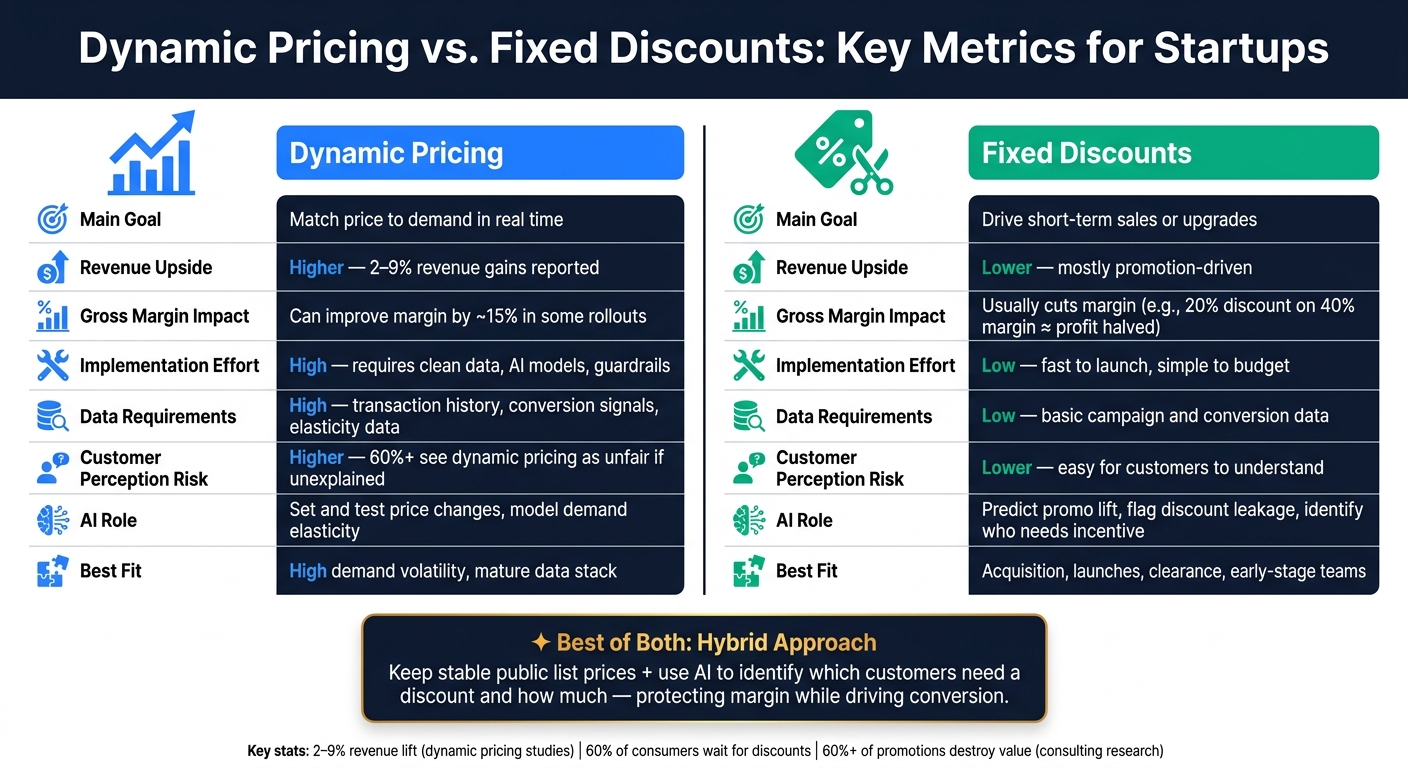
Dynamic Pricing vs. Fixed Discounts: Key Metrics Compared
These two pricing approaches do different jobs. One is built to react to change. The other is built for control and simplicity. For startup teams, the choice usually comes down to three things: how much demand moves, how good your data is, and how much price movement your customers will accept.
Here’s the side-by-side view on the metrics that matter most: revenue, margin, effort, trust, and data needs.
| Criteria | Dynamic pricing | Fixed discounts |
|---|---|---|
| Revenue optimization | Stronger upside in changing demand conditions | More limited upside, mostly promotion-driven |
| Gross margin impact | Can protect or improve margin if managed well | Often reduces margin by design |
| Implementation effort | Higher technical and operational complexity | Faster and simpler to launch |
| Customer perception | Can create fairness concerns if not explained well | Usually easier for customers to understand |
| Data requirements | High; depends on timely and reliable data | Lower; can work with simpler campaign data |
| Time to useful insight | Fast once systems are in place | Fast for basic offers, slower to optimize deeply |
Start with the business conditions that make each model practical.
Which model fits which startup conditions
Demand volatility is the clearest signal. If your revenue changes a lot by time of day, season, inventory level, or competitor activity, dynamic pricing gives you a way to charge more when demand peaks and protect margin when things slow down. If demand is steady and your main goal is customer acquisition or moving excess stock, a well-planned fixed discount can do the job with much less work.
Data maturity is the other big filter. Dynamic pricing depends on clean, timely transaction data. That means solid cost data, conversion signals, and enough volume to measure elasticity with some confidence. Early-stage startups with messy reporting, thin analytics, or small sample sizes often aren’t ready for that. Fixed discounts are easier to run with simpler inputs, like past conversion rates, average order value, and basic campaign numbers. As your data setup improves, dynamic pricing starts to make more sense.
Customer tolerance for price changes also depends on the market. In the U.S., people already expect prices to move in travel, ride-hailing, and short-term rentals. That’s normal behavior in those categories. In day-to-day retail or subscription software, visible price swings can feel random and damage trust. One detail matters a lot here: a 2024 academic study found that demand-based surge pricing is judged substantially less unfair than individualized pricing at the same price level, and that transparency reduces the unfairness reaction.
How to evaluate the tradeoff using finance metrics
Looking only at top-line revenue won’t tell you enough. The numbers that show whether a pricing strategy is working are gross margin, ARPU, conversion rate, CAC payback period, churn, and runway.
Dynamic pricing can improve ARPU by charging higher-value segments closer to what they’re willing to pay. If margin stays healthy, that can shorten payback periods and give you more runway. Fixed discounts usually push ARPU down in the short term because lower prices cut average invoice value and gross profit per customer.
Churn is where both models can trip up founders. Dynamic pricing can drive people away if it feels unpredictable or exploitative. Fixed discounts have their own trap: the cliff effect. A customer signs up at a promo rate, then churns when the lower rate ends and full price shows up. So don’t stop at conversion lift. Build the churn effect into the model too.
For many startups, a hybrid approach is the most practical move: keep stable public list prices as the anchor, then use AI to spot which customers need an incentive and how much. BCG’s 2024 guidance noted that dynamic pricing works better when companies can explain why the price changed; targeted promotions with a clear rationale are easier to defend than visible price swings, and they tend to preserve both margin and trust. That shifts the next step from a branding argument to a measurement test.
How founders can choose the right mix and measure results
Start with clean data and a narrow test
Once you've picked a pricing model, don't roll it out everywhere at once. Test it against a holdout group first.
Start by tracking a clean baseline for:
- ASP
- gross margin
- conversion
- churn
- cash collected
- MRR
- runway
Break those numbers down by product, channel, segment, and cohort. That way, you’re not looking at one blended number and guessing what changed.
When the baseline is stable, test on the smallest scope that still gives you a useful read. That could mean one product line, one customer segment, or one geography. Then compare the test group with a holdout group over the same time window. Let the test run long enough to catch early churn signals too, not just the first bump in conversion.
A/B testing, cohort analysis, and pre/post comparison are the standard tools here. They help separate actual pricing impact from seasonality or shifts in marketing.
Track the impact on margin, cash flow, and runway
Use the same financial readout each time so you can tell the difference between real gains and short-term noise.
Don't treat conversion as the main success metric. A discount can drive more sign-ups and still hurt the business if margin drops. What matters more is whether the test improves contribution margin, cash collected, churn, discount leakage, and runway.
Discount leakage is the margin lost when customers who would have paid full price get the discount, or when the discount spreads beyond the segment it was meant for. That’s why incremental lift matters more than total sales during a promo window. Overlapping discounts can cut profitability even when initial sales go up.
Runway equals cash divided by average monthly net burn, using a 3-month rolling average. That number should sit at the center of any pricing test review, not just top-line revenue. Real-time financial reporting also makes it much easier to watch pricing tests while they’re live.
Conclusion: Use AI to build pricing discipline, not just speed
Dynamic pricing can offer more upside, but it also needs tighter controls, cleaner data, and stronger operating discipline. Fixed discounts are easier to launch, but they’re harder to tune over time and can quietly eat away at margin if no one is watching.
For most early-stage and Series A and B startups, a hybrid approach is the most practical path. Keep public list prices stable as the anchor, then use AI to spot which customers may need an incentive and how much.
AI does its best work here when it connects to reliable financial reporting. It can surface segment-level signals, model scenario outcomes, and flag when a pricing move is helping or hurting unit economics. Pricing should be treated like a measured financial process, not a one-off marketing lever.
FAQs
When should a startup use dynamic pricing?
Startups should use dynamic pricing when market conditions change fast, like sudden swings in demand, inventory changes, or competitor moves.
AI helps by reading data in real time and adjusting prices as conditions shift. That can help improve margins, react to seasonal patterns, and manage stock based on what people are buying.
How much data do I need before testing AI pricing?
Aim for at least 12 months of clean, consistent historical data so AI can pick up seasonal patterns and trend lines.
Focus on three core areas:
- Financial data
- Product data
- Customer data
Check that data against actual transactions, then run a small cohort test for 4 to 8 weeks before rolling it out more broadly.
How do I avoid hurting trust with discounts or price changes?
Be clear about why a price or discount is changing and what the customer is getting in return. If a bill is about to go up, give people notice ahead of time so they’re not blindsided. Spell out the reason for the change, and if there’s any plan to roll prices back later, say that up front.
For AI-driven pricing, set firm guardrails in advance. That can include minimum gross margin floors and rules for discount approval. When prices change, give short, specific explanations instead of vague language. Make it easy for customers to reach a real person if they want to dispute a charge, and connect any increase to clear product improvements they can see and use.