If I had to sum it up in one line: AI startup pricing only works when price tracks customer value and revenue stays ahead of compute cost.
A lot of startups price too low, copy competitors, or use flat plans that fall apart once heavy users show up. That gets risky fast in AI, where each prompt, task, or workflow can add direct cost. The article’s core message is simple: use the right pricing model, pick a value metric customers understand, track cost by user and tier, and test changes with margin limits in place.
Here’s the short version:
- AI pricing is not the same as pricing an AI product. One is about using data and models to improve pricing. The other is about charging for software with direct serving costs like inference and compute.
- Flat pricing can hurt margins. AI-first SaaS often sits around 20% to 60% gross margin, versus 70% to 90% for standard SaaS.
- Hybrid pricing is often the middle ground. It gives buyers a base fee plus usage room, which helps with both predictability and cost control.
- Your value metric matters a lot. Buyers usually understand outcomes like tasks completed or conversations resolved better than tokens or API calls.
- You need clean data before you change prices. Track billing, discounts, churn, conversion, usage, and per-user compute cost.
- Guardrails come first. Set a minimum gross margin floor, review large discounts, and watch heavy users closely.
- Test pricing in small groups. Measure ARPU, gross margin, churn, conversion, LTV/CAC, NDR, and high-end compute cost.
- Keep updating pricing. AI costs move, user behavior shifts, and margins can slip without a clear warning.
Pricing your AI product: Lessons from 400+ companies and 50 unicorns | Madhavan Ramanujam
sbb-itb-17e8ec9
Quick Comparison
| Pricing model | Best fit | Main upside | Main risk |
|---|---|---|---|
| Subscription | Early-stage products | Simple to sell and budget | Heavy users can crush margin |
| Usage-based | API or infra products | Revenue lines up with cost | Bill shock can slow adoption |
| Hybrid | Growth-stage B2B AI | Mix of predictability and cost alignment | More setup and billing work |
| Outcome-based | Mature products with clean attribution | Price ties to buyer results | Hard to measure and enforce |
One stat stands out: companies using seat-only pricing can see 2.3x higher churn than companies using hybrid or usage-based models.
So if I were building an AI startup, I’d keep the pricing logic simple at first, tie it to a customer-facing value metric, and check margin by user segment every week. That’s the main idea behind the full piece.
Choose the Right Pricing Model for Your Startup
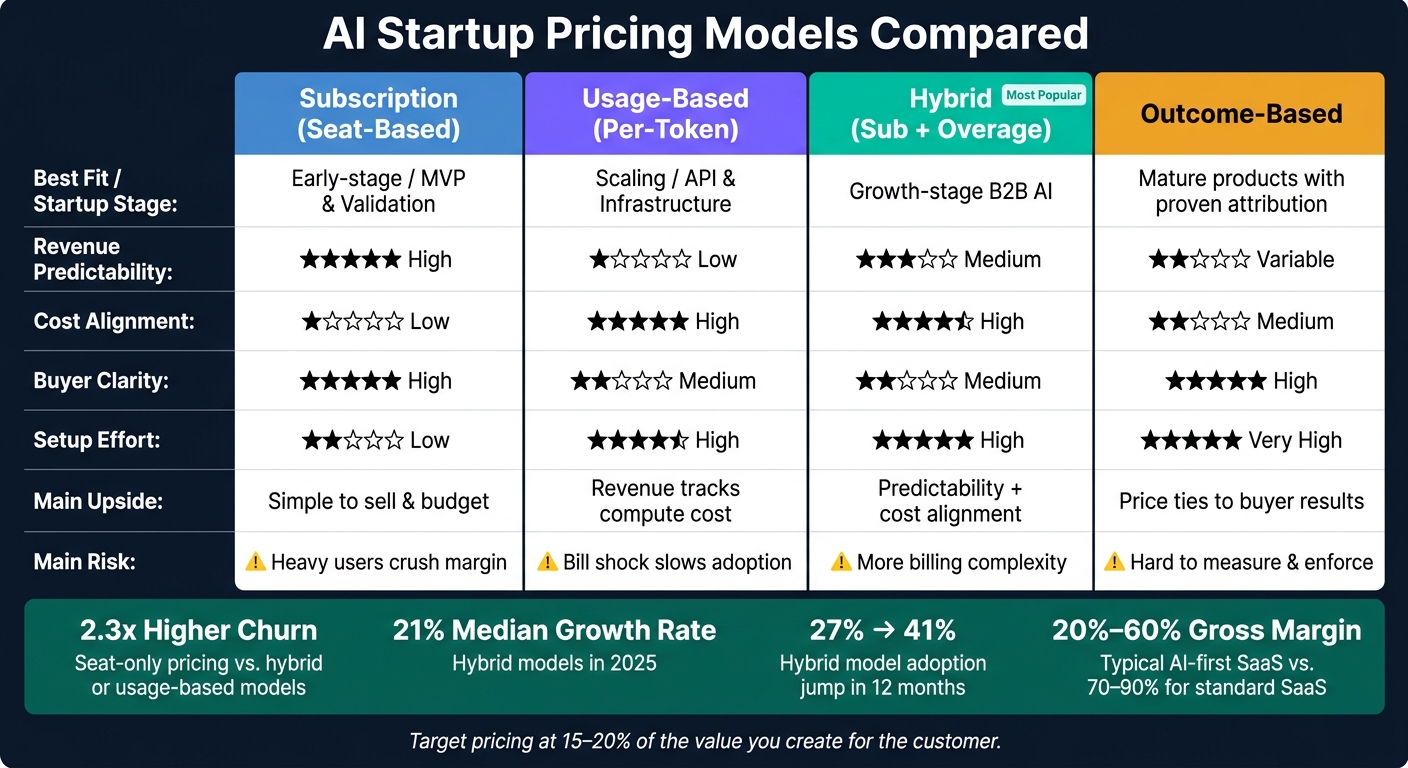
AI Startup Pricing Models Compared: Which One Fits Your Stage?
Once pricing starts shaping margin, the next call is your billing model. This isn't just a packaging choice. It affects growth, retention, and whether your unit economics hold up under pressure.
Pick the model that fits your cost structure, usage pattern, and stage. Get it wrong, and margins can get squeezed long before the revenue problem is easy to spot.
Subscription, Usage-Based, Hybrid, and Outcome-Based Pricing Compared
Each model has tradeoffs.
Subscriptions are easy to budget for and simple to sell. That makes them a good fit when you're trying to reduce friction. But there's a catch: heavy users can consume far more compute than light users. In AI, where every query burns compute, a flat fee can put pressure on margin fast.
Usage-based pricing does a better job of lining up revenue with cost because inference costs are passed through to the customer. The downside is billing shock. If buyers can't predict what they'll owe, they may hesitate to adopt. Cursor's 2025 move from a flat limit to a credit model triggered billing shock and refunds.
Early-stage startups usually need simplicity. Growth-stage startups need tighter cost alignment. Mature products can start charging for results. That's why hybrid pricing - a base subscription plus usage overages or credits - has become common in B2B AI startups. It gives customers a predictable starting point while letting revenue grow with actual usage.
The numbers help explain why. Hybrid models reported a 21% median growth rate in 2025, and adoption jumped from 27% to 41% in 12 months. Companies using seat-only models also see 2.3x higher churn than those using hybrid or usage-based billing.
| Model | Revenue Predictability | Cost Alignment | Buyer Clarity | Setup Effort | Fit by Startup Stage |
|---|---|---|---|---|---|
| Subscription (Seat-Based) | High | Low | High | Low | Early (MVP/Validation) |
| Usage-Based (Per-Token) | Low | High | Medium | High | Scaling (API/Infrastructure) |
| Hybrid (Sub + Overage) | Medium | High | Medium | High | Growth |
| Outcome-Based | Variable | Medium | High | Very High | Mature (Proven Attribution) |
The best model is the one where revenue grows faster than cost.
After you choose the model, the next job is picking the unit that reflects customer value.
Outcome-based pricing charges for results, such as resolved conversations. It sounds attractive, and in many cases it is. But it's also the hardest model to put in place because attribution has to be reliable.
How to Pick Value Metrics That Match Customer Outcomes
A value metric is the unit you charge around. Pick the wrong one, and one of two things usually happens: you leave money on the table, or you add friction that slows growth.
Charge on the metric that maps to customer outcome. Metrics like articles generated, tasks completed, or conversations resolved are easier for buyers to connect to business results than technical units like tokens or API calls.
Per-seat pricing is often a trap for AI products. Why? Because the product may reduce headcount while compute costs keep climbing. That puts your pricing logic and cost base at odds. A useful benchmark is to target 15% to 20% of the value you create for the customer.
A practical path is to start with familiar metrics like seats, credits, or API calls, then move toward outcome-based pricing as attribution gets better. If you rush that shift before you can measure attribution with confidence, billing disputes can follow, and customer trust can take a hit.
Once the model and metric are set, the next step is building the data and guardrails that keep pricing accurate as usage changes.
Build the Data Foundation for AI Pricing
Pricing is only as good as the data behind it. That starts with clean finance, product, and customer data. Then you split those inputs into three buckets: finance, product, and customer.
What Data You Need to Drive Pricing Decisions
Your pricing model depends on measurable unit economics. So the data layer needs to reflect actual costs and usage at the tier level.
On the finance side, that means pulling in billing history, average discount percentages, trial-to-paid conversion rates, churn by plan, and cost of goods sold. That last piece should include per-unit costs like compute, storage, and model inference, all tracked by tier.
Product data shows you how people use the product. Look at feature usage by tier, trial signup volume, and where churn is concentrated across pricing tiers.
Customer data adds the segment view. You want company size, industry, usage intensity, and input from customer interviews about budget and price sensitivity.
One part teams often skip is verification. Every number should tie back to a real transaction, cash receipt, or collection. If you track per-user compute costs from day one, you can spot margin issues early, before they snowball. Clean, real-time financials also make pricing data easier to trust. Lucid Financials gives startups real-time reporting and investor-ready books.
With those inputs in place, you can start estimating demand and willingness to pay by segment.
How to Model Demand, Elasticity, and Willingness to Pay by Segment
A single flat price for every customer is almost always a mistake. Different segments are willing to pay different amounts. Treat them all the same, and you either leave money on the table or make it harder to win price-sensitive buyers.
Once you know your value metric, compare it across SMB, enterprise, light-use, and heavy-use segments. Start with the data you already have. Your CRM and billing system already hold some of the best clues:
- Win rates by deal size
- Discount patterns
- Sales cycle length by tier
If higher-priced plans are closing faster, that usually signals strong value perception and can mean your pricing is too low. It also helps to audit discounts. A lot of startups find they were already priced below what customers would have paid even without the discount.
For a more structured read on willingness to pay, the Van Westendorp Price Sensitivity Meter is a good place to begin. It uses four questions to map the range where a price feels acceptable - not so low that it looks cheap, and not so high that buyers walk away. Pair that with cohort comparisons across segments, and you get a much sharper view than any single average can give you.
Use AI to speed up the analysis, not to replace pricing judgment.
Use those estimates inside strict floors and approval rules.
Set Guardrails Before Automating Pricing Changes
Before you let any system change prices on its own, set hard limits.
The first guardrail is a minimum gross margin floor. Check every deal, tier, and automated discount against it. Then add discount approval rules. If automation suggests a lower price, it should get something in return, like a case study, upfront payment, or logo rights. That give-to-get approach keeps discounting from turning into a habit.
On the usage side, pay close attention to the gap between your median user and your heaviest users. If serving your top 5% of users costs around 10 times more than serving the median user, you have a structural issue that automated pricing alone will not solve. In that case, the better move is surgical rate limiting or shifting those accounts to higher-margin tiers, not a blanket price cut.
Usage spikes can also lead to outsized bills. Put caps on automated changes and send exceptions to review.
You should also document every pricing change in one central log and route automated signals through a cross-functional pricing committee before anything goes live. Pricing changes tend to stick when finance, product, and sales all agree on the reason.
Once the data layer is in place, move to controlled experiments and revenue measurement.
A Step-by-Step Playbook to Launch and Improve Pricing
Once your data setup and guardrails are in place, it’s time to move from planning to controlled testing.
Audit Your Current Pricing, Margins, and Startup Constraints
Start by reviewing your current setup: plans, contracts, ARPU, gross margin, churn by tier, payback period, and discount history. Cut discounts that didn’t help close rates or retention. This audit gives you a clean baseline for every pricing test.
Your pricing should support one main goal at a time:
- Growth
- Burn reduction
- Margin expansion
If your startup is focused on burn reduction, lean toward terms that improve upfront cash collection and retention.
If gross margin is below 20%, pricing isn’t just a growth lever. It’s a runway problem.
How to Design Pricing Experiments and Measure Revenue Impact
Test new prices or packaging with a limited cohort first. Then compare conversion, ARPU, and retention against your baseline.
Use the same KPI set each time so results are easy to compare:
| KPI | What It Measures | AI-Specific Note |
|---|---|---|
| ARPU | Average revenue per user | Compare against cost-per-user to confirm profitability |
| Gross Margin | Revenue minus compute/LLM costs | Monitor often - model usage can change day to day |
| LTV/CAC | Lifetime value vs. acquisition cost | High compute costs can shorten payback if margins aren’t protected |
| Net Dollar Retention | Revenue growth from existing customers | Usage-based models can drive high NDR but are sensitive to model drift |
| Conversion Rate | Free-to-paid transition rate | Below 2% to 3% may point to a free tier that gives away too much |
| Churn | Rate of customer loss by tier | High churn on one tier usually points to a pricing/value mismatch |
For AI products, track P90 compute cost too. That’s the cost to serve your top 10% of users. If a P90 user costs 10x more than a P50 user, the issue may not be the listed price. More often, it means you need usage guardrails, not just a pricing test.
Connect Pricing Changes to Revenue Forecasts and Finance Operations
A pricing change that doesn’t show up in your revenue forecast creates a blind spot. Any change to price, tier structure, or discount policy should flow straight into your MRR projections, cash runway model, and board reporting.
Keep a pricing change log that records each update, what triggered it, and the revenue impact. Clean, real-time financial data makes pricing moves much easier to forecast and explain. Use Lucid Financials to update forecasts, cash flow, and board reporting as pricing changes move through revenue. Then feed those updates into your margin and churn review.
The next step is watching for margin compression, churn shifts, and model drift.
Manage Risk and Update Pricing Over Time
Once pricing goes live, the job shifts from design to watchfulness. Margins can tighten, churn can creep in, and usage patterns can change faster than most teams expect. That matters even more in AI, where costs move fast. Inference prices dropped 78% through 2025, so a model that looked fine six months ago can now put pressure on margins.
Watch for Margin Compression, Churn, and Model Drift
The biggest pricing risk in AI is simple: heavy users can turn into money-losers if no one is paying attention.
Replit ran into exactly that problem. Its AI agent used more LLM resources than the company’s pricing covered, and gross margins swung from +36% to -14% in just a few months. That kind of shift is brutal because it can hide behind top-line growth for a while.
So don’t just track overall gross margin. Track contribution margin per feature. A feature can look like a hit on the surface because engagement is rising, while the underlying unit economics are getting worse due to compute burn.
Another issue to watch is silent usage churn. These customers don’t cancel. They stay on the plan, but they quietly stop using higher-cost features because they don’t want big bills. The account stays active, yet usage-based revenue starts slipping in the background.
It also helps to split NRR into subscription retention and usage expansion or contraction. That gives you a clearer read on whether growth is holding up or whether lower usage is starting to eat away at it.
The table below highlights the main signals to check after any pricing update:
| What to Monitor | Early Warning Sign |
|---|---|
| Contribution margin per feature | Engagement is up, but gross margin is falling |
| NRR decomposition | Subscription retention is steady, but usage expansion is shrinking |
| P90 vs. P50 cost variance | A small user group is consuming a disproportionate share of compute |
| Trial conversion rate | A sudden spike may mean the product is underpriced |
| AI resolution rate | Revenue drops because the model is failing to solve tasks |
Short-Term Pricing Adjustments vs. Long-Term Pricing Changes
Not every pricing issue needs a full rebuild.
Some problems are policy problems. Tighten discounts, adjust overage thresholds, clean up packaging, and you may fix margin leakage without touching the core model. Other problems go deeper. If your pricing model doesn’t line up with how customers get value, you’re looking at a larger redesign.
Price increases are much easier to defend when customers can see what they’re getting in return. Canva increased Teams pricing by up to 300% in some regions and tied that increase directly to expanded AI features. That’s the key point: if the value story is weak, even a small increase can push churn up and damage trust.
Here’s a simple way to think about short-term versus long-term moves:
| Short-Term Adjustments | Long-Term Pricing Changes | |
|---|---|---|
| Examples | Discount tightening, overage thresholds | New tiers, outcome-based pricing, price hikes |
| Cash Burn Impact | Immediate, incremental improvement | Significant shift in LTV/CAC ratios |
| Customer Trust | Low to moderate risk | High risk if value isn't clearly added |
| Implementation Complexity | Low; policy or front-end changes | High; requires data modeling and backend work |
| Upside | Quick margin protection wins | Scalable revenue growth aligned with value |
A good rule of thumb: make smaller optimizations to copy, packaging, and discount policy on a quarterly basis. Save structural changes - like shifting to a two-part or outcome-based model - for an annual review cycle supported by full research.
Conclusion: Core Rules for Startup AI Pricing
A few rules keep pricing grounded as costs and demand move around.
Match your pricing model to how customers get value. Subscription, usage-based, hybrid, and outcome-based models can all work. But each one works best in the right setup and falls apart in the wrong one.
Build from clean financial and usage data. If you don’t know cost per customer or don’t have near real-time margin visibility, pricing decisions are just guesses. And when there are real COGS involved, finance needs a seat at the table.
Test with clear KPIs, protect margins with guardrails, and tie every pricing change back to revenue forecasts and runway. Use Lucid Financials to keep forecasts and board reporting current as pricing changes.
Strong AI pricing comes from disciplined financial thinking and close attention to the data. The earlier you build that habit, the better.
FAQs
How do I choose the right AI pricing model?
Choose a model that fits your product stage, target customers, and the way customer value grows with usage. Then pick a pricing metric that lines up with that value and feels normal for your market, like seats, credits, or API calls.
Credit-based pricing can work well for early-stage products. Hybrid models often make sense for growing B2B SaaS AI products. And if your costs change a lot from one customer to another, usage-based pricing can help protect margins.
The key is to test, watch how people use the product, and adjust based on customer feedback and usage patterns.
What value metric should an AI startup charge for?
An AI startup should charge based on a value metric that lines up with how customers get value from the product. Put simply: the best pricing metric depends on the AI use case and what the product helps customers do.
Common options include:
- Usage-based metrics, such as API calls or tokens
- Workflow-based metrics, such as completed tasks
- Outcome-based metrics, such as successful results
Pick a metric that reflects customer value and grows as the benefits they get grow.
When should a startup switch from flat pricing to hybrid pricing?
A startup should switch from flat pricing to hybrid pricing when it needs revenue to track more closely with actual usage. That shift tends to matter more as AI workloads get less linear and consumption patterns become harder to predict.
Done well, hybrid pricing can make revenue easier to forecast, help the company earn more from heavy users, and cut down on revenue leakage.