AI is reshaping how businesses optimize revenue by turning slow, outdated methods into real-time, data-driven strategies. Here's what you need to know:
- AI boosts sales performance: AI-augmented sales reps generate 41% more revenue than those using traditional methods.
- Real-time insights: Companies can now detect stalled deals days earlier with 84% accuracy and improve customer targeting precision by 50%.
- Key tools driving results:
- Predictive analytics: Improves pricing strategies, leading to an 8–11% boost in operating profit.
- Customer segmentation algorithms: Enhances retention rates by 30% and lowers acquisition costs by 25%.
- Inventory optimization: Prevents overstocking and adjusts prices dynamically to protect margins.
- Proven business impact: AI adoption leads to higher win rates, shorter deal cycles, and reduced operational costs by up to 38%.
- Getting started: Success requires clean, unified data, integration into workflows, and continuous monitoring to refine AI systems.
AI is no longer experimental - it's now a core driver of revenue growth, delivering measurable outcomes like improved conversion rates, retention, and profitability.
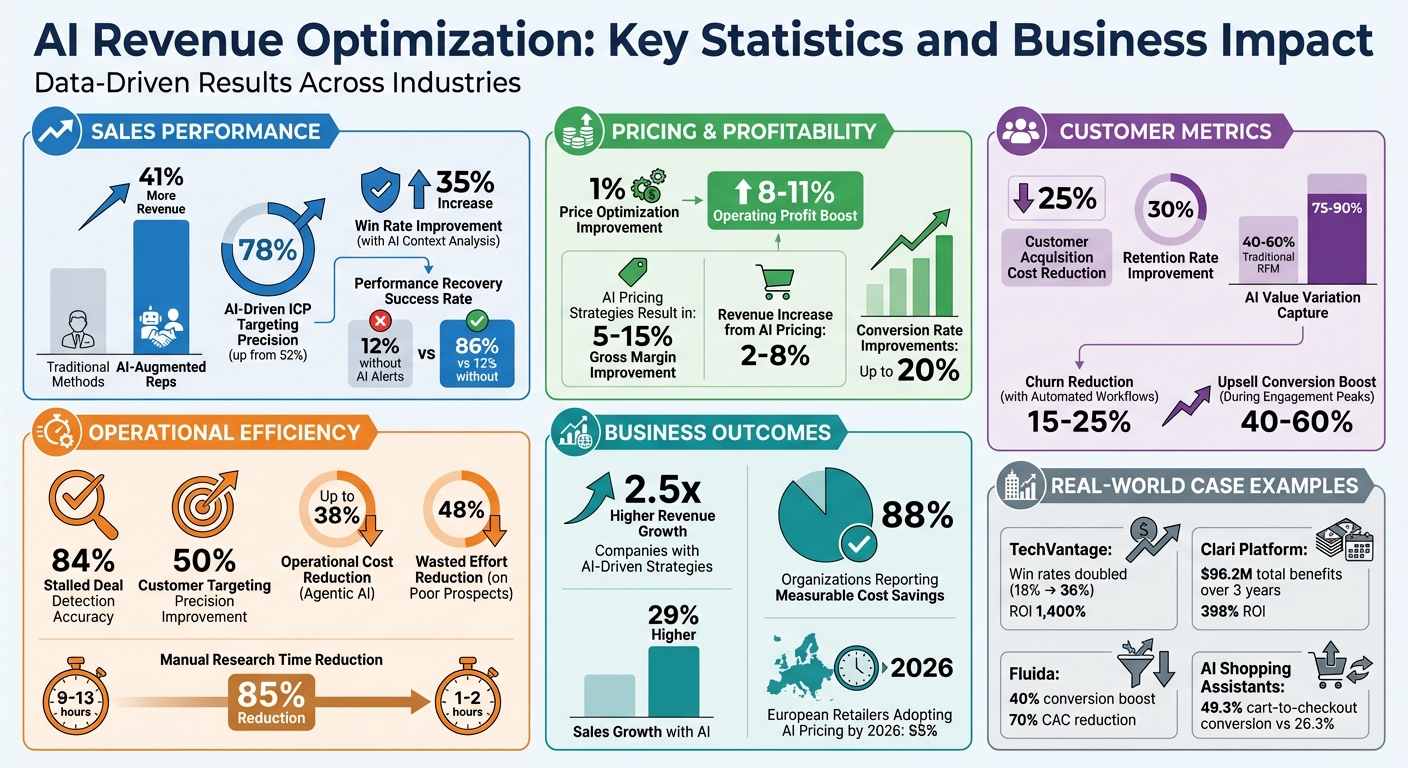
AI Revenue Optimization: Key Statistics and Business Impact
Sales Success With AI: Five Proven Strategies
sbb-itb-17e8ec9
AI Technologies That Drive Revenue Optimization
Revenue optimization today relies on a sophisticated AI stack, blending tools like predictive analytics, segmentation algorithms, and inventory management. These technologies work together in real time, continuously refining strategies to boost revenue. Let’s break down how each one contributes to this process.
Predictive Analytics and Dynamic Pricing
Predictive analytics uses historical sales data, seasonality trends, and factors like local events or economic conditions to deliver ongoing forecasts. AI-powered price elasticity models identify the sweet spot between volume and margin across a product range. Reinforcement learning algorithms then step in, dynamically adjusting prices to respond to sudden changes - like a competitor's flash sale or unexpected inventory shifts - ensuring maximum revenue.
The results speak for themselves: a mere 1% improvement in price optimization can elevate operating profit by 8–11%. For instance, airBaltic adopted a reinforcement learning system to fine-tune seat assignment fees, achieving a 6% rise in seat reservation revenue per passenger in just two months - double its initial target of 2–3%. Similarly, UPS launched its "Deal Manager" AI pricing platform, which boosted win rates by 22 percentage points in U.S. B2B contract negotiations while curbing over-discounting. These examples highlight how precision pricing underpins smarter customer targeting.
Customer Segmentation Algorithms
AI clustering models, such as K-means, DBSCAN, and Gaussian Mixture Models, analyze behavioral and transactional data to uncover 8–15 actionable microsegments. These segments are dynamic, constantly updating in real time. For example, when a high-value customer shows signs of becoming "at-risk", retention workflows are triggered immediately.
The difference is striking: traditional RFM (Recency, Frequency, Monetary) analysis captures only 40–60% of customer value variation, while AI-based clustering achieves 75–90%. Businesses leveraging AI-driven segmentation see 25% lower customer acquisition costs and 30% higher retention rates compared to competitors. For a mid-sized e-commerce company generating $10M annually, this could mean an additional $800,000 to $1.5M in revenue within a year. This level of customer insight directly impacts pricing and inventory decisions.
Inventory and Resource Optimization
AI-powered inventory systems synchronize stock levels with pricing engines every 10–30 minutes, ensuring optimal inventory management. This prevents overstocking and minimizes the risk of products turning into liabilities. For instance, when sales fall 20% below target, AI triggers micro-liquidations, dropping prices by about 5%. Conversely, when stock levels dip below 20% of the target, prices are raised by 5–15% to manage demand and protect margins.
Measured Business Impact of AI Revenue Strategies
Revenue Growth and Cost Reductions
AI is transforming sales by enabling reps to work smarter, not harder. Instead of increasing activity volume, AI-augmented sales teams focus on high-probability prospects, leading to better outcomes. On average, these reps perform 18% fewer activities each month (178 compared to 217) yet close more deals due to improved targeting.
Take TechVantage, for example - a B2B SaaS company with 50 sales reps specializing in marketing automation. Between July 2024 and January 2025, Rebecca Martinez, the company's VP of Sales, adopted Optifai for AI-driven Ideal Customer Profile (ICP) matching. The results? Win rates doubled from 18% to 36%, deal cycles shortened from 60 to 47 days, and the company generated an additional $3.2 million in Annual Recurring Revenue (ARR). This yielded an incredible ROI of over 1,400%.
"We didn't hire a single new rep, but our output looked like we added 22 reps."
- Rebecca Martinez, VP of Sales, TechVantage
The financial benefits of AI extend beyond individual companies. A 2025 Forrester Total Economic Impact study of the Clari Revenue Orchestration Platform found that a composite enterprise achieved $96.2 million in total benefits over three years. This included $52.3 million in growth from a 20-point increase in renewal rates and $14 million saved by reducing wasted spending, thanks to 96% forecast accuracy. The overall ROI hit 398% within three years, with some systems paying for themselves in under six months.
Additionally, 88% of organizations report measurable cost savings after implementing AI. In some cases, agentic AI has reduced operational costs by as much as 38%. These results demonstrate how AI can drive both revenue growth and cost efficiency simultaneously.
Customer Retention and Conversion Rates
AI also plays a crucial role in improving customer retention and conversion rates by identifying high-intent prospects and enabling proactive engagement. For instance, Fluida, a B2B SaaS company, collaborated with t2ó and Bytek to integrate predictive AI that centralized first-party data using BigQuery. This transition from reactive campaigns to value-based bidding led to a 40% boost in conversion rates and a 70% drop in customer acquisition costs.
In e-commerce, AI is proving equally effective. Visitors who interact with AI shopping assistants convert from cart to checkout at a rate of 49.3%, compared to just 26.3% for those who don’t engage with the technology. While only 1% of site visitors interact with these assistants, they contribute about 10% of total revenue. AI also significantly enhances ad performance, with conversion rates improving by 6.1× for Google Ads, 13.1× for Meta Ads, and an astonishing 76× for TikTok Ads.
AI’s real-time capabilities further protect revenue streams. Productivity alerts powered by AI can detect performance issues early, allowing managers to intervene proactively. This approach has an 86% success rate in recovering rep performance, compared to just 12% when problems are addressed at the end of a quarter. AI-driven ICP targeting also boosts precision from 52% to 78%, cutting wasted effort on poorly matched prospects by 48%. Furthermore, teams using AI for context analysis have seen win rates increase by 35% compared to those who don’t leverage such tools.
These examples highlight how AI optimizes both customer acquisition and retention, delivering measurable improvements in business outcomes.
Behavioral Segmentation and Customer Lifetime Value Prediction
Analyzing Behavioral Patterns with AI
AI is transforming how businesses understand customer behavior by focusing on dynamic trends rather than static snapshots. For instance, instead of simply noting login frequency, advanced models track shifts - like a 40% drop in logins over the last 30 days compared to the prior 60. This focus on behavioral changes helps uncover early warning signs that traditional analytics might miss.
Key behavioral indicators include changes in engagement, support interactions, product usage, payment habits, and lifecycle milestones. When analyzed together - such as a rise in support tickets paired with declining product engagement - AI systems can detect risk patterns that single metrics often fail to highlight.
"The difference between a mediocre churn model (65-70% accuracy) and a production-ready one (85-92%) is feature engineering." - Digital Applied
Companies like Domino's Pizza showcase the power of this approach. By using an AI-driven customer lifetime value (CLV) model to adapt to real-time behavioral changes, they achieved a 10% sales increase and boosted customer retention by 25%. Similarly, Amazon’s AI recommendation engine, which analyzes customer behavior and product preferences, now accounts for 35% of its total sales. These examples illustrate how dynamic behavioral insights pave the way for more accurate CLV predictions.
Improving CLV Prediction Accuracy
Building on behavioral analysis, AI-driven models significantly enhance the accuracy of customer lifetime value predictions. Compared to static methods, these models can improve CLV outcomes by 20-35%. Tools like gradient boosted trees (e.g., XGBoost, LightGBM) excel in structured CRM data analysis, achieving 85-92% accuracy. They handle missing data effectively and provide interpretable insights using SHAP values.
For specific use cases, models like BG/NBD are ideal for subscription renewals, while Pareto/NBD combined with Gamma-Gamma works well for transactional businesses. These AI tools can identify at-risk customers 30-90 days in advance, enabling interventions that are 3-5 times more effective.
"A customer predicted to generate $50,000 over three years justifies a $5,000 retention intervention that would be irrational for a $2,000 CLV customer." - Digital Applied
This precision enables smarter resource allocation. By multiplying churn risk by predicted lifetime value, companies can prioritize high-value, high-risk accounts. Automated retention workflows based on these scores can cut churn by 15-25%, while timing upsell offers during predicted engagement peaks can boost conversions by 40-60%.
Building AI-Ready Revenue Systems
Data Infrastructure and Quality Standards
To optimize revenue with AI, having clean, well-organized data is non-negotiable. In fact, data preparation takes up a staggering 60–80% of the AI lifecycle, highlighting the importance of a solid data infrastructure.
The cornerstone of this effort is a unified data foundation - a centralized repository that pulls together information from CRM platforms, marketing tools, and financial systems. Why is this crucial? Disconnected data can slash potential insights by as much as 30%. To avoid this, implement a "Single ID Test", which means linking customer data across all platforms using a unique identifier.
"If the AI Can't Read It, It Doesn't Exist." - Mike Allton, AI Implementation Strategist
Equally important are data quality standards. Aim for a CRM completeness rate of at least 95% for opportunities. This means ensuring every deal includes key details like its stage, close date, and estimated value. For example, Schneider Electric rolled out Microsoft Copilot for Sales to 5,000 users in January 2026. The AI handled tasks like creating CRM records from email signatures and transcribing Teams calls to auto-generate summaries. This not only streamlined contact acquisition but also gave sellers back valuable time.
Beyond completeness, semantic alignment is critical. Departments must agree on standardized definitions for terms like "Qualified Lead." Misalignment can cause AI models to optimize for the wrong goals. Alarmingly, 63% of Chief Revenue Officers report low confidence in their Ideal Customer Profile definitions, which are key datasets for AI. Companies that conduct formal data readiness assessments are 47% more likely to successfully implement AI.
Once your data foundation is solid, the next step is integrating AI into everyday workflows.
System Integration and Continuous Monitoring
Even with high-quality data, AI insights won’t deliver value if they aren’t integrated into daily operations. The goal is to embed AI into tools like CRM systems, email platforms, and communication apps like Slack. This eliminates the "toggle tax", or the productivity drain caused by switching between systems.
"AI can work, but if you don't have the data foundation that's set up properly for AI... You can't just lay AI on top of crappy data because the AI can be crappy." - Adam Cornwell, GTM Leader
A great example of integration comes from ServiceTitan, which in January 2026 linked Salesforce to Google Ads using Zapier. This setup automatically added "Closed-Won" contacts to ad suppression lists and fed actual revenue data back to Google's bidding algorithm. The result? Real-time revenue optimization. Similarly, Udemy slashed its annual go-to-market planning time by 80% - from months to weeks - by replacing scattered spreadsheets with Fullcast’s integrated Salesforce platform, centralizing planning and performance data.
Continuous monitoring is another must. Before deploying AI, establish baseline KPIs like forecast accuracy, sales cycle length, and win rates. This helps track the system’s impact and catch "model drift", where algorithms lose accuracy as market dynamics evolve. High-performing sales teams are 67% more likely to use AI for pipeline management and forecasting, and real-time AI forecasting has been shown to cut forecast errors by 25–35%.
Start with shadow mode testing - a phase where AI outputs, such as email drafts or pricing recommendations, are reviewed by humans before being used. This allows you to fine-tune performance without disrupting operations. To manage risks and set clear policies, form a cross-functional AI Council that includes leaders from Revenue Operations, Sales, Marketing, Legal, and Security.
New Trends in AI-Driven Revenue Optimization
Emerging developments in AI-powered revenue systems are reshaping how businesses approach pricing and sales strategies, enabling instant, data-driven decisions.
Real-Time Decision-Making
AI has revolutionized pricing strategies, moving from static monthly updates to dynamic, real-time adjustments powered by reinforcement learning. Modern AI systems autonomously implement price changes across eCommerce platforms, CPQ tools, and ad networks, while integrating supply chain data and external signals like weather patterns or social media trends. By applying game theory, these systems avoid price wars, resulting in conversion rate improvements of 20% and revenue increases of up to 25%.
By 2026, 55% of European retailers are expected to adopt AI-driven pricing strategies, which can significantly boost revenue if executed effectively.
"Pricing is the most powerful lever in business. A 1% improvement in price realization generates 8-11% improvement in operating profit." - McKinsey
The financial benefits are evident. AI pricing solutions typically lead to a 2–8% increase in revenue and a 5–15% improvement in gross margins. This capability also enhances cross-selling and up-selling efforts, creating further opportunities for growth.
Cross-Selling and Up-Selling Optimization
AI has dramatically changed how businesses identify and act on cross-selling and up-selling opportunities. Instead of relying on gut instinct, machine learning analyzes customer data, including purchase history, browsing patterns, and product usage, to uncover hidden trends. For instance, AI-driven recommendations now contribute to 35% of Amazon's total sales.
Timing plays a key role. Real-time monitoring alerts sales teams when customers approach plan limits or critical usage thresholds, signaling the perfect moment for an upsell. Predictive models use propensity scoring to rank accounts, creating prioritized lists of opportunities with confidence levels attached. This approach reduces manual research time by 85%, cutting it down from 9–13 hours to just 1–2 hours.
The results are impressive. Companies leveraging AI for cross-selling and up-selling have seen a 25% boost in sales conversion rates and a 20% increase in average order value. Some businesses have even achieved a 345% ROI within the first year of implementation. Additionally, 81% of sales teams now use AI, with 78% of frequent users reporting shorter deal cycles.
AI also simplifies product bundling by integrating data from multiple sources, such as CRM systems, support tickets, and social media feedback. Sales teams can override AI-generated recommendations, and their input helps refine the system over time. Beyond creating smarter sales opportunities, AI also ensures profitability through automated discount management.
Discount Management and Margin Protection
AI is now central to managing discounts while safeguarding profitability. It enforces strict thresholds to ensure prices never drop below cost, maintaining a minimum acceptable margin. In B2B settings, AI supports sales reps by offering discount corridors and value-based bundle suggestions during the quoting process. It evaluates deal profitability in real time, factoring in manufacturing capacity, material costs, and customer lifetime value to recommend optimal pricing.
AI systems can autonomously update discounts across eCommerce platforms, content management systems, and partner feeds. Many companies start by testing these updates in "shadow mode" for 2–4 weeks to build trust before granting limited decision-making autonomy under well-defined guardrails.
The financial outcomes are compelling. Businesses using AI pricing strategies report a 5–15% improvement in gross margins, with mid-market B2B firms typically seeing a 3–8% margin increase on quoted business. AI also helps protect margins during volatile periods by monitoring cost changes, inventory levels, and competitor pricing. Competitive price updates are refreshed every 4 to 24 hours, depending on the market. To maintain customer trust, many companies limit price changes to once per day for products in active marketing campaigns and program systems to disregard unusual competitor price shifts, such as flash crashes or errors.
Conclusion
Optimizing revenue with AI requires more than just adopting new technology - it demands clean data, streamlined processes, and a skilled team working in sync. Research shows that companies using AI-driven strategies experience 2.5 times higher revenue growth, with industries like finance seeing revenue increases of up to 35%. On the flip side, poor data quality can lead to costly errors that derail these efforts.
To get started, focus on setting clear KPIs and conducting a thorough data audit. Before diving into AI platforms, ensure your data is accurate, unbiased, and comprehensive enough for machine learning. Start with small, targeted pilot projects to test the waters. This approach helps minimize risks while building confidence within your organization.
Securing executive support and training your revenue team is equally important. Megan, a revenue operations expert, puts it this way:
"AI isn't just a tool - it's a wake-up call for business".
While the financial investment can be steep, the returns often outweigh the costs when implemented thoughtfully. Annual software licensing fees can range from $20,000 to $500,000, with additional expenses for data preparation ($10,000–$100,000+), integration ($15,000–$250,000), and ongoing maintenance ($10,000–$150,000). Despite these costs, businesses using AI for sales have reported 29% higher sales growth, though fine-tuning models often requires significant effort.
For startups, AI is particularly effective at uncovering revenue leaks and identifying micro-opportunities for personalized upselling. By analyzing hundreds of variables simultaneously, AI can reveal opportunities that traditional methods often miss. The trick is to start small, measure results closely, and expand AI initiatives with strong governance. With this approach, businesses can unlock the full potential of AI for revenue optimization.
FAQs
What data do I need before using AI for revenue optimization?
To make the most of AI for revenue optimization, start by ensuring your data infrastructure is in top shape. This means combining data from your CRM, marketing tools, financial systems, and customer success platforms into one unified system.
Begin with a CRM audit - check for completeness in key areas like deal stages and close dates. Then, dive into 18-24 months of historical data to uncover trends and patterns that can guide your strategy.
It’s also crucial to map out your data flows. This helps you identify any gaps and ensures you’re capturing critical information like firmographic details, technographic data, and behavioral signals. These elements are essential for precise segmentation and generating actionable AI insights.
How do I prevent AI pricing from hurting margins or trust?
To prevent AI-driven pricing from harming profit margins or eroding trust, it's essential to set clear pricing boundaries, prioritize transparency, and retain human oversight. These steps ensure pricing remains consistent, understandable, and equitable, safeguarding your brand's reputation and strengthening customer relationships.
How do I prove AI revenue ROI in the first 90 days?
To show ROI from AI within 90 days, prioritize efficiency improvements and pipeline growth over expecting immediate revenue boosts. Keep an eye on metrics like lead quality, intent signals, and how quickly deals move through the pipeline. Real-world examples underline benefits such as higher revenue per sales rep, fewer manual tasks, and quicker identification of potential issues. Establish clear benchmarks and track these metrics regularly to deliver measurable results early in the process.