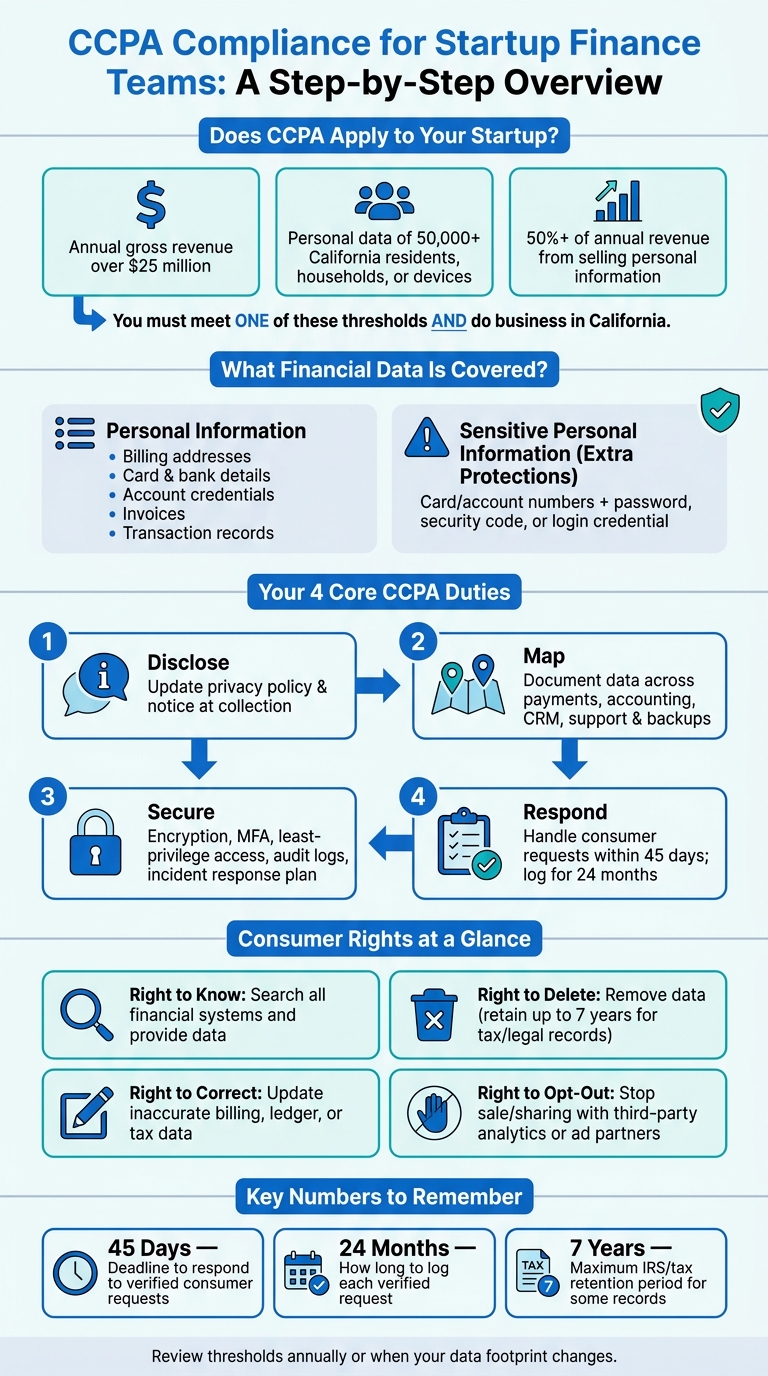
If your startup handles customer billing or payment data from people in California, CCPA may apply sooner than you think. I’d boil the article down to this: check whether you meet the law’s trigger points, identify which finance records count as personal or sensitive personal information, publish clear notices, limit retention, lock down systems, and set up a repeatable way to answer consumer requests within 45 days.
Here’s the short version in plain English:
- I need to check if the business is covered by CCPA based on California activity and one of these thresholds:
- more than $25 million in annual gross revenue
- handling personal data of 50,000+ California residents, households, or devices
- getting 50%+ of annual revenue from selling personal information
- I should treat many finance records as covered data, including:
- billing addresses
- card and bank details
- account credentials
- invoices
- transaction records
- Some finance data can become sensitive personal information when account or card numbers are tied to a password, security code, or login credential.
- PCI-DSS, tax rules, and bookkeeping rules do not remove CCPA duties for notices, consumer rights, and retention.
- My main jobs are to:
- update the privacy policy and notice at collection
- map data across payments, accounting, CRM, support, and backups
- review vendor contracts
- set retention limits
- use security controls like encryption, MFA, least-privilege access, and audit logs
- process access, deletion, correction, and opt-out requests
The article’s core point is simple: even a small team can run into CCPA if it collects enough California customer data. And once that happens, finance data is not just accounting data - it becomes privacy-regulated data too.
CCPA Compliance Checklist for Startup Finance Teams
New CCPA Rules: What Businesses Need to Know
sbb-itb-17e8ec9
Quick Comparison
| Topic | What I need to know |
|---|---|
| Coverage | CCPA can apply if the startup does business in California and meets a revenue or data-volume threshold |
| Finance data | Billing, payments, invoices, credentials, and transaction logs may count as personal information |
| Sensitive data | Card or account numbers tied to login or security details get extra limits |
| Notices | Privacy policy and notice at collection must match actual data use and retention |
| Vendors | Payment and accounting tools need contracts that limit use of data and require incident notice |
| Security | Encryption, MFA, role-based access, logging, and an incident plan matter |
| Consumer requests | Verified requests generally need a response within 45 days and records should be logged for 24 months |
| Retention | Keep data only as long as needed, except where tax or legal rules require longer storage, such as up to 7 years for some records |
If I were reading the full piece, I’d expect one clear takeaway: CCPA compliance for startup finance work starts with knowing what data you hold, why you hold it, where it sits, who gets it, and how long you keep it.
When CCPA Applies to Your Startup
How to tell if your startup is a covered business
CCPA applies to any for-profit business that collects personal information from California residents and does business in California, no matter where the company is based. If your startup meets one of the thresholds above, CCPA applies.
That line can move fast. Revenue can change. Data collection can climb. A startup that falls outside the law today can end up covered tomorrow. Check those thresholds at least once a year, and check sooner if your growth changes your customer base or the amount of data you collect in a big way. Once you know CCPA applies, the next move is simple: figure out where that data sits and which parts of your workflow trigger CCPA duties.
When financial information becomes personal or sensitive personal information
Financial data counts as personal information when it identifies, relates to, or can be linked with a California consumer or household. It becomes sensitive personal information when it includes a financial account number, debit card number, or credit card number plus a required password, security code, or other login credential.
That pairing matters. It brings stricter security and disclosure duties, and it also gives the consumer the right to limit how you use that data.
Why sector-specific rules do not automatically remove CCPA obligations
PCI-DSS and tax-retention rules may narrow how you handle some records, but they do not remove CCPA from the picture. They can help support a reasonable-security defense - courts look at whether your startup's security measures were reasonable given the type of data involved and the level of risk - but they do not wipe out your duties around consumer rights, privacy notices, or data mapping.
Put plainly, having PCI-DSS controls or tax controls in place doesn't get you off the hook. CCPA still covers notices, consumer rights, and retention.
Core CCPA Duties for Customer Financial Data
Once CCPA applies, the work shifts to three things: disclosure, data mapping, and retention limits.
What your privacy policy and notice at collection must include
Your privacy policy needs to spell out the categories of personal information you collected in the past 12 months, where that data came from, why you collected it, and whether you sell or share any of it. Under the CPRA changes, you also need to say how long you keep each category of data, or explain the criteria you use to decide that timeline.
The notice at collection has to be given at the time of collection. It should cover the categories of data being collected and say whether any of that information is sold or shared.
For each financial data category you collect, connect it to a stated purpose and a retention period that lines up with tax, accounting, or legal duties. That link matters. If you collect billing details, for example, you should be able to point to a clear business reason and a defined time frame for keeping them.
How to map financial data across billing, accounting, payments, and support tools
Create a data map that shows where customer financial data comes in, where it lives, who can reach it, and which tools receive it. For many startups, that map includes a payment processor, an accounting platform, a bank portal, a CRM, and sometimes an analytics tool.
For each system, document:
- The specific data category
- The purpose for using it
- Whether a data protection agreement is in place
This map does more than tidy up paperwork. It helps you spot which disclosures need updates and which vendor transfers need tighter contract limits.
How to assess selling, sharing, and retention decisions
Under CCPA, "selling" means disclosing personal information to a third party for monetary or other valuable consideration. "Sharing" refers to disclosing data for cross-context behavioral advertising .
In practice, transfers to vendors like payment processors or accounting platforms usually don't count as selling or sharing, as long as the vendor is bound by contract to use the data only for the service they provide. That limit should appear in a Data Protection Addendum (DPA) with each vendor.
Retention works the same way: keep data only for as long as it's needed for the purpose for which it was collected. A good rule of thumb is to match your retention period to tax, accounting, and legal duties, then record that schedule in your privacy policy.
Security Controls and Vendor Management for Financial Workflows
What reasonable security looks like for startup financial systems
Once you know where customer financial data lives, the next job is simple in theory and serious in practice: lock down every system that touches it.
Under CCPA Section 1798.150, startups should put reasonable security controls in place for the data they handle. Start with encryption. Financial data should be encrypted at rest in databases and backups, and in transit with TLS 1.2 or higher for web and API traffic. Use built-in encryption for databases and backups.
Access control matters just as much. Use the principle of least privilege so employees can only see the financial data they need for their roles. Require MFA for admin accounts, financial SaaS tools, and any production system that stores sensitive data.
You’ll also want audit logs that track login activity, access to sensitive data, and privilege changes. And don’t stop there. A basic incident response plan should name an incident response lead and define severity levels. If there’s a critical live breach, action should start within one hour.
What to require in contracts with accounting, payments, and data vendors
Vendor contracts need clear rules for how financial data is handled. If you work with accounting, payments, or other data vendors, the agreement should require the vendor to follow your processing instructions, send timely breach notification - for example, within 72 hours - and delete or return your data when the contract ends.
| Internal Controls | Vendor Contractual Obligations |
|---|---|
| RBAC & least privilege: Restrict staff access to financial tools by role. | Use only as instructed: Limit how the vendor can use financial data. |
| MFA & SSO: Centralize login security across third-party platforms. | Breach notification: Require the vendor to notify you of incidents, for example within 72 hours. |
| Encryption management: Keep data encrypted at rest and in transit. | Security commitments: Require vendors to maintain SOC 2 Type II or ISO 27001 compliance. |
| Audit logging: Track who accesses financial data in your environment. | Data deletion/return: Make sure data is deleted or returned when the contract ends. |
| Incident response: Maintain an internal plan for containing and recovering from a breach. | Cooperation: Require help with consumer rights requests like access and deletion. |
Before you onboard any new financial tool, ask for a SOC 2 Type II report or a recent penetration test.
Lucid Financials can centralize bookkeeping, tax, and reporting data, which makes access reviews and retention controls easier to manage.
With systems and vendors locked down, the next step is building a repeatable process for access, deletion, correction, and opt-out requests.
Handling Consumer Requests and Keeping the Program Current
Once your systems are mapped and your vendors are under control, the next job is simple in theory and a little messy in practice: build a repeatable way to handle consumer requests.
How to process access, deletion, correction, and opt-out requests
Start with identity verification. Before anyone touches payroll, invoice, or ledger data, confirm that the requester is who they say they are.
It helps to use one intake channel for every request, like a dedicated email address or web form. That keeps things from slipping through the cracks. Then use the same data map you already built to track down every place the consumer's data shows up.
That search should cover all systems in your data map, including:
- billing
- accounting
- payments
- support tools
- CRM
- backups
After verification, respond within 45 days. Also, log each verified request and keep that log for 24 months.
| Consumer Right | Action in Financial Systems | Key Limitation |
|---|---|---|
| Right to Know / Access | Search billing, accounting, and support logs; provide categories and specific pieces of data collected. | Subject to statutory exceptions. |
| Right to Deletion | Remove data from CRM and support tools; flag accounting records for deletion after the legal retention period. | IRS and tax rules may require retaining records for 7 years. |
| Right to Correction | Update inaccurate ledger entries, billing addresses, or tax IDs across all integrated platforms. | Requests may be limited by legal or accounting duties. |
| Right to Opt-Out | Stop the sale or sharing of data with third-party analytics or advertising partners. | Does not apply to service providers processing data strictly for bookkeeping or payments. |
How to handle deletion requests when tax or accounting retention rules apply
Deletion requests usually come down to one thing: what are you still required to keep for legal or accounting reasons?
CCPA allows you to retain records when they are needed for a transaction, a security incident, or a legal duty. So don't treat every deletion request like an erase-everything command. Apply your retention schedule first. Keep only the records covered by legal or accounting exceptions, delete the rest, and document why each record was kept or removed.
Conclusion: A minimum CCPA program for startup finance teams
For a startup finance team, a minimum CCPA program has four layers.
- Confirm whether the law applies to you and publish a privacy notice that matches your actual practices.
- Map every system that stores customer data and classify that data the right way.
- Limit access, put vendor terms in place, and make sure service providers can help with consumer rights requests.
- Run the same intake and response process each time for access, deletion, correction, and opt-out requests.
As your company adds vendors or rolls out new financial workflows, revisit the program. Risk assessments should be updated at least every three years, or whenever you make a material change to how you process data. A small documented process can go a long way as your data footprint grows.
Lucid Financials can help keep financial workflows organized as you build a repeatable request process.