If a breach touches users in more than one country, I may have to report it to more than one regulator, on more than one timeline, at the same time. That is the core issue.
Here’s the short answer: I need to figure out which laws apply, who needs notice, when the clock starts, and what must go into each notice. In many cases, the first deadline is not the law at all. It is a contract that says I must give notice in 24 to 48 hours, while GDPR and UK GDPR allow up to 72 hours after awareness.
Before I do anything else, I want four things mapped out:
- Jurisdictions: EU, UK, Brazil, Canada, California, and any other place where affected people live
- Recipients: regulators, affected people, customers, vendors, insurers, and internal approvers
- Deadlines: 72 hours under GDPR/UK GDPR, 3 business days under Brazil’s LGPD, and as soon as feasible under PIPEDA
- Records: data map, DPA terms, vendor list, notice templates, and a time-stamped incident log
A few points matter most:
- More than one law can apply to one breach
- The shortest deadline should drive my first move
- I do not need every fact before sending an initial notice
- Phased updates are often allowed
- The incident log matters just as much as the notice itself
Here’s a quick view of the main timing rules:
| Rule | Main notice timing | Main trigger |
|---|---|---|
| EU GDPR | 72 hours from awareness | Risk to people’s rights and freedoms |
| UK GDPR | 72 hours from awareness | Risk to people’s rights and freedoms |
| LGPD (Brazil) | 3 business days | Risk or damage to data subjects |
| PIPEDA (Canada) | As soon as feasible | Real risk of harm |
| California | Without unreasonable delay | Breach of covered personal data |
| Contracts/DPAs | Often 24–48 hours | Contract terms |
So if I want a process that holds up with investors, customers, or the board, I should treat cross-border breach reporting as a repeatable workflow: detect, contain, classify, map laws, assess thresholds, send notices, and document every step.
Which Laws Apply to a Cross-Border Breach
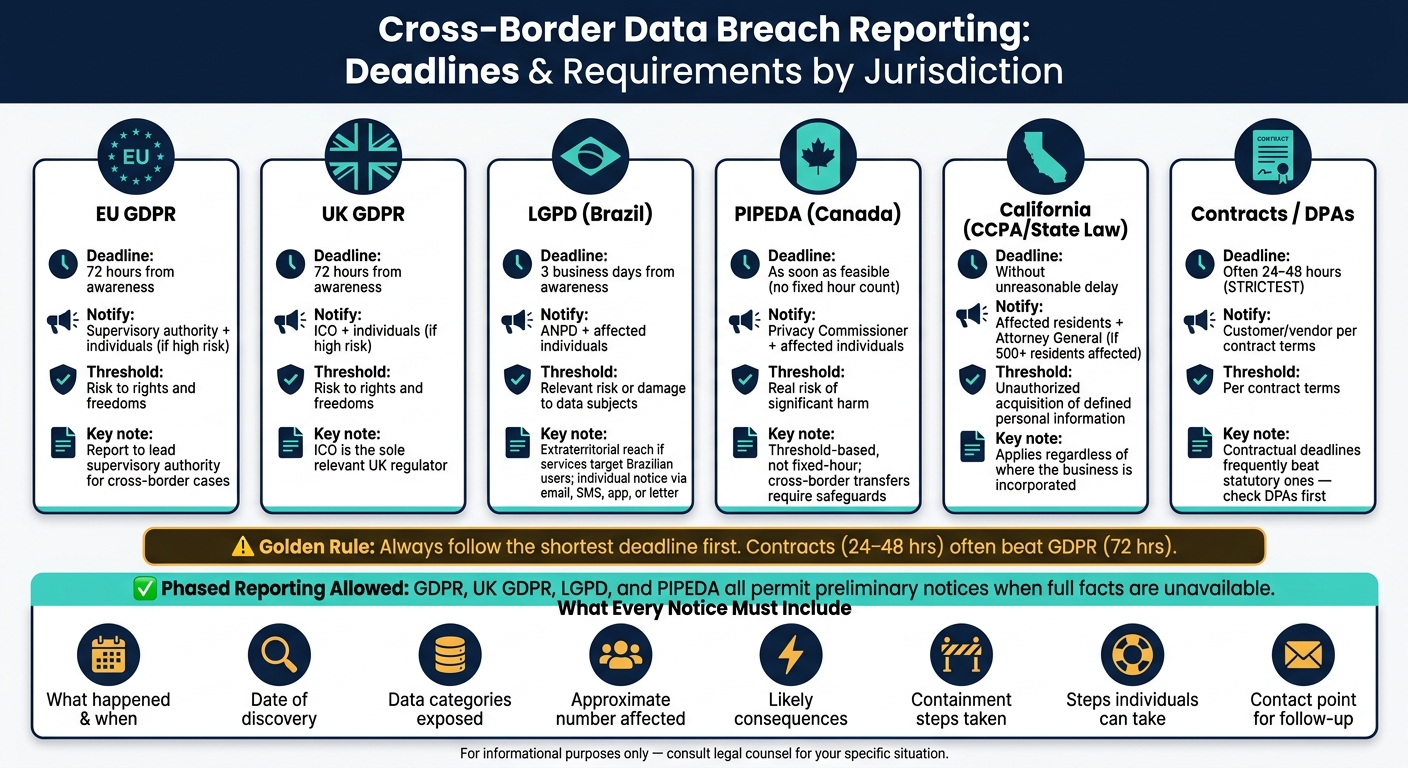
Cross-Border Data Breach Reporting Deadlines by Jurisdiction
The laws that apply depend on three things: where the affected users live, what data was exposed, and whether your startup acted as a controller or processor. In many cases, more than one law can apply to the same breach. That’s where teams get tripped up, because the reporting clocks usually don’t match.
GDPR, UK GDPR, LGPD, PIPEDA, and California Rules at a Glance
Use this table to compare deadlines, thresholds, and who needs to hear from you.
| Jurisdiction | Who Must Be Notified | Deadline | Notification Threshold | Cross-Border Nuance |
|---|---|---|---|---|
| EU GDPR | Supervisory authority; individuals if high risk | Within 72 hours of awareness | Risk to rights and freedoms | Lead supervisory authority for cross-border cases |
| UK GDPR | ICO; individuals if high risk | Within 72 hours of awareness | Risk to rights and freedoms | ICO remains the relevant UK regulator |
| LGPD (Brazil) | ANPD; affected individuals | 3 business days | Relevant risk or damage to data subjects | Extraterritorial reach if services target Brazilian users |
| PIPEDA (Canada) | Privacy Commissioner; affected individuals | As soon as feasible | Real risk of significant harm | Threshold-based, not fixed-hour; cross-border transfers require safeguards |
| California | Affected residents; Attorney General if more than 500 residents are affected | Without unreasonable delay | Unauthorized acquisition of defined personal information | Applies regardless of where the business is incorporated |
After you figure out which law applies, the next issue is just as practical: which regulator do you contact?
How Cross-Border Data Processing Affects Regulator Selection
If your startup has an EU establishment, it will often report to one lead supervisory authority in the country where EU decision-making happens. That said, other EU authorities can still take part as concerned authorities.
If you don’t have an EU establishment but you serve EU users, GDPR may still apply. That’s why it helps to decide in advance whether you need an EU representative and which authority you would contact if something goes wrong.
The type of data involved matters too. Data classification can change your notice duties. One incident may trigger GDPR notice rules but not California notice rules, depending on which fields were exposed.
Once you know the laws in play, map out every regulator, customer group, and internal owner before an incident happens. Keep that regulator map next to your stakeholder list so your team can move fast and notify the right people without delay.
sbb-itb-17e8ec9
Who You May Need to Notify After a Breach
Once you know which laws apply, the next step is figuring out who needs to hear from you.
That usually goes beyond a regulator. Legal notice is only one piece of the work. Your contracts, insurance policy, and internal team structure can all shape what happens next and how fast you need to act.
Regulators and Affected Individuals
Depending on the jurisdictions involved, you may need to notify one or more regulators.
Notice to individuals is a separate duty. Under GDPR, you must notify affected individuals when a breach is likely to create a high risk to their rights and freedoms. LGPD requires notice to data subjects in plain language. California law also sets its own formatting rules for breach notices sent to state residents.
Customers, Vendors, Insurers, and Internal Owners
Your contracts may set tighter deadlines than the law. Data Processing Agreements (DPAs) with enterprise customers or cloud vendors often spell out the exact contact path for notice. In some cases, that means sending notice to a dedicated security email address instead of a general inbox.
You should also notify your cyber insurer early. Late notice can limit coverage for forensic and legal costs. Check your policy for the exact escalation contact and required notice window, then put that information directly into your incident response playbook.
Set owners ahead of time so there is no confusion in the middle of an incident:
- Security gathers facts
- Legal/compliance handles notice analysis
- Finance tracks breach costs
How to Map Stakeholders Before an Incident Happens
Build the contact list before an incident happens, not during one. You don't want people scrambling for names, email addresses, or escalation paths while the clock is ticking.
A standing notification matrix should include:
- Your lead supervisory authority
- Relevant data protection regulators by jurisdiction
- Customer and vendor contacts from your DPAs
- Your insurer's contact details
- Internal executive approvers
Keep contract records searchable so you can quickly pull notice windows and required communication channels. Run a tabletop exercise at least once a year to confirm the contact tree is still correct and that everyone listed knows their role.
Use a single notification matrix to avoid missing a required notice.
| Stakeholder | Who They Are | Key Consideration |
|---|---|---|
| Regulators | Lead supervisory authority, UK ICO, Brazil's ANPD, California AG | Statutory deadlines vary; identify the right authority in advance |
| Individuals | Users whose data was exposed | Notice required when the high-risk threshold is met; format varies by jurisdiction |
| Customers | Counterparties with active DPAs | Contractual deadlines often stricter than statutory ones |
| Vendors | Cloud providers, sub-processors | May have their own escalation requirements under your agreements |
| Insurer | Your insurance carrier | Late notice can limit coverage for forensic and legal costs |
| Internal owners | Security, legal/compliance, finance, executive approvers | Assign roles before an incident, not during one |
When to Report and What to Include in a Breach Notice
Once you've figured out who needs notice, the next job is timing and content. In plain terms, you need to know when the clock starts and what goes into the notice.
How Reporting Timelines Work
The clock starts when your team has reasonable certainty that a reportable breach happened, not when the attack first began. You don't need a complete forensic report before the deadline starts running.
After that, the deadline depends on the rule in play. GDPR and UK GDPR require notice to the relevant supervisory authority within 72 hours of awareness, even if that falls outside normal business hours. Brazil's LGPD gives controllers three business days to notify the ANPD and affected data subjects once they learn the incident affected personal data. PIPEDA doesn't use a set hour count. Instead, it requires notice to affected individuals and the regulator as soon as feasible after the breach is confirmed. And contract terms can be even tighter, sometimes requiring notice within 24 to 48 hours.
For cross-border incidents, start with the shortest deadline. A 24-hour contract notice to a cloud vendor may come due before any filing required by statute.
What to Include in a Breach Notice
Most notices sent to regulators ask for the same core details, no matter the jurisdiction.
- What happened and when it occurred
- When your organization discovered it
- Categories of personal data involved, such as names, financial data, or health records
- Approximate number of people or records affected
- Likely consequences of the breach
- Containment steps already taken
- Steps affected people can take
- A contact point for follow-up questions
Notices to affected individuals should cover much of the same ground, but the wording needs to be plain and easy to follow. Under LGPD, individual notices must be sent directly through email, SMS, app message, or letter within three business days. If individuals can't be identified, LGPD allows public notice on your website, app, or social media for at least three months.
How to Meet Deadlines When the Facts Are Incomplete
Here's the hard part: you almost never have every fact within 72 hours.
GDPR allows phased reporting, which means you can submit an initial notice with what you know and then add more detail as the investigation moves forward, without undue further delay. Brazil's ANPD takes a similar view. It permits a preliminary notice when a full filing isn't possible within three business days, as long as you explain what's missing and follow up later.
The practical move is simple: send the first notice on time, label estimates as preliminary, and document how you reached them. For example, you might say that approximately 1,200 user accounts may have been affected and that final counts are still being reviewed. If your GDPR notice is filed after the 72-hour window, include the reasons for the delay in the notice itself.
| Regime | Deadline | Preliminary Notice Allowed | Key Content Required |
|---|---|---|---|
| GDPR | 72 hours from awareness | Yes - update as facts emerge | Nature of breach, categories and approximate numbers affected, likely consequences, mitigation measures, contact point, reasons for delay if late |
| UK GDPR | 72 hours from awareness | Yes - phased updates accepted | Same as GDPR |
| LGPD (Brazil) | 3 business days from awareness | Yes - explain delay, supplement later | Incident date, awareness date, categories of personal data, number affected, root cause if identifiable, mitigation measures, controller and DPO contact details |
| PIPEDA (Canada) | As soon as feasible to affected individuals and the regulator | Yes - update as the investigation progresses | Nature of breach, significance to individuals, steps to reduce harm, contact point |
| Contracts/DPAs | Often 24–48 hours | Varies by agreement | Per contract terms; often mirrors statutory content |
When more than one rule applies, follow the shortest deadline first, then fill in the missing pieces through updates.
Keep a time-stamped incident log from the moment of discovery onward: when awareness was established, what decisions were made, and when each notice was sent. That log should sit at the center of your incident workflow.
Building a Repeatable Cross-Border Reporting Process
Once you know who to notify and when, the next step is building a process your team can run the same way every time.
A Step-by-Step Breach Workflow for Startup Teams
Use the same response sequence for every incident. That cuts confusion when the clock is already ticking.
- Detect and log the incident
Open an incident log the moment a possible breach is flagged. Record the time, how it was found, and which internal teams were told right away.
- Contain and preserve
Isolate affected systems if needed. Preserve forensic artifacts before anyone changes anything. Assign one incident lead so teams don't make clashing calls.
- Classify the data involved
Figure out whether personal data was accessed or exposed, which categories are involved, and about how many people may be affected. This step shapes every call that comes next.
- Map jurisdictions, transfers, and contracts
Check where affected people live, where data was stored or transferred, and which contract notice triggers apply. A current data map and contract file make this much easier.
- Assess reporting thresholds
Write down the legal basis for notifying - or not notifying - in each jurisdiction. Use a decision matrix to track the basis for notification in each place, the evidence behind your risk review, and the final reason for notifying - or not notifying - each audience.
- Draft and send notices on time
Use approved templates. Tailor them for jurisdiction-specific language, regulator contacts, and timing rules. Send the first notice by the shortest deadline, then update it as facts change.
- Document corrective actions
Record the root cause, affected systems, access-control changes, vendor remediation, and policy updates. Note which notices were sent, when they were sent, and why some parties were or weren't notified.
These records should already exist before an incident starts.
The Records That Make Reporting Faster
Current records decide how fast you can spot your obligations.
| Record | What It Tells You During a Breach |
|---|---|
| Data map | Which personal data categories move between countries and trigger local rules |
| System inventory | Where the breach likely happened and what data was at risk |
| Vendor list | Which processors and subprocessors may need notice |
| DPA repository | What contract notice timelines and approval steps apply |
| Incident log | A single source for decisions, deadlines, and notice timing |
| Notice template library | Prebuilt language that speeds regulator, individual, and partner notices |
Keep this list current before an incident starts.
Key Rules Founders Should Remember
Cross-border breaches create overlapping duties, not one filing. The right recipients depend on where people live, what data was involved, and whether the risk meets the harm threshold in each jurisdiction. Deadlines can start running within hours of awareness, sometimes before you have the full picture.
The safest move is a documented process with named owners. Give clear roles to legal, security, operations, and finance. Keep records current. Treat the incident log like a compliance record.
FAQs
How do I know when a breach is reportable?
A breach is reportable based on the laws that apply to your business. That can change by jurisdiction and by the kind of data involved.
For example, HIPAA in the U.S. and GDPR in the EU do not use the same threshold or timeline. A case that triggers notice under one rule may not trigger it under another. And even when both apply, the reporting window can be different.
To stay compliant, start with the basics:
- Map your data flows so you know what data you collect, where it moves, and where it’s stored
- Identify the rules that apply in each region where you operate
- Use automated breach detection and monitoring to flag reportable events fast
That groundwork matters. If you don’t know where data lives or which rulebook applies, it’s easy to lose time when every hour counts.
What if different countries require different notices?
You need to follow the breach notice rules in every country where you operate or store affected user data. There’s no single global rulebook here. Each country can set its own deadlines, notice triggers, and recordkeeping demands.
A simple way to stay on top of it is to keep a compliance matrix for each jurisdiction. That matrix should track local rules, filing deadlines, and who handles each reporting task. It also helps to work with local legal experts, since small wording differences in the law can change how the rules apply in practice.
What records should I keep before a breach happens?
Keep secure, organized records across your systems and vendors. That means data flow maps, data classification for personal, financial, and HR records, audit trails, access logs, and paperwork for cross-border transfers, such as Transfer Impact Assessments and Data Processing Agreements.
You should also keep payment logs, KYC identity verification records, and business registration documents for international partners for at least five years. Lucid Financials can help you keep everything in order and ready for an audit.