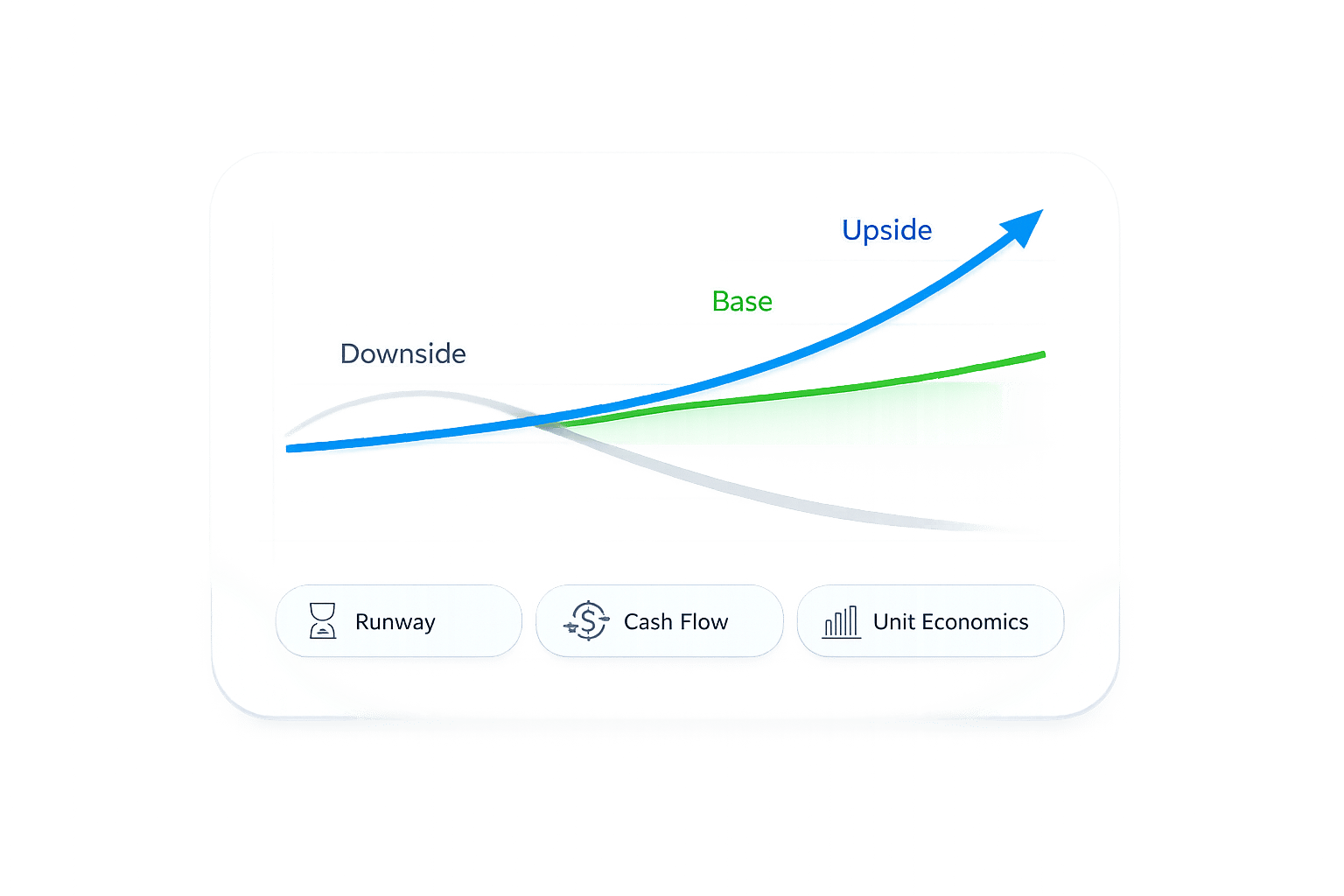
Most investor CRMs log activity but miss investor mood. That gap can lead to mistimed follow-up, missed risk signals, and slower fundraising decisions.
I’d sum it up like this: AI sentiment analysis helps me turn emails, calls, meeting notes, and reply data into simple signals I can act on. It shows when tone changes, flags repeated concerns, and gives me a cleaner view of which investor relationships need attention first.
Here’s the short version:
- The problem: investor context gets split across inboxes, calls, notes, and decks.
- What gets missed: hesitation, trust issues, repeated questions, and slow loss of interest.
- What AI adds: sentiment scores, topic tags, risk flags, and follow-up prompts.
- What I need in the CRM: one investor record, alerts, trend lines, dashboards, and human review.
- What makes the signal more useful: pairing sentiment with current financial data like burn, runway, and forecast variance.
- Why it matters: a transparency study cited in the piece says 58% of investors are more likely to invest in a startup with a transparent founder.
This comes down to one idea: if I can see both investor tone and the numbers behind the business in one place, I can make better fundraising calls with less guesswork.
Where CRM workflows fail to capture investor sentiment
The problem usually shows up in everyday CRM use. Most investor CRMs track activity, not sentiment. They record meetings, emails, and stage changes, but they miss the mood behind those interactions.
So you get a neat timeline without the part that matters most: what the investor was actually thinking.
If an investor sounded hesitant, kept circling back to burn rate, or showed concern about valuation, that context often never makes it into the system. The conversation happened. The signal was there. But the CRM stores the shell of the interaction, not the substance.
Lean teams get hit the hardest. Founders and CFOs are often juggling investor relations along with product, sales, hiring, and finance. That means no one is fully in charge of tracking sentiment. Follow-up, diligence, and board updates then rely on the same partial record.
Scattered communication records leave investor profiles incomplete
One investor relationship rarely lives in one place. It usually stretches across email threads, video calls, shared folders, board decks, and the occasional Slack message.
Each tool keeps its own record. The CRM may get a hand-written summary or a meeting title, but not the full exchange, the follow-up questions, or the change in tone from one quarterly update to the next.
The result is messy in a quiet way. A single investor profile ends up split across systems, with no shared view of how that investor's attitude has changed over time. Teams can't easily spot that the same investor has raised cash runway concerns across several quarterly updates, because those concerns were never tied together in one record.
Manual notes make sentiment tracking subjective and inconsistent
Manual notes strip away nuance and turn it into vague labels. One person's "interested" might mean cautious curiosity. Another person's "interested" might mean close to a yes. That's a big gap.
What matters most often gets left out entirely: skepticism about valuation multiples, unease about hiring pace, or repeated questions about reporting accuracy. And when different team members speak with the same investor without a shared template or common language, the notes become hard to compare over time.
That creates a blind spot. A concern raised in one quarter can look unrelated to a similar concern raised later, even when it's the same investor signaling the same risk.
Late signals leave little time to respond
By the time an investor goes quiet, slows diligence, or pushes back on terms, the team has usually already lost momentum.
Without structured sentiment data, teams are stuck reacting after the fact instead of steering the relationship while there's still time. That's the gap AI sentiment analysis is built to close.
sbb-itb-17e8ec9
How AI sentiment analysis addresses the problem
AI sentiment analysis turns investor communication into clear signals: sentiment scores, topic tags, and follow-up prompts. Inside the CRM, each interaction is labeled as positive, neutral, or negative. It also spots repeated concerns in one place. That means founders and CFOs don't have to dig through scattered notes and inbox threads just to figure out what's changing. They can see the signal early, before diligence slows down or investor interest starts to fade.
Sentiment scoring across emails, meetings, transcripts, and updates
The system can score and tag emails, meeting notes, transcripts, and update replies inside a single record. It tracks repeated topics and sentiment changes over time, so patterns start to stand out. If the same concern shows up across multiple touchpoints, it's hard to miss. That makes it easier to tell the difference between a one-off comment and a real shift in investor mood.
Investor-level risk flags and engagement predictions
Predictive models can flag likely interest or drop-off. Engagement data adds another layer, including where readers stop or re-read. Those early signals help teams time follow-up with more precision. Instead of waiting until momentum disappears, they get a window to adjust outreach while the conversation still has energy.
Why sentiment data matters for startup planning
Sentiment signals help teams decide what needs attention next. If interest is cooling, the CRM can surface that early enough to move follow-up higher on the list. Repeated concerns should feed into the next investor update and the financial model behind it. The next step is to wire those signals into the CRM workflow.
How to add sentiment analysis to an investor CRM
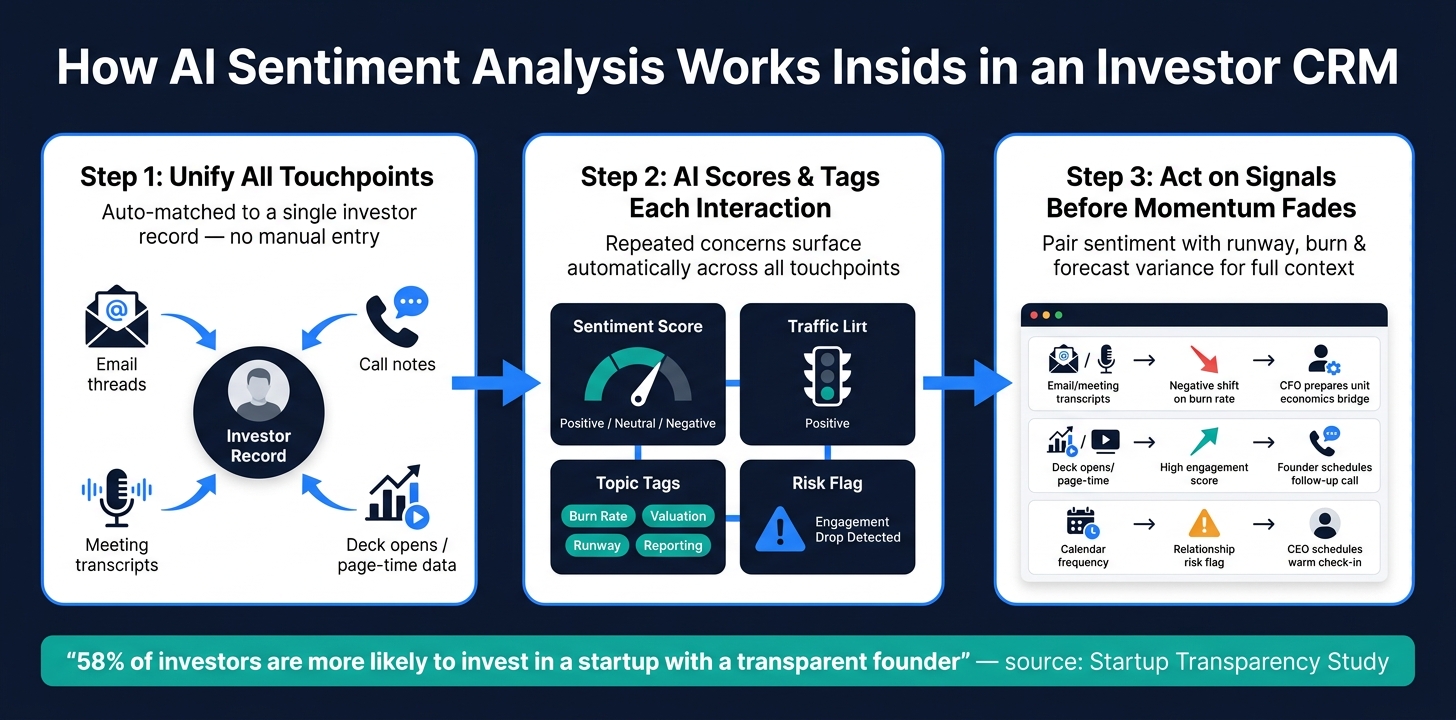
How AI Sentiment Analysis Works Inside an Investor CRM
You can turn sentiment signals into clear CRM actions in three steps: bring all the data into one place, add sentiment fields and alerts, and show patterns in a dashboard.
Pull all communication data into one investor record
Connect every communication channel to your CRM so each touchpoint ends up under a single investor record. That means emails, meetings, call notes, and other interactions all live in one place.
Automatic record matching links each interaction to the right investor. And modern CRMs can log emails and meetings without manual entry, which helps keep the record complete even when the team is moving fast.
Add sentiment fields, alerts, and trend timelines
After the data is flowing in, your CRM needs fields that make sentiment easy to read at a glance. Useful examples include sentiment score, trend, and top concern topics.
These fields turn raw communication data into something a founder or CFO can scan in seconds.
The fields alone aren't enough, though. Alerts matter too. If sentiment drops or engagement starts to slip, the CRM should send a notification so the team can step in early.
Use dashboards for board reporting and fundraising decisions
Once the fields and alerts are set up, pull them into a dashboard the team can check each week. A good dashboard groups investors by sentiment trend and engagement level. It helps the founder spot which relationships need attention and which ones are on solid ground.
It also helps to place engagement metrics next to sentiment scores. Side by side, those signals give the team a clearer read on what to do next.
Use the trend data to prioritize follow-up and prepare board updates.
The table below maps the core workflow from CRM input to team action:
Each row should map directly from CRM input to team response.
| CRM Input | AI Output / Signal | Team Action |
|---|---|---|
| Email and meeting transcripts | Sentiment trend (e.g., negative shift on burn rate) | CFO prepares a detailed unit economics bridge for the next meeting |
| Deck opens and page-time data | High engagement probability score | Founder prioritizes an immediate personal follow-up call |
| Calendar / interaction frequency | Relationship strength or risk flag | CEO schedules a warm check-in to prevent engagement drop-off |
| Market or sector news | Topic-level concern flag | Update pitch messaging before the next meeting |
Use AI outputs as drafts, then review them before sending.
Governance, reporting, and the role of accurate financial data
Accuracy, bias, privacy, and human review
Once sentiment data starts living in your CRM, governance decides whether that signal is useful or just noise.
Generic models often get investor language wrong. A line like we need more time to review can mean normal diligence or a timing issue, not a loss of interest. That’s why domain-specific training matters.
False positives do more than create extra work. They can spark outreach that never needed to happen, or push a founder to treat a healthy investor relationship like it’s in trouble. The fix is simple in theory, even if it takes discipline in practice: log misclassifications, correct them, and feed those corrections back into the model.
Privacy matters too. Investor communications should be protected with encryption, role-based access, audit trails, and retention rules. And for every high-priority flag, human review should be part of the process. No founder wants to make a high-stakes call because a model read the room badly.
Pair sentiment signals with investor-ready financial reporting
Sentiment becomes much more useful when you read it next to runway, burn, and forecast variance.
If a key investor’s tone turns negative at the same time runway gets shorter or forecast variance gets larger, that mix tells you a lot more than either signal on its own. That’s where accurate books make a big difference. Clean, current financials make it easier to read sentiment in context instead of guessing at what it means.
Investors tend to respond with more confidence when the financial story is consistent and easy to check. On the flip side, delayed or unreliable reporting can wear down trust even if relationship sentiment still looks positive. A startup transparency study found that 58% of investors are more likely to invest in a startup with a transparent founder. And that kind of transparency starts with the numbers.
Lucid Financials combines bookkeeping, tax, and CFO support with investor-ready reporting, helping teams read sentiment beside current financial data.
Conclusion: Turn investor sentiment into a usable operating signal
When sentiment, controls, and financials live in one workflow, the CRM starts doing more than storing contacts. It becomes an operating tool.
With the right fields, alerts, dashboards, and human review in place, sentiment signals become dependable enough to shape actual fundraising decisions. Pair that with accurate financial reporting, and the team can shift from reactive relationship management to a more disciplined way of operating.
FAQs
How accurate is AI sentiment analysis for investor conversations?
AI sentiment analysis can help you read the room. It’s useful for gauging tone and spotting shifts in investor interest, especially when you’re dealing with large volumes of notes and communications.
That said, it’s not a standalone fix.
These systems can process a lot of material, but accuracy gets knocked off course by noise, sarcasm, and shifts in financial language. In finance, wording changes fast. A phrase that hinted at confidence last quarter might mean something different now.
On unseen data, models often reach only 50% to 60% directional accuracy, and results can slip over time. That’s why the best setup usually combines a domain-specific model with human review.
In practice, sentiment works best when you read it next to hard financial metrics, not instead of them. Think of it as one signal on the dashboard, not the whole dashboard.
What data should I connect to my CRM first?
Start with your core financial and operating systems, like accounting software, payroll, and banking platforms. That gives you one source of truth for real-time financial data.
Then layer in investor context, such as meeting notes, CRM history, and communications. After that, connect outside sources like financial news, earnings call transcripts, and social media mentions.
Lucid Financials pulls these inputs into one place for real-time updates and sentiment analysis.
How do I use sentiment signals without overreacting?
Treat sentiment signals as a cue to revisit your plan, not as a reason to make snap decisions. Set response bands ahead of time. For example, you might raise capital when scores move above 0.70, or extend runway when scores land between 0.20 and 0.40.
Before you act, check the source material. Sentiment should work as a leading indicator, not a standalone call. Pair it with internal metrics like cash runway and burn rate to see whether a strategy shift makes sense.