AI sentiment tracking helps me spot shifts in investor mood early, so I can time fundraising better, protect cash runway, and avoid making finance decisions off headlines alone.
Here’s the short version: AI scans news, filings, earnings transcripts, analyst notes, and social posts, then turns that text into sentiment scores. Those scores are most useful when I tie them to clear actions like speeding up a fundraise, slowing hiring, or stress-testing runway if a round slips by 3 months.
A few points matter most:
- Investor sentiment changes how the same metrics get judged
- AI reads live text feeds and scores tone from -1 to +1
- Source quality matters more than volume
- Stronger signals often sit at the edges, like above 0.80 or below 0.20
- Low-volume startup coverage can distort scores
- Sentiment should support planning, not drive snap decisions
One number from the article stands out: during the March 2023 Silicon Valley Bank collapse, depositors pulled $42 billion in about 48 hours. That shows how fast market mood can turn into cash movement.
If I were using this in startup finance, I’d keep it simple:
- watch a small set of public comps and sector terms
- set alerts for sharp sentiment moves
- review 5-day and 20-day trends
- connect each alert to a fixed finance response
Here’s a quick view of how sentiment can map to action:
| Sentiment level | Score range | What I’d do |
|---|---|---|
| Bullish | > 0.70 | Start fundraising sooner and target a larger round |
| Neutral | 0.40–0.60 | Keep the current plan |
| Cautious | 0.20–0.40 | Extend runway, slow hiring, focus on margins |
| Panic | < 0.20 | Cut non-core spend and protect cash |
Bottom line: I’d use AI sentiment tracking as an early warning system. It does not tell me what to do by itself. It tells me when to review cash, hiring, and fundraising plans with more care.
How investors can use AI to track market sentiment
sbb-itb-17e8ec9
How AI Reads Investor Sentiment from Live Market Signals
AI turns live text into scores by cleaning it, sorting tone, and rolling the output into alerts or dashboards. Each step matters. If the input is weak or the preprocessing is sloppy, the signal can drift fast.
The Data Sources That Feed Sentiment Models
Most systems pull from several feeds at once. They use APIs to ingest financial news, social media, regulatory filings, and analyst research in near real time. But not all sources carry the same weight. A Reddit post and a Reuters wire should not count the same.
| Source | Freshness | Credibility Weight | Best For |
|---|---|---|---|
| Wire Services (Reuters, AP) | High | 1.0x | Event confirmation |
| Financial Press (Bloomberg, FT) | High | 0.9x | Institutional view |
| Analyst Reports | Medium | 0.8x | Fundamental shifts |
| X / Twitter | Real-time | 0.5x | Real-time pulse |
| Reddit (WallStreetBets) | Real-time | 0.3x | Retail extremes |
| SEC Filings / 8-Ks | Low | High | Regulatory and risk flags |
| Earnings Transcripts | Medium | High | Management tone and guidance |
For founders, the simple read is this: wire services and the financial press are your anchor. Social media is where you check what retail investors feel right now.
How NLP and Sentiment Scoring Work
After the text comes in, the system cleans it. That usually means removing ads, boilerplate, and duplicates, then mapping entities like "$AAPL" and "Apple Inc." to one identifier. From there, finance-focused NLP models such as FinBERT label each sentence as positive, negative, or neutral and attach an intensity score from -1 to +1.
Context is the whole game here. "Cutting costs" may help margins, so it can read as positive. "Cutting guidance" points to weaker growth, so it reads negative. Same verb, very different market signal. FinBERT can process 120 documents per second, which makes it usable for live feeds.
Those sentence-level scores are then rolled up into company or sector composites. The model weighs them by source trust level and recency. A CEO comment on an earnings call should matter more than an anonymous post. What you get is a rolling sentiment score you can track over days or weeks, not just a one-off snapshot.
As a rule of thumb, treat scores between 0.40 and 0.60 as weak signals. The sharper moves tend to show up at the edges - above 0.80 or below 0.20 - where market behavior is often stronger.
Where Real-Time Sentiment Analysis Can Go Wrong
Even solid systems miss things.
Bot activity and coordinated posting can push social sentiment higher or lower than it should be. A small group can make a fringe view look bigger than it is. Sarcasm is another headache. If a model reads irony as praise, the score can flip in the wrong direction.
Repeated headlines create a quieter problem. If dozens of outlets reprint the same wire story, a basic system may count each one as a separate signal. That can make coverage look heavier than it is. Better models deduplicate hard to avoid that loop.
For private startups, the biggest issue is low volume. Public companies can rack up thousands of mentions a day. A Series A startup may get only a few. That thin sample makes scores shaky, so one harsh article can move the reading a lot.
The Silicon Valley Bank collapse in March 2023 is a sharp example of how fast sentiment can hit actual cash movement. A single Bloomberg article about bond portfolio losses helped trigger $42 billion in withdrawals within 48 hours.
If a score jumps, don't change your fundraising plan off the chart alone. Read the source material first. For startups, the upside is spotting fundraising pressure early, not reacting to every market twitch.
Those scores matter only when they feed a repeatable monitoring workflow.
How to Build a Real-Time Sentiment Monitoring Workflow
Set Clear Monitoring Goals and Build the Right Watchlists
Start with one monitoring goal. That could be tracking overall investor risk appetite, sector sentiment, or public comparables to gauge valuation trends.
If you're focused on sector sentiment, keep the watchlist tight. Follow a small group of public companies that investors use as stand-ins for your space, along with a sector ETF that reflects the market's mood. Then add a short set of keywords like "valuation caps", "revenue beat", "lowered guidance," and "burn rate." Round that out with key macro events such as Federal Reserve rate decisions, earnings seasons, and major regulatory announcements.
Once you know what you're watching, the next step is simple: decide which signals are worth your time.
Set Up Alerts, Dashboards, and Review Routines
Set threshold alerts for sharp moves. A drop below 0.30 or a jump above 0.80 is where fundraising-related shifts are most likely to show up.
From there, review:
- Weekly trend lines
- 5-day moving averages
- 20-day moving averages
You should also check sentiment right after a Fed announcement, a major earnings release in your sector, or a major regulatory announcement. The goal isn't to turn this into a daily task. It's to build a rhythm you can stick with without letting it take over your week.
Those alerts matter only if they feed a repeatable review process.
Connect External Sentiment Signals to Internal Financial Planning
External sentiment only helps when it leads to action inside the business.
That usually comes down to finance readiness. If your books are clean and your reporting is investor-ready, scenario planning gets much easier when sentiment moves. Say your sector score drops hard. You can stress-test runway assumptions right away and ask a blunt but useful question: What happens if our next round gets pushed back by three months?
Lucid Financials helps connect that signal to action through Slack integration and always-on investor-ready reporting. That means a sentiment alert can turn into a planning decision without slowing down your finance workflow. If your financials aren't current, those alerts may look interesting, but they're tough to use in practice.
How to Use Sentiment Data in Fundraising and Capital Structure Decisions
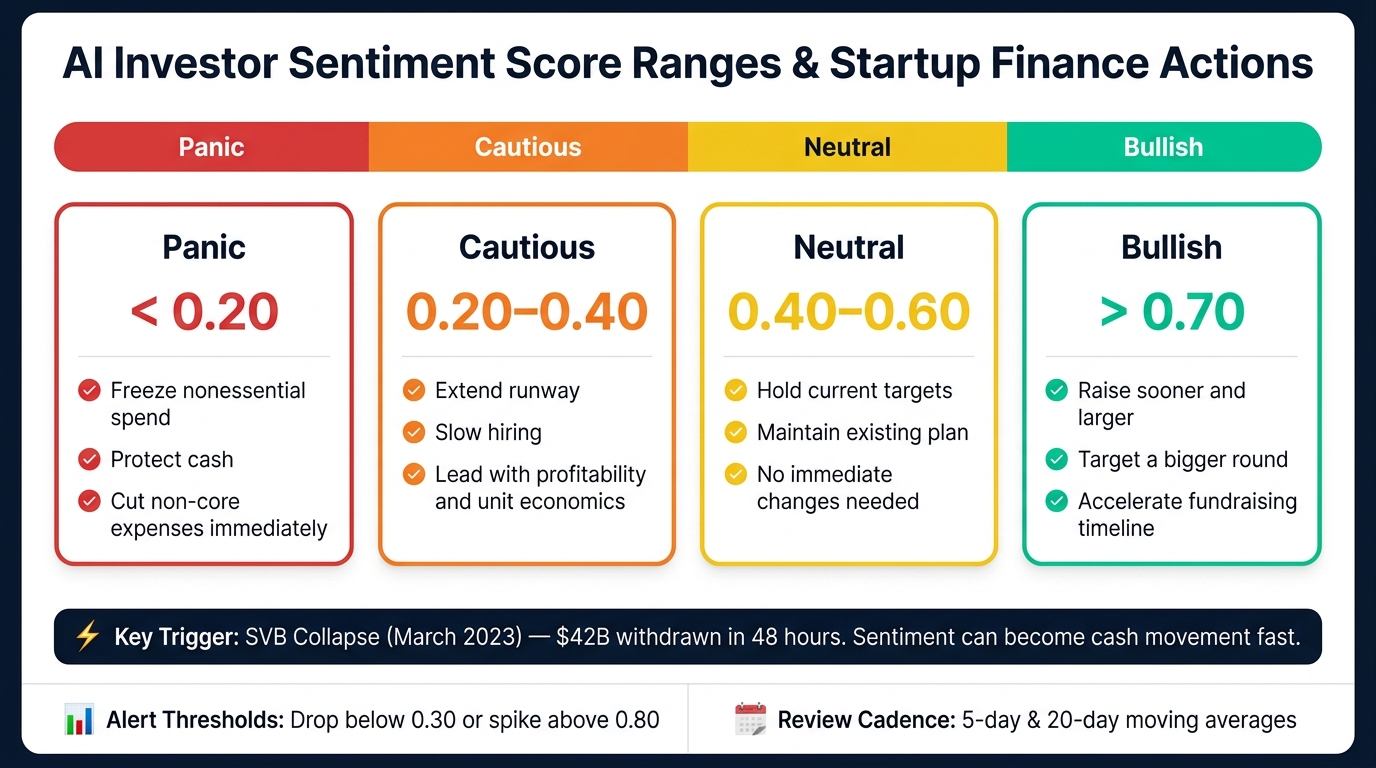
AI Investor Sentiment Score Ranges & Startup Finance Actions
Adjust Round Timing, Runway Targets, and Spending Plans
Once you have sentiment alerts set up, tie each shift to a clear financing move. That’s the whole point. Sentiment only matters if it changes what you do.
Use it to guide round timing, runway targets, and spending plans. If sentiment is strong, it may make sense to raise earlier or go out for a larger round. If sentiment weakens, the smarter move is often to extend runway and slow hiring.
This works best when you connect the signal directly to cash runway and hiring plans. Sentiment tends to matter most when the size and timing of an equity round are already up for debate.
Use Scenario Planning Instead of Reacting to Daily Noise
Instead of reacting to every market wobble, set fixed response bands ahead of time. That way, a shift in sentiment triggers the same capital decision each time.
| Sentiment Scenario | Score Range | Fundraising Response |
|---|---|---|
| Bullish | > 0.70 | Raise sooner and larger. |
| Neutral | 0.40–0.60 | Hold current targets. |
| Cautious | 0.20–0.40 | Extend runway and slow hiring. Lead with profitability and unit economics. |
| Panic | < 0.20 | Freeze nonessential spend. |
Having those responses ready helps keep sentiment alerts from turning into emotional board discussions. It also keeps hiring pace and spending decisions tied to planning instead of mood.
Build Investor Updates That Reflect Market Conditions
Sentiment also affects how you talk to investors. Your updates should match the market backdrop.
If sentiment in your sector is slipping, say that plainly. Then show why your business still stands up on the numbers. Pair outside sentiment trends with internal metrics like cash runway, revenue growth, and forecast updates so the board can see why valuations may be moving even when company performance stays steady.
When sentiment is cautious, lead with conservative projections and sensitivity analysis. When sentiment is strong, lead with faster expansion.
Conclusion: Use AI Sentiment Tracking as a Planning Input, Not a Shortcut
Once alerts and scenario bands are set, use sentiment as a prompt to review the plan, not a reason to react on instinct. AI sentiment tracking gives founders an early look at investor mood before it starts to affect fundraising activity.
Sentiment is a leading indicator, not a decision rule.
Outside signals work best when you pair them with internal numbers like cash runway, burn rate, and revenue growth. That only helps if your current financials are clean, up to date, and ready to compare against the signal. Use sentiment only when it changes decisions around runway, burn, or revenue.
Lucid Financials keeps books clean and investor-ready, so teams can move fast when sentiment shifts.
The goal is simple: act only when a signal changes the financing plan. Treat sentiment as input, then test it against the model.
FAQs
How accurate are AI sentiment scores?
AI sentiment scores aren’t magic verdicts on their own. They work best when a system can tell the difference between a useful signal and plain noise, check whether the source is worth trusting, and read the context instead of just the words.
To stay reliable, teams may give more weight to sources that have shown strong relevance over time, set confidence thresholds so weak signals don’t drive decisions, and retrain models as language shifts. Human oversight and peer verification help cut bias too, which supports more balanced decisions.
Which sources matter most for tracking investor sentiment?
The most important sources blend trust, relevance, and speed:
- wire services like Reuters and AP
- major financial press such as Bloomberg and the Financial Times
- corporate disclosures, including SEC filings and earnings call transcripts
- social platforms like X, Reddit, and StockTwits
AI gives more weight to trusted sources and filters social media noise to track real-time sentiment.
How should startups respond to a sudden sentiment drop?
Startups need to move from reacting to planning ahead. A simple if-then framework can help: if revenue slips, then hiring slows; if burn climbs past a set limit, then spending gets reviewed. That kind of planning makes it easier to spot trouble early instead of waiting for investors to bring it up.
It also helps to set up automated risk flags in your financial plan. When a metric drifts off course, the team gets a heads-up right away. That gives you time to fix the issue, tighten the story, and walk into investor talks with answers already in hand.
Another smart move is to extend cash runway - for example, from 18 to 24 months. That extra time can give startups more room to deal with lower valuations and slower fundraising without making rushed decisions.
AI can help here too. It can draft risk disclosures and investor FAQs so your messaging stays consistent and tied to the concerns investors are most likely to have.