AI headcount planning helps startups make smarter hiring decisions by using data and AI tools to align hiring with financial goals and growth milestones. Instead of guessing or relying on outdated spreadsheets, this approach integrates financial, HR, and operational data to forecast hiring needs, manage costs, and avoid overhiring or underhiring. Key benefits include:
- Cost Control: Headcount often represents 60-70% of operating expenses. AI helps avoid premature hires that shorten runway.
- Milestone-Based Hiring: Ties hiring decisions to revenue or funding milestones, like reaching $2M ARR or closing a Series B round.
- Data-Driven Metrics: Tracks burn rate, revenue per employee, and other metrics to ensure efficient hiring.
- Scenario Modeling: Simulates how hiring decisions impact cash flow and runway in different growth scenarios.
- Skills Gap Analysis: Identifies current and future skill needs to prioritize critical hires.
The Basics of Startup Headcount Planning
What Is Headcount Planning?
Headcount planning involves figuring out who to hire, when to bring them on board, and how much it will cost - all while ensuring these decisions align with your business goals and financial runway. It’s not just about filling vacancies; it’s about assessing the skills and capacity your company needs to hit its next big milestone. That could mean securing funding, launching a product, or hitting a revenue target.
Since payroll often eats up 60%–80% of operating expenses, every hiring decision - or delay - directly affects your cash flow. To manage this effectively, startups need to align hiring with milestones. For example, the total cost of an employee goes beyond their base salary. When you factor in payroll taxes, benefits, equity, equipment, and software, the actual cost usually runs 1.25× to 1.4× the base salary. So, a frontend engineer with a $120,000 base salary might cost $150,000–$168,000 annually.
The most successful startups don’t hire based on the calendar; they hire based on progress. Instead of saying, “We’ll hire in Q2,” they set clear triggers, like: “We’ll hire another Account Executive once we hit $1.2M in ARR” or “We’ll bring on a Head of Engineering after closing our Series A.” This approach ensures spending directly ties to measurable business outcomes.
Understanding this framework is key to tracking its impact through specific metrics.
Key Metrics for Headcount Decisions
When it comes to hiring, startups should rely on a few core metrics to guide their decisions:
- Burn rate and runway: Every new hire shortens your cash runway. Before making an offer, calculate how the role will influence your financial runway over the next 12–18 months.
- Revenue per employee: This metric shows how efficiently your team generates revenue. If revenue per employee dips as headcount grows, it could signal that costs are growing faster than output. Top public SaaS companies like Atlassian and Zoom hit $350,000–$450,000 in revenue per employee, while a solid Series B target would be $150,000–$200,000.
- Budget variance: Keeping planned versus actual headcount spending within a 5% variance demonstrates strong financial discipline.
- Time-to-fill and ramp time: Filling a mid-market role typically takes 42 days, while executive positions can take 90 to 120 days. On top of that, onboarding isn’t instant - B2B sales reps often need around seven months to reach full productivity. This means you can’t assume immediate results from new hires.
"Headcount plans are almost always revenue plans in disguise. They're built on the assumption that if the ARR plan hits, the headcount will be justified." - Victor Hoang, Co-Founder & CMO, Rework
These metrics help ensure headcount decisions are tied to strategic milestones, keeping the process data-driven and aligned with business goals.
How AI Changes Headcount Planning
AI is reshaping headcount planning by making it more dynamic and data-driven. Traditional methods rely on static spreadsheets updated once a year, but AI tools continuously integrate data from finance, payroll, and workforce systems. This allows you to instantly model scenarios, like how delaying an engineering hire by 90 days could extend your cash runway or how hiring two sales reps in a different quarter might impact your burn rate.
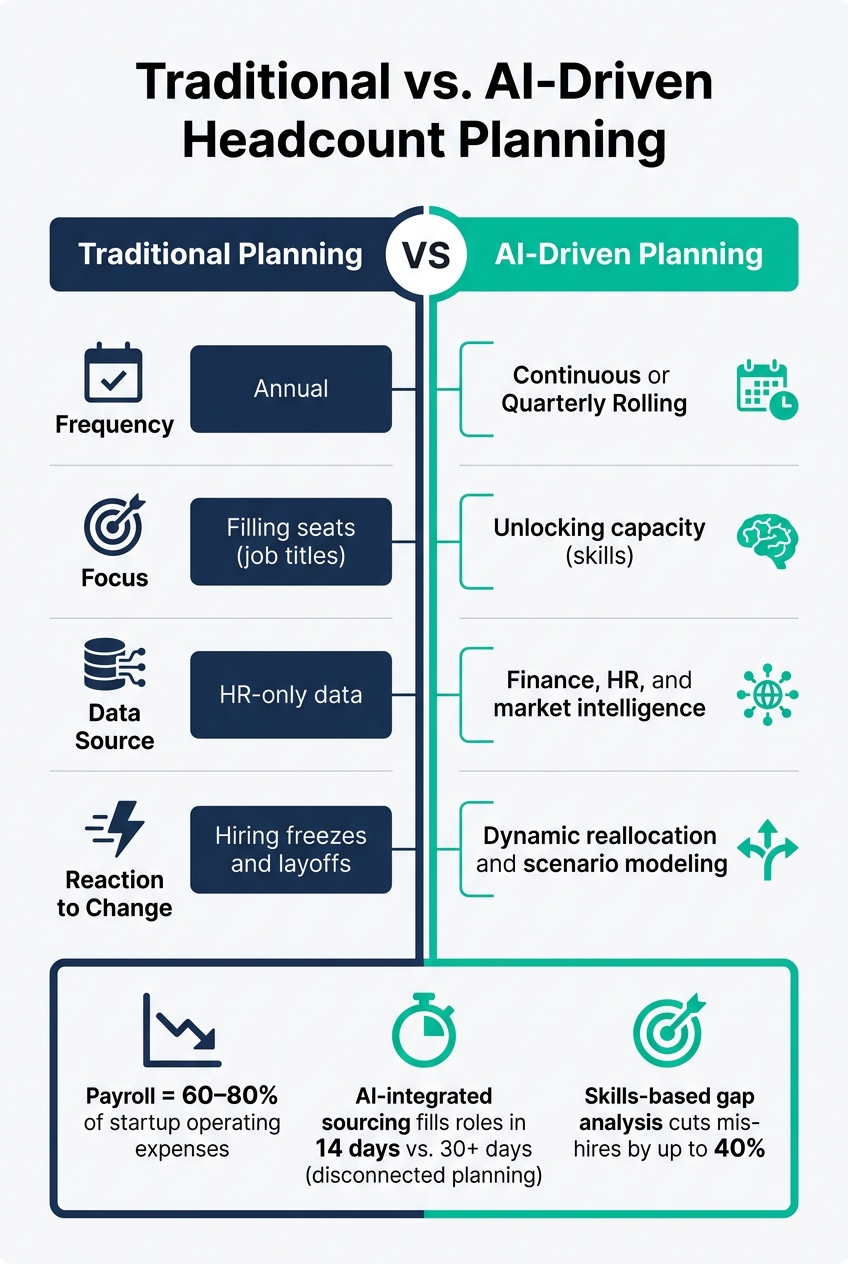
Here’s a quick comparison of traditional versus AI-driven planning:
| Feature | Traditional Planning | Modern AI-Driven Planning |
|---|---|---|
| Frequency | Annual | Continuous or Quarterly Rolling |
| Focus | Filling seats (job titles) | Unlocking capacity (skills) |
| Data Source | HR-only data | Finance, HR, and market intelligence |
| Reaction to Change | Hiring freezes and layoffs | Dynamic reallocation and scenario modeling |
AI doesn’t just speed things up - it also uncovers trends you might miss. For example, 53% of HR leaders say they’ve decided not to backfill certain roles because AI tools now handle those tasks, and 77% of organizations report that AI has created entirely new roles. For startups, this means headcount planning needs to go beyond the current org chart. It should also anticipate how AI might change the skills your company will need in the future.
sbb-itb-17e8ec9
AI Adoption for Headcount
Building a Data-Driven AI Headcount Planning Framework
Traditional vs. AI-Driven Headcount Planning: Key Differences
Essential Data Sources
Effective AI headcount planning starts with strong data inputs. The backbone of this process includes your HRIS, which tracks headcount, roles, and compensation, and your Applicant Tracking System (ATS), which provides insights into time-to-hire, candidate pipelines, and recruitment costs. To add meaningful context, financial and sales data - like ARR, burn rate, and sales pipeline - along with operational metrics such as product roadmap milestones and support ticket volumes, are key components.
Additionally, a skills inventory built from resumes, performance reviews, and certifications helps map your team's current abilities. Pair this with external market data, like compensation benchmarks and talent availability, to get a clear picture of your hiring landscape.
"Startups should leverage a combination of historical data, market trends, and a deep understanding of their product roadmap to build effective workforce plans." - Jason Buss, Founder, Talent HQ
The results are tangible: startups using data-driven hiring capacity models report a 20% faster time-to-fill. These gains are possible only when HR, recruitment, financial, and operational data are brought together in a unified system.
With these integrated data sources, forecasting models can directly shape your hiring strategy.
Financial and Workforce Models
Once your data is in place, connect it to a driver-based model that adjusts hiring needs as revenue grows.
A practical way to structure this planning is through a four-layer headcount model:
| Layer | Definition | Example Trigger |
|---|---|---|
| Core | Minimum headcount required to maintain ARR | Always active |
| Growth | Roles linked to specific revenue milestones | Reaching a defined revenue milestone |
| Bet | Strategic hires with clear kill criteria | Strategic outcomes not being achieved |
| Flex | Contractors or fractional hires for flexibility | Before committing to full-time positions |
This layered approach ties financial milestones directly to hiring decisions, ensuring alignment with your AI-driven headcount strategy.
To make smarter hiring choices, model three scenarios - Base, Growth, and Downside. For each planned hire, calculate the impact on your burn multiple and runway. A simple but effective question to ask is: “What breaks if we don’t make this hire within 90 days?” This question helps prioritize critical hires over less urgent ones.
The success of these models, however, depends on clean and well-governed data, which is covered next.
Maintaining Data Quality and Governance
Accurate headcount planning relies on clean, reliable data. Start by auditing your HRIS to standardize role categories, ensure compensation data is complete, and document termination reasons. These steps are vital since 70% of startups face challenges in accurately forecasting their hiring needs.
To streamline processes, standardize data formats - use USD for compensation and mm/dd/yyyy for dates. This ensures smooth integration between your HRIS and financial planning tools. Middleware solutions like MuleSoft or Workato can automate these data flows, cutting down on manual errors.
Good governance is also about protecting sensitive information. Implement role-based access controls and automated audits to secure your data for both internal and investor reviews. Additionally, establish an SLA between Finance and HR to ensure timely updates when start dates change, employees leave, or compensation is adjusted. Without regular updates, outdated data can lead to misleading projections about your runway.
AI Tools and Methods for Headcount Optimization
AI Use Cases in Headcount Planning
When backed by reliable data, AI transforms workforce planning into a more precise and proactive process. The most practical applications focus on three key areas:
- Demand forecasting: By analyzing the relationship between business metrics and headcount, AI can automatically determine hiring needs as your business grows. For instance, as ARR increases, the model recalculates how many customer success or engineering hires are required - eliminating the need for manual adjustments.
- Attrition prediction: AI examines turnover trends to flag employees who may leave within the next 3 to 6 months. This early insight allows teams to plan replacements in advance, avoiding last-minute hiring scrambles.
- Skills gap analysis: AI compares your team’s current skill set against your product roadmap to identify gaps before they hinder progress. This helps you decide whether to hire new talent, upskill existing employees, bring in contractors, or automate tasks.
"Traditional workforce planning is not planning. It is budgeting with job titles." - Superdots
These examples highlight how AI can take workforce planning beyond guesswork, setting the stage for a deeper dive into the methods that make it all possible.
Key AI Methods
The transformation of headcount planning is driven by three core AI methods:
- Predictive models: Tools like SHAP-enhanced XGBoost use revenue trends and historical data to forecast hiring needs. By providing transparency into why a model suggests a specific headcount, these tools build trust with stakeholders, making their recommendations easier to act on.
- Optimization algorithms: These algorithms simulate the financial impact of hiring decisions, showing how they affect runway, margins, and cash flow. Instead of just presenting data, they model the broader consequences, ensuring hiring decisions align with overall business goals.
- Natural language interfaces: These interfaces simplify complex data outputs into clear, actionable insights, making it easier for non-finance stakeholders to understand and use the information.
When teams integrate approved headcount plans directly with sourcing automation, they can fill roles in an average of 14 days - a significant improvement over the 30+ days it typically takes when planning and execution are disconnected.
These methods not only improve forecasting accuracy but also make decision-making more efficient, especially when paired with integrated platforms.
How Lucid Financials Supports Headcount Planning
By combining these AI-driven methods, Lucid Financials offers a streamlined approach to workforce planning. Unlike traditional tools that rely on outdated spreadsheets, Lucid uses real-time financial data to create forecasts that reflect your business's current state.
Lucid’s scenario modeling feature allows users to compare best-case, worst-case, and actual outcomes side by side. Before opening a new role, you can see how it impacts your burn rate and runway under different market conditions. As Lucid explains: "Our AI generates and compares scenarios, helping you choose the right path." This level of insight shifts hiring from reactive to strategic.
Additionally, Lucid provides industry benchmarks tailored to your sector, enabling you to validate your headcount ratios and metrics like CAC against similar companies. Founders have described the platform as "having a full finance team on demand". One founder even noted that VCs were impressed to see fully up-to-date financial data during fundraising meetings - a testament to Lucid’s ability to keep businesses agile and informed.
Best Practices and Governance for AI Headcount Planning
Avoiding Common Mistakes
One of the big missteps startups often make is focusing their budget solely on base salaries. As mentioned earlier, the actual cost of hiring someone goes beyond just their salary - a difference that can quietly drain your resources if overlooked.
Another frequent error is what’s called the "January 1st Fallacy" - rushing to make all planned hires at the beginning of the year without considering whether recruiters or onboarding teams can realistically handle the load. Spacing out hires based on your actual recruiting pipeline and team readiness helps avoid bottlenecks and keeps your financial projections on track.
Then there’s the issue of relying on a single revenue scenario. Less than 30% of companies align their headcount plans with multiple forecasts. For instance, a B2B SaaS company with 180 employees learned this lesson the hard way. After missing its 2024 ARR target by 18%, they had already hired 22 new employees based on a single optimistic forecast. The following year, they switched to a more flexible model, dividing roles into four categories: 145 Core roles, 8 Growth roles tied to milestones, 3 Bet roles tied to specific criteria, and 4 Flex contractors. When revenue slowed in Q1 2025, they avoided layoffs by holding off on five of the eight Growth hires.
Understanding these common mistakes sets the stage for better collaboration across teams.
Setting Up Cross-Team Collaboration
Headcount planning often stumbles when Finance and HR work in isolation. For example, if Finance keeps the headcount plan in one spreadsheet and HR tracks sourcing efforts elsewhere, every new hire search essentially starts from scratch - adding over 30 days to the hiring process.
The fix? Create a joint steering committee that includes your CFO, CHRO, and leaders from key business units. This group should meet monthly or quarterly to compare actual progress against the plan and review AI-generated insights. Additionally, Finance and HR should agree on a shared service-level agreement (SLA) that outlines standard benchmarks like time-to-hire, start date flexibility, and ramp-up timelines for each role. This collaboration ensures that AI models produce more accurate and actionable forecasts.
"Hiring capacity modeling is not just about filling roles; it's about aligning talent acquisition with business goals and financial projections." - Lori Goler, VP of People, Meta
Another helpful strategy is to tie hiring approvals to milestone-based triggers, such as reaching $2M ARR or closing a funding round, instead of relying on fixed calendar dates. This keeps hiring plans grounded in real business outcomes. These collaborative efforts help integrate AI-driven insights into practical decision-making.
Using AI Tools Responsibly
With solid governance and collaboration in place, the next step is using AI tools thoughtfully. While AI can handle the heavy lifting of analyzing data and spotting trends, your team still needs to apply strategic judgment. Before scaling any AI tool, audit your HRIS data, as poor data quality is often the main obstacle to accurate AI predictions - not the tool itself. Clean data on metrics like tenure, job roles, and termination reasons forms the backbone of reliable forecasting. Start by piloting the AI tool in one department with clear, measurable goals before rolling it out across the company.
Two governance practices are especially important: require AI tools to provide confidence ranges (e.g., "6–10 engineers needed") rather than a single number, and maintain version control on every plan. This ensures there’s a clear record of what was approved, who approved it, and the assumptions behind it. These steps transform AI from a mysterious "black box" into a transparent tool that leadership can trust. By following these responsible practices, you can align workforce costs with your financial goals while maintaining confidence in AI-driven processes.
Conclusion: Smarter Workforce Planning with AI
For most startups, headcount is the single largest expense, often accounting for 60% to 70% of total operating costs. Missteps in headcount planning can disrupt growth, making AI-driven solutions a game-changer in this space.
AI ensures hiring decisions are tied to tangible milestones, enabling timely and strategic choices. By conducting skills-based gap analyses, it can cut costly mis-hires by up to 40%. Additionally, it allows businesses to evaluate the financial impact of each new hire before making commitments.
One standout advantage is the financial clarity AI brings. By integrating HRIS, payroll, and financial data, it eliminates spreadsheet errors and boosts FP&A efficiency. In fact, integrated platforms can free up over 40 hours per planning cycle for FP&A teams, allowing them to focus on strategic initiatives rather than administrative tasks.
Lucid Financials exemplifies how these tools deliver results. With AI-generated forecasts, real-time runway visibility, and scenario modeling, it provides founders with the confidence to make informed headcount decisions. As Aviv Farhi, Founder and CEO of Showcase, shared:
"Lucid turned our bookkeeping and taxes from a headache into a simple, reliable process. Their CFO insights give us clarity to plan growth with confidence - it feels like having a full finance team on demand."
This sentiment is echoed by other industry leaders:
"Most hiring problems aren't hiring problems - they're planning problems." - Newxel
These testimonials highlight the importance of precise, data-driven planning. The tools and frameworks presented in this guide - ranging from skills-based capacity planning to milestone-driven hiring - reinforce a key takeaway: smarter planning builds stronger teams and ensures financial health. The startups poised for efficient scaling in the years ahead won’t necessarily be those hiring the most but those making the most strategic, data-informed hiring decisions.
FAQs
What data do I need to start AI headcount planning?
Begin by collecting detailed information about your current workforce, including their skills, any existing gaps, and future needs based on business goals. This should also cover internal talent availability, salary and benefits estimates, and the factors that trigger hiring needs.
Once you have this data, align it with your company’s strategic objectives. This approach ensures your plan remains adaptable and informed by insights from HR, finance, and market trends, creating a well-rounded strategy for workforce planning.
How do I tie hiring approvals to revenue or funding milestones?
To make sure hiring stays in step with revenue or funding milestones, establish clear financial targets that will guide your decisions. Regularly compare forecasts with actual performance to confirm that headcount growth aligns with the company’s financial stability. AI-powered tools like Lucid Financials can be incredibly helpful here, offering real-time insights and scenario modeling. These tools enable data-driven decisions, helping you avoid risks like over-hiring during slow periods or under-hiring when business is booming.
How do I account for the true fully loaded cost of a hire?
To figure out the fully loaded cost of hiring an employee, you’ll need to account for more than just their base salary. Include expenses like payroll taxes (think FICA, FUTA, SUTA), employee benefits (such as health insurance or 401(k) matching), and overhead costs (like equipment and workspace). These additions typically increase the base salary by 25% to 40%. Using a multiplier between 1.25x and 1.4x can help startups plan their budgets accurately.