Startups succeed when workforce allocation aligns with business goals. Misalignment drains resources, disrupts progress, and wastes time. Proper alignment ensures every hire and task supports measurable objectives like revenue growth, product launches, or funding milestones.
Key takeaways:
- Workforce Allocation: Match skills and capacity with tasks to avoid inefficiencies.
- Business Objectives: Define clear, measurable goals tied to funding or growth milestones.
- Strategies: Function-based, project-based, skills-based, and capacity-based allocation each have unique strengths and risks.
- Hiring Prioritization: Use frameworks like P0–P3 to focus on mission-critical roles first.
- Financial Planning: Account for fully-loaded costs (1.25–1.4× base salary) and ramp-up periods (60–90 days).
Pro Tip: Regularly review alignment gaps, update plans quarterly, and use tools like Lucid Financials for real-time insights. Misaligned hiring isn’t just costly - it’s preventable with better planning.
How to Build Out a Strategic Workforce Plan
sbb-itb-17e8ec9
Workforce Allocation Strategies
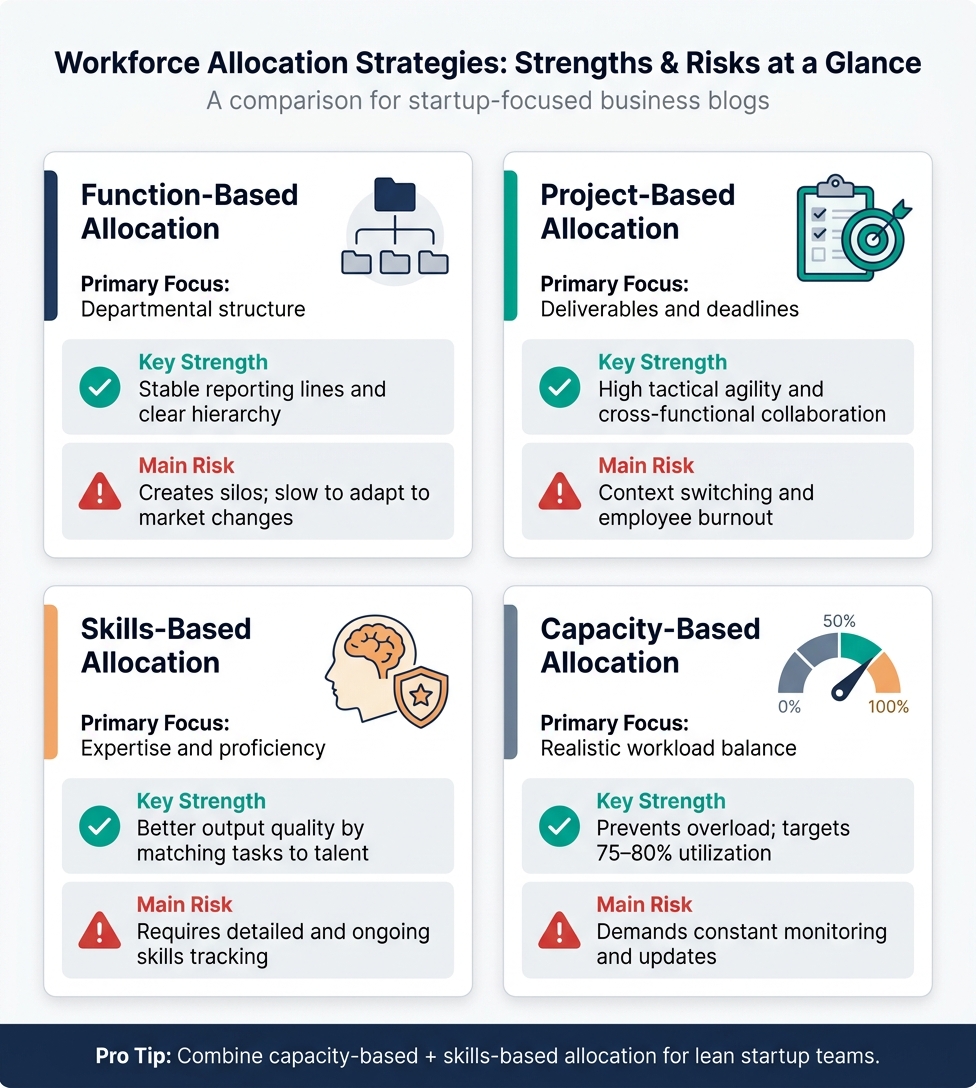
Workforce Allocation Strategies: Strengths & Risks at a Glance
Startups adopt various workforce allocation strategies to improve responsiveness, efficiency, and team performance. Each approach offers unique advantages while addressing specific challenges, all aimed at aligning teams with broader business goals.
Function-Based Allocation
This method organizes employees by department - engineering, marketing, sales, customer support - and assigns tasks within those groups. It’s a familiar structure that establishes clear reporting lines and provides stability, especially in the early stages when roles are well-defined.
However, this structure can become rigid over time. Teams may stick to outdated routines even as priorities shift, leading to silos and slower responses to market changes. While the stability is helpful, the lack of flexibility can hinder the ability to adapt quickly.
Project-Based Allocation
In this setup, employees are grouped based on specific deliverables and deadlines rather than their departmental roles. For example, a product launch might involve a cross-functional team of an engineer, a designer, and a marketer working toward a shared goal. This approach encourages collaboration and ensures focused efforts on clear objectives.
The challenge? Employees can end up juggling too many projects, leading to frequent context switching and reduced productivity. Over time, this can also contribute to burnout.
Capacity-Based and Skills-Based Allocation
These two methods often complement each other. Capacity-based allocation ensures workloads are realistic, considering not just who is technically available but how much bandwidth each team member actually has. For example, aiming for 75–80% utilization allows room for administrative tasks and unexpected delays.
Skills-based allocation, on the other hand, focuses on matching tasks with the right expertise. Instead of simply filling gaps in the schedule, this approach ensures that individuals are assigned work they’re best equipped to handle.
"Allocation based on availability breaks at scale." - Kailash Ganesh, Rocketlane
Using a skills matrix to map team expertise can highlight areas of strength and risk, which is especially critical for lean startups. By balancing capacity with specialized skills, teams can align their efforts more effectively with business priorities.
| Strategy | Primary Focus | Key Strength | Main Risk |
|---|---|---|---|
| Function-Based | Departmental structure | Stable reporting lines | Creates silos; slow to adapt |
| Project-Based | Deliverables and deadlines | High tactical agility | Context switching and burnout |
| Skills-Based | Expertise and proficiency | Better output quality | Requires detailed skills tracking |
| Capacity-Based | Realistic workload balance | Prevents overload | Demands constant monitoring |
How Startups Define and Act on Business Objectives
Turning Objectives into Action
Startups thrive when they turn broad goals - like increasing revenue, launching new products, or achieving profitability - into actionable steps. The difference between startups that succeed and those that struggle often comes down to asking the right question. Instead of focusing on "How many people can we afford?", high-performing startups ask, "What do we need to achieve, and what resources are essential to get there?".
One effective method is zero-based org charting, where startups design their organizational structure from the ground up, based solely on their immediate goals. Whether the aim is to hit a revenue milestone, launch a product, or secure funding, every role must clearly align with a specific objective.
To prioritize roles, startups often use the P0–P3 framework:
- P0 (Mission-Critical): These roles are essential. Without them, key milestones or revenue goals are blocked.
- P1 (High Priority): Important for driving core initiatives, with a goal to fill these positions within 30–60 days.
- P2 (Nice-to-Have): These roles add value but can be delayed without immediate consequences.
- P3 (Opportunistic): These roles are pursued only if an exceptional candidate becomes available, without active recruitment.
This structured approach to prioritizing roles ensures that startups focus on positions that directly impact progress, avoiding reactive or unnecessary hiring. By linking roles to specific outcomes, startups create a foundation for financial decisions that extend runway and drive growth.
Startups can also benefit from milestone-anchored planning, where headcount is tied to funding rounds or revenue goals rather than arbitrary time periods. Take the Newxel fintech case study, for example: the startup hired three core engineers by month two, scaled to nine engineers by month four to build essential features, and expanded to 20 engineers - including specialized roles - by month seven after hitting key traction metrics. Each hire was made to address a proven, immediate need.
"Most hiring problems aren't hiring problems – they're planning problems." - Newxel Leadership Team
This kind of goal-driven hiring naturally feeds into financial planning, ensuring every decision supports sustainable growth.
The Role of Financial Planning in Meeting Objectives
Once roles are prioritized, financial planning helps translate hiring decisions into measurable financial outcomes. Since every hire impacts operating costs, startups must treat each role as a critical line item in their financial models. However, 70% of startups report challenges in accurately forecasting hiring needs, often leading to overstaffing or understaffing.
To plan effectively, startups need to account for the fully loaded cost of each hire - typically 1.25–1.4× the base salary to cover taxes, benefits, equipment, and recruiting fees. Additionally, they must factor in a 60–90 day ramp-up period before new hires reach full productivity. For example, if a key deliverable is required by Q3, hiring for that role should begin in Q1.
Real-time financial forecasting is crucial for making informed decisions. By running scenario models - asking questions like, "How will hiring two engineers next month impact our runway compared to waiting until after the next funding round?" - startups can rely on data instead of intuition. For instance, Notion used a rolling 12-month forecast, updated quarterly, to link headcount to upcoming product releases. Similarly, Zapier aligned each new hire with specific revenue targets and customer growth plans.
Tools like Lucid Financials make this process even smoother. These platforms provide real-time insights, enabling startups to align workforce decisions with evolving business goals.
A simple but effective question can help avoid costly hiring mistakes: "What breaks if this role isn’t filled in the next 90 days?" If the answer is "not much", the role might be more of a nice-to-have than a necessity.
Spotting and Fixing Alignment Gaps
Common Misalignments
Even the best-laid plans can go awry, especially in startups where resource allocation often misses the mark. A typical issue is overstaffing in outdated or lower-priority areas while neglecting the teams that are critical for growth. Why does this happen? Often, hiring decisions are made on the fly - reactive responses to immediate needs rather than thoughtful, strategic planning. Managers may lack a clear view of broader business trends, leading to short-sighted decisions.
Another recurring challenge is the presence of organizational silos. Teams working in isolation tend to focus on their own metrics instead of aligning with company-wide goals. This can result in overlooked dependencies, duplicated efforts, and a general disconnect from the bigger picture. For instance, the percentage of organizations reporting team misalignment as a workflow issue jumped from 37% in 2023 to 44% in 2024.
| Aligned Allocation | Misaligned Allocation |
|---|---|
| Hiring linked to revenue goals and the product roadmap | Reactive hiring triggered by departures or managerial pressure |
| Cross-functional teams with shared objectives and integrated tools | Teams working in silos, leading to redundant efforts and communication gaps |
| Job roles updated to match evolving skills and market demands | Static roles that fail to keep up with changes in technology and business models |
| Employees understand how their work contributes to company priorities | Employees uncertain about how their tasks align with the company’s strategy |
These types of misalignments often show up as tangible performance issues.
Warning Signs of Misalignment
When deadlines are repeatedly missed, it’s often a sign that cross-functional coordination is breaking down. Another red flag? Endless meetings that fail to move the needle, coupled with disengaged employees. High performers, in particular, may feel disconnected from the company’s mission and either lose motivation or leave altogether. Additionally, if employees struggle to find critical project data - an issue reported by 65% of workers in misaligned organizations - it points to deeper structural inefficiencies.
Steps to Realign
Spotting these warning signs is just the first step; taking action is where the real work begins. Start by bridging the information gap. Shockingly, only 28% of executives and middle managers responsible for executing strategy can accurately list their company’s top priorities.
"Sharing where the company has been, where it's at currently, and where you plan to take it, will help teams execute in an impactful way that aligns to the vision." - Jessica Gusitolise, Evangelist, Lucid
From there, a gap analysis becomes essential. Compare the skills and roles required to meet your goals with your current team’s capabilities and the resources available externally. Use the "Build, Buy, or Borrow" framework: Build by upskilling your current team, Buy by hiring for key roles, or Borrow by bringing in contractors for specialized needs.
Aligning your workforce with your business objectives requires more than one-off adjustments. Shift to a continuous planning model instead of relying solely on yearly reviews. Regular quarterly talent reviews, updated financial forecasts, and real-time tracking of expenses - using tools like Lucid Financials - can provide the visibility needed to make informed, proactive decisions.
"Achieving real alignment, where strategy, goals, and meaningful purpose reinforce one another, gives an organization a major advantage because it has a clearer sense of what to do at any given time." - McKinsey
A Framework for Matching Workforce Allocation to Business Objectives
Instead of scrambling to fix workforce misalignments after the fact, why not build a system that ensures every hiring decision supports your business goals? This proactive approach can help startups align their hiring strategies with their broader objectives, avoiding costly mistakes down the line.
Set Clear Priorities First
Before making any hiring decisions, focus on defining your immediate business milestones. Tie your hiring needs to specific, measurable goals - like closing a Series A round, hitting a revenue target, or launching a key product feature - instead of sticking to arbitrary timelines for filling roles.
Here’s a simple test: Ask yourself, "What will break in the next 90 days if we don’t fill this role?" If the answer is "not much", then the role may not be urgent. For early-stage startups, where every dollar counts, this level of discipline can make all the difference.
"Without the right people, your product roadmap is just a wish list." - Vicky Liu, Juicebox
Interestingly, only 12% of organizations engage in long-term workforce planning with a horizon of three years or more. Even adopting a rolling 12-month plan tied to your product and revenue goals can set your startup apart from the competition.
Once you’ve clarified your priorities, the next step is to ensure your hiring plans align with your financial realities.
Check Financial Feasibility
Don’t just budget for base salaries - account for the real cost of hiring. Fully-loaded costs, which include taxes, benefits, and other fees, typically range from 1.25× to 1.4× the base salary. For example, a senior engineer in the U.S. with a $130,000 base salary will actually cost around $160,000–$180,000 annually.
Also, keep in mind the ramp-to-productivity period. It often takes 60–90 days for a new hire to start contributing fully, during which time they’re on payroll but not yet delivering their expected output. This lag should be factored into your financial modeling to avoid surprises.
Scenario modeling is another critical step. By evaluating Base, Upside, and Downside cases, you can see how workforce costs might impact your burn rate and runway under different revenue scenarios before making a commitment. Tools like Lucid Financials can simplify this process. Their CFO support tier offers AI-generated hiring plans, real-time cash flow insights, and scenario modeling, giving founders a clear view of how each hire affects their runway.
Once financial feasibility is confirmed, the final piece of the puzzle is tracking results and adapting as needed.
Track Measurable Outputs
To ensure your workforce allocation is driving results, you need to monitor key metrics once your team is in place. Metrics like ramp-to-productivity, revenue per employee, and plan variance can help you evaluate whether your hiring decisions are paying off.
| Metric | What It Tells You |
|---|---|
| Ramp-to-productivity | Whether new hires are contributing on schedule |
| Revenue per employee | If headcount growth is translating into business output |
| Burn multiple impact per hire | How each hire affects your financial runway |
| Plan variance | Whether hiring delays are affecting product or revenue goals |
For SaaS companies, a common benchmark is $150,000–$250,000 in revenue per employee. Tracking this figure over time can reveal whether your workforce is scaling in proportion to the value it generates.
"Capacity planning without live workforce data is headcount math, not strategy." - Insightful
Review your plan variance monthly and adjust quarterly to account for changes in revenue goals or your product roadmap. The aim isn’t to achieve perfection but to establish a process that catches potential misalignments early - before they turn into expensive mistakes. By following these steps, you’ll create a reliable foundation for scaling your workforce strategically.
Conclusion
Aligning workforce allocation with business goals isn't just an HR responsibility; it's a critical factor in a company's overall success. A poorly aligned hire can ripple through the organization, creating challenges that extend far beyond the hiring process.
Shifting from reactive hiring to a milestone-driven approach is a hallmark of efficient startups. This change helps avoid unnecessary cash burn and the scramble to course-correct later on.
Financial clarity plays a big role here. Tools like Lucid Financials give founders real-time insights into the true cost of each hire - typically 1.25–1.4× the base salary - and how those costs impact broader financial scenarios. Such visibility ensures hiring decisions are grounded in the bigger financial picture.
Precision in workforce planning isn’t a one-and-done task. With 25% of job skills having changed since 2015 - and that number expected to double by 2027 - companies must continually reassess their strategies. Regular monthly variance reviews and quarterly adjustments ensure hiring plans stay adaptable and relevant.
"Most hiring problems aren't hiring problems – they're planning problems." - Newxel
FAQs
How do I choose the right workforce allocation strategy for my startup?
To effectively allocate your workforce, start by aligning your talent planning with your business objectives and growth targets. Begin by forecasting the demand for specific roles and skills over the next 6–18 months. Once you have a clear picture of future needs, evaluate your team’s current capabilities to pinpoint any gaps.
From there, decide how to address these gaps - whether that means hiring new talent, investing in upskilling your existing team, or bringing in contractors for specific tasks. Keep in mind that your workforce strategy isn’t static. Regularly revisit and adjust your plan to ensure it continues to meet your startup’s changing demands. This approach will help your team stay flexible and aligned with your company’s growth.
Which roles should we hire first to hit our next milestone?
To hit your next milestone, it’s crucial to align your hiring strategy with your company’s financial needs and growth stage. Begin by bringing on a bookkeeper to keep your financial records accurate and organized. As your transaction volume increases, it may be time to bring in a controller or a fractional CFO to handle compliance and provide strategic insights.
If your business reaches $1–3 million in annual recurring revenue (ARR) or you’re preparing for significant funding, consider hiring an FP&A analyst or a senior accountant. These roles will ensure your financial operations keep pace with your revenue, transaction volume, and funding goals.
How do I model the true cost and runway impact of a new hire?
To get a clear picture of the true cost and its impact on runway, you need to consider the fully burdened cost. This includes not just the salary but also benefits, taxes, equipment, and overhead expenses. Don’t forget to factor in the ramp-up time - typically around 3 to 6 months for onboarding and getting up to speed.
Using scenario analysis can help you prepare for potential delays or unexpected changes. Finally, compare the total cost of the hire to their projected revenue contribution or the operational value they bring. This ensures their cost aligns with your runway goals and overall business objectives.