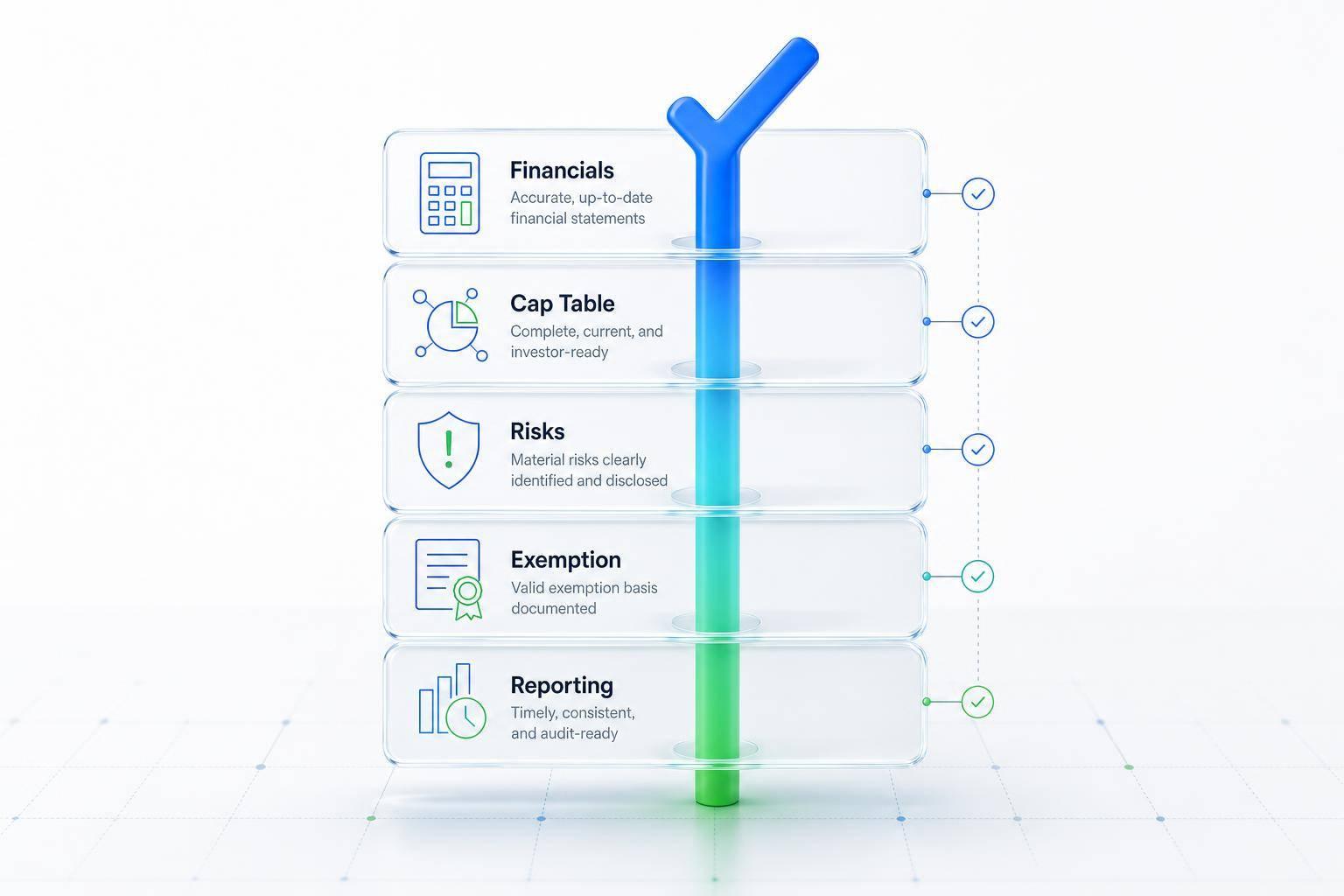
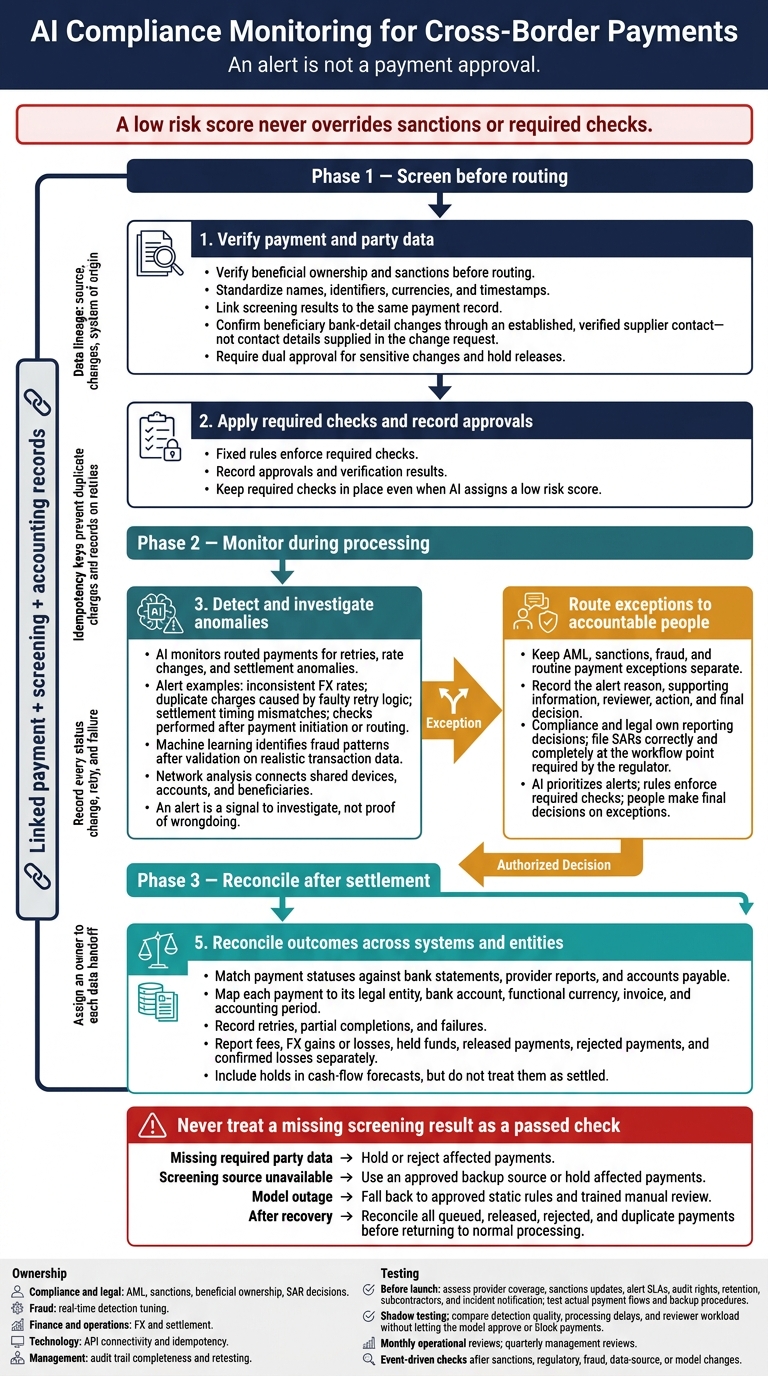
AI can flag risky cross-border payments - but an alert is not a payment approval. I recommend 3 checks: screen before routing, monitor during processing, and reconcile after settlement. Keep required checks in place, even when AI assigns a low risk score.
Here’s what I would put in place:
- Clear ownership: Name who reviews alerts, approves exceptions, and decides whether reporting is required. Your business and payment provider may have different duties.
- Linked records: Connect payment, screening, and accounting data so reviewers can trace decisions, retries, FX differences, and settlement errors across entities.
- Tested controls: Check provider coverage, model accuracy, sanctions updates, and backup procedures before launch - and after changes.
My rule: <u>never treat a missing screening result as a passed check</u>. If a system fails, use an approved backup or hold affected payments. AI supports the review; accountable people make the final call.
AI Compliance Monitoring for Cross-Border Payments
AI in Cross-Border Payments: Winning Customer Loyalty and Cutting Fraud [Webinar]
sbb-itb-17e8ec9
AI Detection of Suspicious Payments
After screening, AI monitors routed payments for retries, rate changes, and settlement anomalies. An alert points to something to investigate - not proof of wrongdoing. Unexpected activity could stem from fraud or a processing error. Duplicate retries, FX mismatches, and settlement timing errors call for different responses than unauthorized payments.
Payment Patterns That Trigger Alerts
Monitoring can flag inconsistent FX rates, duplicate charges caused by faulty retry logic, settlement timing mismatches, and checks performed after payment initiation or routing.
But these signals need context. AI and ML models should be validated on realistic transaction data, not just idealized test data. Otherwise, they may block legitimate activity or miss suspicious transactions.
Each payment alert should link to the relevant approval record and verification steps.
For a last-minute bank-detail change, verify the change through an established supplier contact - not the phone number or email supplied in the change request. Keep the verification result with the alert, and escalate unresolved discrepancies to the assigned approver.
Rules, Machine Learning, and Network Analysis
Each monitoring technique serves a different purpose. Fixed rules can enforce required checks. Machine learning can help identify fraud patterns after validation on realistic transaction data. Network analysis can connect shared devices, accounts, and beneficiaries to expose coordinated fraud.
When an alert occurs, reviewers need a complete event trail, including the data that triggered the alert. Audit trails should record every status change, retry, and failure so reviewers can distinguish fraud from processing errors.
Data and System Connections for Monitoring
AI alerts depend on payment, screening, and accounting records staying aligned across systems. Assign an owner to each data handoff across payment processing, screening, reporting, and accounting. Make clear who handles missing or conflicting data and delayed updates. Most data failures happen at system boundaries, so check that records arrive complete and on time - not just that each system is running.
Party and Payment Data
Keep payment and FX data consistent across layers. If one layer uses cached rates while another uses live feeds, reconciliation can fail. Standardize names, identifiers, currencies, and timestamps so reviewers can follow alerts across systems. Use ISO 20022 fields where supported to preserve payment data, and link screening results to the same payment record so reviewers can trace each decision.
Data Protection and Recordkeeping
Use data lineage to track each field’s source, changes, and system of origin. Use idempotency keys to prevent duplicate charges and records when a transaction retries. Check that logs, reporting feeds, and SAR outputs stay synchronized after retries or delayed updates, giving reviewers one reliable trail to verify, escalate, or report. Include monitoring logs and SAR workflows in continuous tests, then simulate delayed providers, out-of-sequence events, and volume surges.
Human Review and AI Oversight
Once alerts and audit trails are in place, name who can review, override, and report each exception.
Assign decision owners by control area. Compliance and legal handle AML, sanctions, beneficial ownership, and SAR decisions. Fraud tunes real-time detection, while finance and operations handle FX and settlement. Technology owns API connectivity and idempotency. Management reviews audit trail completeness and retesting.
Payment and Reporting Decisions
Put escalation paths and authorized review requirements in writing. Keep AML, sanctions, fraud, and routine payment exceptions separate so the right team reviews each issue. For a complete audit trail, record the alert reason, supporting information, reviewer, action, and final decision.
Send flagged payments to the named reviewer. Compliance and legal own reporting decisions. File SARs correctly and completely, at the point in the workflow required by the regulator.
Model Testing and Updates
Written policies should spell out approval authority, how overrides are documented, testing requirements, and review frequency. Test models before deployment and at regular intervals, including adversarial scenarios and failure simulations. Retest automated screening whenever regulatory frameworks or sanctions lists change.
Track overrides to distinguish isolated false positives from model drift.
AI, Manual Review, and Static Rules
AI prioritizes alerts, rules enforce required checks, and people make final decisions on exceptions.
Before go-live, test these handoffs, including backup procedures and entity-level coordination.
Checks Before Implementation
Before go-live, test whether the controls work under production conditions.
Review the provider’s controls before launch - not just its AI features. Ask for evidence of screening coverage, sanctions updates, alert SLAs, audit rights, retention, subcontractors, and incident notification. Map risks by corridor, currency, customer type, and entity. Use OFAC’s core program elements - management commitment, risk assessment, internal controls, testing, and training - to guide the review.
Once you understand the provider’s controls, test them on actual payment flows.
Testing and Backup Procedures
Build a control inventory that links each risk to a rule, data source, owner, escalation path, and required action. Check that payment data is complete, timely, and traceable. For supervised models, review past case labels: closed alerts can hide false negatives. Use shadow testing to compare detection quality, processing delays, and reviewer workload against existing controls without letting the model approve or block payments.
Run monthly operational reviews and quarterly management reviews. Also run event-driven checks after sanctions, regulatory, fraud, data-source, or model changes.
Write a separate backup procedure for each failure mode. Hold or reject payments that lack required party data. If a screening source is unavailable, use an approved backup source or hold affected payments. Never assume screening succeeded. During model outages, fall back to approved static rules and trained manual review. After recovery, reconcile all queued, released, rejected, and duplicate payments before returning to normal processing.
Then check that exception handling still reconciles correctly across entities and bank accounts.
Finance Coordination Across Entities
Map each payment to its legal entity, bank account, functional currency, invoice, and accounting period. Include holds in cash-flow forecasts, but do not treat them as settled.
Reconcile payment statuses against bank statements, provider reports, and accounts payable. Report fees, FX gains or losses, held funds, released payments, rejected payments, and confirmed losses separately.
Confirm beneficiary bank-detail changes through a verified contact channel. Require dual approval for sensitive changes and hold releases.
Key Takeaways
Monitoring works only when payment, screening, and ledger data stay aligned. Use sanctions screening, AI alerts, and human review before funds leave the account.
Alerts are signals, not proof. A low risk score never overrides sanctions or required checks.
Before routing a payment, verify beneficial ownership and sanctions. Record approvals and every payment outcome, including retries, partial completions, and failures. Reconcile payment status across entities, APIs, gateways, and banks so detection, review, and reconciliation stay aligned throughout the payment path.
FAQs
Which U.S. compliance rules apply to my cross-border payments?
U.S. cross-border payments require federal registration with FinCEN as a Money Services Business and state Money Transmitter Licenses. These requirements include capital reserves and surety bonds.
You must also comply with OFAC sanctions screening, FinCEN anti-money laundering and reporting rules, IRS tax reporting and FATCA, and FATF Travel Rule requirements.
Compliance systems - including AI tools - must provide audit trails, governance documentation, and explainable decisions.
How can I measure whether AI monitoring is effective?
Test controls continuously with scenario-based checks, rather than relying only on fixed thresholds. Run internal audits annually and external audits every two years to check that controls remain accurate after updates.
Track detection accuracy and false positive rates. Modern AI can reduce false positive rates by 60–80%. Keep a tamper-evident audit trail for every decision, recording timestamps, transaction amounts in USD, model versions, and the specific reasons for each alert.
How can I reduce false alerts without weakening compliance?
Replace rigid, rule-based systems with AI models that learn customer behavior. By setting a baseline for each customer, AI can separate routine activity from actual risk and reduce false positives.
Explainable AI tools, such as SHAP or LIME, help translate the reasons behind flagged transactions into plain language. This gives your team the clarity to fine-tune risk thresholds, maintain strong compliance, and cut repetitive, unnecessary alerts that add work to manual reviews.