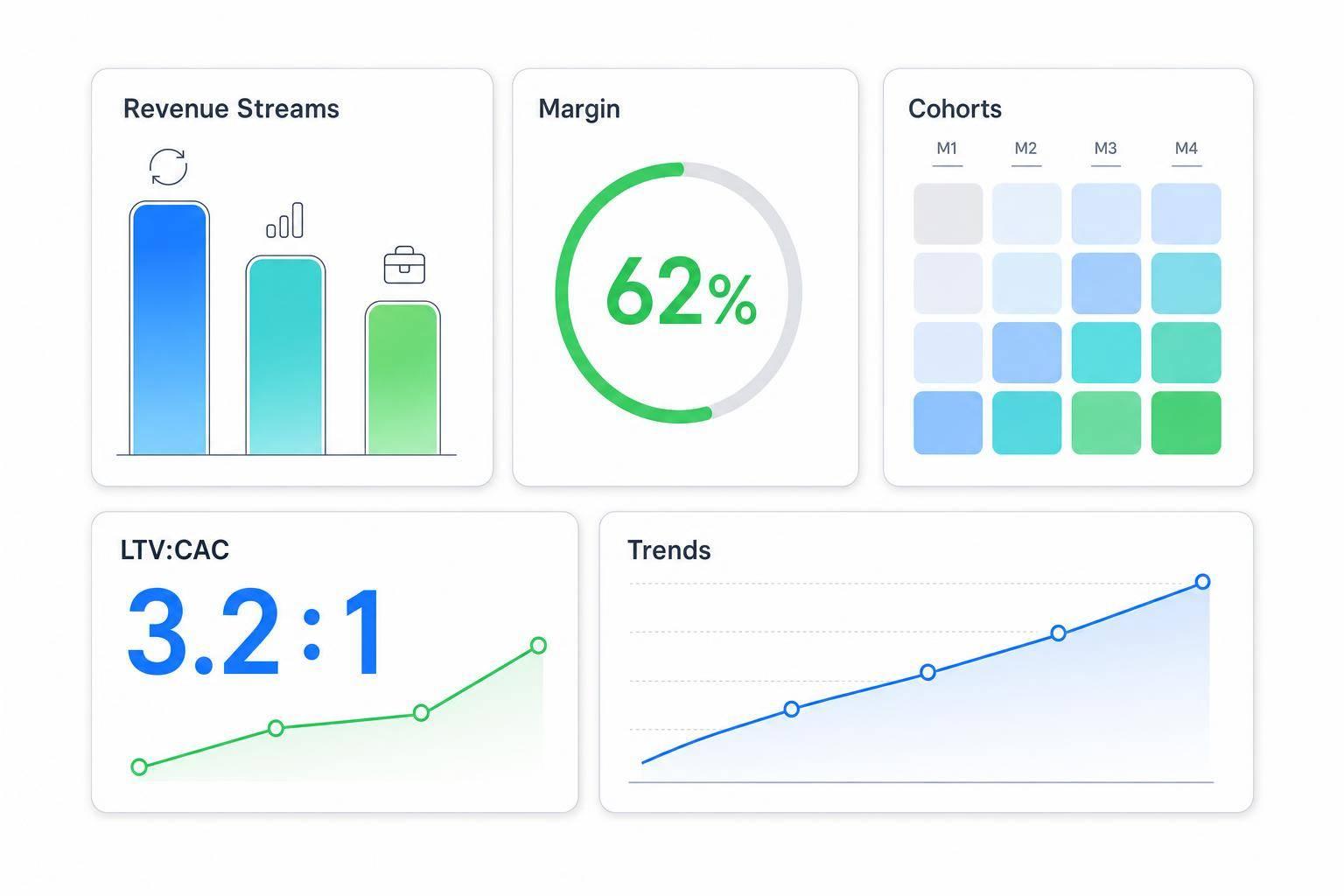
In 2026, SaaS startups face mounting challenges in tracking key metrics like ARR, MRR, and CAC. Investors demand accurate, real-time data, but fragmented systems, manual processes, and shifting definitions create delays and errors. AI tools now offer a solution by integrating data, automating calculations, and delivering instant insights. Here’s the key takeaway:
- Why It Matters: Investors rely on metrics like LTV/CAC, NRR, and CAC payback to assess growth potential. Inaccurate data undermines trust and funding opportunities.
- Core Challenges: Manual tracking struggles with data fragmentation, inconsistent definitions, and evolving product changes, leading to outdated or unreliable dashboards.
- AI’s Role: AI simplifies metric tracking, enabling real-time data integration, predictive analytics, and scenario modeling for better forecasting and decision-making.
- Emerging Trends: Usage-based pricing complicates ARR forecasting, while AI-driven automation shifts focus to new metrics like Annual Recurring Margin (ARM).
AI-powered platforms, like Lucid Financials, streamline financial management for SaaS startups by providing real-time insights, investor-ready reports, and forecasting tools - all at accessible rates.
Essential SaaS Metrics for a Series A Raise | SaaS Metrics School | Series A Fundraising
sbb-itb-17e8ec9
Common SaaS Metric Challenges for Startups
Startups often face tough metric challenges as they scale quickly and seek funding. The fast pace of growth, combined with evolving products, changing pricing models, and scattered data, can make it difficult to provide clear answers to investors. What looks like strong growth on the surface might conceal deeper issues, like retention problems. These challenges can lead to bigger headaches in forecasting, measurement, and understanding customer retention.
Forecasting Problems with Usage-Based Pricing
Usage-based pricing is throwing a wrench into traditional forecasting methods for ARR and MRR. When revenue depends on fluctuating consumption - like API calls, tokens, or tasks - it’s hard to rely on historical data for predictions. For instance, customer usage can swing dramatically based on project timelines or seasonal needs. This shift is even more pronounced with AI-driven tools, which reduce the need for human users, making per-seat pricing models less relevant.
Startups need advanced tools to keep up. AI-powered systems can analyze usage patterns in real time, spot trends across customer groups, and create forecasts that account for these shifts. Manual spreadsheets just can’t handle this level of complexity, especially at scale. On top of that, frequent product updates further muddy the waters when it comes to tracking customer acquisition metrics.
Inconsistent LTV/CAC Ratios from Frequent Product Changes
Constantly updating products might be great for innovation, but it can wreak havoc on LTV and CAC calculations. When customer behavior shifts due to new features or pricing changes, predicting lifetime value becomes tricky. For example, a feature that boosts retention today could lose its relevance in a few months, disrupting cohort analyses and making it hard to stick to standard benchmarks.
Changes to onboarding processes, trial periods, or pricing tiers can also skew acquisition costs. This leaves finance teams comparing apples to oranges when evaluating marketing performance or channel efficiency. Without AI tools that can adapt to these changes in real time, startups may find it difficult to present reliable unit economics to investors.
Gaps in Churn Analysis and Retention Tracking
Understanding churn is about more than just tracking when customers cancel. Metrics like GRR don’t always reveal early warning signs, such as customers using fewer features, requesting discounts, or needing more support - all of which can signal dissatisfaction.
Traditional engagement metrics like DAU and MAU are also becoming less useful. As AI agents take over tasks, human logins are no longer a reliable measure of engagement. If an AI agent is completing workflows, a drop in user logins doesn’t necessarily mean churn is happening. This shift creates blind spots in retention tracking. As Jake Saper, General Partner at Emergence Capital, notes:
"Pre-Claude, getting humans to do their jobs inside your software was a powerful moat, but if agents are doing the work, who cares about human workflow?"
Without real-time data integration and AI-driven churn analysis, startups risk missing early signs of trouble. This can lead to sudden revenue declines that catch both founders and investors off guard. To address these challenges, startups need AI tools that provide dynamic insights and help them stay ahead of potential issues. These tools are no longer optional - they’re essential for delivering the kind of clarity investors demand.
How AI Solves SaaS Metric Problems
AI tools are reshaping how SaaS companies handle metrics by replacing static spreadsheets with systems that integrate data, analyze patterns in real time, and offer actionable insights. This shift is especially important as traditional metrics like Annual Recurring Revenue (ARR) lose relevance for AI-driven businesses. The focus is now shifting to Annual Recurring Margin (ARM), which factors in variable costs like compute and token usage that directly affect profitability. These advancements come through real-time data integration, enhanced forecasting, and scenario modeling to address growth uncertainties.
Real-Time Data Integration
AI brings together financial data from billing platforms, CRMs, and usage systems, creating a real-time view of critical metrics. This eliminates the need for manual tasks like exporting CSVs, fixing data inconsistencies, or manually updating dashboards. For SaaS companies relying on usage-based pricing models, real-time integration is a game-changer. When revenue depends on API calls or token consumption, waiting until the end of the month to analyze performance could mean missed chances to tweak pricing, address customer risks, or capitalize on growth opportunities.
Additionally, having instant access to metrics like Net Revenue Retention (NRR), customer cohort performance, and margin trends allows finance teams to respond quickly to investor questions, prepare for board meetings, and navigate fundraising discussions.
Predictive Analytics for Revenue and Retention
With real-time data in hand, AI takes forecasting to the next level. Predictive analytics is transforming how SaaS companies forecast revenue and retention. Unlike traditional models that assumed low marginal costs, AI-driven products often bring variable costs tied to compute and inference. Mark Stiving, CEO of Impact Pricing, captures this shift perfectly:
"ARR treats them [customers] as identical. Your contribution margin does not."
AI helps predict churn and evaluates revenue stability by analyzing whether software serves as a reliable system of record. This is crucial for tackling retention challenges in an evolving landscape. For instance, in early 2026, companies like Genesys and Cresta showcased how AI-driven automation could manage more customer interactions, weakening the traditional link between headcount and revenue. This has led to the development of new metrics that can forecast revenue without relying on headcount as a primary factor.
Scenario Modeling for Growth Planning
Beyond analytics and forecasting, AI-driven scenario modeling equips startups to manage uncertainties in growth. This capability allows companies to simulate various scenarios - like the impact of doubling usage or transitioning from seat-based to consumption pricing - turning unknowns into measurable insights.
Structured AI risk assessments are also becoming essential for lenders, helping them gauge the reliability of future cash flows. Instead of asking broad questions like "Is AI risk high?" the focus shifts to evaluating how well an asset is positioned for long-term growth. For example, an analysis of the SaaS Capital Index in February 2026 found a strong link between high AI-readiness ratings and higher ARR valuation multiples. Founders are advised to emphasize Annual Recurring Margin (ARM) to ensure growth covers fixed costs in an AI-intensive market. Scenario modeling also helps test whether new product strategies can mitigate risks tied to AI-driven changes.
Lucid Financials: AI-Powered Financial Management for SaaS Companies

Lucid Financials addresses the growing challenges of manual metric tracking and the shifting landscape of SaaS businesses. By 2026, investors and auditors expect immediate access to critical data like customer engagement, profit margins, and cash flow. Meeting these expectations requires a financial system that delivers precise, real-time insights without overburdening already stretched teams. Lucid Financials combines AI-driven automation with expert oversight, designed specifically for startups navigating these evolving demands.
Slack-Based AI Support for Quick Metric Insights
The rise of autonomous AI workflows is transforming how founders interact with their financial data. With Lucid Financials, founders can simply ask questions in Slack to receive instant, AI-generated insights on metrics like Net Revenue Retention - even during live meetings. For situations that need a human touch, Lucid’s finance experts are accessible through the same Slack channel, ensuring seamless support for more nuanced scenarios.
Investor-Ready Reporting in Just 7 Days
Lucid’s AI simplifies transaction matching and reconciliation, providing clean, board-ready financials within seven days. This is a game-changer for startups, especially when due diligence or board meetings require up-to-date reports. The platform produces investor-grade forecasts and reports with a single click, ensuring that financial data is always ready when it’s needed. To guarantee accuracy and compliance, every AI-generated report is reviewed by Lucid's expert finance team. This efficient process paves the way for more advanced financial planning.
CFO-Level Forecasting Designed for SaaS Growth
Lucid Financials goes beyond reporting with tools that enable proactive financial planning. The platform offers AI-generated forecasts, hiring plans, and what-if scenario modeling tailored to the growth needs of SaaS companies. Founders can explore the financial impact of pricing changes, usage shifts, or runway adjustments in real time. This empowers finance teams to confidently address investor concerns and strategize for growth. With pricing starting at $150 per month, Lucid provides transparent, startup-friendly rates - no hidden costs or hourly fees - making it an ideal partner for companies scaling from pre-seed to Series C.
Conclusion: Using AI for Better SaaS Metrics
AI-Powered SaaS Metrics: Performance Impact Statistics
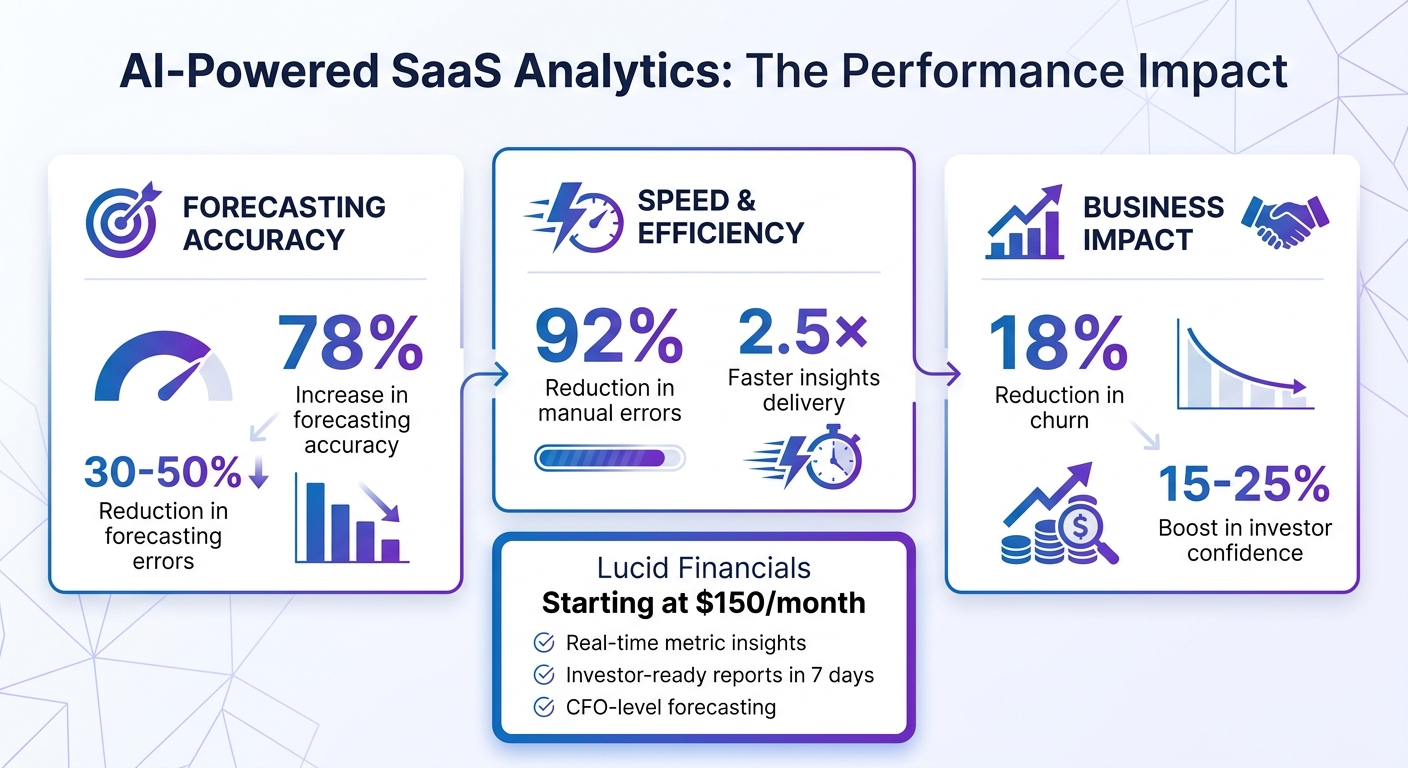
Modern SaaS businesses simply can't rely on manual tracking anymore. AI tools are changing the game by slashing forecasting errors by 30–50% and reducing churn by 18% - delivering the accuracy that investors demand. Imagine having real-time access to metrics like Net Revenue Retention or CAC payback periods, not in days but in seconds. This kind of instant insight allows founders to make faster, smarter decisions that fuel growth and improve funding opportunities.
The numbers back it up: AI-powered SaaS analytics increase forecasting accuracy by 78%, deliver insights 2.5× faster, cut manual errors by 92%, and boost investor confidence by 15–25%. These benefits highlight why AI solutions are essential to tackling today’s SaaS challenges.
Lucid Financials steps in as a comprehensive solution for startups at any stage. It effortlessly manages complex needs like usage-based pricing, multi-entity structures, and frequent product changes, all while generating investor-ready reports. With a straightforward pricing model starting at $150 per month and no hidden fees, founders gain access to CFO-level insights without the hefty price tag.
The transition from spreadsheets to AI isn't just a choice - it's a necessity for scaling SaaS companies efficiently. Finance expert David Sacks from Craft Ventures sums it up perfectly:
"AI turns noisy SaaS data into investor magnet - precise, predictive metrics secure investor confidence".
This shift transforms financial reporting from a tedious task into a strategic asset. When your financial data is accurate, up-to-date, and powered by predictive models, you're not just presenting numbers - you’re demonstrating a level of operational maturity that can seal the deal in funding rounds.
For SaaS founders in 2026, adopting AI-powered tools like Lucid Financials isn’t just about keeping up - it’s about turning financial data into a powerful engine for growth.
FAQs
How do I forecast ARR with usage-based pricing?
To predict ARR (Annual Recurring Revenue) in a usage-based pricing model, AI-driven tools are your best bet. These models analyze historical usage data and customer behavior to provide more precise forecasts. By simulating scenarios based on usage patterns, churn rates, and expansion revenue, AI can help you make more informed predictions.
Here’s how to get started: Gather 12 months of clean usage data from your billing systems. This data is the foundation for AI models to identify trends and calculate revenue projections. These tools take into account factors like churn, seasonal fluctuations, and growth opportunities. Regularly updating your data ensures the forecasts stay accurate and aligned with any changes, helping you make smarter business decisions.
What is Annual Recurring Margin (ARM) and why does it matter?
Annual Recurring Margin (ARM) is a key metric for evaluating the profitability of recurring revenue streams in SaaS companies. It essentially measures how effectively a business turns its recurring revenue into profit. For investors, ARM is particularly important because it offers insight into the long-term sustainability and profitability of a SaaS company's revenue model.
How can AI spot churn risk before customers cancel?
AI helps identify customers at risk of churning by examining patterns in their behavior and engagement. For instance, it looks at signs like declining usage, lower interaction levels, frequent support tickets, or missed payments. Using advanced models, it flags these early warning signs of dissatisfaction or withdrawal, giving businesses the chance to step in before it's too late. Predictive analytics also play a big role, estimating the likelihood of churn based on historical data. This allows SaaS companies to take timely action, keeping customers on board and protecting their revenue streams.