AI revenue forecasting is transforming how SaaS startups predict their financial future. Here’s why it matters:
- Manual spreadsheets are outdated. They’re prone to errors, rely on static assumptions, and can’t handle complex variables like churn or seasonal trends.
- AI improves accuracy by 20–40%. Early-stage startups often see 70–80% accuracy, while growth-stage businesses achieve 85–95%.
- It’s data-driven and dynamic. AI uses historical data to simulate scenarios, spot trends, and deliver real-time updates that adapt as new data comes in.
To get started, you’ll need 12 months of clean, standardized data. AI tools like Lucid Financials simplify this process by integrating with billing systems, CRMs, and product analytics. With AI, SaaS startups can make smarter decisions about hiring, funding, and marketing while avoiding costly forecasting mistakes.
Key Metrics AI Uses:
- MRR & ARR: Track recurring revenue monthly and annually for short- and long-term insights.
- Churn Rate: Predict cancellations and revenue loss using cohort analysis.
- Expansion Revenue & CAC: Identify upsell opportunities and manage customer acquisition costs.
Forecasting Models:
- Time-Series: Best for steady, seasonal trends.
- Machine Learning: Handles multiple variables and real-time changes.
- Pipeline-Based: Focuses on sales-led teams and active opportunities.
Clean data, scenario planning, and regular updates ensure reliable forecasts. AI tools like Lucid Financials combine speed and precision, making it easier to plan for growth and manage risks effectively.
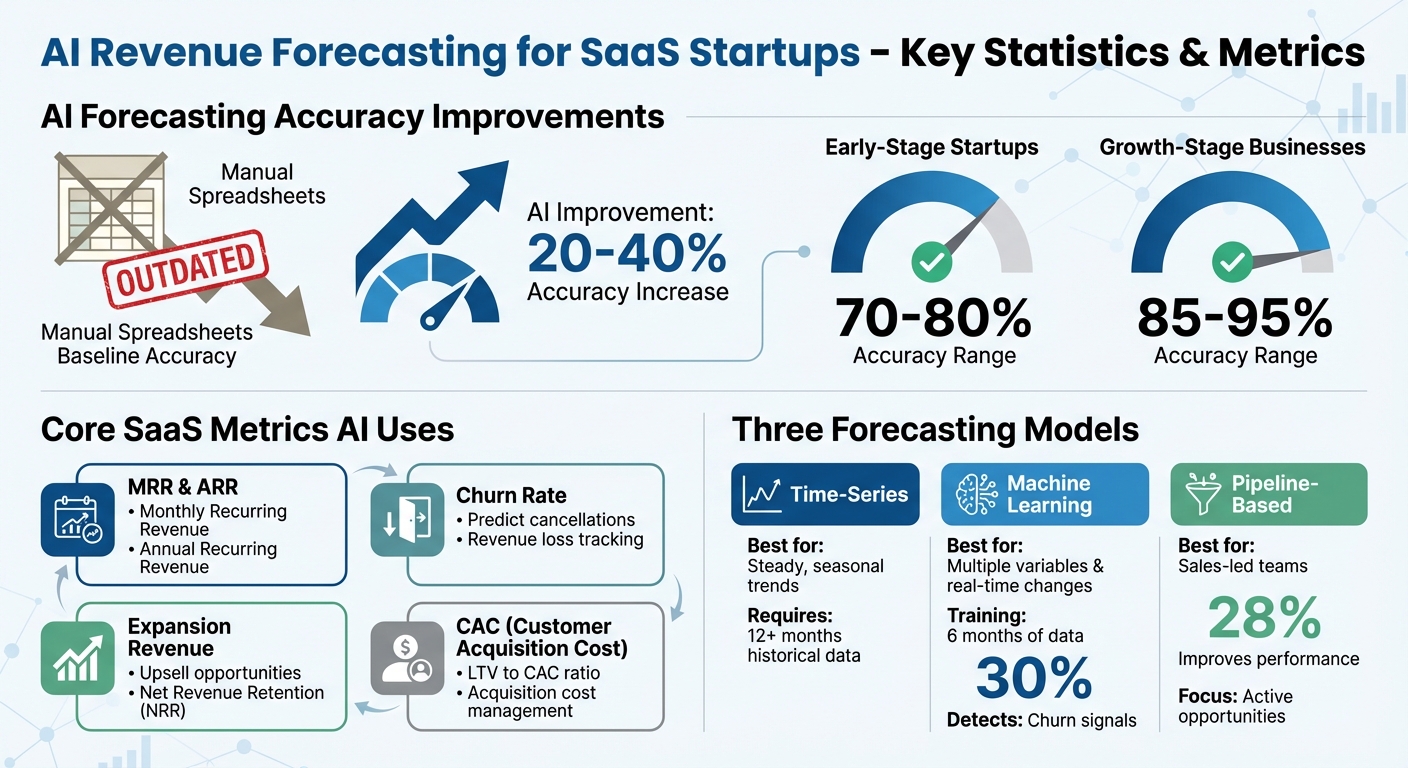
AI Revenue Forecasting Accuracy and Key SaaS Metrics for Startups
How I Forecast SaaS Revenue (My Exact Model & Process After 1,000+ Forecasts) | The SaaS CFO
sbb-itb-17e8ec9
Core SaaS Metrics AI Uses for Revenue Forecasting
AI-driven forecasting models depend on specific financial metrics to make precise revenue predictions. For SaaS startups, these metrics shed light on how revenue is generated, where it might slip away, and what fuels growth within the customer base. Knowing which metrics matter - and how AI interprets them - is essential for creating forecasts that guide strategic decisions. This understanding forms the backbone of the forecasting models SaaS companies rely on.
Monthly Recurring Revenue (MRR) and Annual Recurring Revenue (ARR)
MRR is the cornerstone of any SaaS forecast. It’s calculated by multiplying the number of active customers by the average revenue per customer each month. AI models use an "MRR buildup" process to predict growth. This involves starting with the current MRR, adding new subscriptions, subtracting churn, and factoring in upsells (expansion) and downgrades (contraction). This method gives a clear picture of both revenue gains and losses.
ARR, on the other hand, takes a broader view by projecting growth over a 12-month period. It’s a key metric for board-level reporting and helps AI models identify trends and seasonal variations that might go unnoticed in monthly snapshots. Together, MRR and ARR create a comprehensive framework for forecasting revenue, balancing short-term momentum with long-term patterns.
Churn Rate and Customer Retention
Churn, the percentage of revenue lost due to cancellations or downgrades, adds complexity to revenue forecasting. Its effects can snowball - losing 5% of MRR in one month means starting the next month with a smaller base. AI models use cohort analysis to track retention trends by customer signup date, which can reveal patterns like whether certain cohorts are more likely to stick around.
Churn is often unpredictable, driven by factors like budget cuts, seasonal demand shifts, or unexpected product issues. AI helps by spotting early warning signs, such as reduced product usage, that could signal upcoming cancellations. This allows businesses to adjust forecasts and take preventative measures.
Expansion Revenue and Customer Acquisition Costs (CAC)
Expansion revenue - generated from upsells, cross-sells, or higher usage within the existing customer base - plays a key role in Net Revenue Retention (NRR). When NRR exceeds 100%, it means the company is growing without needing to acquire new customers. AI analyzes expansion trends to pinpoint which customer segments are most likely to upgrade, providing actionable insights for growth strategies.
Customer Acquisition Costs (CAC) also influence forecasting, even if they don’t directly appear in revenue models. The ratio of Customer Lifetime Value (LTV) to CAC is a critical factor. As Stripe explains, "If your LTV far exceeds your CAC, it might be reasonable to model faster expansion. If it doesn't, your forecast probably needs to pace itself". AI uses this ratio to simulate different scenarios, such as how rising acquisition costs or slower upselling could impact cash flow.
For accurate forecasts, integrating data from billing systems, CRM platforms, and product analytics is crucial. Disconnected data can lead to incorrect assumptions or duplicate revenue entries, which can derail your entire forecast. These metrics set the stage for the forecasting models discussed next.
AI Forecasting Models for SaaS Startups
Once you’ve pinpointed the metrics that drive your revenue, the next step is selecting the right forecasting model. The choice of model depends on factors like your revenue streams, sales process, and growth stage. Many high-growth SaaS companies use a mix of models to account for the unique behaviors of their different revenue streams.
Each revenue stream - whether it’s new customer acquisition, renewals, or expansion - follows its own patterns. Using a one-size-fits-all model can lead to blind spots and inaccuracies. By combining models, you can create a more complete and reliable revenue forecast.
Time-Series Forecasting for Seasonal Trends
Time-series models analyze at least 12 months of historical MRR data to detect recurring patterns. This makes them ideal for identifying predictable seasonal trends - like Q4 spikes in enterprise deals or slower summer months in certain industries. The model uses monthly multipliers to project these patterns into the future, helping SaaS startups plan around predictable revenue cycles.
This method is especially effective for mature SaaS businesses with steady recurring revenue, such as renewals. If your revenue shows consistent year-over-year patterns, time-series forecasting can provide highly accurate predictions. However, it has its limitations - it doesn’t account for real-time financial insights or rapid growth, which can make it less suitable for fast-scaling startups.
Machine Learning for Multi-Factor Predictions
Machine learning models take forecasting a step further by analyzing multiple variables simultaneously, including customer product usage, buyer intent signals, stakeholder involvement, email sentiment, and even macroeconomic trends. Unlike static models, ML dynamically updates predictions based on real-time data, such as activity levels or missing next steps.
These models require about six months of training on your specific data to perform at their best. They excel at uncovering insights that manual forecasting often misses. For example, 30% of churn signals can be detected through subtle usage drop-offs that traditional methods might overlook. However, ML models come with added complexity - they need robust data systems and integrations across CRM, billing, and product analytics tools. They’re particularly valuable for adapting to fast-changing market conditions and work well alongside time-series models.
"One pattern we consistently observe at Forecastio is that many SaaS companies combine renewals, expansions, and new business into a single pipeline. This creates a distorted picture of performance and significantly reduces forecast accuracy." – Alex Zlotko, CEO, Forecastio
Pipeline-Based Forecasting for Sales-Led Teams
Pipeline-based models focus on active opportunities in your CRM, relying on data like deal stage, historical win rates, and sales cycle length to predict future revenue. AI-enhanced versions go further, factoring in "soft" signals such as deal age, stakeholder involvement, and whether next steps are clearly defined. This approach gives you a real-time snapshot of which deals are most likely to close.
This model works best for sales-led teams where new business is driven by structured sales processes. Organized pipeline management can improve performance by 28%. However, it’s not without challenges. Human bias - like sales reps inflating probabilities based on optimism - can skew results. AI mitigates this by prioritizing objective activity data over subjective input.
To maximize accuracy, separate pipelines for renewals, expansions, and new business are crucial. Each type of revenue behaves differently, and mixing them can distort performance metrics. Additionally, keep your pipeline clean - remove deals that have lingered longer than your typical sales cycle to avoid skewing the data. Regular maintenance helps ensure your forecasts stay reliable.
How to Build AI Revenue Forecasts: Step-by-Step
Creating an AI-driven revenue forecast requires a structured approach that aligns with your business objectives. Here's how to do it.
Define Your Forecasting Horizon
Once you’ve set up your AI models, the next step is to determine the right forecasting horizon. This should align with your business’s decision-making cycles and current growth phase. For example:
- Early-stage startups often stick to 1–3 month horizons to closely monitor cash flow and churn.
- Growth-stage companies typically extend their focus to 3–6 months, balancing pipeline management with expansion revenue.
- Mature startups may look at 6–12 month forecasts, especially for strategic planning like setting annual ARR goals .
Quarterly horizons work well for board meetings and investor updates, as they naturally align with reporting schedules. The key is to ensure your timeline is SMART - Specific, Measurable, Achievable, Relevant, and Time-bound . For example, if you’re preparing for a funding round, a 3–6 month horizon offers actionable insights while avoiding the uncertainty of long-term projections. Monthly forecasts are ideal for operational tasks like cash flow management, while quarterly ones are better suited for strategic budgeting and investor presentations. These timelines also allow you to incorporate critical SaaS metrics like MRR and churn into your forecasts.
Prepare Clean and Accurate Data
Accurate data is the backbone of reliable forecasts. Poor data quality can inflate forecast variance by as much as 30% . Start by pulling data from your CRM, billing systems, and usage logs. Then, clean your data by:
- Removing duplicates
- Addressing missing values
- Normalizing formats, such as converting all figures to US dollars ($1,234.56) and dates to MM/DD/YYYY
Validate this data by cross-checking it against source systems. For example, compare your ARR figures with invoices to ensure consistency. Enhance your dataset by incorporating external factors like seasonal trends, and store everything in a centralized location - tools like Google Sheets or Notion work well. Standardized checklists can cut preparation time by up to 50% .
Platforms like Lucid Financials can streamline this process, delivering clean financial data within a week. Once your data is ready, test your assumptions by running multiple scenarios.
Run Scenarios and Assign Ownership
Scenario planning helps you test the reliability of your forecast. Start with a baseline scenario using realistic inputs, such as 5% churn and 10% MRR growth. Then, build alternative scenarios:
- Optimistic: 3% churn, 20% growth
- Conservative: 8% churn, 5% growth
AI tools can run Monte Carlo simulations across thousands of iterations, offering insights into potential revenue ranges. For instance, a baseline Q3 MRR forecast might be $500,000, while an optimistic scenario could reach $650,000 .
To keep everything on track, assign clear responsibilities using the RACI framework. For example:
- Finance handles MRR data
- Sales manages pipeline inputs
- Product oversees churn and expansion metrics
Document these roles in shared tools like Asana or Notion, and schedule weekly check-ins to review progress. Assigning accountability, such as having your CRO approve the baseline scenario, ensures alignment and reduces gaps in responsibility .
Using AI for Seasonal Revenue Optimization
Seasonal fluctuations can pose significant challenges for SaaS startups, but AI offers a way to predict and manage these shifts effectively. By analyzing both historical data and real-time customer behavior, AI can turn seasonal volatility into an advantage. This approach helps uncover distinct patterns in seasonal revenue, enabling smarter decision-making.
Identifying Recurring Seasonal Patterns
AI models excel at analyzing historical account metrics like Monthly Recurring Revenue (MRR), churn rates, and usage trends to spot recurring seasonal patterns. For SaaS businesses with shorter sales cycles, time-series analysis highlights when customers are more likely to upgrade, downgrade, or churn.
In usage-based models, AI tracks behavior metrics such as API calls, seat counts, or data consumption to predict revenue shifts tied to seasonal usage. Cohort-based forecasting takes this a step further by grouping customers based on factors like signup month or industry, offering insights into how different segments behave during specific seasons. Additionally, AI-driven anomaly detection monitors transactions in real time, flagging unusual spikes or dips that may indicate seasonal changes.
A great example comes from Monte Carlo, which in 2025 shifted to daily revenue tracking and adjusted its go-to-market strategy based on real-time customer behavior. This move made daily revenue a key boardroom metric.
To achieve similar results, consider integrating tools like Stripe, Salesforce, or Segment into a unified data warehouse. This setup allows you to monitor seasonal revenue trends as they happen. For startups with highly variable revenue patterns, switching from monthly to daily tracking can capture real-time fluctuations more effectively. Running sensitivity checks using AI - such as calculating the potential Annual Recurring Revenue (ARR) loss from a 1% rise in seasonal churn - and comparing these projections to actual results monthly can refine your strategies further. These insights enable you to adjust dynamically when market conditions shift.
Adjusting Assumptions for Market Shifts
AI can also update revenue forecasts in real time, allowing you to model best-case, worst-case, and actual scenarios. By building on earlier AI-driven forecasts, real-time updates ensure your predictions stay accurate even during market volatility. Integrating real-time data into your forecasting models ensures they reflect your most current financial position, enabling immediate responses to shifting seasonal trends.
Lucid Financials is a tool that allows startups to run multi-scenario models and compare different growth trajectories instantly.
"Just want to say props to the whole Lucid team. We pulled up the Lucid platform in a meeting with a VC and they were extremely impressed. His jaw just about dropped when he saw October was even up to date." – Giorgio Riccio, Founder of Lumino Technologies
AI can also benchmark your performance against industry standards, helping you identify whether a revenue dip is specific to your company or part of a broader market trend. Monitoring your runway in real time ensures you can track burn rates and adjust spending quickly if seasonal revenue falls short of projections. Regularly updating your bookkeeping - whether monthly or weekly - ensures AI-driven forecasts are based on the most up-to-date data.
Maintaining Accuracy and Adapting to Change
AI revenue forecasting thrives on adaptability. For SaaS startups, keeping forecasts accurate means constantly updating models to reflect shifting market conditions and business dynamics. At the same time, leaving room for human judgment ensures that unexpected changes don’t derail financial decision-making.
Continuous Model Refinement
AI models get better by learning from their mistakes. By regularly comparing forecasted Monthly Recurring Revenue (MRR) with actual results, you can identify when your model needs an update. For example, if the variance exceeds 10%, it’s time to retrain the system. This process helps the AI adapt to new patterns, like evolving customer behavior or seasonal trends that older data might not account for.
Take Zuora as an example. In Q1 2024, they experienced a 12% variance in their forecasts due to unexpected seasonal churn. To address this, their VP of Finance, Alex Hamilton, initiated weekly variance reviews and retrained their XGBoost model using data from over 50,000 subscriptions. The result? Forecast error dropped to 4.2%, unlocking $15 million in optimized cash flow and boosting ARR forecast precision to 96%.
Automated alerts can also play a big role. Set up notifications for key metric shifts - like churn spikes over 20% or sudden increases in Customer Acquisition Cost (CAC) - to prompt immediate model updates. Many SaaS companies report that retraining models every one to three months delivers the best results, with 85% seeing improved accuracy with this approach.
While these refinements help capture evolving trends, some situations call for human oversight.
Manual Adjustments for Strategic Decisions
AI forecasts can struggle with major disruptions - think product launches, pricing shifts, economic downturns, or unexpected competition. These events often lack the historical data AI models rely on, making human intervention essential.
For instance, during the 2023 economic downturn, HubSpot had to manually adjust its AI pipeline forecasts by 22% across 120,000 customers. Rising customer acquisition costs caught their system off guard. CFO Sonia Cunha led the team in running scenario models that incorporated GDP signals and potential layoffs. These manual tweaks helped the company avoid $8.7 million in overcommitments and increased retention by 14%.
To manage these moments effectively, establish clear guidelines for when to override AI models. Assign your CFO or finance lead the authority to make such adjustments and document the rationale behind each decision. For example, when Snowflake launched a new AI product in H2 2024, their initial forecast missed the mark by 18%. Data Science Lead Maria Gonzalez stepped in, refining the model by analyzing 10TB of usage data and implementing anomaly detection for market changes. These updates reduced the forecast error to 3.1%, leading to $45 million in additional pipeline conversion.
Platforms like Lucid Financials combine AI-driven forecasting with human expertise to help startups navigate these unpredictable moments. Lucid generates multiple scenarios - best-case, worst-case, and actual - allowing businesses to weigh different growth paths and make smarter adjustments when conditions shift.
"Lucid's CFO services give us the visibility we need, while their bookkeeping and tax support keep everything accurate and stress-free." – Luka Mutinda, Founder and CEO @Dukapaq
Conclusion
AI-powered revenue forecasting is reshaping financial management for SaaS startups. By tapping into key metrics like MRR, ARR, churn rate, and CAC, AI models deliver forecasts that are 25–35% more accurate than traditional methods. This level of precision empowers smarter decision-making, whether it’s about managing cash flow, planning new hires, or preparing for investor pitches.
To make the most of these tools, it’s essential to define your forecasting horizon, ensure your data is clean, and run multiple scenarios to account for market fluctuations. Techniques like time-series forecasting for seasonal trends and machine learning for complex, multi-factor predictions are especially effective for scaling SaaS businesses. Startups that adopt these approaches have reported impressive results, including an 18% boost in sales close rates, a 40% improvement in churn prediction accuracy, and savings of over $2 million in ARR through AI-driven expansion strategies.
However, even with advanced technology, precision requires continuous refinement. Regularly updating models and incorporating strategic manual adjustments are critical. Research shows that 70% of decisions can be guided by AI, with the remaining 30% benefiting from human expertise.
Lucid Financials takes this approach to the next level. The platform combines cutting-edge AI tools with expert guidance to maintain consistent forecasting accuracy. With features like forecasting that's 100× faster than traditional methods, real-time Slack updates, and CFO-level insights, Lucid turns forecasts into actionable strategies. From balancing the books in just seven days to producing investor-ready reports on demand, Lucid simplifies financial management so founders can focus on scaling their business.
"Lucid's CFO services give us the visibility we need, while their bookkeeping and tax support keep everything accurate and stress-free. It's been a game-changer for our operations."
– Luka Mutinda, Founder and CEO, Dukapaq
With AI-driven precision, every decision becomes sharper and more strategic. Clean up your data, model seasonal trends, and let AI help uncover your next $500K+ revenue opportunity. Starting at just $150/month, Lucid Financials makes it easier than ever to leave guesswork behind and embrace data-driven growth.
FAQs
What data do I need before using AI revenue forecasting?
Before diving into AI revenue forecasting, make sure you’ve collected your historical sales data along with essential metrics like monthly recurring revenue (MRR), churn rate, customer acquisition cost (CAC), average sales cycle, and seasonality patterns. These details are crucial for generating precise predictions and gaining clearer financial insights.
Which forecasting model fits my SaaS (time-series, ML, or pipeline)?
The right forecasting model for your SaaS business hinges on your specific data and objectives. Time-series models are a solid choice if you have a wealth of historical sales or usage data, as they excel at spotting patterns and trends over time. On the other hand, machine learning (ML) models are better suited for handling complex variables like churn rates and renewals, offering more dynamic and adaptable forecasts. For an even more streamlined approach, a pipeline system can automate tasks like data collection, cleaning, and modeling. When combined with AI-driven techniques like predictive analytics, this can significantly boost forecasting precision.
How often should I retrain or override an AI forecast?
AI forecasts need regular updates or retraining - ideally every month. Why? Because fresh data keeps them relevant, adjusts for seasonal trends, and ensures accuracy, particularly in industries that evolve quickly. Consistent updates sharpen predictions and lead to smarter financial decisions.