If you want the short answer: GPT-4 helps most before a credit decision, not as the credit decision. Research in 2025 and 2026 points to a simple setup: use GPT-4 to read PDFs, pull fields from statements and disclosures, and draft analyst notes. Then let a separate scoring model handle the final risk call.
Here’s the core takeaway in plain English:
- GPT-4 is strongest with messy text like audit reports, bank statements, loan narratives, and disclosures.
- Standard tabular models still lead on final scoring, with results like 92.5% accuracy for XGBoost and 94.1% for a hybrid LSTM + XGBoost setup.
- The safer setup for U.S. lenders and startups is: LLM for extraction and summaries, rules or ML model for the score.
- Source traceability matters. If a model flags a risk item, teams need to tie that output back to a line in the source file.
- Clean books come first. If the records are messy, the output will be messy too.
If I were putting this into one sentence, it would be this: GPT-4 can help analysts move faster, but it should not be the final judge of borrower risk.
GPT-4 can do Financial Statement Analysis!!!
sbb-itb-17e8ec9
Quick comparison
| Area | Where GPT-4 fits | Where other models fit |
|---|---|---|
| Document review | Pull fields from PDFs and text | N/A |
| Analyst support | Draft summaries and memos | N/A |
| Final credit score | Limited fit | Best handled by tabular ML or rules |
| Explainability | Harder to check on its own | Easier with SHAP, LIME, and rule logs |
| Data need | Works on unstructured text | Works best on clean structured data |
For startups in the U.S., the near-term play is pretty simple: start with intake, document summaries, and analyst prep - not automated approval or denial.
Where GPT-4 Is Being Applied in Credit Risk Research
Recent studies point to three main uses for GPT-4 in credit risk research: document extraction, analyst report drafting, and prompt-based risk classification. The big thing to note is where these tools fit. They tend to work best before underwriting decisions, not inside the final scoring model.
Predicting Default From Financial Disclosures and Loan Narratives
The clearest use case is document parsing. LLMs such as GPT-4o-mini and Claude Sonnet 4 are being used to pull structured financial fields from PDFs, including DSCR, ICR, and auditor qualifications, from documents like bank statements, audit reports, and balance sheets.
A January 2025 project, LLendify, analyzed bank statement PDFs to flag income patterns and spending habits, then generated instant eligibility reports. For startups, that can mean a much faster review of bank statements, disclosures, and lender memos.
That same pattern shows up in memo drafting too. GPT-4 can take extracted fields and turn them into analyst-ready narratives, which saves time and gives teams a cleaner starting point.
Drafting Credit Risk Reports and Supporting Analysts
Beyond extraction, GPT-4 and Claude are also being used to generate credit narratives and help human analysts. The March 2026 Intelli-Credit engine uses Claude Sonnet 4 to turn 22 extracted fields into a 10-section Credit Appraisal Memorandum, with each claim tied to a source quote. That setup helps with auditability because it keeps scoring separate from text generation.
Classifying Borrower Risk From Structured Data Using Prompts
Some projects also test whether LLMs can read structured records through prompts and help with risk categorization. In January 2026, Abdullah Badrudeen's Credit-Worthiness-Application used GPT-4o-mini to extract data from bank statements and generate personalized feedback for loan officers, while the actual 0–100 credit score and Low/Medium/High risk classification came from a separate Scikit-learn model. In that workflow, GPT-4o-mini handles explanation and feedback, while the scoring model still handles the credit decision.
So in practice, GPT-4 tends to add the most value in extraction and explanation. That leads straight to the next issue: where GPT-4 helps, and where conventional models still do a better job.
What the Research Finds: Benefits, Limits, and Trade-Offs
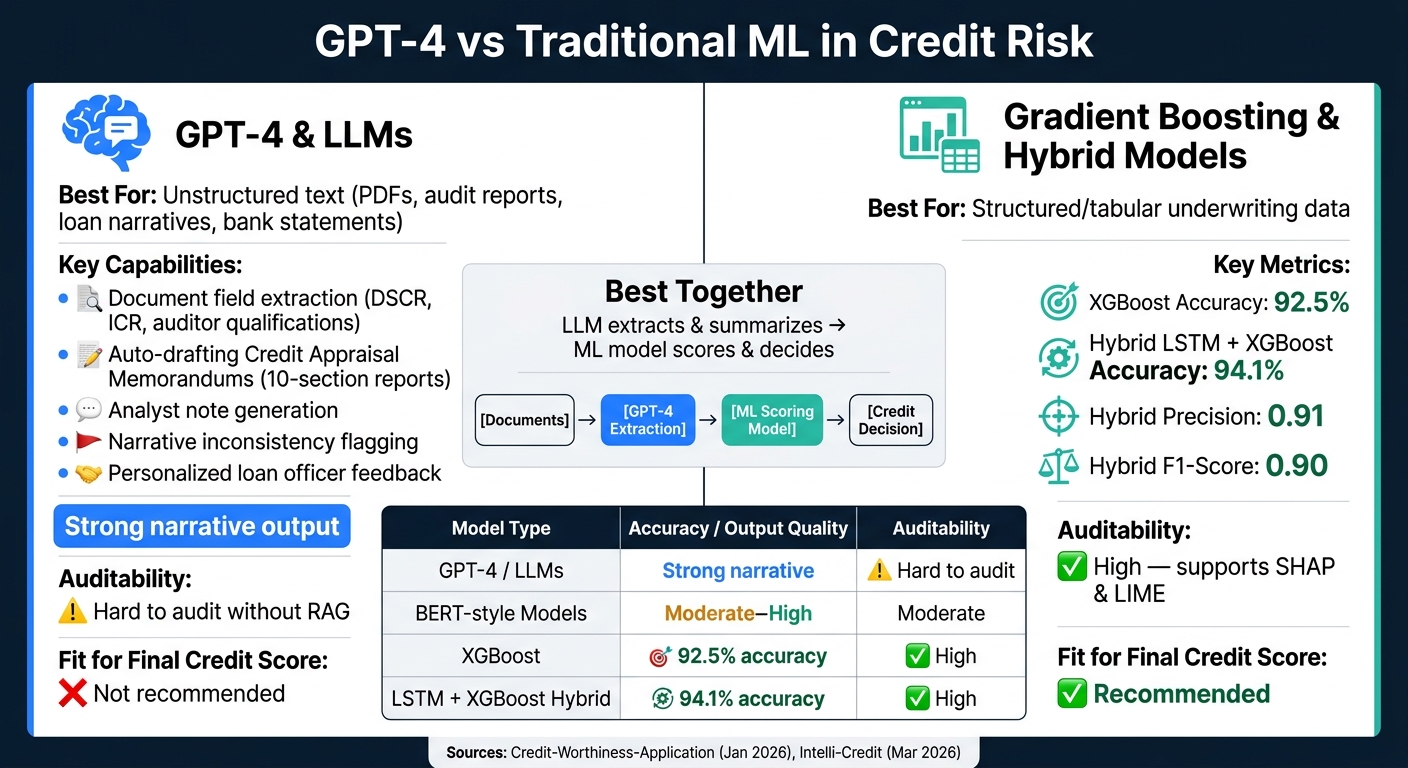
GPT-4 vs Traditional ML Models in Credit Risk: Key Metrics & Use Cases
Where GPT-4 Adds Value
GPT-4 is most useful when it pulls risk signals out of messy credit text, like audits, loan narratives, and disclosures, and turns them into short analyst-ready summaries. It can take extracted fields and rewrite them into concise credit language that a team can review fast.
That matters most when GPT-4 works alongside standard scoring models, because those models still perform better on structured credit prediction.
Where Conventional Models Still Lead
When the input is tabular underwriting data, gradient boosting models still come out on top. XGBoost reaches 92.5% accuracy in credit scoring tasks, and a hybrid LSTM + XGBoost model improves that to 94.1% accuracy, with precision of 0.91 and an F1-score of 0.90. That’s a big reason conventional models are still the better fit for structured credit scoring.
| Model Type | Performance | Data Coverage | Auditability |
|---|---|---|---|
| GPT-4 / LLMs | Strong narrative output | Unstructured text | Hard to audit |
| BERT-style Models | Moderate–High | Text-heavy disclosures | Moderate |
| Gradient Boosting (XGBoost) | Very High (92.5%) | Structured/tabular data | High |
There’s the trade-off in plain English: the more GPT-4 does in the analysis, the more pressure there is to explain and check every output.
Governance, Fairness, and Auditability
Fine-tuned LLMs are built to produce smooth writing, not line-by-line traceability. That makes them a weak fit for auditable credit decisions. RAG helps by grounding outputs in source documents. Each flag or summary can be tied back to a source line. It also helps teams stay current. When a new financial report arrives, the document store gets updated instead of the model being retrained.
For U.S. teams, bias testing and adverse action explainability are non-negotiable. If a decision affects the final credit outcome, conventional models paired with SHAP or LIME still offer the cleaner route.
| Use Case | Primary Benefit | Key Risk | Oversight Need |
|---|---|---|---|
| Default Prediction | High accuracy via multi-source data | Model drift over credit cycles | Frequent back-testing |
| Report Generation | Automates repetitive analyst tasks | Hallucination of figures | Human-in-the-loop review |
For startups, the live issue isn’t whether GPT-4 has a place. It’s where to slot it into the workflow so the team gets the speed without losing control.
How Startups Can Apply These Findings
Workflows That Fit Early-Stage and Series A-B Teams
The research suggests a clear first move: use GPT-4 to extract and summarize, not to decide. For startups, the practical issue is simple. Where can GPT-4 help in the workflow without turning into the decision-maker?
The safest fit is a tight intake workflow, not a full underwriting system. GPT-4 works well as an intake layer that pulls key fields, flags missing items, and standardizes documents for analyst review. It can also auto-fill intake summaries and draft analyst notes, which gives the team a cleaner starting point without replacing the underwriting step.
Narrative screening is another low-risk place to test it. GPT-4 can scan management narratives for inconsistencies or adverse background signals in founder disclosures, bank statements, or lender communications, then flag those lines for analyst review. A person still checks the output before anything moves into a financing decision.
LLMs should not make the final score. A rules-based engine or a trained tabular model should handle the final risk-band decision. GPT-4 prepares the inputs; the scoring engine makes the call. That split also puts the spotlight on data quality. GPT-4 is only as good as the records it reads.
For Series A-B teams that need to move fast, a 90-day pilot focused on one narrow use case, like document summarization or memo drafting, is a practical way to go from idea to production without building too much too soon.
Why Clean Financial Data Comes Before GPT-4
None of this works if the underlying financial records are messy. GPT-4 can only extract what is actually on the page. If records are incomplete or inconsistent, the output carries those same gaps. Bad input leads to bad summaries. It’s the old “garbage in, garbage out” problem.
Source-grounded extraction makes this even clearer. In well-designed systems, the model must return an exact quote from the source document for every extracted value. If the source text is missing, the field stays blank. So the quality of your financial documents directly shapes the quality of your AI output.
That’s why clean, reconciled books need to come first. They are the starting point for GPT-4 extraction you can trust. If a startup plans to use GPT-4 in a credit or financing workflow, Lucid Financials can help by delivering clean books within seven days, real-time reporting, and board-ready financials backed by an experienced finance team. That means the records feeding into a credit-risk NLP workflow are already reconciled and verified.
Clean books first. GPT-4 second.
Conclusion: What to Watch Next in GPT-4 Credit Risk Research
Recent research points to a clear pattern: GPT-4 adds the most value at the front end of credit risk work. It does its best work when pulling signals from disclosures and borrower narratives. But when it's time for final numeric scoring, tabular models still tend to do better.
Governance isn't optional here. In regulated lending, every GPT-4 output needs to be tied back to a source line. That audit trail matters. RAG keeps knowledge outside the model and easier to review, which is why it's often preferred over fine-tuning for credit analysis.
Once governance is in place, the next shift is about bringing in more input data and handling messier risk scenarios. Multimodal credit analysis is starting to take shape, with models combining imagery, filings, and legal data into a single risk view. Forward-looking stress testing is moving ahead too. Here, AI can model chain reactions - for instance, how a natural catastrophe might disrupt supply chains, weaken insurance coverage, and then hurt debt service capacity.
For startups, both paths matter. They expand what can be checked and reviewed before a financing decision gets made.
The main takeaway hasn't changed: GPT-4 can support credit judgment, but it shouldn't replace it. The teams that get the most from GPT-4 will be the ones that pair clean data with source traceability and close monitoring.
FAQs
Why shouldn’t GPT-4 make the final credit decision?
GPT-4 shouldn’t make final credit decisions because it lacks clear explanations. Credit decisions need to be verifiable and include plain reasons for a denial. But GPT-4 can’t reliably tie its conclusions back to specific documents, line items, or ratios.
It can also return inconsistent results and reflect historical bias. In regulated financial settings, that weakens the traceability and accountability required for final decisions.
What data should GPT-4 handle in a credit workflow?
GPT-4 and similar language models should work with both structured and unstructured data to give a fuller picture of borrower creditworthiness.
That means looking at financial documents like PDFs, scanned tax returns, bank statements, balance sheets, and financial presentations. It also means pulling from text-based sources such as earnings call transcripts, regulatory filings, news articles, customer reviews, social media posts, and professional network data.
How can lenders audit GPT-4 outputs?
Lenders audit GPT-4 and other large language model outputs with RAG, so each conclusion points back to source documents such as financial statements or credit policies.
They also use interpretability tools like SHAP and LIME, keep detailed audit logs of model versions, features, and decision thresholds for at least 24 months, and apply forensic fraud detection plus automated audit trails to support compliance.