If I had to boil this down to one answer, it’s this: use AES-256 for stored data, TLS 1.3 for data moving between systems, RSA or ECC for keys and signatures, and add E2EE, P2PE, or tokenization based on how much payment data your stack touches.
Cross-border payments have more risk because data passes through more systems, more countries, and more compliance checks. One weak handoff can expose payment details, delay settlement, or expand audit scope. The article’s core point is simple: no single control is enough.
Here’s the short version of what matters:
- AES protects payment data in storage and inside encrypted payloads
- TLS 1.3 protects each network connection between systems
- E2EE keeps the payload encrypted across the full route
- P2PE encrypts card data at the point of entry
- RSA handles key exchange and message signing
- ECC does similar jobs with smaller keys and lower overhead
- Tokenization removes raw card data from much of your stack
A few facts stand out:
- The 2018 Cosmos Bank breach led to $13.5 million moved across 28 countries
- In 2025, 83% of data breaches involved unencrypted or badly encrypted data
- Tokenized payments saw a 10.3-point lift in approval rates
- Network tokens may cut fraud-related chargebacks by up to 49%
Module2 Lecture 7: Tokenization and Encryption in Payment Security
sbb-itb-17e8ec9
Quick Comparison
| Standard | Main job | Protects | Best use |
|---|---|---|---|
| AES-256 | Bulk encryption | Data at rest and payloads | Databases, storage, records |
| TLS 1.3 | Secure connections | Data in transit | APIs, gateways, internal traffic |
| E2EE | Full-route payload protection | Data in transit end-to-end | Multi-hop payment flows |
| P2PE | Encrypt at entry | Card data from capture to decryption | Terminals, merchant checkout |
| RSA | Key exchange, signatures | Keys and signed messages | Certificates, file signing |
| ECC | Key exchange, signatures | Keys and signed messages | High-volume APIs, mobile flows |
| Tokenization | Replace sensitive data | Scope reduction | Card-on-file, cross-border storage limits |
If I were setting up a payment stack today, I’d start with TLS 1.3 + AES-256-GCM, store keys in HSM/KMS, and keep raw PANs out of my systems with tokenization or P2PE whenever possible.
Why Encryption Standards Matter in Global Payment Flows
Encryption isn’t just an engineering pick. It’s a controls decision.
In cross-border payments, that choice touches compliance, partner trust, and uptime all at once. When a payment moves across countries, it can fall under more than one regulator at the same time. A single transaction may involve U.S. OFAC, the UK FCA, and Singapore MAS, which means teams need one clear set of technical controls instead of scattered workflows.
Standards matter for fraud prevention too. Message-level inspection of ISO 20022 and SWIFT MT messages can help with sanctions screening and fraud detection before payment instructions leave your network.
The danger here isn’t abstract. The August 2018 Cosmos Bank breach made that painfully clear: attackers got past internal controls, reached SWIFT, and moved $13.5 million across 28 countries in two days. One weak link can put the whole payment chain at risk.
Trust is part of the picture as well. Under GDPR and HIPAA, strong encryption can cut breach-notification exposure. And the numbers are hard to ignore: according to 2025 data, 83% of data breaches involved unencrypted or improperly encrypted data.
Encryption standards also shape where data can move and how it must be reported. In data-localization markets, even HSM placement can carry compliance impact. In plain terms, your standard choice can affect system design far beyond the crypto layer.
It also hits day-to-day operations. Encryption choices can change latency, certificate rotation, and settlement uptime.
1. Advanced Encryption Standard (AES)
AES-256 is the standard symmetric cipher for payment data. In most payment systems, RSA or ECC encrypts the AES key for transport, while AES protects the data itself. In cross-border payment flows, that means AES secures the actual payment data moving through international gateways and settlement records, while asymmetric algorithms take care of key exchange.
Primary Role and Data Protection Scope
At rest, AES protects databases, disks, and cloud storage. In transit, TLS usually carries AES-256-GCM payloads between gateways. For highly sensitive fields like card numbers (PANs) or beneficiary IDs, column-level encryption at the application layer adds another barrier before the data even reaches the database.
Performance at Payment Scale
In cross-border settlement, speed matters. Latency affects both authorization and reconciliation, so encryption can't become a bottleneck. AES-NI hardware acceleration helps keep AES fast enough for high-volume gateways, with AES-128 reaching about 4 GB/s and HSMs handling about 20,000 operations per second.
Regulatory and Industry Acceptance
Technical strength isn't enough on its own. Auditors and regulators have to accept the control too. AES-256 is required or preferred in major payment-security frameworks:
- PCI DSS 4.0 (Requirement 3.5) calls for it when making PANs unreadable
- FedRAMP High requires AES-256
- FIPS 140-3 requires it for U.S. federal systems and regulated industries
Use AES-256-GCM instead of CBC. GCM encrypts data and checks integrity at the same time, which is a big deal in payment systems where silent tampering is not an option. AES-256 also gives more headroom against future quantum risk, which matters for startups that may need to keep transaction records for many years. AES protects the data itself; TLS, RSA, and ECC handle transport and key exchange.
2. Transport Layer Security (TLS)
If AES protects the data itself, TLS protects the path that data takes between systems.
TLS secures the network connection that payment data moves through each time a payment instruction travels between a bank, a payment gateway, or a third-party API. It authenticates endpoints, encrypts traffic, and checks integrity across each leg of a cross-border transaction. In plain terms, TLS is the standard control for every external API call and every internal payment hop.
Primary Role and Data Protection Scope
TLS protection stops at each hop. So when data moves from one internal system to another, that handoff needs its own secure session. For internal service-to-service traffic, use mTLS.
Performance at Payment Scale
At payment scale, version choice matters just as much as cipher choice.
TLS 1.3 cuts handshake latency with a one-round-trip handshake and makes Perfect Forward Secrecy mandatory. That matters for one big reason: if a private key is compromised, previously recorded traffic still can't be decrypted.
Regulatory and Industry Acceptance
U.S. frameworks generally require TLS 1.2 or 1.3.
| Standard | TLS 1.0/1.1 | TLS 1.2 | TLS 1.3 |
|---|---|---|---|
| PCI DSS 4.0 | Prohibited | Minimum (AEAD only) | Preferred |
| NIST SP 800-52r2 | Prohibited | Minimum | Preferred |
| HIPAA (HHS) | Deprecated | Minimum | Recommended |
| FedRAMP High | Prohibited | Allowed (FIPS ciphers) | Preferred |
On the operations side, the basics matter a lot:
- Enforce HSTS with
includeSubDomainsandpreload - Disable weak ciphers such as RC4 and 3DES
- Automate certificate renewals with ACME-based systems
- Audit third-party APIs too
That last point is easy to overlook. A compliant system connected to a non-compliant endpoint can still create regulatory risk.
TLS secures data in transit. The next control decides who can read that data after it arrives.
3. End-to-End Encryption (E2EE)
End-to-end encryption (E2EE) keeps payment data encrypted from origin to destination. Put simply, where TLS stops and restarts at each hop, E2EE keeps the payload locked the whole trip.
Primary Role and Data Protection Scope
E2EE keeps payment data encrypted from origin to destination, which means intermediaries can't read it. Unlike TLS, E2EE preserves encryption across the full payment chain - through gateways, correspondent banks, and beneficiary banks - so intermediaries cannot read or alter it. That becomes a big deal when payment data moves across several legal and technical boundaries before settlement.
The protected data can include Primary Account Numbers (PANs), transaction instructions, remittance details, and beneficiary identifiers.
Performance at Payment Scale
This kind of protection has to work at payment speed, not just on paper. Most E2EE systems handle that with hybrid cryptography: RSA or ECC for key exchange, and AES-256 for payload encryption.
Regulatory and Industry Acceptance
E2EE is a cornerstone of PCI DSS compliance. And if you use a PCI-validated Point-to-Point Encryption (P2PE) solution - a specific form of E2EE - you can cut down PCI assessment scope by a lot.
A few practices matter here:
- Store private keys in HSMs
- Rotate keys on a regular schedule
- Pair E2EE with tokenization so you don't store raw card data
When payment devices need a tighter, PCI-scoped version of this model, P2PE is the next layer.
4. Point-to-Point Encryption (P2PE)
Where E2EE protects data across the full trip, P2PE locks things down right at the moment of capture. It encrypts payment card data before that data ever reaches merchant systems. The big win is simple: payment data stays outside the merchant’s PCI scope until decryption.
Primary Role and Data Protection Scope
P2PE is mainly about shrinking PCI scope. The Primary Account Number (PAN) and sensitive authentication data are encrypted at the point of entry and stay protected until they reach a PCI-validated decryption environment. In plain English, the merchant environment stays away from the highest-risk part of a PCI audit.
That matters even more in cross-border payment flows. Card data may pass through regional gateways, local acquirers, and global payment networks. With P2PE, that data stays isolated through those handoffs, which can make day-to-day operations much easier.
Performance at Payment Scale
At global checkout scale, P2PE works with iFrames and mobile SDKs without pushing the merchant into a larger PCI footprint. So if you add new markets, more acquirers, or extra payment methods, your compliance burden doesn’t have to grow right alongside them.
Regulatory and Industry Acceptance
Validated P2PE plays a central role in PCI DSS v4.0/4.0.1 and can cut the assessment burden from SAQ D to SAQ P2PE. That scope reduction applies only to validated P2PE.
"Only the specific version (or versions) of a given Product or Solution that is identified on a List has been evaluated and determined to comply with the applicable Standard." - PCI Security Standards Council
For cross-border payment stacks, P2PE also works well with 3-D Secure 2. Card data stays encrypted while authentication signals continue to move through the flow. Once card data no longer enters core systems, tokenization becomes the next layer.
5. RSA
RSA is a core part of trust across global payment infrastructure. In a payment stack, it sits between transport security and payload encryption, handling trust and key exchange.
Primary Role and Data Protection Scope
RSA is used for key exchange and digital signatures. It is not meant to encrypt large payment payloads. In cross-border payment systems, RSA wraps a symmetric key, such as an AES key, and that symmetric key then encrypts the payment data itself.
RSA also supports digital signatures on outbound payment files and SWIFT messages. That helps confirm who sent the message and shows proof of sender origin.
SWIFT's PKI infrastructure uses RSA in certificates that identify payment parties. TR34 covers the asymmetric exchange of symmetric keys between systems. It defines the handoff between a Key Distribution Host and a Key Receiving Device.
Performance at Payment Scale
RSA is computationally expensive. If you tried to encrypt large amounts of transaction data with RSA directly, you'd add too much latency to global payment flows.
That’s why teams usually use it for a small but IMPORTANT job: protecting the symmetric key, not the full data payload. Store RSA private keys in FIPS-validated HSMs.
Regulatory and Industry Acceptance
RSA is still accepted under PCI DSS v4.0/4.0.1 and remains part of established key-loading protocols like TR34. Use 2,048-bit RSA keys or larger. Reject 1,024-bit keys.
If you need the same trust functions with smaller keys and faster handshakes, ECC is the next option.
6. Elliptic Curve Cryptography (ECC)
ECC is a public-key system used for key agreement and digital signatures in financial services. In plain English, it helps systems establish trust, verify who sent what, and protect data in motion. One big reason teams use it: a 256-bit ECC key can provide security roughly on par with a 3,072-bit RSA key. That smaller key size can make a big difference when you're handling large volumes of cross-border transactions.
Primary Role and Data Protection Scope
Like RSA, ECC is used to handle trust. But ECC gets there with smaller keys and less overhead. It supports ECDHE-based TLS handshakes, helps authenticate payment APIs, and signs payment orders and interbank messages so systems can check authenticity and integrity. ECC also supports ECDH key exchange for HSMs and other parts of payment infrastructure.
Performance at Payment Scale
Smaller keys usually mean less work for CPUs and less data moving across the network. That's why ECC is a good fit for payment systems that need to move fast without adding extra load. It also works well for mobile and embedded payment devices, where processing power and bandwidth can be tighter.
Regulatory and Industry Acceptance
ECC is defined under ANSI X9.63 for key agreement and transport and under NIST FIPS 186-5 for digital signatures. PCI also supports ECDH for electronic key exchange in payment HSMs.
After ECC protects keys and signatures, tokenization can keep raw payment data out of the stack.
7. Tokenization
After encryption protects keys and traffic, tokenization helps keep raw payment data out of your stack.
Primary Role and Data Protection Scope
Tokenization is not an encryption standard. It works beside encryption as a companion control. Instead of scrambling sensitive data, it swaps data like PANs and beneficiary identifiers with a surrogate token that is stored in a secure vault.
That token has no usable mathematical link to the original value. So if someone intercepts it, they can't reverse-engineer the underlying payment data.
For cross-border transactions, this matters a lot. Tokenization can help with data-residency rules in markets like India or Nigeria by keeping sensitive data onshore in a vault while only the non-sensitive token moves through global systems. Put simply: it cuts down the amount of exposed data before that data crosses borders.
Performance at Payment Scale
Tokenization isn't niche anymore. Global tokenized transaction volumes are projected to hit 574 billion by 2029, up from 283 billion in 2025.
It also smooths out a common payment headache. When cards are reissued, tokens can update automatically, which helps recurring billing keep running without interruption. And network tokens work across countries, gateways, and processors. Gateway-specific tokens, by contrast, can lock you into a single provider.
The payment upside is hard to ignore:
- Tokenized payments saw a 10.3 percentage point improvement in approval rates compared to non-tokenized cards in 2025.
- Network tokens can reduce fraud-related chargebacks by up to 49%.
Regulatory and Industry Acceptance
PCI DSS 4.0, enforced as of March 31, 2026, formally recognizes network tokens as outside the scope of cardholder data environments. That can make a big difference during compliance work. In many cases, a merchant using network tokenization can move from the more complex SAQ D audit to the much simpler SAQ A.
For cross-border payments, network tokens are usually the better pick over gateway-specific tokens. They travel better, reduce provider lock-in, and fit neatly alongside AES, TLS, and E2EE in cross-border payment flows.
Side-by-Side Comparison of the Top Standards
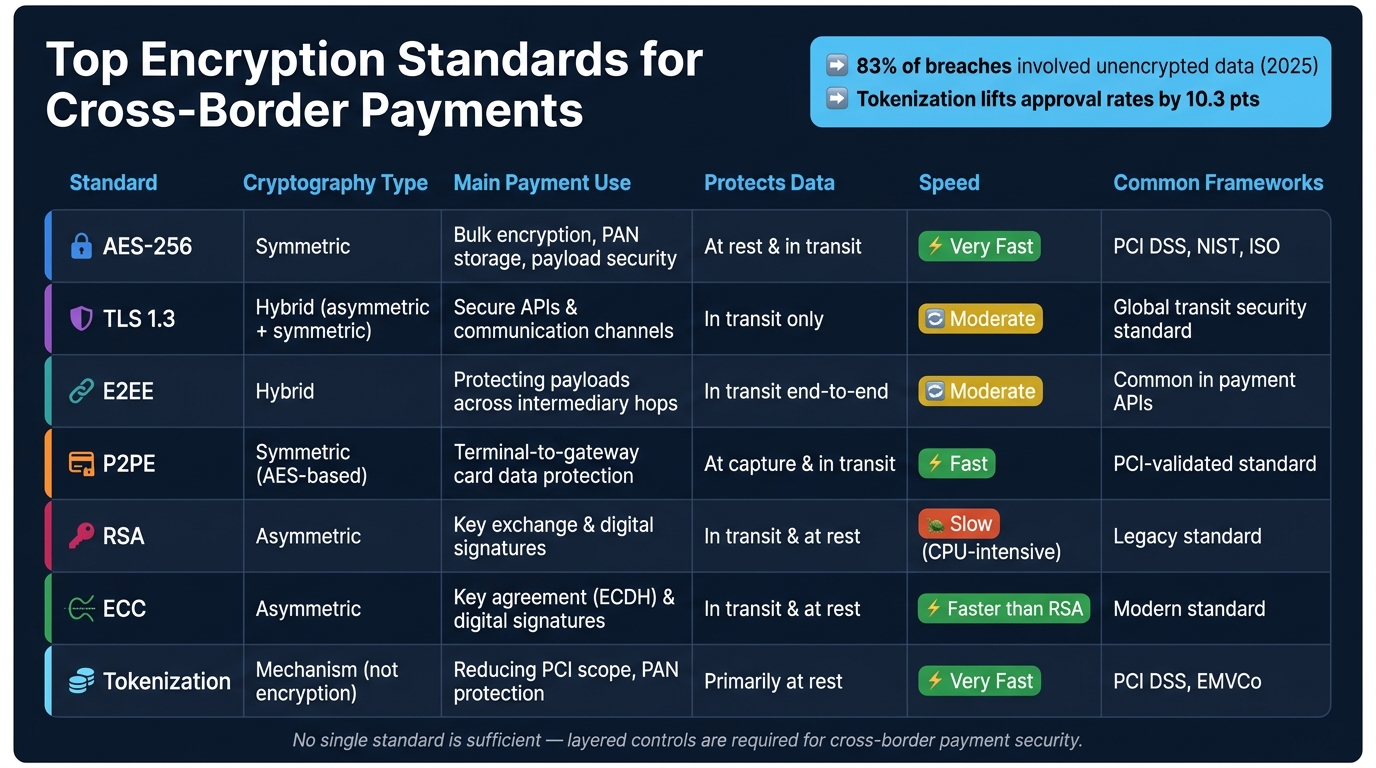
Top Encryption Standards for Cross-Border Payments: Side-by-Side Comparison
This comparison maps each control to a different part of a cross-border payment flow. Some protect stored data. Some protect traffic moving between systems. Others help shrink PCI scope. The point is simple: pick the control based on its job - data protection, transport security, key handling, or scope reduction.
| Standard | Cryptography Type | Main payment use | Protects Data | Speed | Common frameworks |
|---|---|---|---|---|---|
| AES | Symmetric | Bulk encryption, PAN storage, payload security | At rest and in transit | Very fast | PCI DSS, NIST, ISO |
| TLS 1.3 | Hybrid (asymmetric + symmetric) | Secure communication channels (HTTPS, APIs) | In transit only | Moderate | Global standard for transit security |
| E2EE | Hybrid | Protecting payloads across intermediary hops | In transit end-to-end | Moderate | Common in payment APIs |
| P2PE | Symmetric, typically AES-based | Terminal-to-gateway card data protection | At capture and in transit to decryption | Fast | PCI-validated standard |
| RSA | Asymmetric | Key exchange and digital signatures | In transit and at rest | Slow (CPU-intensive) | Legacy standard |
| ECC | Asymmetric | Key agreement (ECDH) and digital signatures | In transit and at rest | Faster than RSA | Modern standard |
| Tokenization | Mechanism | Reducing PCI scope, PAN protection | Primarily at rest | Very fast | PCI DSS, EMVCo |
Here’s the plain-English version. AES is the workhorse for stored data and encrypted payloads. TLS 1.3 protects the connection itself, like a guarded tunnel between two systems. E2EE and P2PE go a step further by keeping the payment payload encrypted as it moves across payment hops, which matters when more than one party touches the transaction.
RSA and ECC are mostly about key exchange and signatures, not bulk data encryption. Between the two, ECC usually fits high-volume payment flows better because it uses smaller key sizes and supports faster handshakes. Tokenization sits in a different bucket. It is not encryption. It is a scope-reduction control that keeps raw PANs out of internal systems and cuts down PCI scope.
The next section shows how to layer these controls in one payment stack.
How to Layer These Standards in a Payment Stack
No single standard covers every step in a cross-border payment flow. That’s why layered controls matter. You don’t want one weak point to expose the whole transaction.
Think of it like deadbolts, alarms, and a safe. If one control breaks, the others still stand in the way.
This stack protects data at capture, in transit, at rest, and across key boundaries. Each control has one clear job: storage, transport, capture, identity, scope, or key protection.
Use this stack:
| Layer | Standard | Role |
|---|---|---|
| Data at rest | AES-256-GCM | Storage |
| Data in transit | TLS 1.3 | Transport |
| Authentication | RSA or ECC | Identity |
| Card capture | P2PE for terminals; E2EE for app/API payloads | Capture |
| Card-on-file | Tokenization | Scope reduction (sits beside encryption, not inside it) |
| Key management | Envelope encryption (Cloud KMS/HSM) | Key protection |
Above the data layers sits key protection. Use envelope encryption: a data key encrypts the record, and a KEK in HSM or KMS wraps that key.
That split matters. The data key handles the record itself, while the KEK protects the data key. So even if someone gets access to encrypted records, they still need access to the wrapped keys.
In ISO 20022 systems, the message format and the security layer are separate. AES protects stored fields, while TLS or mTLS protects transport. They do different jobs, and you need both.
For internal service-to-service communication, use mTLS so both endpoints authenticate each other.
What U.S. Startups Should Focus On When Picking an Encryption Approach
If you're a U.S. startup moving money across borders, the encryption choices you make early can shape your compliance position for years. This isn't just about checking a box. It's about cutting PCI scope, protecting data in transit, and making sure your setup can stand up to partner review. In practice, the big areas are transport, key rotation, and data minimization.
For transport, the default should be TLS 1.3. Use TLS 1.3 for all in-transit data. If you still have to deal with older partner systems, require TLS 1.2 with AEAD ciphers only. Turn off SSL, TLS 1.0, and TLS 1.1. If a partner or processor can't meet that floor, don't connect. A compliant internal stack can still be exposed if it talks to a non-compliant third-party endpoint.
Rotate keys on a schedule, not when something breaks. Rotate master keys and certificates once a year, and rotate application secrets every 90 days. Use managed KMS or HSM-backed services so keys remain hardware-protected. Automation matters here. It helps you avoid certificate outages, machine-identity sprawl, and last-minute key changes in the middle of live payment processing.
After key hygiene, cut down the amount of raw data your systems ever touch. Use client-side tokenization, iFrames, or redirect models so raw PANs never reach your servers. That can shrink PCI DSS scope and may qualify you for lighter Self-Assessment Questionnaires (SAQs). For analytics and AI workflows, stick with masking or tokenization instead of raw data. Once raw PAN or account data enters an AI pipeline, PCI and audit scope expands right away.
Your controls are only as strong as the partners you connect to. Before you connect, verify each partner's TLS settings, key rotation practices, and protocol support. In payments, one weak link can undo a lot of careful work.
Conclusion
No single encryption standard can secure a cross-border payment by itself. That’s why layered controls matter. Think of it like a stack: each layer covers a different part of the payment journey, from capture and transit to storage and key handling.
AES-256 protects data at rest. TLS 1.3 secures data in transit. RSA and ECC manage key exchange and signatures. E2EE and P2PE help keep payment data protected as it moves across different hops. Tokenization strips raw data out of the stack. When these controls work together, they cut exposure without slowing payment flow.
The right mix depends on your transaction volume, payment rails, counterparties, and compliance scope. And the algorithms aren’t the whole story. Key management and monitoring matter just as much.
A good starting point is TLS 1.3 and AES-256. As your payment flow grows, add tokenization and E2EE or P2PE.
FAQs
How do I choose between E2EE and P2PE?
Choose based on your security setup and compliance needs. E2EE keeps data encrypted from the sender all the way to the recipient, which makes it a better fit when you need to protect data across its entire lifecycle. P2PE encrypts data only between set points, like a merchant terminal and a payment processor.
For financial transactions, the choice should come from a formal risk assessment and rules such as PCI DSS. P2PE can help reduce PCI scope, while E2EE gives broader protection for general data transfers.
When should I use ECC instead of RSA?
Use ECC over RSA when you need better efficiency, faster processing, and smaller key sizes for the same level of security. That makes ECC a strong fit for resource-constrained environments and devices with limited computing power.
ECC also supports smaller certificates and more efficient signing, so it’s generally the better choice for modern TLS handshakes and digital signatures. Use RSA when you need compatibility with older legacy clients.
Does tokenization replace encryption?
No. Tokenization and encryption are different security measures, and they often work side by side.
Encryption scrambles data so it can't be read without the right key. It's used to protect data in transit and at rest.
Tokenization, on the other hand, swaps sensitive data for non-sensitive tokens. That helps cut down how much sensitive data lives inside business systems.