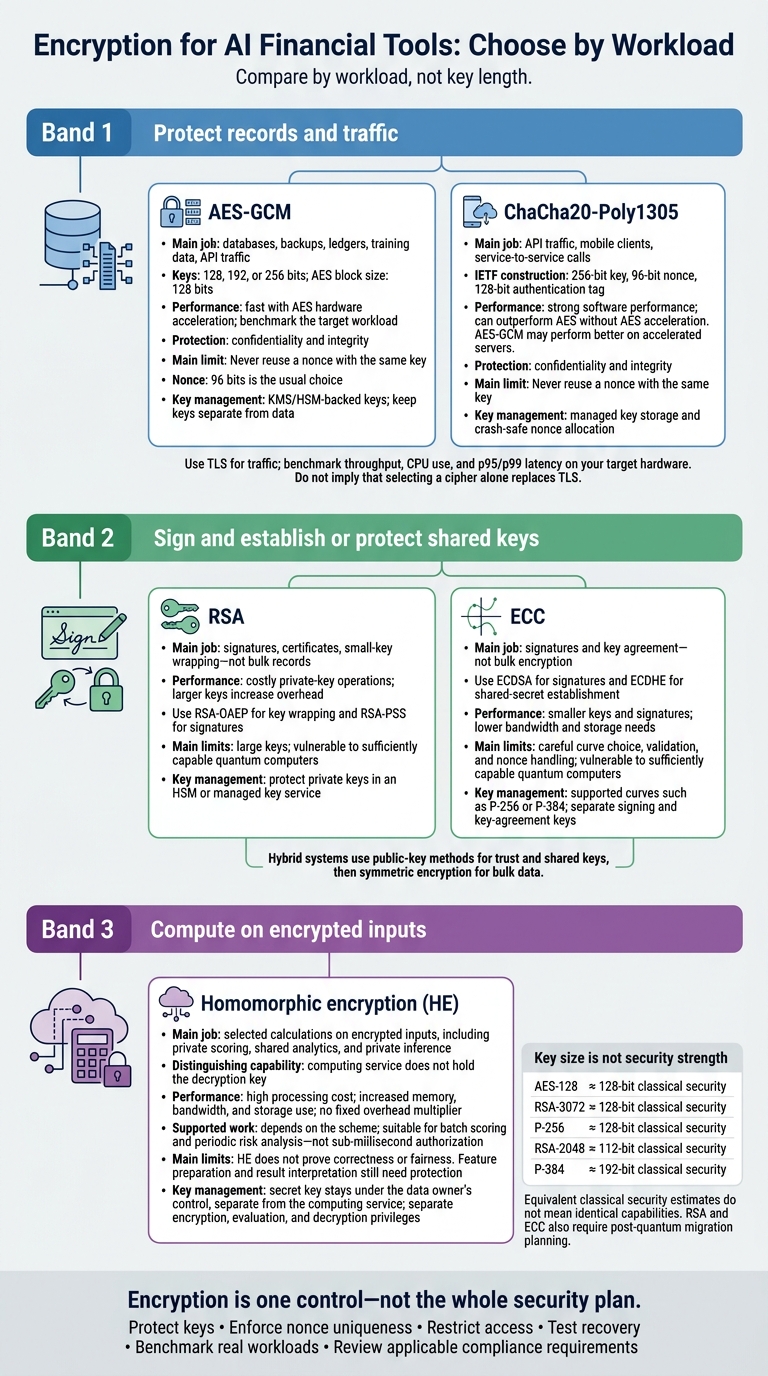
I’d choose encryption by the job - not by key size alone. Use AES-GCM or ChaCha20-Poly1305 for financial records and traffic, RSA or ECC for signatures and shared keys, and homomorphic encryption when data must stay encrypted during computation.
Here’s how I’d narrow your options:
- AES-GCM: Protect databases, backups, and training data. AES supports 128-, 192-, and 256-bit keys; performance depends on hardware and workload.
- RSA: Sign files or protect small encryption keys - not bulk records. RSA-3072 offers about 128-bit classical security.
- ECC: Use smaller keys for signatures and key agreement. P-256 also offers about 128-bit classical security.
- ChaCha20-Poly1305: Protect messages with encryption and tamper checks. It often performs well without AES hardware support.
- Homomorphic encryption: Run selected calculations on encrypted inputs, with higher computing costs and limits on supported work.
Quick Comparison
| Method | Main job | Performance | Main limit |
|---|---|---|---|
| AES-GCM | Bulk data protection | Fast with hardware support | Never reuse a nonce with the same key |
| RSA | Signatures and key transport | Costly private-key work | Large keys; quantum risk |
| ECC | Signatures and key agreement | Small keys and low bandwidth use | Careful implementation; quantum risk |
| ChaCha20-Poly1305 | Message and traffic protection | Strong software performance | Never reuse a nonce with the same key |
| Homomorphic encryption | Encrypted computation | High processing cost | Limited work; no proof of correct results |
My deployment checklist starts with <u>key protection, access limits, and recovery tests</u>. I’d also test latency and accuracy, review applicable U.S. financial rules, and plan for post-quantum changes to RSA and ECC. Encryption is one control - not the whole security plan.
Encryption for AI Financial Tools: Choose by Workload
Fastest vs Strongest Encryption Tier List
sbb-itb-17e8ec9
How Encryption Protects Stored, Shared, and Processed Data
Data at rest includes databases, backups, exports, and AI training datasets. Symmetric encryption uses the same secret key to encrypt and decrypt stored information efficiently. Keep keys separate from the data. Encryption at rest won’t stop an app with decryption rights from reading records. OWASP recommends AES with at least a 128-bit key, preferably 256 bits.
Data in transit travels between browsers, APIs, databases, and model-serving endpoints. Use TLS connections with certificate validation. Protect internal service connections, too - not just public-facing traffic. Amazon’s published API guidance requires TLS 1.2 or higher and recommends TLS 1.3 where supported.
Hybrid systems split the work. Public-key methods help check identities and establish or protect shared keys, while symmetric encryption handles the bulk data. Digital signatures can verify a sender or model file. But encrypting a key with a recipient’s public key does not, by itself, authenticate the sender. Use authenticated encryption when integrity matters.
Authenticated encryption encrypts data and checks for tampering. Verify the tag before accepting the result. Associated data lets a system authenticate visible metadata without encrypting it. Follow nonce rules exactly: reusing a nonce with the same key in GCM breaks protection.
Data in use is plaintext in memory, which creates exposure during live processing. Most AI workflows need plaintext for feature extraction and inference. Decrypt only where needed, restrict process and admin access, and keep sensitive inputs out of logs and temporary files. Homomorphic encryption keeps data encrypted during computation, but it’s slow and complex. Benchmark it for your workload before use.
1. Advanced Encryption Standard (AES)
Role and Financial Uses
AES is the bulk-encryption standard for stored financial data, including databases, backups, ledgers, and training data. NIST defines 128-, 192-, and 256-bit keys, all of which use 128-bit blocks.
Performance for AI Workloads
Benchmark AES on your target CPU, library, data size, and storage path. Hardware acceleration reduces overhead, but authentication still affects latency.
Measure performance with encryption enabled: database latency, training-data throughput, and backup duration. Don’t assume the overhead is negligible. AES-256 can run slower than AES-128, so test your chosen variant on workloads that resemble production. These results help determine whether AES fits your live ledgers, backups, and training pipelines.
Security and Limits
Use AES-GCM for both confidentiality and integrity. Follow your library’s nonce rules; 96-bit nonces are the usual choice. Set per-key usage caps, and prevent nonce reuse across workers, retries, and backup restores.
AES-256 provides a larger security margin for sensitive records kept over long periods, but it cannot make up for exposed keys. Nonce discipline is the main deployment risk.
Key Management and Setup
Generate keys with a cryptographically secure random number generator or managed KMS. Never embed keys in code or notebooks.
Use envelope encryption: a protected key-encryption key encrypts separate data-encryption keys. Keep production and development keys separate, restrict permissions by service and purpose, and audit both successful and failed key-access attempts.
Set rotation intervals based on your risk policy and cryptoperiod. Before retiring keys, test rewrapping or re-encrypting existing data, revoking compromised keys, and recovering historical backups.
Preserve each record’s encryption metadata so you can retrieve, audit, and decrypt it. Store the ciphertext alongside its nonce, tag, key ID, and algorithm version.
2. RSA
Role and Financial Uses
RSA pairs a public key with a confidential private key. It supports certificate-based identity checks, signatures, and key transport - not bulk data encryption.
A sender can protect a small symmetric key with the recipient’s public key.
In this hybrid model, RSA protects the key while symmetric encryption handles the data itself.
Performance for AI Workloads
Keep RSA out of data-heavy processing. Its operations are slow, and padding limits payload size. Test signing, verification, and key-unwrapping latency under loads that reflect production use. Larger keys also increase processing and storage costs, especially for private-key operations.
Security and Limits
For financial tools, use RSA only where asymmetric trust is needed. Use RSA-OAEP for key wrapping and RSA-PSS for signatures through a vetted library. A 2,048-bit modulus offers approximately 112-bit classical security. Treat it as a context-dependent minimum, and consider 3,072-bit keys for longer-lived data or stricter policy requirements.
Static RSA key exchange lacks forward secrecy, and TLS 1.3 does not support it. Use modern TLS with ephemeral key agreement. Sufficiently capable quantum computers could defeat RSA, so inventory your RSA dependencies and plan a migration to post-quantum standards or hybrid adoption.
Key Management and Setup
Use a cryptographically secure random source and the 65,537 public exponent when your library supports it. Keep private keys inside an HSM or managed key service. Applications should request signing or unwrapping operations rather than export the keys.
Validate certificate chains, key usage, expiration, and revocation. For TLS connections, verify hostnames too.
3. Elliptic-Curve Cryptography (ECC)
ECC handles the same public-key tasks as RSA, but uses smaller keys and signatures.
Role and Financial Uses
ECC handles public-key tasks, not bulk encryption. Use ECDSA to sign transaction approvals, API requests, and model artifacts. Use ECDHE to establish a shared secret for symmetric encryption. ECDHE adds forward secrecy, but ECDH alone doesn't authenticate peers.
Performance for AI Workloads
P-256 provides about 128-bit classical security with much smaller keys than RSA-3072. P-384 provides roughly 192-bit classical security.
Smaller keys and signatures can cut handshake bandwidth and memory use for mobile clients and distributed AI services. Still, benchmark connection setup on the devices and networks you'll use. Certificate chains, hardware, and network delays all affect latency.
Security and Limits
Financial tools often use ECC to keep signatures and key exchange fast. But speed doesn't replace safe implementation.
ECDSA requires a secure per-signature secret called a nonce. Reusing a nonce - or making it predictable - can expose the signing key. Deterministic nonce generation reduces dependence on runtime randomness, but you still need secure key generation and careful validation.
ECC is not quantum-resistant. Inventory your ECDSA and ECDH dependencies, and plan a migration for financial data that must stay confidential for years.
Key Management and Setup
Choose supported, standardized curves such as P-256 or P-384, not custom parameters. Check applicable FIPS and vendor requirements.
Generate keys with a cryptographically secure random number generator. Keep signing keys separate from key-agreement keys, and separate keys across tenants and environments. Store private keys in an HSM, managed key service, or hardware-backed keystore.
Use vetted libraries with point validation and side-channel defenses. Before production, test key rollover, restarts, and key-service outages. Account for these tradeoffs when comparing ECC with AES, RSA, and ChaCha20-Poly1305 for each workload and its latency needs.
4. ChaCha20-Poly1305
Role and Financial Uses
ChaCha20-Poly1305 protects confidentiality and integrity. ChaCha20 encrypts data, while Poly1305 tags ciphertext and associated data. Tampering causes verification to fail before decryption. Use it for API traffic, mobile clients, and service-to-service calls, and reject any message that fails authentication. Its main appeal is strong protection with low overhead in software-heavy systems.
Performance for AI Workloads
ChaCha20-Poly1305 can outperform AES on systems without hardware acceleration. On accelerated servers, AES-GCM may perform better. Benchmark p95 and p99 latency, CPU use, and battery drain using actual workloads. ChaCha20-Poly1305 is a practical choice when AES acceleration is weak or unavailable.
Security and Limits
The IETF construction uses a 256-bit key, 96-bit nonce, and 128-bit authentication tag. Never reuse a nonce with the same key - even one reuse can expose plaintext relationships and break authentication. Use crash-safe counters or sequence numbers that cannot roll back after restores.
Handle replay protection in the surrounding protocol. Also check whether your approved module and cipher suite meet FIPS controls.
Key Management and Setup
Check support for TLS_CHACHA20_POLY1305_SHA256 across clients, TLS libraries, gateways, and load balancers, and allow secure cipher-suite negotiation.
For application-level encryption, use a maintained AEAD library and protect keys in managed storage. Bind tenant, request, or record context in associated data. Document nonce allocation and key-rotation limits, then test authentication failures, restarts, restores, and network interruptions before production.
When confidentiality must extend to computation, homomorphic encryption changes the tradeoff.
5. Homomorphic Encryption
Role and Financial Uses
Unlike the earlier algorithms, HE shifts the tradeoff from speed to privacy. Homomorphic encryption (HE) lets a service compute on encrypted data without holding the decryption key.
Use HE when data must stay encrypted during analysis, such as shared risk scoring or private inference. Potential uses include credit scoring, fraud detection, shared analytics, and private inference.
HE protects the computation - not feature preparation or result interpretation.
The main HE variants differ in how much computation they support.
| Approach | Strengths | Limits | Deployment needs |
|---|---|---|---|
| Partially homomorphic | Efficient for one operation type | Cannot support general-purpose computation | Narrow aggregates; key custody and authenticated inputs |
| Leveled HE | Supports bounded additions and multiplications | Noise growth limits computation depth | Fixed-depth scoring; parameter selection and accuracy testing |
| Fully homomorphic | Bootstrapping enables deeper computation | Higher latency and operating cost | Specialized engineering and workload benchmarks |
Performance for AI Workloads
Once you've chosen a scheme, test the full pipeline, not just individual operations. Ciphertext expansion increases memory, bandwidth, and storage costs, but there's no fixed multiplier. Packing multiple values into one ciphertext can improve throughput.
Keep multiplications and ciphertext rotations to a minimum, and measure bootstrapping costs. Use HE for batch scoring and periodic risk analysis - not sub-millisecond authorization.
Security and Limits
BFV and BGV support exact modular integer arithmetic. CKKS supports approximate real-number arithmetic suited to numerical inference.
Before using CKKS, set an error budget. Then check whether rounding changes credit decisions, risk limits, or fraud alerts. Integer schemes also need overflow and fixed-point checks. HE does not prove correctness or fairness; endpoint security, output controls, and governance must stay in place.
Key Management and Setup
Keep the secret key under the data owner's control, separate from the computing service. Separate encryption, evaluation, and decryption privileges, and authenticate and version evaluation keys. Use established libraries for prototyping, but get an independent security review before deployment.
Before deployment, compare encrypted and plaintext results using representative financial data. Record ciphertext sizes, memory use, batch throughput, latency, accuracy drift, and infrastructure cost. Set acceptance limits before testing. Also validate failure recovery, revocation, and protected backups.
Compare Roles, Performance, and Limits
Compare by workload, not key length. For AI financial tools, start with what happens to the data: storage, transmission, signing, or computation. The matrix groups algorithms by bulk data protection, public-key trust, secure transport, and privacy-preserving analytics.
| Algorithm | Role and financial uses | Performance | Strengths | Weaknesses | Key management |
|---|---|---|---|---|---|
| AES-GCM | Records, backups, documents, and API traffic | Fast with AES acceleration | Broad support; integrity protection | Nonce-sensitive | KMS/HSM-backed keys |
| RSA | Signatures, certificates, and small-key wrapping | Slow | Works with legacy systems | Large keys; quantum-vulnerable | Protect private keys |
| ECC | Compact key agreement and signatures | Efficient | Low bandwidth and storage needs | Curve-sensitive; quantum-vulnerable | Use supported curves and validate peers |
| ChaCha20-Poly1305 | Authenticated transport encryption | Strong software performance | Does not require AES instructions | Nonce-sensitive | Never reuse a key/nonce pair |
| Homomorphic encryption | Private scoring and analytics | High processing overhead | Only option in this table for computation on encrypted data | No built-in correctness guarantee | Separate public, evaluation, and secret keys; restrict output access |
AES-GCM vs. ChaCha20-Poly1305
| Criterion | AES-GCM | ChaCha20-Poly1305 |
|---|---|---|
| Software performance | Depends on the processor and implementation | Often competitive without AES acceleration |
| Hardware performance | Strong acceleration on many servers | Less dependent on specialized hardware |
| Keys and nonces | 128-, 192-, or 256-bit keys; commonly a 96-bit nonce | 256-bit key; IETF version uses a 96-bit nonce |
| Integrity | Authenticates ciphertext and associated data | Authenticates ciphertext and associated data |
| Deployment support | Broad storage, database, TLS, and enterprise support | Broad modern TLS and library support; check legacy compatibility |
Benchmark both on your target hardware. Measure throughput, CPU use, and tail latency. Authenticate context - such as tenant ID, record type, or API version - as associated data. This protects it against modification but does not encrypt it.
RSA vs. ECC
| Criterion | RSA | ECC |
|---|---|---|
| Approximate classical security | 2,048-bit RSA ≈ 112 bits; 3,072-bit RSA ≈ 128 bits | A 256-bit curve ≈ 128 bits |
| Connection overhead | Larger keys and signatures | Smaller keys and signatures |
| Computational cost | Costly private-key operations; public-key performance varies | Often efficient key agreement and signatures |
| Implementation complexity | Padding-sensitive | Sensitive to curve choice, validation, and randomness |
| Deployment support | Mature certificate and legacy infrastructure | Strong modern support; curve compatibility varies |
| Quantum exposure | Vulnerable to sufficiently capable quantum computers | Also vulnerable |
Smaller keys do not mean stronger protection. NIST’s estimates place AES-128, RSA-3072, and 256-bit ECC at roughly 128-bit classical security, but they do not provide identical capabilities. Compare certificate bytes, handshake latency, and concurrent-connection capacity - not just key length.
Conventional Encryption vs. Homomorphic Encryption
| Criterion | Conventional encryption | Homomorphic encryption |
|---|---|---|
| Processing privacy | Plaintext is available to the trusted computing environment | Supports computation on encrypted inputs |
| Supported computation | Arbitrary computation after decryption | Operations depend on the scheme |
| Performance | Low encryption overhead | High encrypted-computation cost |
| Integrity and correctness | AEAD detects tampering, not incorrect computation | HE alone proves neither correct computation nor safe output |
For HE, use authorization, output limits, and audit logs to control wrong outputs and query leakage. Add verifiable computation or differential privacy when needed.
Deploy Encryption in U.S. Financial Tools
Match Encryption to Data State and Latency
Start by inventorying databases, object storage, local caches, backups, logs, queues, APIs, model-training datasets, prompts, outputs, and third-party subprocessors. Record how each uses encryption. Map every place plaintext appears in production, including memory, temp files, support tools, and inference jobs. Use AEAD for stored data and TLS for traffic.
Benchmark workloads that reflect expected transaction rates, record sizes, concurrency, hardware acceleration, and geographic distance. Measure p95/p99 latency, CPU and memory use, recovery behavior, and interoperability - not just encryption speed.
Use the completed data-flow map to define key controls and recovery paths.
Manage Keys, Nonces, and Access
Define the key lifecycle before launch. Generate keys with a CSPRNG and protect them in a managed KMS or HSM. Where practical, separate responsibility for encryption, key administration, application deployment, and audits. Give applications narrowly scoped key-use permissions, not unrestricted export access.
Document rotation, recovery, revocation, and destruction. Test recovery without giving operators unrestricted key access, and maintain recoverable backups with separately protected recovery keys. Ensure nonce uniqueness survives worker restarts, regional failover, and backup restoration.
Log key use and privileged changes in separately controlled storage. Never record plaintext or secret keys in those logs. With these controls in place, review vendor compliance and supporting evidence.
Check Vendor Controls and Compliance
An algorithm name alone does not prove compliance. Assess applicable GLBA obligations, the FTC Safeguards Rule, PCI DSS scope, and state or contractual requirements. Covered institutions must maintain a broader security program. The FTC rule requires encryption of customer information on systems and in transit, or an approved effective alternative when encryption is infeasible.
Document modes, key sizes, protocols, rotation periods, and exceptions. Verify the exact module, version, operating environment, approved mode, and validation status. Include prompts, outputs, logs, and training data in the review.
For an AI-enabled accounting service such as Lucid Financials, request current data-flow diagrams, encryption modes, key-management details, retention and deletion rules, subprocessors, admin-access controls, incident-notification terms, audit reports, and evidence of access reviews.
After these checks, inventory RSA and ECC dependencies for migration.
Plan for Post-Quantum Migration
Inventory RSA and ECC use across certificates, VPNs, APIs, signing systems, key wrapping, and archives. Identify dependencies for signatures and key exchange, as covered in the RSA and ECC sections.
Require standards-based vendor migration roadmaps, replaceable cryptographic interfaces, and versioned key formats. Pilot post-quantum key establishment and signatures, testing interoperability, latency, and failure recovery.
Conclusion: Choose Encryption for Each Workload
Match encryption to the workload and its limits. Use AES-GCM or ChaCha20-Poly1305 to protect bulk records and traffic. Use RSA or ECC for signatures and key establishment.
Homomorphic encryption fits only when computing on encrypted data is worth the extra latency, memory use, and limited set of supported operations.
At deployment, implementation determines the outcome. Use vetted libraries and bind tenant or account IDs as associated data to prevent ciphertext reuse in the wrong context. Set performance thresholds and test the full workflow - not just the cipher.
FAQs
How can I verify a provider’s encryption claims?
Run regular security audits of their encryption protocols, access controls, and key management. Check their documentation for specific protections, including AES-256 for data at rest and TLS 1.2 or higher for data in transit.
Use automated vulnerability scans to find known flaws or misconfigurations. Review audit trails and clear documentation of key rotation and storage to confirm that systems work as intended.
What should I do if an encryption key is compromised?
Follow your incident response plan immediately. Isolate affected systems, stop data transfers, and preserve evidence without changing logs. Restore systems from clean backups and re-encrypt compromised data. Verify system integrity before resuming operations.
To reduce future risks, rotate keys regularly and use a secure, dedicated key management system that's separate from your data. Use perfect forward secrecy so one exposed key won't compromise past communications.
When is homomorphic encryption worth the cost?
Homomorphic encryption is worth the cost when you need to analyze sensitive financial data without decrypting it. For startups that work with third parties or cloud services, it offers a way to protect privacy and meet strict regulatory requirements.
It also lets financial institutions detect fraud together and conduct audits without exposing confidential details. The trade-off has long been speed. But recent improvements have made basic arithmetic efficient enough for use in financial applications.