Churn prediction tools help SaaS startups identify customers at risk of canceling their subscriptions, enabling proactive retention strategies. With SaaS businesses facing an average monthly churn rate of 3.5%, reducing churn even slightly can significantly boost customer lifetime value and revenue. These tools analyze behavioral data, such as feature usage and sentiment, to predict churn and provide actionable insights.
Here’s a quick overview of the tools covered:
- Kumo.ai: Connects directly to data warehouses, uses temporal graphs for deeper insights, and excels in detecting "social churn."
- Gainsight: Focuses on customer success with risk categorization and AI-driven playbooks.
- ChurnZero: Offers real-time churn alerts and automated retention workflows.
- Pecan AI: A no-code platform for predictive analytics, ideal for lean teams.
- Zendesk: Leverages support interactions to flag churn risks using AI.
- Totango: Provides modular templates for customer success workflows.
- Pendo: Tracks feature usage and offers churn insights via machine learning.
- DataRobot: Enterprise-grade AutoML platform with explainable AI.
- H2O.ai: Open-source AutoML platform for churn prediction.
- Sybill: Analyzes sales calls and emails for churn signals.
- Cuoral: Detects churn signals within minutes and triggers alerts.
- VWO: Focuses on behavioral analytics with A/B testing to reduce churn.
Quick Comparison
| Tool | Starting Price | Primary Use Case | Setup Effort | Best Fit for Startups |
|---|---|---|---|---|
| Kumo.ai | Custom | Deep insights from data warehouses | High | Data-savvy teams |
| Gainsight | ~$2,500/month | Customer success and health scoring | High | Mid-market/enterprise |
| ChurnZero | Custom | Real-time churn alerts | Medium | Post-Series A growth |
| Pecan AI | Custom | Predictive analytics with no-code tools | Medium | Data-ready startups |
| Zendesk | ~$55/agent/month | Support-driven churn signals | Low | Broad integrations |
| Totango | Free tier available | Customer success workflows | Low–Medium | Early-stage teams |
| Pendo | Free tier available | Product analytics and engagement | Low | Product-led startups |
| DataRobot | ~$2,500+/month | AutoML for churn prediction | High | Growth-stage SaaS |
| H2O.ai | Free (open-source) | Open-source ML for churn prediction | High | Technical teams |
| Sybill | ~$19/user/month | Sales call and email analysis | Low | Sales-focused startups |
| Cuoral | ~$49/month | AI churn prediction and alerts | Low–Medium | SMB SaaS companies |
| VWO | ~$665/month | Behavioral analytics and A/B testing | Low | Growth-focused teams |
Choose a tool based on your scale, team expertise, and data infrastructure. For startups with fewer than 50 customers, focus on direct customer engagement before investing in tools. For more established teams, prioritize platforms that integrate well with your existing systems and deliver actionable insights.
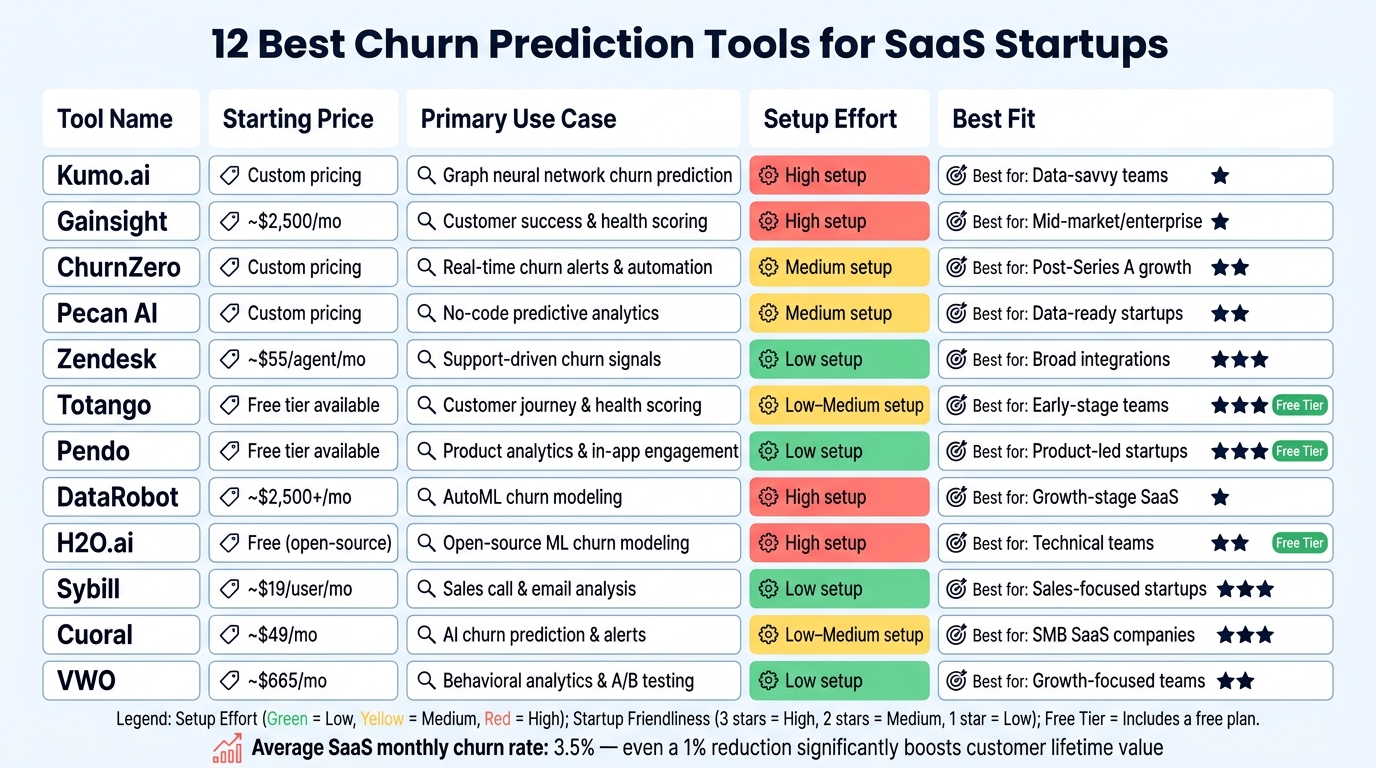
12 Best Churn Prediction Tools for SaaS Startups: Side-by-Side Comparison
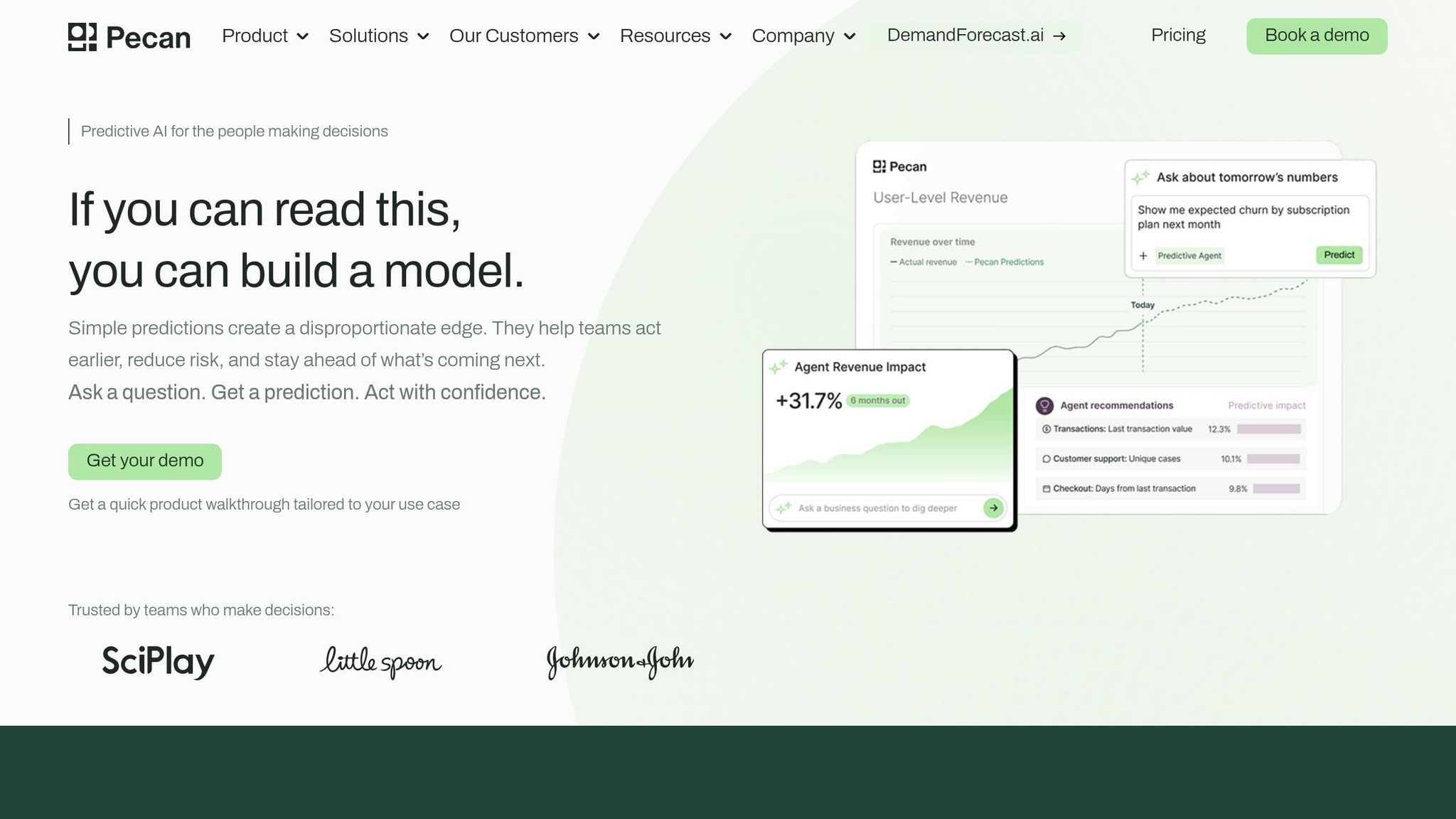
I Built a Churn Prediction Model in Minutes (No Code, No Data Science Team) | Pecan AI Agent Review
sbb-itb-17e8ec9
1. Kumo.ai

Kumo.ai takes a fresh approach to churn prediction by connecting directly to your data warehouse - whether it's Snowflake, BigQuery, Databricks, or Redshift. Instead of compressing your data into a single table, it reads raw relational tables as a temporal graph, preserving the original structure of your usage logs, billing records, support tickets, and CRM data. This setup allows Kumo.ai to identify relationships across tables and uncover insights that traditional models might miss.
Here's the key: churn signals often exist between tables rather than within a single one. For example, Kumo.ai can detect "social churn" - when peer accounts of a customer start canceling. If three peer accounts churn, that customer becomes 5x more likely to churn. Another critical signal is champion departure, where the loss of a power user or executive sponsor increases churn risk by 8x. These are the types of insights that flat-table models simply can't capture.
Kumo.ai also stands out with its Predictive Query Language (PQL), which allows analysts to define complex churn scenarios in just 1–2 lines of SQL-like code. This eliminates the need for writing hundreds of lines of Python or SQL. Matt Loskamp, a GTM Data Science Leader at an enterprise financial firm, highlighted this efficiency:
"We replaced six months of pipeline work with a single afternoon."
Kumo.ai's results speak for themselves. On the SAP SALT enterprise benchmark, its KumoRFM model achieved 89% accuracy, outperforming PhD-level data scientists using XGBoost (75%) and LLM+AutoML approaches (63%). Each prediction is accompanied by automated feature attribution, explaining the reasoning behind the flag - such as "68% decline in dashboard usage" or "2 of 5 peer accounts churned."
Pricing: Kumo.ai offers custom, enterprise-level pricing based on the size of your data warehouse and prediction volume. While it doesn't provide a self-serve tier, it’s tailored for SaaS companies with established data infrastructures looking to scale. A free trial is available, but you'll need to schedule a demo first.
2. Gainsight
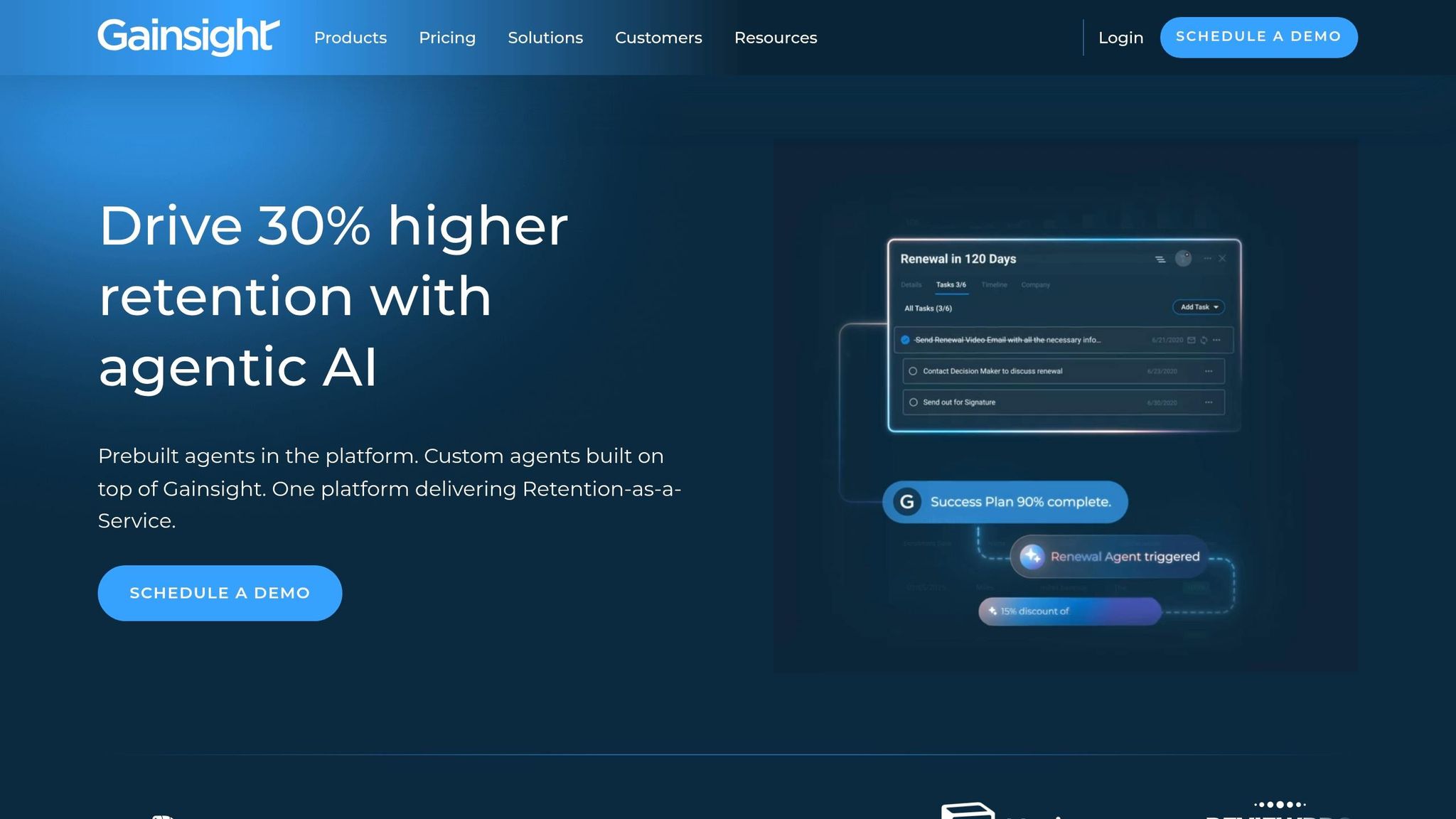
Gainsight stands out in the Customer Success space with its focus on actionable risk management and seamless integrations, offering tools that help businesses predict and mitigate churn risks effectively.
At its core, Gainsight uses an Explainable Boosting Machines Model to predict renewal probabilities based on historical data like NPS scores, survey responses, and engagement metrics. Its Staircase AI module adds another layer by monitoring emails, meetings, support tickets, and Slack for sentiment changes and signs of disengagement. These insights allow companies to take proactive, customized actions.
One of Gainsight’s key strengths is how it translates analytics into clear, actionable steps. For example, when churn risk is detected, the platform categorizes it into one of nine specific risk types, such as "Adoption Struggles" or "Stakeholder Change." From there, it provides an AI-generated playbook with step-by-step guidance for Customer Success Managers.
Rockwell Automation has seen firsthand how this approach accelerates churn risk detection:
"When I first started, we were working with a data scientist to connect engagement and churn risk. With Staircase, we can now measure quality of engagements and identify sentiment, accelerating that entire process."
- Doan Thai, Digital Customer Success, Rockwell Automation
Gainsight also integrates smoothly with tools like Salesforce, HubSpot, Mixpanel, Segment, and Snowflake, creating a unified view of customer data. The Staircase AI module can be set up quickly - anywhere from one hour to one week for basic connections. However, full enterprise deployments typically take 3–6 months.
Pricing and Suitability
Gainsight’s pricing starts at approximately $2,500 per month for its Essentials plan, which supports 10 users and allows each user to manage up to 100 customers. The Enterprise plan is customized based on company needs and is offered through a sales-led approach.
Implementation fees are an additional consideration, typically adding 20–40% to first-year costs. For mid-market companies, total costs often range between $80,000 and $400,000 per year, depending on the deployment scale. It's worth noting that the advanced AI prediction engine requires at least 50 opportunity records to function optimally. For smaller startups with fewer than 100 accounts, the cost and complexity might outweigh the benefits.
| Essentials | Enterprise | |
|---|---|---|
| Starting Price | ~$2,500/month | Custom / Sales-led |
| Included Users | 10 | 20 |
| Customers per User | 100 | 200 |
| AI Features | AI Insights & Automations | AI Insights + Renewal Forecasting |
| Setup Time | 6–8 weeks | 3–6 months |
3. ChurnZero
SaaS startups that aim to stay ahead of customer churn know the importance of proactive strategies. ChurnZero is a Customer Success Platform tailored for mid-market SaaS teams focused on retention. Its standout feature is the ChurnScore, which uses behavioral data and rule-based triggers to predict disengagement in real time. When a customer shows signs of leaving, the platform automatically sends alerts and launches retention workflows to address the issue.
ChurnZero also leverages AI through its specialized agents:
- Harbinger: Detects risks in customer relationships.
- Vibes: Monitors shifts in customer sentiment.
- Echo: Turns feedback into actionable insights.
- Beacon: Flags opportunities for upselling or expansion.
These agents give teams a heads-up on at-risk accounts, sometimes as early as 30–90 days before churn might occur.
"ChurnZero's AI Agents have been instrumental in helping us shift from reactive firefighting to proactive, systematic customer success. We needed intelligent automation that could identify at-risk customers early and trigger the right interventions at scale." - Marc R., Director of CS
The platform integrates seamlessly with over 60 tools, including Salesforce, HubSpot, Slack, Microsoft Teams, Intercom, and Zendesk. Its CRM sync updates every 15 minutes, ensuring Customer Success Managers always have the latest data to assess risks effectively. Initial setup takes 4–8 weeks, while complete deployment, including custom health scores and integrations, typically requires 2–3 months.
Pricing and Suitability
ChurnZero doesn’t disclose pricing on its website, but 2026 estimates suggest the following:
- Growth: ~$1,000 per user/month
- Pro: ~$2,500 per user/month
- Premium: ~$5,000 per user/month
The average contract is around $40,000 annually, with implementation and administrative costs adding another 15–35%. While the platform offers robust features, it’s best suited for mid-market teams with an established Customer Success function. For startups with under $2M ARR or fewer than 50 paying customers, the investment may be excessive unless retention strategies are already in place.
| Plan | Est. Price (approx. 2026) | Best For |
|---|---|---|
| Growth | ~$1,000 per user/month | Teams up to 100 members, 1,000 customers |
| Pro | ~$2,500 per user/month | Advanced segmentation, up to 5,000 customers |
| Premium | ~$5,000 per user/month | Enterprise scale, SSO, dedicated success team |
4. Pecan AI
Pecan AI takes a different approach compared to traditional health scores and playbooks, offering a solution tailored for SaaS startups aiming to predict customer churn. Instead of relying on manual processes, it provides a no-code predictive analytics platform that builds machine learning models using your existing data - no need for a data scientist. One standout feature is its conversational AI agent, which enables analysts and RevOps teams to define churn-related questions in plain English. For example, you might ask, "Which customers are likely to cancel in the next 30 days?", and the platform will create production-ready models based on your input.
What sets Pecan AI apart is its ability to process unstructured data efficiently. The platform handles tasks like data cleaning, joining, and feature engineering automatically. This means you can deploy a churn model much faster. For instance, Clearwave Fiber used Pecan AI to build a highly accurate churn model in just four weeks and had it running live within two months - all without hiring additional staff.
"With a lean team, we built churn predictions in weeks and put them live within two months. Its conversational guidance simplified the process. No extra hires, with a quick ROI." - Campbell Faulkner, Director of Reporting and Analytics, Clearwave Fiber
Pecan AI also integrates seamlessly with major data warehouses and tools like Salesforce and HubSpot. The Credit Pros leveraged these integrations to implement proactive retention strategies, which led to a 25% reduction in cancellations. What would typically take three months to develop was completed in just three weeks.
Pricing and Suitability
Pecan AI offers flexible pricing with no setup fees, and its plans scale based on the volume of predictions and data storage needs.
| Plan | Monthly Cost (Annual Billing) | Prediction Batches/Month | Storage |
|---|---|---|---|
| Starter | $760 | 2 | 500M rows |
| Team | $1,400 | 10 | 2Bn rows |
| Enterprise | Custom | 60+ | 5Bn rows |
For those who prefer month-to-month contracts, pricing starts at $950/month for the Starter plan via AWS Marketplace. The Starter plan is often sufficient for early-stage SaaS startups, though some reviewers point out that the initial cost might feel high if your retention workflows aren’t fully developed yet. Pecan AI currently holds an impressive 4.7/5 rating on G2, based on 39 reviews.
5. Zendesk
Zendesk takes a different route to churn prediction by focusing on customer support interactions instead of relying solely on product usage data. Its AI examines every single customer interaction across all support channels to assess sentiment and flag potential churn risks before they turn into cancellations.
One of its standout tools is Spotlight, which highlights problematic tickets and conversations that suggest high levels of dissatisfaction. For example, if a customer is flagged as "angry", Zendesk’s intelligent routing ensures their case is sent to the team best equipped to resolve it, minimizing the risk of further escalation [51, 52]. Zendesk also recommends that customers with three or more escalated tickets within 30 days or a CSAT score below 2/5 should be treated as critical churn risks, with executive-level outreach initiated within 24 hours.
Zendesk’s approach has delivered measurable results. In 2024, The Boston Globe implemented an AI chatbot named GloBot, integrated with Zendesk, to provide proactive, 24/7 support. This move led to a 10% decrease in churn [51, 60].
"We can now offer personalized, 24-hour support because the Ada chatbot, which we call GloBot, partners well with the Zendesk help center." - Eric Witman, Lead CX Systems Specialist, The Boston Globe
Zendesk also integrates with over 1,800 apps through its Marketplace, including CRMs, product analytics tools like Amplitude, and various AI-driven chatbots. By combining support data with product usage insights, Zendesk can predict churn with up to 85% accuracy and provide early warnings as far as 60 days in advance.
Pricing and Suitability
Zendesk offers a compelling deal for startups: 6 months free through its Zendesk for Startups program, covering up to 50 agents. After the trial, pricing begins at $19 per agent per month. However, advanced AI capabilities - like intelligent triage and sentiment analysis - require the Advanced AI add-on, which costs an additional $50 per agent per month and is available with the Professional and Enterprise tiers.
| Plan | Price (per agent/mo, billed annually) | Key Churn Features |
|---|---|---|
| Suite Team | $55 | Basic AI, AI agents, messaging |
| Suite Professional | $115 | Custom analytics, skills-based routing |
| Advanced AI Add-on | +$50 | Intelligent triage, sentiment analysis |
| AI Copilot | +$50 | Real-time agent assistance, thread summarization |
While the free startup program makes Zendesk appealing for new businesses, costs can increase significantly as you add advanced AI features. As of May 2026, Zendesk holds a 4.3/5 rating on ToolChase.
6. Totango
Totango's Unison AI engine takes historical engagement data - like calls, emails, meetings, and support tickets - and uses it to identify churn risks and uncover potential growth opportunities. Standard AI models can be up and running in just 1–2 days for health score analysis. For more tailored needs, Custom AI models dive deeper into your unique historical data, flagging risks months or even years before renewal deadlines.
With SuccessBLOCs, Totango offers pre-built, modular templates that make it easy for smaller teams to hit the ground running. These templates allow you to launch workflows for onboarding, retention, and expansion without needing a dedicated RevOps team. Instead of starting from scratch, you’re working with a structured framework from day one.
Totango also integrates seamlessly with tools like Salesforce, HubSpot, Microsoft Dynamics, Slack, Gmail, Outlook, Zendesk, and data platforms such as Snowflake and Google BigQuery. Its bi-directional syncing ensures that automated Slack or email alerts notify your team of any changes in risk status. These real-time updates help teams respond quickly to reduce churn.
"The ability to look at all actions through the lens of revenue is paramount. If my team is able to stay ahead of churn pitfalls that were previously unpredictable, that's a win and puts a clearer lens on the opportunities to protect and grow customer revenue." - Conor Nolen, Chief Customer Officer, Drata
Pricing and Suitability
Totango offers a free tier for those just starting out, with paid plans beginning at $199/month for the Starter plan and $1,099/month for the Growth plan. Enterprise pricing is custom-tailored, with the median annual contract value estimated around $66,150.
One key detail: Totango’s pricing is based on the number of customer accounts you manage, not the number of users. This means it’s important to estimate your account growth carefully to avoid unexpected fees. For early-stage startups (typically Series A or earlier), Totango offers 25–50% discounts, though these aren’t always advertised upfront. As of June 2026, Totango has earned a 4.3/5 rating from 1,146 reviews.
| Plan | Price | Best For |
|---|---|---|
| Free | $0/month | Teams just getting started |
| Starter | $199/month | Small teams, entry-level health scoring |
| Growth | $1,099/month | Automation, advanced segmentation, integrations |
| Enterprise | Custom | Large organizations, custom workflows, dedicated CSM |
7. Pendo
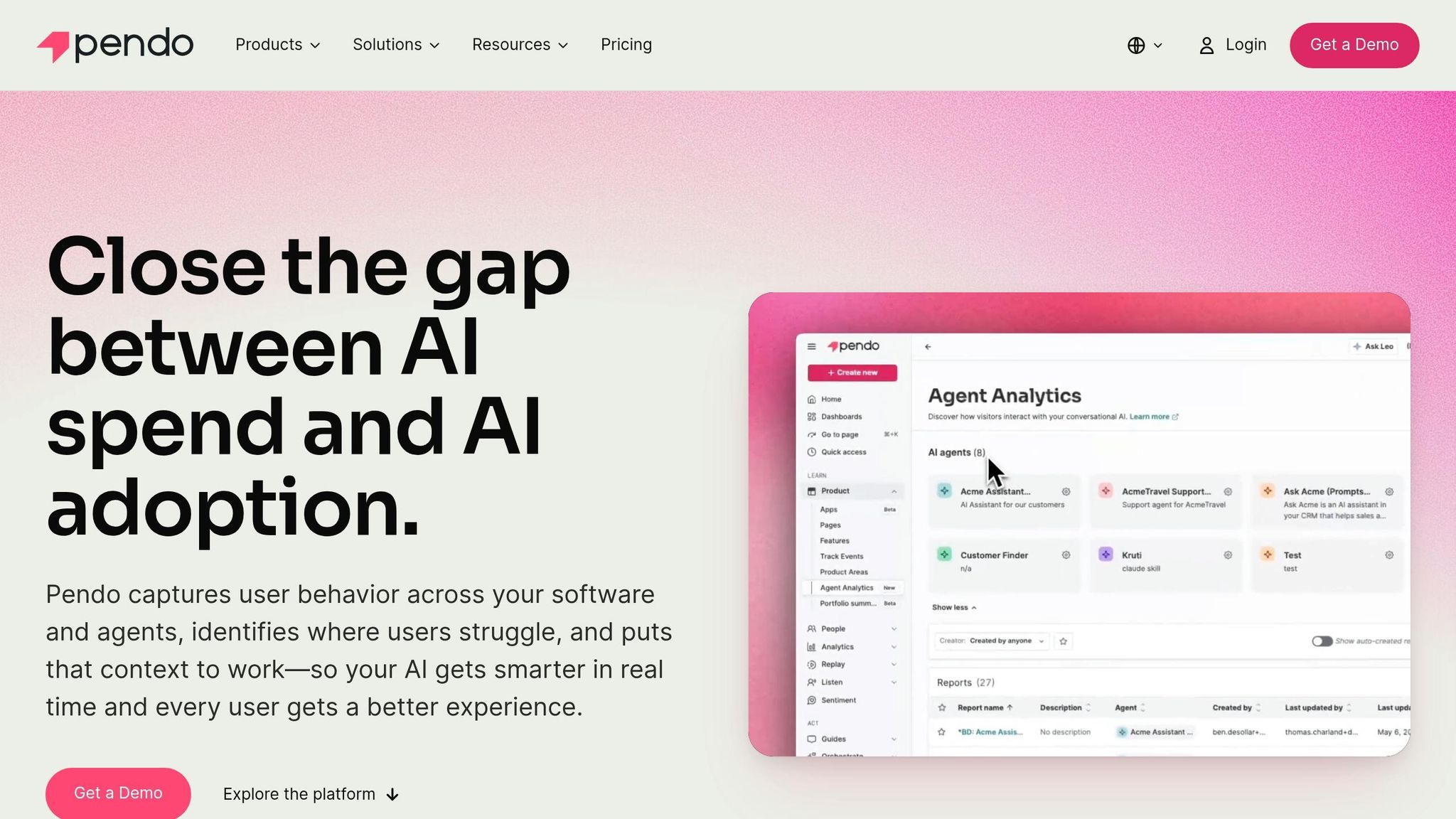
Pendo takes a distinct approach to churn prediction with its Pendo Predict module. This tool leverages machine learning to analyze real customer behavior - like clicks, sessions, and feature usage - to identify churn risks before they turn into major issues, such as a flood of support tickets or declining NPS scores.
What sets Pendo Predict apart is its ability to provide plain-language explanations for churn risk scores. This means your customer success team can take action without needing a background in data science. On top of that, Predict acts as a smart AI assistant, reviewing your retention strategies and recommending specific next steps for each account. This aligns seamlessly with proactive retention strategies.
"The biggest differentiator [...] is that Predict gives reps the intelligence where they already work in Salesforce and Slack. Once that clicked in my head, there was no other option." - RevOps Leader, Cybersecurity company
Integration and Ease of Use
Pendo Predict supports over 20 pre-built integrations, including popular platforms like Salesforce, HubSpot, Slack, Snowflake, Amazon Redshift, and Google BigQuery. It’s designed to be analytics-agnostic, meaning it can incorporate data from external sources while continuously retraining its models to stay accurate.
Its no-code setup makes it possible for non-technical teams to create and deploy predictive models in just a few days. Startups with fewer than 500 monthly active users can kick things off with the free plan ($0/month) to establish basic analytics and then scale up by adding Predict when needed.
Pricing and Suitability
| Plan | MAU Limit | Price | Key Features |
|---|---|---|---|
| Free | 500 | $0/month | Basic analytics, in-app guides, NPS |
| Base / Core | Custom | Custom | Advanced analytics, Session Replay |
| Ultimate | Custom | Custom | Sentiment analysis, Data Sync, Orchestrate |
| Predict (Add-on) | Custom | Custom | ML churn/upsell models, CRM integration |
Pendo Predict offers flexible, volume-based pricing, making it accessible for early-stage SaaS startups. Even the free tier can be enhanced with Predict, allowing companies to scale as they grow. With its tools managing software experiences for 900 million users every month, Pendo is a solid option for businesses aiming to stay ahead of churn.
8. DataRobot
DataRobot is a high-powered AutoML platform designed for enterprise use, specializing in AI-driven churn prediction. It combines data from CRM systems, usage logs, and billing records, leveraging its Automated Feature Discovery to simplify data preparation.
One standout feature is its Explainable AI (XAI), which uses Shapley values and Feature Impact visualizations to help teams pinpoint and understand churn risk signals. This clarity enables customer success teams to take targeted action. Vibhor Rastogi, Global Director of AI and ML Investments at Citi Ventures, highlights the platform's value:
"Eighty percent of the challenge in a data science project is preparing that data and making it ready for ultimately business intelligence and machine learning, and the AI platform has solved that problem."
A notable case study involves a global pharmaceutical company using DataRobot's Catalyst BI trial. They achieved a 20% reduction in churn and boosted revenue by approximately $3 million. Additionally, their sales team gained access to churn insights and could log feedback seamlessly.
Integration and Ease of Use
DataRobot doesn't just excel in prediction - it also makes integration and usability straightforward. It connects effortlessly with tools like Snowflake, BigQuery, Databricks, Google Drive, Slack, and Microsoft Teams. For added flexibility, it features an open API, allowing businesses to feed churn scores back into CRMs or set up automated retention workflows.
One of its strengths is accessibility for non-technical users. The no-code GUI app builder enables anyone on the team to interpret and act on predictions without needing programming skills. Setup is simple: upload a CSV file, select the "Churn" target column, and let the platform run 50–100+ algorithms simultaneously to find the best-performing model.
Pricing
DataRobot's pricing ranges from $2,500 to $7,500 per month (around $30,000–$90,000 annually). A free trial is available, and startups with fewer than 50 employees should explore the Startup Program for discounted rates.
"If you have fewer than 50 employees, ask DataRobot about the 'Startup Program.' Venture-backed companies qualify for big discounts. Do NOT buy at list price." - Sami Ullah, Founder, GrowrAI
According to a Forrester study, DataRobot can deliver an impressive 514% ROI, with payback achievable in as little as three months. This makes it an excellent choice for growth-stage SaaS startups, though it may not be the best fit for companies in their earliest stages.
9. H2O.ai
H2O.ai is an open-source AutoML platform designed to deliver advanced machine learning capabilities for churn prediction - without the need for a full-fledged data science team. Its flagship product, Driverless AI, streamlines the entire model-building process by automating tasks like feature engineering, hyperparameter tuning, model selection, and validation. What used to take 6–7 hours can now be completed in under 30 minutes.
One standout feature is its Automated Feature Engineering, which is especially helpful for SaaS churn prediction. By eliminating the need for 878 lines of manual SQL code, H2O.ai automatically identifies patterns and interactions in the data. After the model is built, its Machine Learning Interpretability (MLI) feature provides clear "reason codes" for every prediction, explaining why a customer might be at risk. Alongside fast model development, the platform integrates smoothly with existing data ecosystems.
Industry experts have praised these capabilities. Pawan Divakarla, Data and Analytics Business Leader at Progressive, shared:
"With H2O we are able to build many models in a much shorter period of time."
Similarly, Julian Bharadwaj, Senior Data Scientist at PayPal, highlighted its impact:
"It's been so successful that there is now a program built around the output of these machine learning algorithms... people have seen the impact we made on consumer churn."
Integration and Ease of Use
H2O.ai doesn’t just focus on efficient model development - it also offers strong integration options for real-time churn scoring. The platform connects seamlessly with data sources like Amazon S3 and Hadoop HDFS and allows models to be deployed as REST endpoints, making it easy to integrate with CRM systems. For teams that need a visual interface, H2O Wave provides tools to create live-updating dashboards, enabling real-time monitoring of churn risks across the customer base. While the platform is user-friendly, non-technical teams may still benefit from having a data specialist to fully utilize its capabilities.
Pricing
The core H2O open-source platform is free, making it an appealing option for startups looking to experiment with churn prediction models. For enterprise-level needs, products like Driverless AI require a paid license. The H2O AI Enterprise Starter package costs $720,000 per year and includes 8 GPUs along with Professional Services. For those hesitant to commit, H2O offers a 90-day free trial of the H2O AI Cloud, giving startups ample time to test their churn models on real data before making a decision. This makes it a practical choice for SaaS companies aiming to leverage AI for churn prediction.
10. Sybill
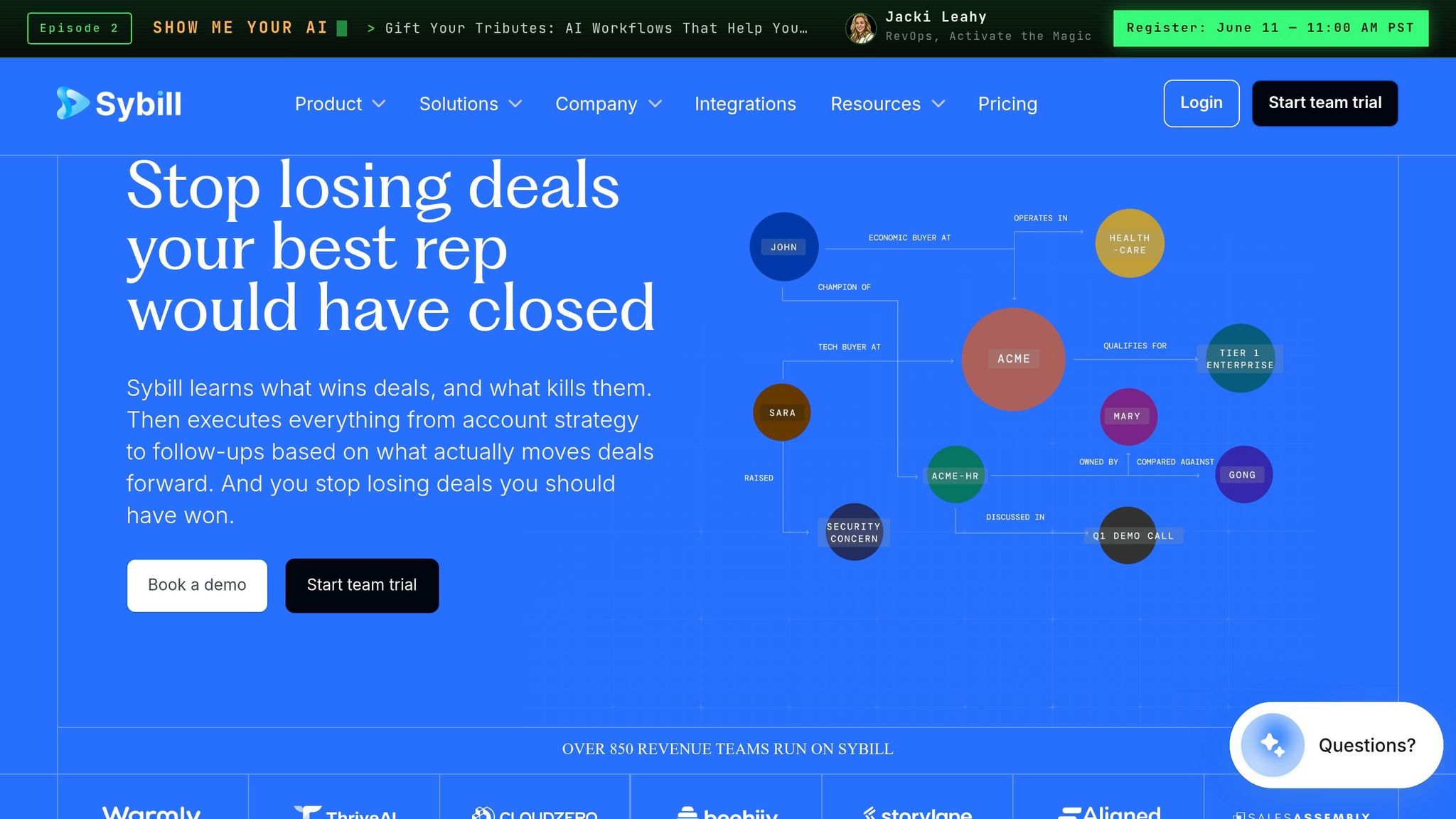
Sybill is an AI-powered revenue intelligence tool that takes a fresh approach to churn prediction. Instead of relying only on usage data, it focuses on behavioral signals like stakeholder silence, changing sentiment, and late-stage objections. By analyzing calls, emails, and Slack interactions, Sybill identifies accounts that might be at risk.
One of its standout features is "Ask Sybill", a conversational AI that allows users to ask questions in plain English. For example, you can ask which accounts lost deals due to missing features, and it provides actionable insights that have even helped recover lost deals. Additionally, Sybill detects non-verbal cues during video calls to spot buyer disengagement early. It also compares current account activity to patterns from churned customers, making it easier to predict potential issues. These insights are designed to fit seamlessly into your existing workflow.
Integration and Ease of Use
Getting started with Sybill is quick - it takes about 15 minutes to set up. The platform automatically maps data from your last 30 deals. It also integrates with popular tools like Salesforce, HubSpot, Zoho, Microsoft Dynamics 365, Zoom, Google Meet, Microsoft Teams, Gmail, Outlook, and Slack.
For SaaS startups, Sybill’s Scheduled Prompts feature is a game-changer. It can send automatic reports on at-risk accounts to Slack every Tuesday morning, just in time for your pipeline review.
Pricing
Sybill offers a 14-day free trial - no credit card required - and even includes a free tier for teams just starting out.
| Plan | Price (Annual) | Key Features |
|---|---|---|
| Free | $0/user/month | 20 AI meeting summaries/month, unlimited recordings, 3 months storage |
| Core | $19/user/month | Unlimited summaries, AI follow-ups, pre-meeting briefs |
| Pro | $79/user/month | CRM integration, 10 CRM autofill fields, Deal Workspace |
| Business | $90/user/month | Ask Sybill across all data, unlimited credits, custom templates |
| Enterprise | Custom Pricing | Unlimited CRM autofill, API access, dedicated account manager |
For early-stage SaaS startups, the Pro plan is a solid choice. It provides key features like CRM autofill and deal intelligence without adding extra platform fees.
11. Cuoral
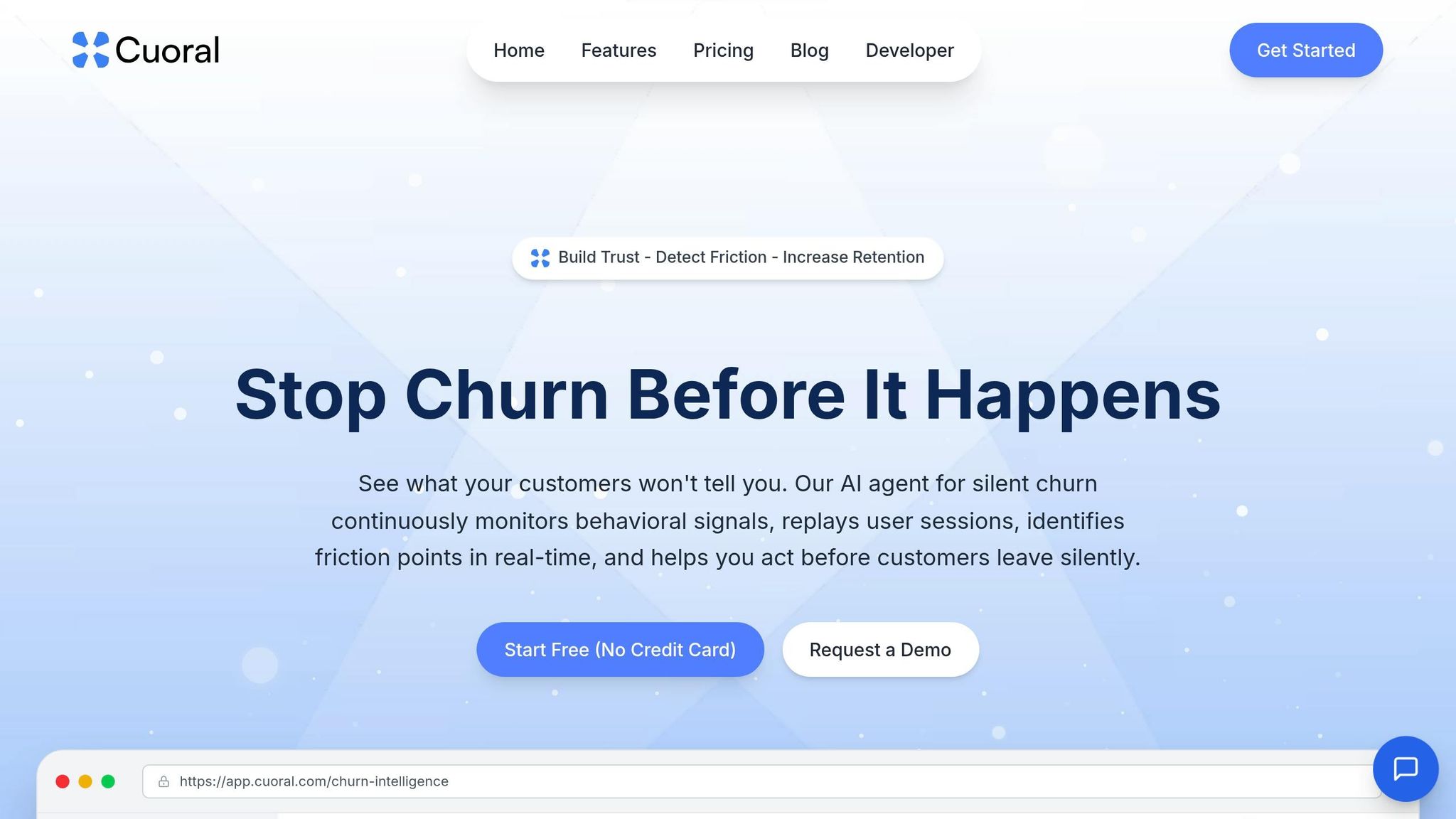
Cuoral is all about speed and simplicity, offering quick detection and actionable insights for startups aiming to manage churn effectively. Its standout feature? Speed. Cuoral identifies churn signals and triggers alerts in just 2–5 minutes. This is crucial because detecting churn 30 days ahead can lead to a 68% save rate compared to only 12% when caught at the point of cancellation.
The AI engine behind Cuoral monitors over 12 behavioral signals simultaneously, including changes in login frequency, abandoned workflows, support ticket sentiment, and payment issues. This helps uncover "silent churn", a phenomenon where 85% of at-risk customers show no obvious signs of disengagement. Additionally, the session replay integration allows teams to pinpoint exactly where users face difficulties, enabling more targeted and effective outreach.
Integration and Ease of Use
Cuoral’s setup is designed to be quick and hassle-free, with a no-code integration process that takes around 5 minutes - much faster than platforms that require months to implement. It works seamlessly with tools like Salesforce, Zendesk, Slack, Microsoft Teams, and various billing systems. All this data is consolidated into a real-time health score (ranging from 0 to 100) for each account.
For example, in April 2026, an e-commerce SaaS company used Cuoral to address a Salesforce integration failure. Cuoral flagged 47 accounts that experienced a complete usage drop within 10 minutes. Slack alerts enabled the team to fix the issue within two hours, saving 94% of those accounts from cancellation.
Pricing
Cuoral offers a simple and affordable pricing structure, starting with a free plan for basic features.
| Plan | Price (Monthly) | Key Features |
|---|---|---|
| Free | $0 | Live chat, 1 user, basic reporting, friction detection |
| Basic | $49 | Churn prediction, session replays, 4 users, proactive AI assistant |
| Advanced | $150 | 10 users, ticketing system, customer risk profiling |
| Professional | $299 | 20 users, dedicated account manager, advanced security |
| Enterprise | Custom | Unlimited scale, custom integrations |
For early-stage SaaS startups, the Basic plan at $49/month offers essential features like churn prediction, session replays, and real-time alerts. It’s a cost-effective solution that avoids the complexity and expense of a full customer success platform, making Cuoral a smart choice for proactive churn management.
12. VWO
VWO shifts its focus to behavioral analytics, using tools like heatmaps, session recordings, and A/B testing to identify where users lose interest in your product. Its VWO Insights module pinpoints friction in conversion funnels, helping SaaS teams uncover why users disengage before they churn entirely. This approach offers actionable insights that go beyond those provided by traditional churn platforms.
With VWO Copilot, the platform automates test creation and behavioral analysis. This makes it especially helpful for product and growth teams aiming to address churn signals by experimenting with potential fixes, rather than just identifying problems. However, it’s worth noting that VWO is primarily an experimentation and optimization tool, not a dedicated churn prediction platform.
Integrations and Setup
VWO's setup is straightforward, requiring just a single JavaScript snippet called SmartCode. Its visual editor allows non-technical users to create and launch A/B tests without needing a developer. For more advanced needs, integrations with platforms like Salesforce, Segment, and Google Tag Manager are available on the Pro and Enterprise plans. These integrations align with VWO’s goal of simplifying the process of identifying and addressing user friction.
Pricing
In early 2026, VWO adopted a Monthly Tracked Users (MTU) pricing model following its merger with AB Tasty. The Starter plan was discontinued in late 2025 and replaced with a 30-day trial. Pricing is now modular, meaning each product - Testing, Insights, and Personalize - requires its own subscription.
Here’s an overview of VWO's updated pricing structure:
| Plan | MTU Tier | Annual Billing (Monthly Equivalent) |
|---|---|---|
| Growth | 100,000 | ~$665/mo |
| Pro | 100,000 | ~$1,336/mo |
| Enterprise | Custom | Contact Sales |
The average annual spend for a VWO customer in 2026 is approximately $16,660. Be mindful of potential overage charges as user growth increases - concentrating the VWO script on high-value pages like checkout or signup can help manage MTU counts. When negotiating contracts, customers have reported securing discounts of around 20%.
"If prices are no longer communicated publicly, you lose comparability. Testing tools evolve from a clear software solution to complex, opaque contract negotiations." - Varify.io via WiserReview
VWO works best when paired with dedicated churn prediction tools, allowing teams to experiment with solutions to reduce user drop-off effectively.
Tool Comparison Table
The 12 tools reviewed here offer diverse methods for churn prediction. Some emphasize customer health scoring, while others rely on behavioral analytics or machine learning. To help early-stage SaaS teams make an informed choice, we’ve compared them across critical factors: pricing accessibility, primary use case, setup effort, and fit for startups.
| Tool | Starting Price | Primary Use Case | Setup Effort | Early-Stage Startup Fit |
|---|---|---|---|---|
| Kumo.ai | Enterprise pricing (custom quote) | Graph neural network churn prediction | High | Low - ideal for data-savvy teams |
| Gainsight | ~$2,500/mo | Customer success and health scoring | High | Low - better for mid-market and enterprise |
| ChurnZero | Enterprise pricing (custom quote) | Real-time churn alerts and customer success automation | Medium | Medium - scales well for post-Series A growth |
| Pecan AI | Enterprise pricing (custom quote) | Predictive analytics via SQL | Medium | Medium - needs a solid data infrastructure |
| Zendesk | ~$55/seat/mo | Support-driven churn signals | Low | High - easy to adopt with broad integrations |
| Totango | Free tier available | Customer journey and health scoring | Low–Medium | High - free tier works well for early teams |
| Pendo | Free tier available | Product analytics and in-app engagement | Low | High - great for product-led growth strategies |
| DataRobot | Enterprise pricing (custom quote) | Automated ML churn modeling | High | Low - requires a dedicated data science team |
| H2O.ai | Open-source / Custom | Open-source ML churn modeling | High | Medium - free but highly technical |
| Sybill | ~$49/seat/mo | Sales call analysis and deal churn signals | Low | High - quick setup for sales teams |
| Cuoral | Enterprise pricing (custom quote) | AI-driven churn prediction and recovery | Low–Medium | High - tailored for SMB SaaS companies |
| VWO | ~$665/mo (Growth) | Behavioral analytics and A/B testing | Low | Medium - works better as a complementary tool |
This comparison highlights the trade-offs between ease of use and the depth of features. For instance, Gainsight and DataRobot deliver robust capabilities but come with higher costs and complexity, making them better suited for larger teams with dedicated resources. On the other hand, tools like Totango, Pendo, and Sybill are budget-friendly and easier to implement, making them excellent choices for startups prioritizing efficiency.
To illustrate the potential impact, consider these examples: A $6M ARR SaaS company using Cuoral cut churn from 7% to 4.2%, saving $2.1M annually. Meanwhile, an $80M ARR company using Gainsight reduced churn from 5.2% to 3.8%, saving approximately $4.8M. These examples underscore the financial benefits of churn management but also highlight the varying levels of complexity involved in deploying these tools.
For early-stage SaaS teams, the focus should be on tools with accessible pricing and minimal setup requirements. Platforms like Kumo.ai, DataRobot, and H2O.ai demand weeks of effort and engineering support, while Zendesk, Pendo, and Sybill offer quicker, more straightforward implementation.
Conclusion
When deciding on an AI-powered churn prediction tool for your SaaS startup, focus on these key factors: your current ARR, the type of churn you’re tackling, your data infrastructure, and your team’s ability to act on flagged accounts. Remember, identifying at-risk accounts only matters if you can respond quickly and effectively.
If you have fewer than 50 paying customers, consider skipping the tools altogether for now. Direct, qualitative founder calls often provide deeper insights at this stage. Once you surpass that threshold, align your choice of tool with your scale. Smaller teams may benefit from targeted platforms, while larger operations with higher ARR might find full Customer Success Platforms more fitting.
"Without a defined intervention, a list of at-risk accounts produces zero retention. Build the playbook first, then buy the tool." - ChurnBase Team
Before committing to any tool, ensure your product analytics, CRM, and billing system are properly connected to track usage events. Without complete data, churn scores become little more than billing snapshots. Integration is critical - your tool should turn churn signals into actionable steps. If involuntary churn (like failed payments) is your primary issue, a dunning or recovery tool might deliver faster results.
Start small. Opt for a focused tool first - it’s quicker, more affordable, and easier to manage. As your revenue and team expand, you can transition to a more robust platform. Use these insights to fine-tune your retention strategy as your startup grows.
FAQs
What data do I need before using a churn prediction tool?
To build a churn prediction model that works well, start by collecting at least 6–12 months of data from a pool of 500 or more customers. Pay close attention to four critical categories of data:
- Behavioral data: Includes metrics like how often users log in and which features they interact with.
- Transactional data: Covers details such as payment history and subscription renewal dates.
- Engagement metrics: Tracks things like customer support ticket volume and Net Promoter Score (NPS).
- Demographics: Focuses on attributes like the customer's industry and the size of their company.
Before diving into analysis, make sure the dataset is well-prepared. This means removing duplicate entries, standardizing data formats, and addressing any missing values. Clean data is essential for reliable predictions.
When should a SaaS startup start paying for churn prediction?
Specialized churn prediction tools are overkill if your startup has fewer than 50 paying accounts. At that stage, direct conversations between founders and customers are far more impactful for understanding churn.
For startups generating under $1M in Annual Recurring Revenue (ARR), focus on subscription analytics to track and analyze customer behavior. Once your ARR falls between $1M and $10M, it might be time to explore churn-risk platforms to identify patterns and trends.
However, before diving into machine learning models for churn prediction, ensure you have a solid foundation: at least 500 historical churned accounts to provide reliable data. And don’t forget - having a well-thought-out retention plan in place is essential to act on the insights these tools generate.
How do I turn churn risk scores into real retention actions?
Organize your customers into risk tiers - Critical, High, Medium, and Low - to streamline your outreach efforts. This segmentation helps you focus your attention where it’s needed most, such as addressing urgent concerns for critical-risk customers or maintaining engagement with low-risk ones.
Use AI-driven insights to guide your actions. For example, you might offer personalized training to customers struggling with advanced features or address recurring issues flagged in support tickets. These tailored approaches can help resolve pain points and reduce churn.
Automate Real-Time Alerts
Set up automated alerts - like Slack notifications - to stay on top of key issues as they happen. For instance, you can receive instant updates about failed payments or other critical events, enabling your team to act quickly and minimize disruption.
Track the outcomes of these interventions to fine-tune your retention strategies over time. By analyzing what works and what doesn’t, you can improve your accuracy and effectiveness in retaining customers.