Most U.S. startups should keep one default vesting schedule: 4 years with a 1-year cliff - then make only a few role-based changes.
If I were setting this up, I’d keep the core rules the same for most people and change only a small set of terms by role. In practice, that means:
- Founders: reverse vesting, often 4 years with a 12-month cliff
- C-suite: same baseline, but sometimes refresh grants and double-trigger acceleration
- Core employees: keep the standard schedule and change grant size by role and level
- Advisors and contractors: use shorter schedules, often 12 to 24 months, with no cliff or a 3- to 6-month cliff
- Performance vesting: use it only when results are easy to measure, such as ARR, quota, or launch targets
- Tax and compliance: get a current 409A valuation, board approval, and matching plan documents before grants go out
A simple way to think about it: keep vesting mechanics fixed, and adjust only what the role calls for. For most hires, the main lever is how much equity you grant, not a custom vesting deal.
Quick comparison
| Role | Common Schedule | Cliff | Main Changes |
|---|---|---|---|
| Founders | 4 years | 12 months | Reverse vesting, repurchase right, deal terms on exit |
| C-suite | 4 years | 12 months | Refresh grants, double-trigger acceleration, sometimes performance terms |
| Core employees | 4 years | 12 months | Grant size by level |
| Advisors | 12–24 months | 0–6 months | Smaller grants, usually NSOs |
| Contractors | 12–24 months | 0–6 months | Smaller grants, tied to engagement term |
One tax point matters right away: if options are granted below fair market value, workers can face ordinary income tax plus a 20% penalty under Section 409A. That’s why vesting policy is not just an HR issue - it also touches legal, accounting, and cap table work.
So my takeaway is simple: start standard, write role-based rules once, and document every exception in writing.
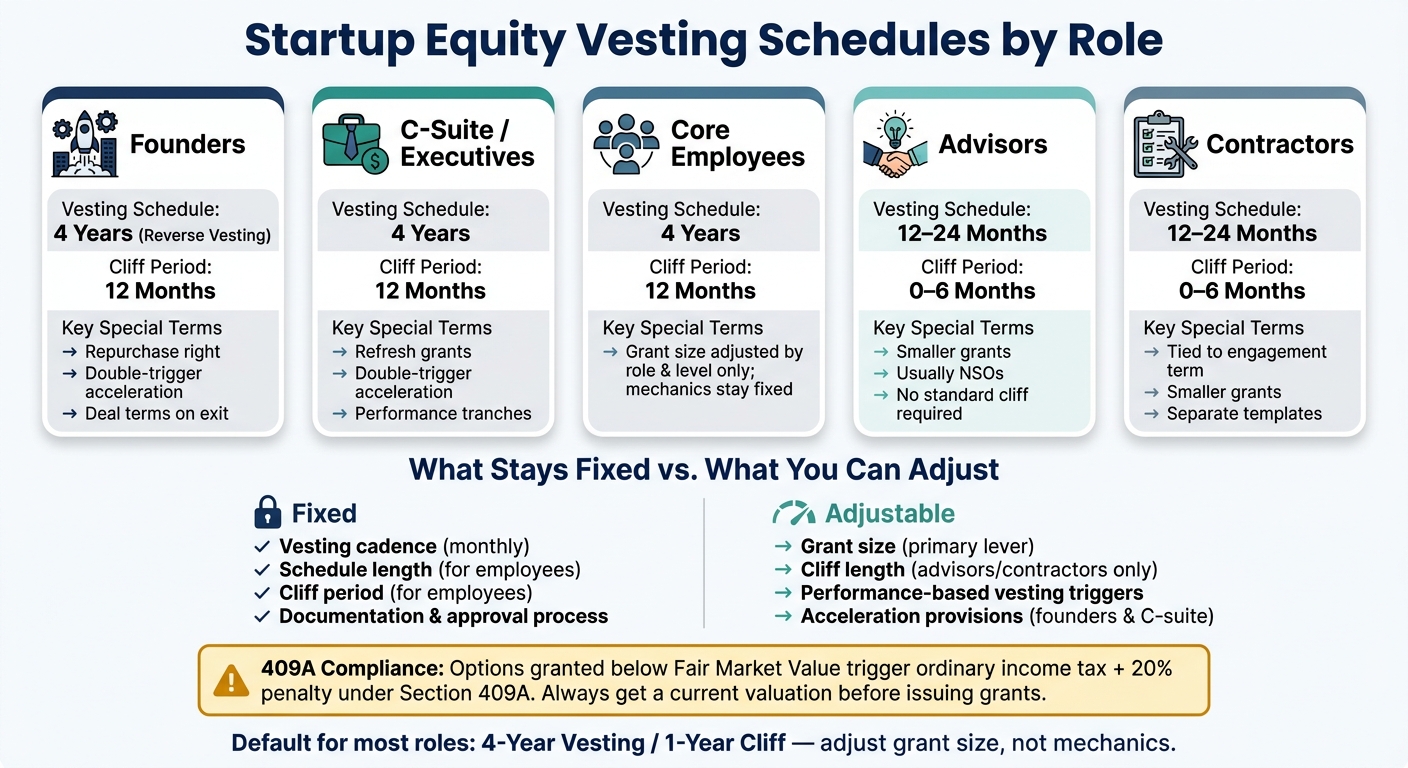
Startup Equity Vesting Schedules by Role: Quick Reference Guide
How Equity Vesting Schedules Work Protecting Ownership and Incentivizing Growth
sbb-itb-17e8ec9
Build a Standard Vesting Framework First
Start with one default schedule. Then set a small number of role-based exceptions.
That gives you a clean baseline. It also makes exceptions easier to defend and easier to explain to new hires, your board, and other stakeholders as the company grows. Once the default is in place, decide which terms stay fixed and which ones can change by role.
Identify the Vesting Terms You Can Change
Not every vesting term should change by role. For most employees, the parts that should stay the same are vesting cadence (monthly is the standard default), the overall schedule structure, and the documentation and approval process. Think of these as your fixed rules.
The terms you can adjust are more limited:
- Grant size
- Cliff length in limited cases
- Performance-based vesting triggers
- Acceleration provisions on a change of control or termination
In most cases, role-based differences should show up in grant size, not the vesting schedule itself. Keep the schedule standard. Adjust equity based on responsibility.
Write a Role-Based Vesting Policy Instead of One-Off Deals
One-off vesting deals tend to create fairness problems because employees compare outcomes. And they will compare them.
A cleaner path is a role-and-level policy matrix: a short internal document that sets vesting terms for each employee group, such as founders, C-suite, full-time employees, advisors, and contractors. Each group gets a clear default. Any exception should come with a written business reason and the right approval. A written policy can speed up hiring and make approvals easier.
Comparison Table: Fixed Vesting Terms vs. Adjustable Vesting Terms
| Vesting Term | Fixed or Adjustable | Notes |
|---|---|---|
| Vesting schedule length | Fixed for employees; shorter only for advisors or contractors | Standard for most employees; shorter schedules may apply to advisors or contractors |
| Vesting cadence | Fixed | Monthly installments after the cliff are the common U.S. startup default |
| Cliff period | Fixed for employees; shorter only for advisors or contractors | Usually 1 year; can be shorter for advisors or contractors |
| Grant size | Adjustable | Primary lever for differentiating by role and level |
| Performance-based triggers | Adjustable | Used selectively for senior roles or milestone-driven hires |
| Acceleration (single/double trigger) | Adjustable | Often reserved for founders and C-suite hires |
Keeping this line clear - fixed mechanics, adjustable variables - is what makes a role-based vesting policy work in practice. It gives you room where you need it without turning every offer into a custom negotiation. Use these rules to map founders, executives, employees, advisors, and contractors to different vesting structures.
Match Vesting Schedules to Each Employee Role
With your fixed and adjustable terms set, the next step is to apply them by contributor type. The baseline shouldn’t look the same for everyone. Founders, executives, employees, advisors, and contractors each need a different mix of schedule length, cliff, and acceleration.
Use the role to decide what changes. In some cases, that means a different cliff. In others, it means changing acceleration or grant size.
Founders and C-Suite: Reverse Vesting, Retention, and Exit Protection
Founders often start with shares that are already issued. In that case, use reverse vesting. The company keeps a repurchase right over unvested shares if a founder leaves early, usually on a 4-year schedule with a 1-year cliff.
For C-suite executives, the same 4-year baseline usually applies. But senior hires often negotiate refresh grants. These are added option packages that start vesting after year 2 or 3, helping keep leaders focused through milestones like a Series B or a product launch.
Use double-trigger acceleration here. That means equity vests only if two things happen: a change of control and a qualifying termination. Once performance conditions and tax rules enter the picture, these decisions usually get tighter.
Core Employees: Keep the Baseline, Adjust Grant Size by Role and Level
For the rest of your full-time team - engineering, product, sales, and operations - keep the vesting schedule the same. Change the grant size based on role and level, but leave the vesting mechanics alone.
Use equity bands by function and level so similar roles get similar grants. That does a few things at once:
- Keeps offers consistent
- Makes cap table admin easier
- Holds up better in investor due diligence
That kind of consistency also makes later performance or tax exceptions easier to explain.
Advisors and Contractors: Shorter Schedules and Shorter Cliffs
Advisors and contractors usually get shorter, simpler vesting because the relationship is shorter and less tied into day-to-day company work. Common advisor setups use 12 to 24 months of monthly vesting, with either no cliff or a short 3- to 6-month cliff.
Grant sizes are smaller and often use nonqualified stock options (NSOs) since advisors aren’t employees. Contractors follow the same basic approach: shorter vesting, smaller grants, and terms tied closely to the actual engagement.
Use separate templates for these groups, and review tax and worker classification issues with legal counsel. Next, layer in performance terms and tax treatment before finalizing any exception.
Add Performance Terms and Handle Tax and Compliance
Use performance vesting only when the role has output you can measure cleanly. For most employees, stick with the baseline vesting schedule. For senior roles tied to clear business results, performance terms can add a tighter link between pay and results.
When Performance-Based Vesting Makes Sense
Performance vesting fits best when the metric is objective and easy to confirm. Think of a VP of Sales tied to ARR targets, a Chief Revenue Officer tied to quota attainment, or a VP of Product tied to a feature launch with defined adoption metrics.
One common setup splits the grant 50/50. Half vests on a standard 4-year time schedule. The other half vests only when the company hits a defined milestone that audited financials confirm. That way, you keep the retention piece while adding a direct performance link.
Set the rules up front:
- Define the metric
- Set the threshold
- Name the measurement period
- Decide who approves the result
Keep performance tranches to two to four per grant, and use metrics your team already tracks for board reporting. Those terms also need to be written clearly enough for tax, board, and accounting review.
Performance vesting should stay limited to roles with direct, measurable impact.
409A Valuations, Tax Treatment, and Plan Documents
Once you set performance terms, the next job is making sure the grant is legal and tax-compliant.
Before you grant stock options, get a current 409A valuation. This is an independent appraisal of your common stock’s fair market value (FMV) under Section 409A of the Internal Revenue Code. If you grant options below FMV, the employee can face ordinary income tax plus a 20% penalty.
Update your 409A at least every 12 months. Do it sooner after a priced round, a material business change, or an acquisition. A compliant valuation gives you a 12-month safe harbor against IRS challenge.
The type of equity you grant changes the tax outcome too. ISOs (Incentive Stock Options) usually do not create regular federal income tax at grant or vesting. The spread at exercise may trigger Alternative Minimum Tax (AMT). If the employee holds the shares for at least two years from grant and one year from exercise, the full gain may qualify for long-term capital gains treatment.
NSOs (Nonqualified Stock Options) work differently. They trigger ordinary income tax on the spread at exercise, and that amount is subject to withholding. RSUs are usually taxed as ordinary income when they vest and settle, with the value reported as wages.
Board approval matters here too. Get approval for the equity plan, grant templates, and any custom terms. Your employment agreements should match the vesting rules, especially the definitions of cause, good reason, and change of control. Those terms directly affect when acceleration applies.
Comparison Table: Role-Based Vesting Choices and Tradeoffs
| Role | Vesting Term | Cliff | Performance Conditions | Acceleration | Administrative Complexity |
|---|---|---|---|---|---|
| Founders | 4–5 years (reverse vesting) | 12 months | Rare | Tailored, often double-trigger | High |
| C-Suite / Executives | 4 years, often with performance-based tranches | 12 months | Moderate (revenue, fundraising, product milestones) | Often double-trigger | High |
| Core Employees | 4 years | 12 months | None | None | Low |
More conditions mean more admin work. Sometimes that tradeoff is worth it, especially for roles with a direct line to company value. But it also means more time, more legal review, and more accounting work. Under ASC 718, you generally recognize stock-based compensation expense only when achievement of a performance condition becomes probable, so the accounting team has to reassess that likelihood each reporting period.
Use these rules to shape grant templates, approval steps, and finance review checks.
Roll Out the Policy with Templates, Examples, and Financial Oversight
A Step-by-Step Rollout Process for Startup Teams
Once the matrix is approved, put it to work through templates and a clear approval flow. Start by sizing the option pool based on your hiring plan and role mix, so grant sizes line up with the equity you expect to issue.
Then move through a simple process:
- Draft standard templates: Use vetted offer letter and equity agreement templates that hard-code the 4-year / 1-year cliff schedule as the default. Only change the grant size, grant date, and any role-specific acceleration terms.
- Run approvals: The hiring manager proposes the grant, finance checks the pool and cap table impact, legal reviews compliance, and leadership or the board signs off on exceptions.
- Record the grant in the cap table and accounting system: Once the paperwork is signed, log the grant along with the approval details.
- Communicate clearly to employees: Share a plain-English summary of the vesting terms, including the cliff date, monthly vesting cadence, and what happens at termination or a change of control.
Revisit the pool and vesting matrix at each major milestone: seed close, Series A, Series B, and after large hiring waves. Those check-ins help keep grants in line with hiring and fundraising plans.
How Lucid Financials Can Support Vesting Decisions
Vesting decisions affect burn, dilution, and reporting. That means finance should review them before grants go out. Lucid Financials can help model dilution, runway, and hiring scenarios before you issue new grants, while keeping cap table, bookkeeping, tax, and CFO oversight in sync for founders who want financial review tied to equity decisions.
Conclusion: Keep Schedules Consistent and Make Exceptions Intentional
The 4-year / 1-year cliff is still the default for most roles. Use exceptions only when the role calls for them, document each deviation in your vesting matrix, and make sure it appears the same way in your offer letters, equity agreements, and internal policy docs.
Use the same matrix for every grant. If you make an exception, put it in writing. That keeps the policy simple to apply.
FAQs
When should a startup make vesting exceptions by role?
Consider vesting exceptions when a standard schedule doesn’t fit the role, the project timeline, or the company’s stage of growth.
For example, you might use milestone- or performance-based vesting for roles tied to specific outcomes. You could use back-weighted schedules when the goal is to keep people around for the long haul. And for senior hires, double-trigger vesting can make sense when a liquidity event changes the timing of taxes.
How do I decide between a larger grant and custom vesting terms?
Balance your company’s stage, the role, and your long-term retention goals. A larger grant can help bring in high-impact hires, while custom vesting terms can connect equity to sustained performance, not just time on the job.
If stability is the goal, standard time-based vesting is still the go-to option. If you want to reward specific outcomes, a hybrid approach may make more sense. For senior roles, back-weighted or extended vesting can work better than simply offering more equity.
What documents should be updated before issuing equity grants?
Before issuing equity grants, make sure every entry is backed by signed, legally enforceable documents.
That means having board resolutions, stockholder approvals, finalized equity grant agreements, a current 409A valuation report, and an updated cap table that shows all outstanding options, warrants, SAFEs, and convertible notes.