If I wait until an audit, customer review, or funding diligence starts, I’m already late. The article’s main point is simple: I can use AI to find missing controls early, map each rule to an owner and proof, and keep compliance on a set review schedule instead of treating it like a one-time cleanup.
Here’s the short version in plain English:
- Gap analysis shows what I’m missing before someone else finds it.
- Framework choice comes first: SOC 2, ISO 27001, GDPR, HIPAA, ISO 42001, and the EU AI Act only matter if my product, data, users, or market trigger them.
- AI helps with the first pass, but a person still needs to check the output.
- Risk scoring matters: fix high-risk items in under 30 days, medium-risk items in 30–90 days, and low-risk items after that.
- Compliance works best on a schedule: monthly, quarterly, annual, and event-based reviews.
Beyond compliance, real-time financial insights help startups manage the costs of these long-term requirements. A few facts stand out:
- A SOC 2 Type II review looks at control performance over 6–12 months, not just one point in time.
- Medical record retention can run 6–10 years, based on state law.
- A 30-day side-by-side test between AI and manual workflows can help catch errors before I depend on the tool.
The big takeaway? AI can sort, track, and flag. But people still make the final call. That’s the model this article lays out: pick the right frameworks, build one source of truth, score gaps by risk and effort, assign one named owner to each item, and keep evidence ready year-round.
That gives me a cleaner path to audits, customer checks, and investor questions without last-minute panic.
AI Compliance Capstone: From Gap Analysis to Audit Readiness | Module 6.3
sbb-itb-17e8ec9
Choose the frameworks that match your startup's risks
Startup Compliance Frameworks Compared: SOC 2, ISO 27001, GDPR, HIPAA & More
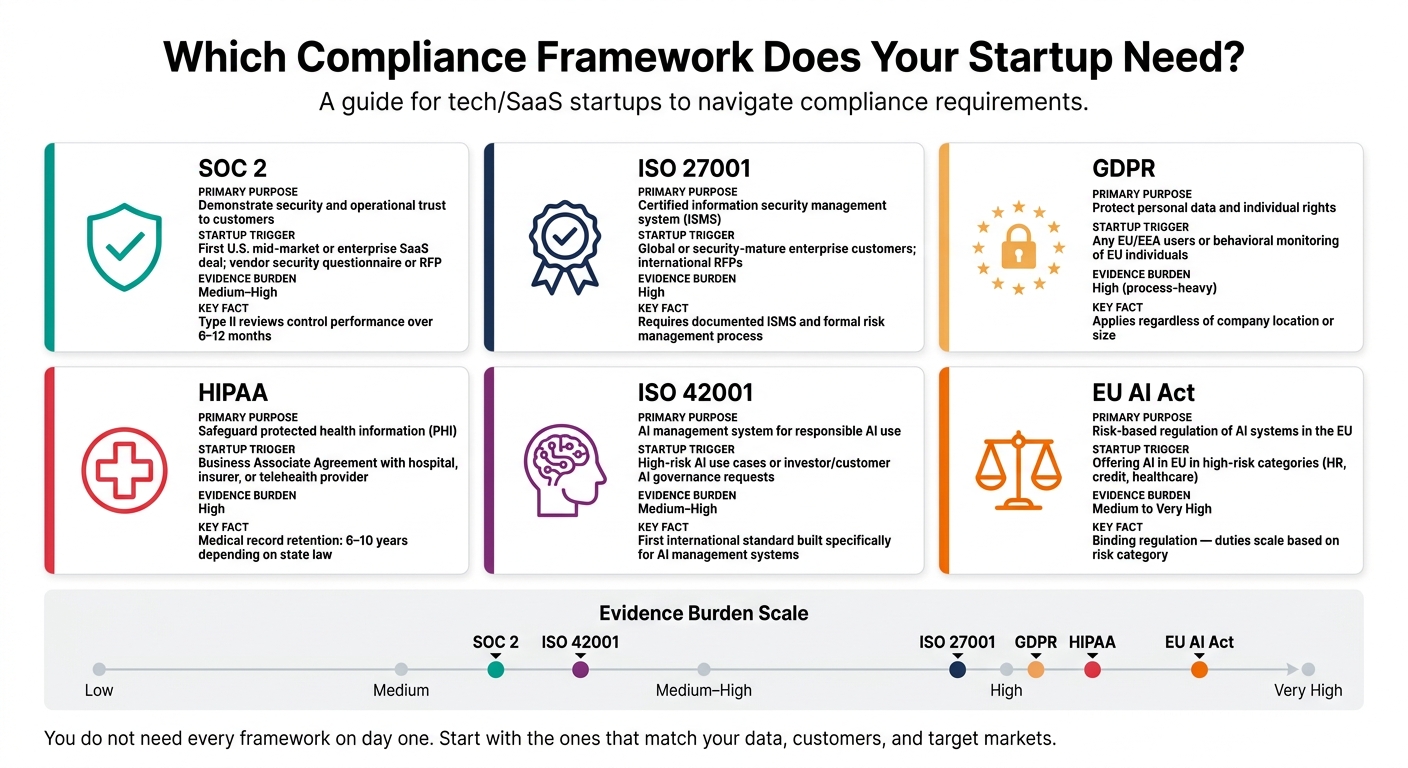
You do not need every framework on day one. Start with the ones that fit your data, customers, and target markets. The table below helps narrow the field before you map duties to controls.
| Framework | Primary Purpose | Typical Startup Trigger | Evidence Burden |
|---|---|---|---|
| SOC 2 | Demonstrate security and operational trust to customers | First U.S. mid-market or enterprise SaaS deal; vendor security questionnaire or RFP | Medium–High |
| ISO 27001 | Certified information security management system (ISMS) | Global or security-mature enterprise customers; international or regulated-industry RFPs | High |
| GDPR | Protect personal data and individual rights | Any EU/EEA users or monitoring behavior of individuals in the EU | High (process-heavy) |
| HIPAA | Safeguard protected health information (PHI) | Business Associate Agreement with a hospital, insurer, or telehealth provider | High |
| ISO 42001 | AI management system for responsible AI use | High-risk AI use cases or requests from investors and large customers for AI governance evidence | Medium–High |
| EU AI Act | Risk-based regulation of AI systems in the EU | Offering AI in the EU in high-risk categories such as HR, credit, or healthcare | Medium to Very High |
Security and trust: SOC 2 and ISO 27001
SOC 2 is a common ask for U.S. B2B SaaS companies selling into enterprise accounts. It is not an ISO standard. It is an AICPA attestation framework where you define your own system boundaries and pick the Trust Service Categories that apply.
A lot of enterprise buyers want a SOC 2 Type II report. That matters because Type II looks at operating effectiveness over 6–12 months, not just whether controls were designed well at a single point in time.
ISO 27001 covers much of the same territory, but it is more prescriptive. It calls for a documented ISMS, a formal risk management process, and planned control selection from Annex A. It is often the better fit for European customers, financial services firms, and enterprise buyers that want a certified third-party audit instead of an attestation.
The good news is that SOC 2 and ISO 27001 overlap a lot. Areas like access control, change management, incident response, vendor management, and security policies show up in both. So instead of building two separate programs, design controls once and reuse proof like access reviews, incident reports, vendor checks, and CI/CD logs across both. That shared layer makes later control mapping much less painful.
Privacy and regulated data: GDPR and HIPAA
GDPR applies as soon as you have EU users or monitor the behavior of people in the EU, no matter where your company is based or how small it is. For a U.S. SaaS startup, that turns privacy by design into a product issue, not just a legal one. Data minimization, purpose limitation, set retention periods, and in-product flows for access, deletion, and consent need to show up early.
HIPAA is triggered when your startup acts as a business associate to a covered entity such as a hospital, insurer, or telehealth provider and handles protected health information (PHI). At that point, you need Business Associate Agreements (BAAs) with every PHI-handling vendor. You also need encryption for PHI in transit and at rest, audit logs for PHI access, and a clean split between marketing systems and clinical data.
Retention can get strict here too. Medical records often need to be kept for 6–10 years, depending on state law.
Once you know the trigger, the next move is simple: define the controls and the proof each framework expects.
AI governance: ISO 42001 and the EU AI Act
ISO/IEC 42001:2023 is the first international standard built just for AI management systems. It gives teams a structure for governing how AI is developed, deployed, and monitored. That includes risk assessments, model documentation, human oversight design, and continuous improvement.
It starts to matter when AI is part of products that affect high-risk decisions, or when large customers and investors ask for proof of AI governance before any formal rule forces the issue.
The EU AI Act is a different beast. It is binding regulation, and the duties scale based on risk category. High-risk AI systems, including those used in employment screening, credit scoring, healthcare decision support, or critical infrastructure, face the heaviest load. That can include technical documentation, conformity assessments, and post-market monitoring.
If your product touches any of those categories and you serve EU customers, this is no longer a future problem. It is an active duty.
For early-stage AI startups, the most practical place to start is an internal AI use case inventory. Write down every AI model or feature in the product, sort each one by risk level, and note what human oversight is in place. That inventory becomes the starting input for gap analysis, control mapping, and owner assignment.
How to run an AI-powered compliance gap analysis, step by step
Once you know which frameworks apply, the next step is to turn your systems, controls, and evidence into a clear picture of what exists, what’s missing, and what needs attention first. AI tools can speed up that first review. But before you act on anything, a person should check the results.
Inventory your systems, data flows, vendors, and AI use cases
Start with a source-of-truth inventory of the records, systems, and data flows tied to the frameworks you picked. Gather your core governance documents, state tax registrations, accounting system records, related contracts or agreements, and any AI use cases.
AI can flag missing or out-of-date evidence on its own, but a human should verify that the inventory is complete.
This inventory becomes the starting point for control mapping.
Map obligations to controls, owners, and evidence
Once the inventory is in place, link each requirement to a control, a named owner, and an evidence item. A control could be a policy, a system setting, a reconciliation log, or even a screenshot that shows the requirement is being met.
AI can draft the first control map, but legal, security, and finance owners should check it. If the company expands into multiple states, hires employees, or is heading into an audit, fundraise, or acquisition, don’t hesitate to override the output.
After the controls are mapped, rank the remaining gaps by risk and effort.
Score gaps by risk, effort, and business impact
After mapping, score each gap so the team tackles the highest-risk items first. A simple 3-point rubric works well, especially when each level has a clear time window for fixing it.
| Risk Level | What It Means | When to Fix It |
|---|---|---|
| Red (High) | Critical regulatory or legal exposure; launch blocker | Immediate (< 30 days) |
| Amber (Medium) | Substantial gap; customer or revenue impact | Short-term (30–90 days) |
| Green (Low) | Minor documentation cleanup; low exposure | Medium-term (90+ days) |
Then add effort into the mix. High-impact, low-effort items should go first. High-impact, high-effort work should move into a planned work cycle.
Each gap should have:
- An owner
- A due date
- An evidence link
That way, the analysis doesn’t just sit in a spreadsheet. It turns into a working plan people can follow.
Set up your AI compliance tools and team routines
Once you’ve ranked the highest-risk gaps, set up the tool around those first. That gives you a simple way to decide which alerts matter and which evidence sources the system should watch.
Connect documents, systems, and evidence sources
Start by loading the obligation map into the AI tool so it can track the right controls. Then connect the systems that store your evidence: policy folders, ticketing systems, cloud infrastructure logs, HR systems, vendor records, and your evidence repository. The goal is simple: reviews shouldn’t hinge on someone chasing files by hand.
Before you switch fully, run the AI workflow alongside your manual process for 30 days. That side-by-side period helps you spot issues early without losing control.
Once those data sources are connected, define the small set of events that should trigger a review.
Set up alerts, review rules, and human review gates
Keep alerts tight. Only trigger them for material control changes so you don’t bury the team in noise. Then review and trim those alert rules every quarter.
You also need clear handoff points so the AI knows when a person has to step in. A low confidence score, a new regulatory change, or any high-risk item should route straight to a named owner. Routine flags can go to a junior analyst. Harder judgment calls should go to your compliance lead or outside counsel.
And when a person reviews an AI output and overrides it, log that decision and the reason inside the tool. That keeps your audit trail in place and gives you a record of how calls were made.
Assign owners across finance, legal, security, and ops
If your startup team is lean, keep ownership simple. By this point, each obligation should already be tied to a control and an evidence source from the earlier mapping step. Here, you’re just assigning the person who keeps it up to date.
Each obligation should list:
- what is required
- how often it is checked
- one specific person’s name and role, not just “Legal” or “Finance”
| Function | What They Own |
|---|---|
| Finance | Books, tax, and investor-ready reporting |
| Legal / Compliance | Regulatory change tracking, obligation map maintenance |
| Security / Ops | Cloud infrastructure evidence, HR system data, vendor record updates |
These routines shape the review cadence that keeps compliance current as the company grows.
Keep compliance running as your company grows
A gap analysis is the starting point. What keeps your company protected is the routine you build after that. Once owners are assigned, compliance stops feeling like random cleanup work and starts working like a repeatable operating rhythm.
Build a review cadence for monitoring and control testing
Compliance work compounds. That can work in your favor, or it can come back to bite you. A small gap that sits untouched for one quarter can turn into an expensive mess right before a fundraise. A steady review rhythm helps stop that from happening.
The table below matches the main tasks to the right timing:
| Cadence | Key Activities |
|---|---|
| Monthly | Reconcile bank and card accounts, confirm payroll tax withholding, log ownership or address changes |
| Quarterly | Review multi-state nexus exposure and new hiring or registration triggers |
| Annual | File state annual reports, issue 1099s and W-2s, update corporate meeting minutes, renew business licenses, conduct HR policy reviews |
| Triggered | File Corporate Transparency Act filings, execute new state registrations |
As payroll grows, worker-classification rules get harder to manage, and state privacy duties keep expanding, quarterly reviews become a must.
Keep reporting ready for customers, investors, and the board
That same cadence should feed your board and investor updates. Diligence tends to move fast, so your records need to stay clean all year. The goal is simple: be ready for diligence at any time, not just during the few hectic weeks before a raise.
In practice, that means keeping three things current:
- Clean books
- A clear compliance status summary
- A gap log with remediation owners and target dates
When a board meeting or investor update comes up, those inputs make it much easier to pull together a useful update without a last-minute scramble.
Keep books, tax, and investor reporting current so diligence requests stay fast.
Key takeaways for founders
The main lesson in this guide is simple: compliance is a system, not a checklist. Here’s what to keep in mind:
- Define scope first. Know which obligations apply to your business before you build controls around them.
- Use AI to speed up gap analysis, but have a person review every output who understands the business context.
- Prioritize fixes by risk and business impact, not by what looks easiest. Payroll tax filings and state registrations can block funding.
- Turn compliance into an operating process. Monthly, quarterly, annual, and triggered routines help keep the AI-generated gap analysis accurate over time and your company ready for diligence year-round.
FAQs
How do I know which framework applies first?
Start with a thorough gap analysis of your current operations. Pull all obligations into one place, including federal and state rules, standards like SOC 2, HIPAA, and SOX, plus any contract terms you need to meet.
Then map those requirements against your current policies and controls to spot the gaps. From there, focus first on the area causing the most pain or carrying the most risk, and confirm your obligations with legal experts before you roll out automated solutions.
What proof should I collect for each control?
Start with a control inventory that maps each in-scope control to the evidence it needs and how often it should be reviewed.
Then gather artifacts like configuration files, multi-factor authentication logs, backup records, vulnerability scans, CI/CD deployment records, and audit trails that show who, what, when, where, why, and how. Those trails should also include approvals and certifications.
With Lucid Financials, you can pull these data points in automatically through API integrations.
When should a person override AI output?
Override AI output in high-stakes situations or when the system flags low-confidence matches. In those moments, a compliance expert should step in, review the case, and make the final call.
Human oversight also matters when you need to check that AI-driven actions match the startup’s long-term financial goals and fiduciary duties. And every override should go into your audit trail, so it’s there for regulatory review.