AI personalization paid off when startups used it on one clear revenue problem.
As I read these cases, the lesson is simple: better timing, better offers, and better audience splits led to more revenue and lower churn. In this article, one startup used purchase signals, subscription behavior, and referral-source data to improve cross-sells, lifecycle emails, and landing pages.
Here’s the short version:
- Post-purchase product suggestions helped push 18-month LTV from $44 to $66, a 50% increase
- Behavior-based email flows helped move subscription revenue from 31% to 54% of total revenue
- Referral-based landing pages helped referred visitors convert 3.1x more often than cold paid social traffic
- The team also cut blended CAC from $38 to $31
- And it improved LTV/CAC from 1.16x to 2.1x
What stands out to me is that this was not about adding AI everywhere. It was about using customer signals in a few places that directly affect conversion, retention, and margin.
If you want the main takeaway in one line, it’s this: AI personalization works best when you tie it to a single bottleneck, track hard numbers, and expand only after it works.
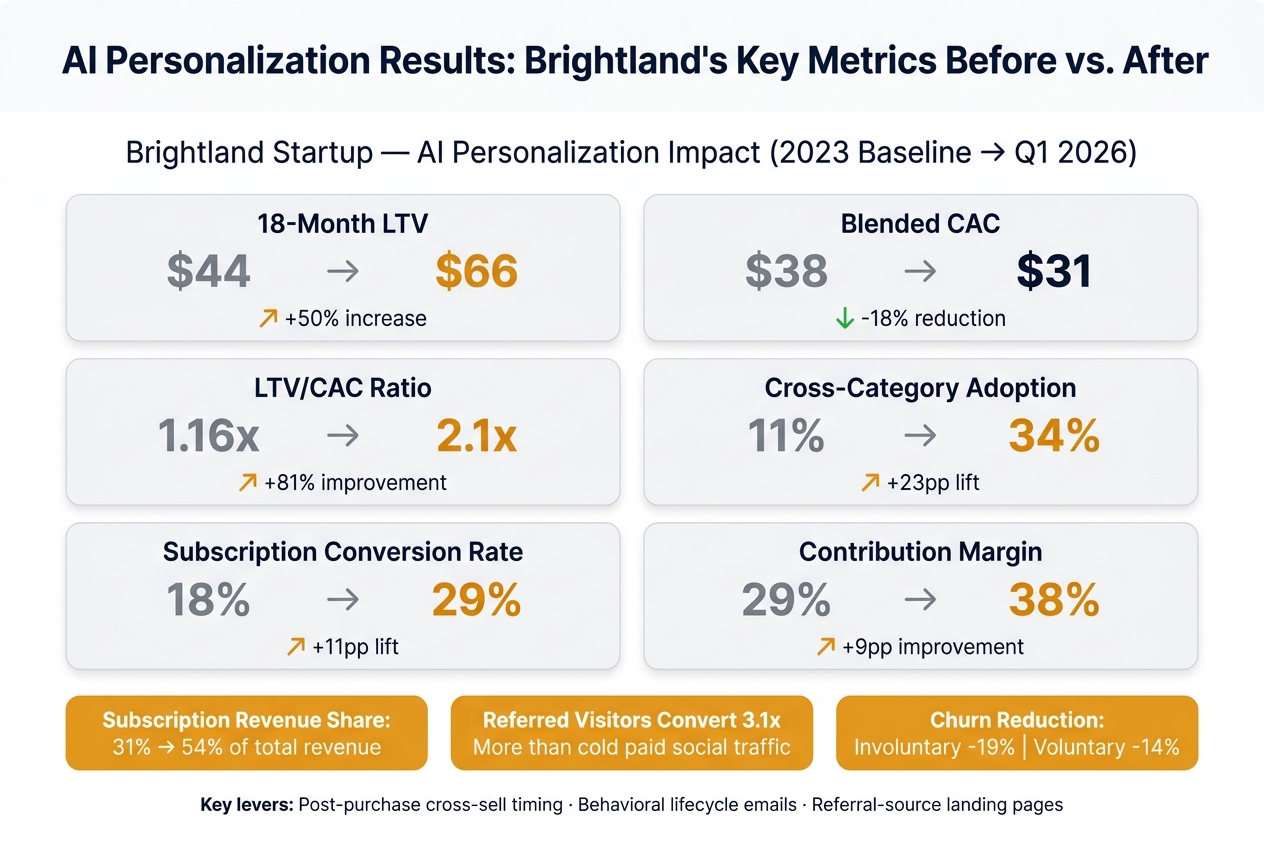
AI Personalization Results: Brightland's Key Metrics Before vs. After
Case study 1: AI recommendation engines that increased conversion
| Startup | Brightland |
|---|---|
| Personalization tactic | Predictive cross-sell triggers via Klaviyo LTV scoring |
| Channel | Email flows + subscription portal |
| Result metric | 18-month LTV up 50% ($44 → $66) |
| Timeframe | Q2 2024 – Q1 2026 |
Company background and personalization challenge
Brightland, a California olive oil startup, had loyal subscribers. The problem was simpler than it sounds: people liked the brand, but they weren't adding much more to their baskets.
AI method, campaign execution, and results
To deal with weak basket expansion, Brightland rebuilt its post-purchase journey around predictive triggers. Marcus Holloway, VP of Growth, used Klaviyo's predictive analytics suite and Recharge's API to swap out generic onboarding emails for automated flows tied to LTV prediction scoring.
That change let Brightland put complementary products, like vinegars and honey, in front of customers at the 45-day mark. Instead of sending the same follow-up to everyone, the brand used timing and product suggestions based on likely customer value.
Brightland also moved to a bundle-first subscription model built around an $89/month "Foundation Pantry" tier. And when subscribers tried to skip or cancel, the brand didn't fall back on blanket discounts. It offered personalized substitutions instead.
Over 18 months, the numbers moved in a big way:
| Metric | 2023 Baseline | Q1 2026 Result |
|---|---|---|
| 18-Month LTV | $44 | $66 |
| Blended CAC | $38 | $31 |
| LTV/CAC Ratio | 1.16x | 2.1x |
| Cross-Category Adoption | 11% | 34% |
| Subscription Conversion Rate | 18% | 29% |
| Contribution Margin | 29% | 38% |
"The real answer is almost never about the top of funnel. It's about making your existing customers so embedded in the brand that they become the funnel." - Marcus Holloway, VP of Growth, Brightland
Brightland's lift came from getting post-purchase cross-sell timing right. The next case shifts from product timing to email timing and message fit.
sbb-itb-17e8ec9
Case study 2: AI email and lifecycle campaigns that increased subscription revenue
| Startup | Brightland |
|---|---|
| Personalization tactic | AI behavioral segmentation and predictive cross-sell triggers |
| Channel | Email lifecycle flows + subscription portal |
| Result metric | Subscription revenue rose from 31% to 54% of total revenue |
| Timeframe | July 2024 – Q1 2026 |
The same customer data that improved recommendations also helped Brightland send emails at better moments and make save offers more relevant.
What was underperforming before personalization
Brightland's email and portal flows weren't converting well, even though the brand already had strong customer loyalty.
How AI changed the message and timing
Brightland used those same behavioral signals to move beyond product recommendations and into lifecycle messaging. Instead of relying on static flows, the team used Klaviyo-powered segmentation with LTV scoring and behavioral triggers to decide what message to send and when to send it.
That shift let Brightland trigger personalized cross-sells right when purchase intent was highest. And when subscribers tried to cancel, the brand used a cancel-save flow that offered options based on each customer's situation rather than giving everyone the same message.
Results
Personalized lifecycle messaging pushed more revenue into subscriptions and cut churn at the same time. Subscription revenue rose from 31% to 54% of total revenue. Involuntary churn fell 19%, and voluntary churn dropped 14%. By mid-2026, Brightland had reached $130M in trailing twelve-month revenue without increasing its paid media budget.
Case study 3: AI website and onboarding personalization that improved lead quality
| Startup | Brightland |
|---|---|
| Personalization tactic | Referral source segmentation and bundle-first onboarding flows |
| Channel | Website landing pages + subscription onboarding flow |
| Result metric | Referred customers converted 3.1x more often than cold paid social visitors |
| Timeframe | July 2024 – June 2026 |
After improving email timing, Brightland pushed personalization further up the funnel and started with the first landing page.
How the site experience changed by segment
Brightland also tailored landing pages and onboarding based on referral source. The team used referral-source data to separate referred visitors from cold paid social traffic. That split changed what people saw right away.
Referred visitors landed on a page with a full-size product gift instead of a discount. And the change didn’t stop at the first offer. The same segment data shaped the onboarding flow too, so the path matched the referral offer with a simpler subscription journey.
Measured impact on lead quality and conversion
The payoff showed up in both lead quality and conversion. Referred customers converted 3.1x more often than cold paid social visitors. Their 90-day retention was also 22 percentage points higher than the paid acquisition cohort.
What founders should take from these examples
The common factors behind the best results
Across these case studies, the pattern is pretty clear: the teams that won didn't try to do everything at once. They picked one bottleneck, one data set, and one channel, then expanded later. That kept them from spreading themselves too thin. It also helped them avoid the trap of getting customer love without bigger baskets. The levers were steady across the board too: recommendation timing, lifecycle timing, and segment-based site messaging.
Brightland followed that same playbook. Bundle-first subscriptions, predictive cross-sells, and referral-gift offers pushed 18-month LTV from $44 to $66 and improved LTV/CAC from 1.16x to 2.1x. That’s the point: personalization works best when it improves margin and conversion, not when it just drives more activity.
The other pattern was measurement discipline. The strongest outcomes showed up when founders tracked contribution margin, cohort retention, and referral rate, instead of stopping at clicks or open rates.
That makes measurement the thing that sets the best teams apart.
Conclusion: Personalization works when results are measurable
A focused AI use case, clean customer data, and disciplined execution separate startups that see real revenue gains from those chasing measurable revenue gains without a clear system. Clean books make it much easier to track CAC, LTV, and margin.
FAQs
Where should a startup start with AI personalization?
Start with clear, outcome-based goals. For example, aim to reduce churn or grow a specific revenue stream. That works better than trying to use every bit of data all at once.
Put your attention on high-quality first-party data, like purchase history or engagement metrics. Then add one more factor before you scale. Think of it like turning one dial at a time - you can see what changes, what works, and what needs fixing.
Use accurate data to shape tailored touchpoints, and track conversion rates so you can keep improving over time.
What customer data matters most for personalization?
Focus on high-quality behavioral data. In many cases, it tells you more than static demographic data ever will.
The signals that matter most include purchase history, browsing behavior, and product usage data like login frequency or feature adoption. Relationship signals matter too, especially support ticket history and NPS scores.
When you pull these signals together in your CRM and analytics platforms, you get dynamic customer profiles that shift in real time as customer behavior changes.
Which metrics show personalization is working?
Track the metrics that connect personalization to business results: LTV, conversion rates, ROMI, and CAC. These numbers show whether your campaigns are driving revenue and changing customer behavior in a way that matters.
It also helps to keep an eye on engagement signals, such as email open rates, click-through rates, customer satisfaction, churn risk scores, and purchase likelihood scores. Together, they show how well your messaging is landing and can help you spot high-value opportunities early.