
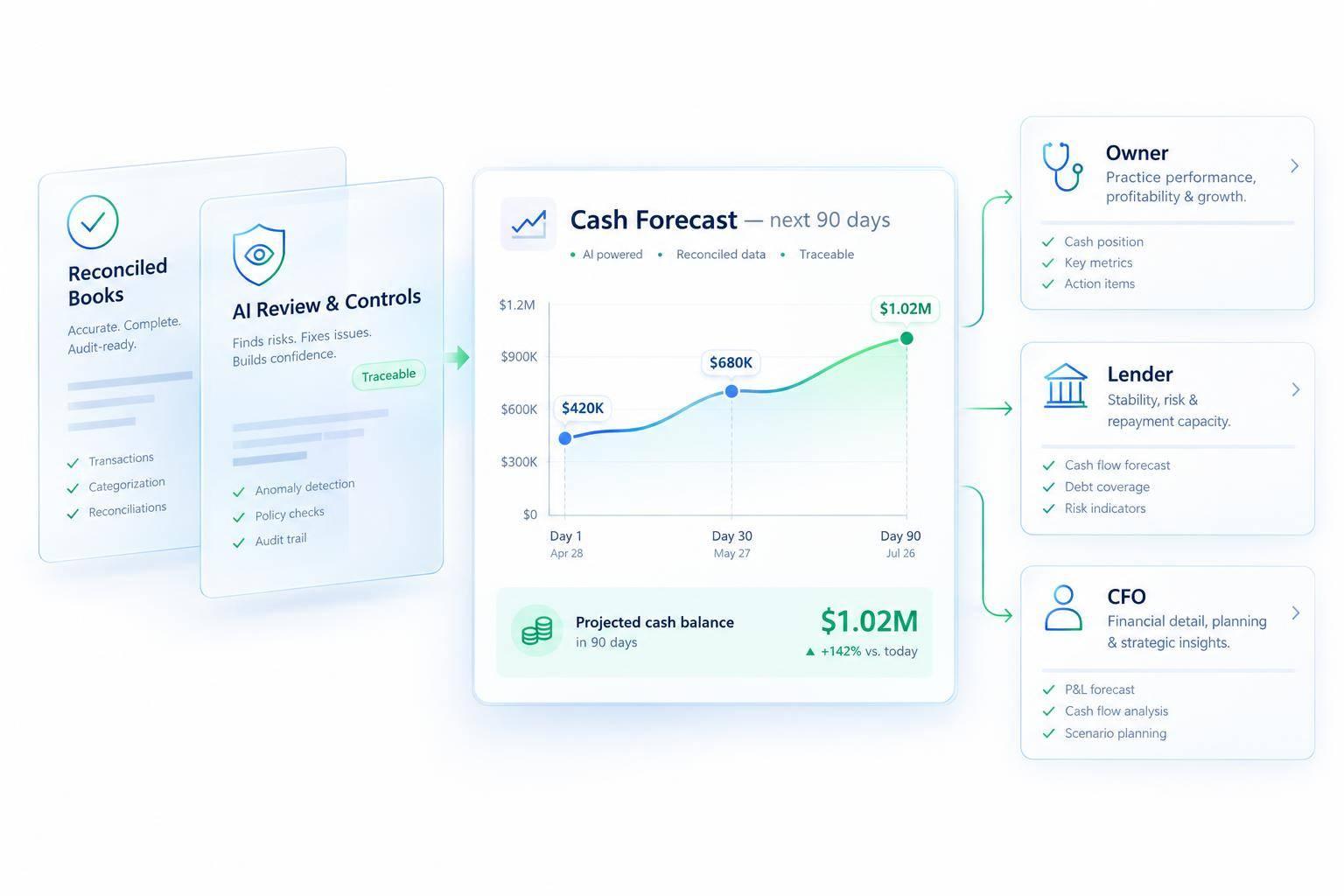
Useful financial reporting starts with reconciled books—not a dashboard. Medical practice owners need to understand where cash is going, whether collections can cover upcoming obligations, and how each location or entity is performing. Practice managers and the finance team need reports that explain what requires action.
Keep billed charges, recognized revenue, and cash received separate. Then use accountant-reviewed reports to evaluate staffing, spending, owner distributions, and expansion. AI-assisted analysis can help organize information and draft explanations, but it does not replace reconciliation or professional judgment.
A practical reporting workflow has four priorities:
- Match the report to the decision. Show cash, collections, costs, and location profitability with clear dates and definitions.
- Plan cash weekly. Use a rolling 13-week forecast to test hiring and investment against payment delays and committed costs.
- Keep people in control. Assign preparation, review, and approval responsibilities, and limit access to sensitive information.
- Test before expanding. Compare AI-assisted reports with approved results before relying on them for recurring decisions.
The goal is numbers owners can trace and decisions the finance team can explain.
Build the Monthly Reporting Package Around Owner Decisions
A practice does not need every available metric in its monthly package. It needs a consistent set of reports that explains performance, cash availability, and exceptions requiring attention.
| Report | What it should show | Decision it supports |
|---|---|---|
| Practice and entity-level financial statements | Profit and loss, balance sheet, and material changes from prior periods or budget | Understand results, obligations, and amounts needing investigation |
| Cash summary and forecast | Available cash by entity, upcoming payments, expected receipts, and projected low points | Schedule spending, assess distributions, and plan financing |
| Collections and receivables summary | Payer receipts, patient balances, aging, and material collection changes | Direct follow-up with the billing team and revise receipt assumptions |
| Payroll and staffing expense report | Provider and administrative payroll, benefits, and relevant budget variances | Evaluate affordability before adding staff or changing schedules |
| Location P&L | Direct revenue and costs, shared-cost allocations, and margins before and after allocations | Assess location performance and expansion readiness |
| Variance and action summary | Significant differences, supporting evidence, responsible person, and next step | Turn financial review into assigned follow-up |
Every issued report should identify its reporting period, accounting basis, entity or location scope, and whether it is preliminary or final. A current-looking dashboard can still contain incomplete payroll, stale bank information, or unresolved adjustments.
sbb-itb-17e8ec9
Connect and Reconcile Financial Records
Bring together the records needed for the reporting package: bank accounts, payroll registers, accounts payable, the general ledger, and appropriate billing and payment summaries. Standardize account names, dates, vendors, entities, and locations before combining information.
Map transactions to a consistent chart of accounts. Investigate missing records, duplicate invoices, unusual amounts, and postings to unexpected accounts. Keep business and personal activity separate. The IRS guide to business recordkeeping explains the importance of complete records, separate business accounts, and bank reconciliation.
For example, reconcile a payment processor settlement to gross payments, fees, refunds, and settlement timing rather than treating the net deposit as a complete revenue record. The accountant should determine the appropriate posting based on the practice’s accounting method and existing entries.
AI-assisted tools may suggest matches or flag exceptions where supported by the workflow. An authorized reviewer should approve material corrections and journal entries.
| Activity | Preparation work | Required review |
|---|---|---|
| Data collection | Gather records and standardize fields | Confirm completeness, timing, permissions, and mapping |
| Reconciliation | Match transactions and list differences | Investigate unresolved items and approve corrections |
| Report preparation | Assemble statements, comparisons, and commentary | Confirm close status, calculations, and entity scope |
| Exception review | Identify unusual transactions and changes | Decide whether each item reflects an error, legitimate activity, or a control concern |
Only after the underlying records reconcile should the reports be used to explain cash and profitability.
Read Collections, Payroll, and Location Profitability Together
Separate Charges, Revenue, and Cash
Billed charges are not the same as recognized revenue or collected cash. Charges reflect amounts billed or submitted. Revenue depends on the applicable accounting method and recognition policies. Cash reflects payments received.
Contractual adjustments, denials, patient balances, refunds, and payment timing help explain differences. Review collections alongside receivable aging and billing-team summaries rather than assuming that higher charges will immediately fund payroll.
If receipts decline, first determine whether the change comes from lower activity, payment timing, adjustments, or another documented cause. A financial variance alone does not establish a billing problem.
Review Staffing Costs in Context
Separate provider and administrative payroll where useful. Include benefits and other relevant employer costs so a hiring decision is not based only on salary.
Compare staffing expenses with budget, receipts, and the timing of upcoming payroll. A temporary increase may reflect onboarding or coverage rather than a lasting deterioration in performance. The report should distinguish a known timing issue from a recurring cost increase.
Make Location and Entity Results Comparable
Assign direct costs to the location that incurred them. For shared costs, document allocation drivers such as headcount, square footage, or provider hours. Choose a driver that reasonably reflects the expense and apply it consistently across comparable periods.
Show location margins both before and after shared-cost allocations. This helps owners distinguish a location’s direct performance from the effect of central administrative costs.
For multi-entity practices, retain entity-level statements and bank reconciliations alongside consolidated reporting. Have the accountant review intercompany balances and consolidation adjustments so transfers do not distort the combined picture.
These reports inform different decisions: whether to investigate a location’s spending, adjust shared-cost allocations, delay an expansion, or examine why an apparently profitable entity has limited cash.
Use a Rolling Cash Forecast Before Committing Funds
A monthly P&L explains performance, but it does not show every upcoming cash obligation. Build a rolling 13-week cash forecast, update it weekly, and compare forecast receipts and payments with actual results.
Estimate receipts using payer timing, receivable aging, patient balances, and information from the billing team—not gross charges alone. Where practical, separate payer categories with meaningfully different collection patterns.
Schedule provider and administrative payroll, benefits, vendor invoices, rent, debt payments, planned tax payments, and equipment purchases by expected payment date. Confirm tax-payment assumptions with the practice’s tax adviser. Keep committed obligations separate from discretionary spending.
Record each material assumption’s source, date, and owner. This makes a forecast easier to challenge and update.
Test Hiring and Expansion Against the Lowest Cash Balance
Before approving a new provider, equipment purchase, or location, examine the forecast’s lowest weekly cash balance—not just ending cash or reported profit. Compare it with a reserve level selected by management with finance input.
Illustrative planning example—not actual practice results or recommended benchmarks: A practice wants to test a provider hire and potential equipment purchase. The following assumptions are sensitivity tests, not predictions.
| Scenario | Illustrative assumptions | What the finance team should evaluate | Possible owner decision |
|---|---|---|---|
| Base | Current collection patterns and approved staffing costs continue | Lowest weekly cash balance after committed payments | Maintain the plan if reserves remain adequate |
| Collection delay | Expected payer receipts arrive 10 days later | Whether payroll and other obligations remain funded during the delay | Defer discretionary purchases or discuss financing options |
| Higher staffing cost | Payroll expense is 5% above the base forecast | Whether recurring receipts support the additional cost | Revisit the hiring date or staffing budget |
| Expansion | A $90,000 equipment payment occurs before additional collections begin | Upfront cash need, ongoing costs, and sensitivity to delayed receipts | Phase the investment, arrange financing, or postpone |
These assumptions do not establish an ending cash balance. The finance team must calculate each scenario using the practice’s actual payment schedule and expected receipts.
For expansion, review location and entity margins alongside deposits, buildout, equipment, rent, new payroll, and collection ramp-up. Document why actual results differ from the forecast and revise assumptions rather than carrying an outdated estimate forward.
Assign Reporting Ownership and Review Controls
Start with the owner’s and manager’s recurring decisions. Assign one accountable reporting owner, then document each report’s audience, source records, calculation logic, update schedule, reviewer, and approval requirement.
A workable monthly sequence is:
- Set the cutoff. Identify which periods and records are included and what remains outstanding.
- Complete reconciliations. Resolve material differences or clearly disclose unresolved items.
- Prepare the package. Use consistent definitions, entity boundaries, and allocation methods.
- Obtain accountant review. Check statements, material adjustments, allocations, and commentary against supporting records.
- Meet with the owner or manager. Discuss exceptions and decisions rather than reading every line aloud.
- Record follow-up. Assign an owner and due date for each action, and revisit it at the next meeting.
Location managers may need their location’s collections, labor, and spending reports. Owners may need consolidated results and entity-level cash. External lenders should receive the approved information appropriate to their request, not unrestricted access to internal payroll or unrelated entity records.
An unusual transaction or variance is a prompt to investigate—not proof of fraud, poor management, or a particular cause. Require explanations to reference supporting records and distinguish confirmed findings from hypotheses.
Limit Patient Information in Financial Analysis
Use aggregate payer categories, financial totals, and appropriately de-identified data when patient-level information is unnecessary. Do not put patient-identifiable information into ordinary Slack messages or a general-purpose AI tool to explain a revenue variance.
When accounting work involves protected health information, assess the vendor’s role and applicable contractual requirements before sharing it. The HHS overview of the HIPAA Privacy Rule explains covered entities and business associates, including circumstances involving accounting services. Its minimum necessary guidance describes the standard and its exceptions.
Work with appropriate privacy or legal advisers when needed. These considerations do not establish any vendor’s compliance status.
Test AI-Assisted Reporting Before Relying on It
Start with a limited workflow, such as drafting a monthly variance summary from approved financial statements. Keep posting entries, approving payments, and issuing final reports under human control.
Run the proposed workflow alongside the existing process for several reporting cycles. Compare totals, classifications, entity scope, unresolved exceptions, reviewer corrections, and time to approved distribution.
Measure the work from source collection through final approval—not just drafting speed. Faster drafts offer little benefit if the accountant must spend more time correcting them. Recheck results after changes to data sources, reporting rules, or tools.
Optional Background: AI in Financial Accounting and Reporting
This webinar provides general background on AI in accounting and reporting; it is not evidence of a specific medical practice outcome or Lucid service capability.
Work With a Practice-Focused Finance Team
Lucid Financials provides CPA-led bookkeeping, tax, and CFO services for staffed U.S. private medical practices. It combines AI-assisted financial work with a human finance/CPA team, including clean books, catch-up bookkeeping, location and entity financial visibility, and support through Slack.
Agree on the reporting scope before work begins: entities and locations covered, accounting basis, shared-cost allocations, review responsibilities, and delivery schedule. Ask how accountant-reviewed reports will support your specific decisions, such as adding a provider, managing cash between obligations, or assessing a location’s performance. Keep patient-identifiable information out of ordinary Slack conversations.
Conclusion: Turn Reliable Reports Into Decisions
A useful reporting package connects reconciled records to owner action. It explains what changed, what remains uncertain, and whether cash can support the next commitment.
Start with consistent monthly statements, location and entity visibility, and a weekly cash forecast. Add AI assistance where testing shows it helps, while retaining accountant review and clear approval responsibilities.
FAQs
How can I verify an AI-generated financial explanation?
Trace the figures to approved financial statements and supporting schedules. Check the period, accounting basis, entity scope, calculations, and comparison being used. Ask the reviewer to separate documented causes from possible explanations.
A claim that payroll increased because of a new hire should agree with payroll records. A claim that collections fell because of payer delays needs supporting collection information. Do not treat plausible wording as evidence or assume every tool provides a complete audit trail.
How much financial history do I need for a useful cash forecast?
There is no single amount that makes every forecast reliable. Begin with reconciled cash, upcoming obligations, receivables information, and documented collection assumptions. More comparable history can help reveal timing patterns and seasonality, but older records may be less relevant after a major staffing or location change.
If history is limited, make uncertainty explicit, use conservative scenarios, and compare forecasts with actual receipts and payments each week. A forecast remains a planning estimate, not a guarantee.
How do I measure the value of AI-assisted reporting?
Compare total preparation and review costs before and after adoption. Include software, setup, training, support, and correction time. Track time to approved reporting, unresolved exceptions, and whether reports arrive early enough to inform decisions.
Also check whether the workflow improves follow-through: for example, whether a cash shortfall is identified before a hiring commitment. Do not assume a fixed percentage reduction in manual entry or reporting time, and do not count projected savings as realized results.