AI credit scoring can help startups get faster lending decisions - but it doesn’t guarantee approval or lower rates. My first advice: reconcile your books and correct errors before sharing financial data with a lender.
In one Vancity pilot, average application time fell from up to 4 hours to about 5 minutes. That’s application time - not time to receive funding.
Here’s what I’ll cover:
- Faster decisions with less manual data handling.
- More accurate risk estimates when models pass testing.
- More financing options for startups with limited credit history.
- More consistent reviews using the same rules.
- Lower processing costs for startup lenders.
- Earlier risk warnings after loans are funded.
- Less bias and clearer reasons when testing and review controls work.
The trade-off? Staff spend less time sorting files and more time checking models, handling exceptions, and reviewing results. I’ll explain why <u>clean data, limited data access, and human oversight</u> matter - and why faster scoring alone isn’t enough.
AI-Assisted Loan Processing: One Deployment’s Results
AI-Driven Credit Risk: A Framework for Small-Scale Lending | Uplatz
sbb-itb-17e8ec9
1. Faster Credit Decisions
With authorization, an AI-assisted system can pull permitted data from bank, accounting, payroll, payment, and credit bureau sources. It then standardizes the data, flags gaps, estimates repayment risk, and applies eligibility and pricing rules. The result may be an approval, decline, offer, or referral for human review.
In a six-month small-business lending pilot, Vancity used automated analysis of recent transaction history. The case study reports that average application time fell from up to 4 hours to approximately 5 minutes.
That means faster review, not instant funding. The speed depends on clean, simple data and a model built to keep reviews moving with few hurdles.
Straightforward applications with clear, verifiable data may get a decision in minutes. Irregular revenue, complex ownership, missing documents, or larger requests usually require human review. And an early eligibility result isn't final approval.
For founders, an earlier answer helps with payroll, inventory, and hiring plans. If financing falls through, it also leaves more time to delay spending and negotiate supplier terms.
2. More Accurate Risk Estimates
Speed helps, but startups also need decisions that stay accurate as data changes. Machine learning can detect nonlinear relationships, where risk depends on how signals interact. With training and testing on relevant financial and transaction data, it can improve risk estimates. Those estimates help startups avoid overextending capital and help lenders price credit more fairly.
Compare the AI model with the current scorecard using the same borrowers over a 12-month outcome window. Ask for ROC-AUC, which measures how well the model ranks higher-risk borrowers above lower-risk borrowers. Track default rates by score band, along with borrower counts in each band. Default rates should increase as risk increases.
At the cutoff, false positives reject good borrowers, while false negatives miss risky ones. Also check whether predicted default probabilities match actual outcomes. This helps make the score useful for pricing - not just approval.
Require out-of-sample testing on data never used to train or tune the model, preferably from a later period. Back-testing is one form of out-of-sample testing. Ask whether the results hold for businesses in your industry, revenue range, and company-age group.
Missing data, overfitting, and changing conditions can distort predictions. After launch, startup lenders should monitor score-band default rates and changes in inputs. They should also revalidate the model when the borrower mix, data sources, or lending conditions change to check whether its estimates remain reliable.
3. More Financing Access With Limited Credit History
A thin credit file doesn’t tell the whole story of a startup’s ability to repay. With authorization, AI underwriting can review bank, accounting, invoice, payment, and transaction data to spot cash-flow patterns a credit score may miss. Federal banking agencies have also pointed to cash-flow data as a way to improve the speed, cost, and accuracy of small-business underwriting and expand credit access.
A 2025 NBER study of about 1.1 million small-business loan applications from 2013–2024 found that cash-flow-focused lenders increased approval chances for entrepreneurs under 40 by 2.4 percentage points. That finding concerns the owner’s age - not the startup’s age - and doesn’t guarantee approval or better terms. The same cash-flow view can also support more consistent repeat reviews later.
This access matters most for startups with little bureau history but strong business records. Before connecting accounts, ask which data sources the lender uses, how many months of records it needs, and how often it updates that data. Also ask how it handles data retention, sharing, and permission revocation, along with irregular revenue, seasonality, funding rounds, transfers, and founder advances.
Ask for plain-language reasons tied to your data and a way to correct inaccurate records. The explanation should identify factors such as weak cash flow or high obligations - not simply say an algorithm made the decision.
Transaction records can expose employee, customer, and vendor information, so limit access to what underwriting requires. Ask whether the model uses nonfinancial inputs that may act as proxies for protected traits. Keep those data limits in place for repeat reviews, too.
4. More Consistent Credit Reviews
As credit volume grows, consistency matters as much as speed. AI can apply the same eligibility rules, score thresholds, and approval limits to every application. That means repeatable policy enforcement - not automatically better judgment.
Keep models and policies under version control. For each release, record its effective date, owner, feature list, training-data window, decision thresholds, and approval record. This lets you trace every decision back to the rules used. Validate each release before deployment.
Create a shared data dictionary that defines key terms, such as revenue and debt. Write down what triggers human review, including conflicting records or applications outside the model’s intended scope. Require authorized reviewers to document why they approved an exception.
Maintain an access-controlled audit log of the inputs used, versions, decisions, reviewers, and overrides. Track exceptions by reviewer and reason to spot inconsistent decisions.
Use outcome checks and fairness testing to catch flawed rules and uneven results. These controls also reduce rework and manual exception handling.
5. Lower Processing Costs for Startup Lenders
Once reviews are standardized, the next step is to cut the cost per file. AI-assisted document review can extract bank-statement data, check for missing fields, and organize records for underwriting. For startup lenders and embedded-credit programs, this can mean less manual data entry and more applications handled by the same team.
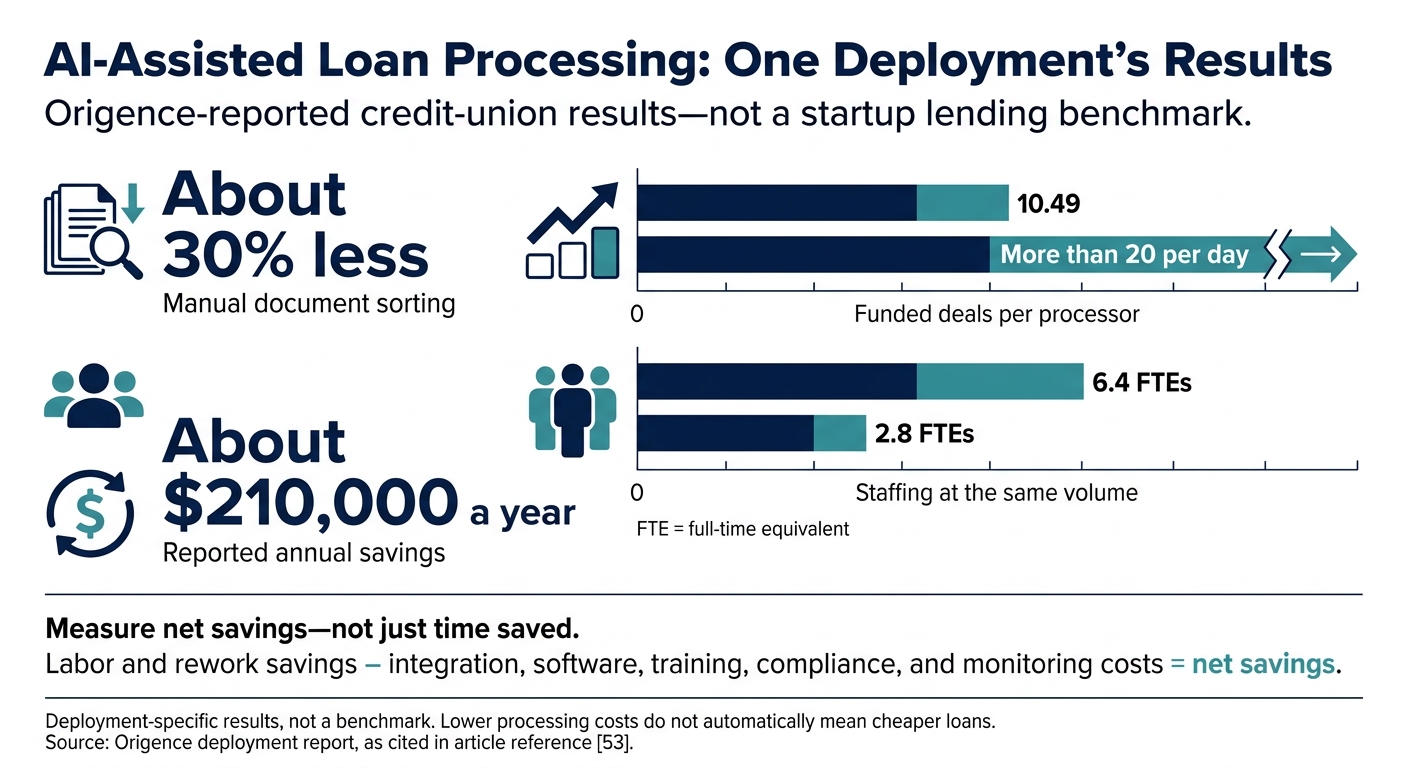
Origence reports that one credit-union deployment cut manual document sorting by about 30%, raised funded deals per processor from 10.49 to more than 20 per day, and reduced staffing from 6.4 to 2.8 FTEs at the same volume, saving about $210,000 a year. Treat this as deployment-specific, not a benchmark.
Measure net savings, not just time saved. Subtract integration, software, training, compliance, and monitoring costs from labor and rework savings. Low application volume, disconnected systems, or complex documents can wipe out those savings. When unit costs fall, lenders may find it easier to serve thin-file startup borrowers profitably.
Start with one high-volume, standardized workflow, such as bank-statement extraction. Compare its cost per application, processing time, error rates, exception volume, and human review rates with the current process. Expand only when measured savings exceed recurring operating and governance costs.
Lower processing costs don’t automatically mean cheaper loans. Lenders may put the savings toward handling more applications, improving service, or strengthening controls. Lowering rates or fees requires a separate pricing decision. The savings matter most when lenders can handle more volume without losing sight of risk.
6. Earlier Portfolio Risk Warnings
AI can keep watching for risk after funding as conditions change. Application scoring guides the initial decision; portfolio monitoring tracks risk after funding.
With current, authorized data, monitoring can flag declining deposits, higher utilization, returned payments, and frequent extension requests before cash flow tightens. It can also reveal concentration risk by industry, geography, or funding source. A cluster of declines matters more than one outlier.
Treat alerts as triage, not proof. Before acting, check source records, how current the data is, seasonality, and the borrower’s explanation.
Start with a monitor-only pilot. Assign someone to each alert and set response times, then review false positives and missed risks monthly. Log every alert, review outcome, and action taken. When reasons must be given, explain the specific cause - not just that the model flagged risk. Use that same consistent approach to make reasons clearer in later reviews.
7. Less Bias and Clearer Decision Reasons
The controls that make lending decisions more consistent can also help spot bias. Better feature selection can reduce avoidable declines and build borrower trust. AI can reduce bias, but it cannot remove it. Use inputs tied directly to repayment capacity, such as verified revenue, cash-flow stability, and debt obligations. Document why each input matters, remove unlawful or unjustified proxies, and test whether less discriminatory inputs offer similar predictive value.
Where law and privacy rules allow, compare approval, pricing, and error rates across demographic groups. Check both disparate impact and gaps in error rates.
Testing is only part of the job. Clear reasons are a legal requirement. Under ECOA and Regulation B, creditors must provide specific, accurate principal reasons in required adverse-action notices - even when a complex model makes the decision. Clear explanations help founders correct data and reapply sooner.
Give borrowers a documented appeal process so they can correct data and submit evidence. For thin-file startups, this creates a chance to fix inaccurate records and regain approval opportunities. Track reversals by group to spot problems with the model, source data, or notices.
Run monthly checks and quarterly fairness reviews, with assigned owners and clear thresholds for action. Test again after model or data changes to protect the quality of approvals and explanations. Biased historical data and opaque models can weaken every safeguard. Before deployment, require documentation of training data, model limitations, and adverse-action reason testing. Pair these controls with human review for edge cases.
Manual vs. AI-Assisted Credit Reviews
AI changes how credit reviews get done, supporting faster decisions, lower costs, and more consistent reviews.
The main change is where the work happens - not who has approval authority. Staff spend less time handling files and more time overseeing models, resolving exceptions, and monitoring results.
| Review factor | Manual review | AI-assisted review |
|---|---|---|
| Review time | Staff collect, verify, and assess files. Timing depends on file complexity and workload. | Retrieves and analyzes data, prioritizes applications, and flags missing or unusual information so more applications can move through at once. |
| Labor needs | Staff handle most verification, analysis, and documentation. | Automates data extraction, preliminary scoring, and triage. Trained reviewers still handle exceptions and oversight. |
| Scalability | Growth depends largely on staffing and workflow improvements. | Handles higher volumes when integrations, data quality, and controls are reliable. |
| Consistency | Standard rules and quality checks help, but reviewer judgment can vary. | The same inputs produce the same outputs, but poor data or flawed rules can still lead to bad decisions. |
| Oversight | Supervisors check judgment, documentation, and policy compliance. | Adds model validation, integration checks, and regular monitoring. |
This shift matters most when an application falls outside the model’s tested scope. Manual review still fits files that need context or missing evidence. AI-assisted workflows need clear routing rules for incomplete records, conflicting data, and out-of-scope cases. Assign one owner to the exception queue before increasing volume.
Measure the full workflow, not just scoring speed. Track exception rates and integration failures. Count setup, validation, and monitoring costs when assessing whether automation reduces work.
Conclusion: Prepare Your Data and Controls
AI credit scoring can improve startup financing decisions - but only with sound data and strong controls. Those gains are possible, not guaranteed.
Use this checklist to put the right safeguards in place:
- Reconcile books. Keep source data current, and flag errors, gaps, and outliers.
- Secure integrations. Use encrypted, least-privilege connections, and document how to revoke access.
- Document consent and governance. Record approved data uses, and assign accountability for the model and review process.
- Validate models. Test before launch, monitor drift after deployment, and retrain or roll back when performance slips.
- Route exceptions to humans. Assign trained reviewers to disputed records and low-confidence results. Provide specific principal reasons when adverse-action notices are required.
AI supports responsible underwriting; it doesn’t replace it. Clean data and clear controls help make AI credit scoring a practical tool - not a shortcut.
FAQs
Can my pre-revenue startup qualify for AI-scored financing?
Yes, your pre-revenue startup can qualify for AI-scored financing. These models assess startups with little or no credit history using alternative data, such as behavior patterns, digital activity, and real-time business metrics - not just past financial records.
These signals help lenders spot creditworthy borrowers they might otherwise overlook. They can also help your startup secure competitive financing terms, even at an early stage.
How can I tell if AI underwriting fits my startup?
AI underwriting may suit your startup if you’re growing fast, processing a high volume of transactions, have little credit history, or find that manual processes slow you down. Check whether your data infrastructure can support real-time monitoring and whether you need faster financial scenario modeling.
If you work in a highly regulated industry, put explainable AI and SOC 2 compliance first to support transparency. If your needs are stable and straightforward, standard underwriting methods may be enough.
What should I do if my AI credit decision seems wrong?
Ask for a clear explanation of the decision and the main factors behind it. Regulators increasingly require lenders to give specific reasons for denying credit. If data errors led to the decision, request a review and correction of your records.
Lucid Financials combines AI automation with expert review. Its audit trails and clear reports help you understand your financial data and back it up with supporting records.