AI can help you spot cash problems before month-end, but it does not replace finance judgment.
If I boil this down, the article says three things:
- AI is best at short-term cash tracking, especially 6- to 13-week forecasts
- It works only when data is clean and systems are connected
- People still need to review big variances, forecast changes, and board-facing comments
That matters because cash issues often show up late. And by then, your options are smaller.
Here’s the short version:
- AI can watch bank, payroll, AR, and AP data in near real time
- It can flag issues like late collections, spend spikes, duplicate entries, and shifts in burn
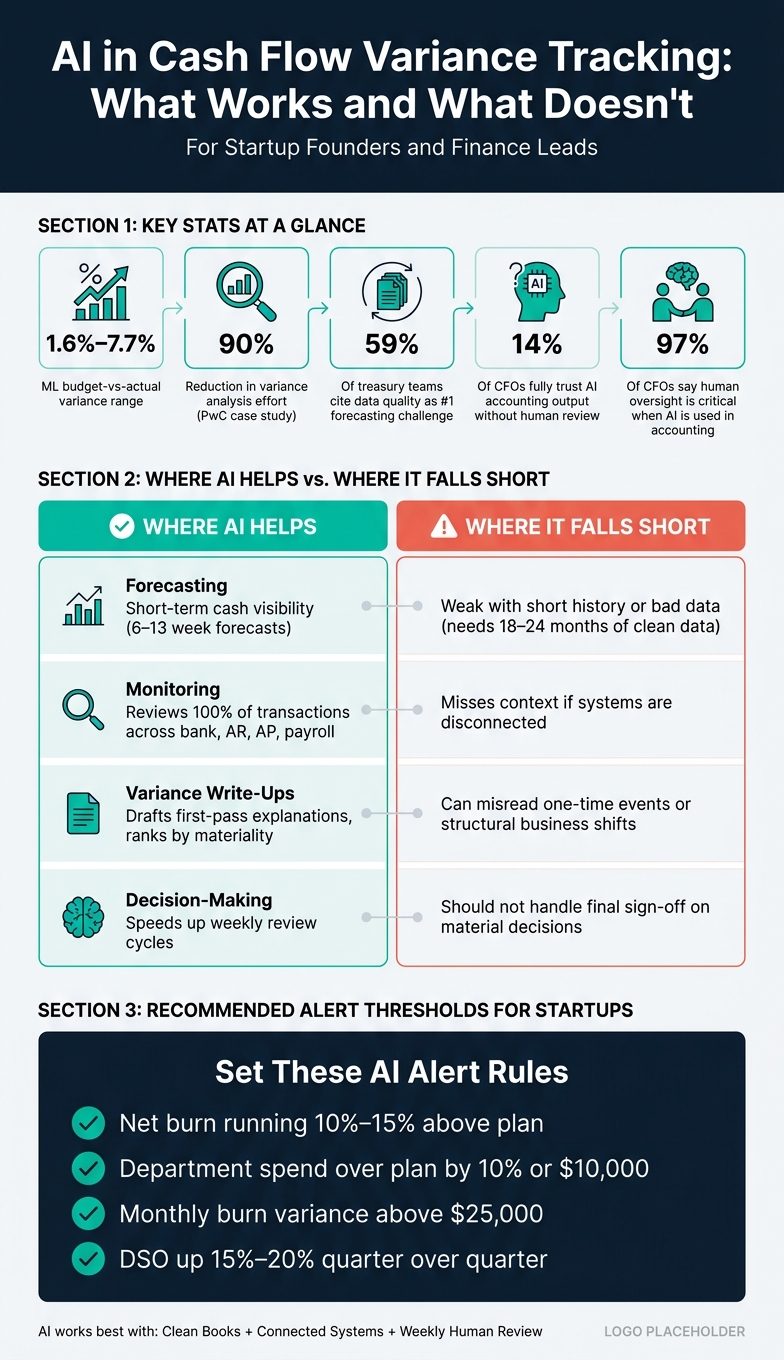
- Some finance teams report 1.6% to 7.7% variance in ML-based budget-vs.-actual work
- In one case study, automating finance analysis cut effort by about 90%
- But 59% of treasury teams still say data quality is the main problem
- And only 14% of CFOs fully trust AI to produce correct accounting data without review
What should you do with that?
If you run a startup, I’d keep AI focused on a small set of checks:
- Net burn
- Runway
- Operating cash flow
- DSO
- Major spend buckets
Then I’d set simple alert rules, like:
- burn running 10% to 15% above plan
- department spend over plan by 10% or $10,000
- monthly burn variance above $25,000
- DSO up 15% to 20% quarter over quarter
Bottom line: AI is good at finding drift early. It is not good at judging one-off events, messy books, or major business changes on its own.
A quick snapshot:
| Area | Where AI helps | Where it falls short |
|---|---|---|
| Forecasting | Short-term cash visibility | Weak with short history or bad data |
| Monitoring | Reviews all transactions, not samples | Misses context if systems are disconnected |
| Variance write-ups | Drafts first-pass explanations | Can misread one-time events or shifts in the business |
| Decision-making | Speeds up review | Should not do final sign-off |
If I were setting this up, I’d use AI in a weekly 13-week cash review, not just at close. That’s where it has the most use.
AI vs. Human Review in Cash Flow Variance Tracking
What research shows AI does well in variance tracking
Better short-term cash forecasting and earlier variance signals
AI does its best work in 6- to 13-week cash forecasts, which is the stretch that matters most when a startup is trying to keep burn under control. When the data is clean and properly categorized, models can spot recent payment patterns and seasonality that are easy to miss in a manual review.
One FP&A machine learning prototype reported budget-vs.-actual variance in the 1.6% to 7.7% range, with forecasts produced in under a day after the models were tuned with input from domain experts. That speed matters. The main upside here isn't just a forecast on paper. It's getting an earlier signal that cash outflows are starting to drift, so the team has time to adjust hiring plans, trim spend, or push on collections before month-end.
That said, this falls apart fast if the source data stops staying current.
Real-time monitoring across bank, payroll, AR, and AP data
AI can connect live feeds from bank, payroll, invoicing, and bill-pay systems, then flag exceptions right away. So if customer payments start coming in late, payroll jumps, or software spend is running 12% over budget, the system can alert the team before month-end instead of after the damage is done.
The big edge is coverage. AI anomaly detection tools can review 100% of transactions, not just samples. That makes it easier to catch issues like:
- unusual charges
- duplicate entries
- shifts in AP aging
And once those issues start stacking up, they get harder to untangle.
Automated variance analysis and first-draft commentary
AI can help with the next step too: explaining why the variance happened. It can rank variances by materiality, which lets finance teams start with the biggest gaps first. From there, it can group likely drivers into buckets like price, volume, mix, timing, and headcount.
A PwC CFO Advisor case study found that automating about 20 analysis types, including variance drill-downs and trend identification, led to about a 90% reduction in variance analysis effort and saved around 10 FTE-months. In that same case, monthly close moved from days to hours.
It can also draft plain-English variance summaries for board or investor updates. But that draft still needs a human check. Someone has to confirm the context and decide whether the driver is temporary or structural.
That makes the finance review faster, not final.
sbb-itb-17e8ec9
AI for FP&A: From Raw Data to Variance Analysis in Minutes | Webinar Highlight
Where AI falls short and where human review is still needed
AI starts to struggle when the inputs are messy, the company doesn’t have much history, or the business changes direction. That matters more than it may seem at first glance. A bad variance signal can throw off runway planning and create problems in board reporting.
Data quality, short history, and startup volatility
The biggest issue in AI cash forecasting is usually not the model. It’s the data going into it. In an AFP survey, 59% of treasury teams said data quality and availability were their main forecast accuracy challenge, while 18% blamed technology limits.
For startups, this tends to show up in familiar, messy ways. Unapplied cash and unmatched invoices can skew accounts receivable inflow estimates and trigger false variance alerts. Put simply: one bad input can make burn look worse than it is, or hide a real spike. And if the books close 3 to 5 days late, near-term forecasts can get noisy fast in a business that changes week to week.
Inconsistent tagging creates another problem. If similar transactions are marked as “software” in one case and “contractors” in another, the model has a harder time finding stable patterns. Then there’s the history problem. Common guidance says you need at least 18 to 24 months of clean, consistent data to pick up seasonality and cohort behavior. A pre-seed startup with only a few months of books just doesn’t have that runway of history.
The same issue shows up when a startup changes its business model. If a company moves from one-time licenses to subscriptions, the old link between billings, collections, and churn may stop being useful.
AI also can’t predict one-off shocks or explain why leadership made a certain call. So if customer behavior changes overnight, a major churn event hits, or the company makes a strategic pivot, the model may flag the wrong thing or miss what matters. Practitioners say about 30% of AI cash forecasting deployments land at only 70% to 80% accuracy because data prep broke down before launch.
That’s why workflow design matters just as much as model quality.
Explainability, controls, and material decisions
Even clean data doesn’t fix the oversight issue. If AI produces a polished variance report, founders still shouldn’t assume the output checks itself. A CFO survey found that only 14% of CFOs completely trust AI to deliver accurate accounting data on its own, and 97% say human oversight is critical when AI is used in accounting.
The explainability gap is still a real problem. Complex models often can’t clearly show what caused a variance, and generative AI can give different outputs from the same inputs without a built-in audit trail. That matters because variance commentary isn’t just filler. Founders need to know whether a gap is temporary, structural, or material. So AI can help with a first pass, but it should not handle final sign-off on material decisions.
Some teams use review thresholds like these:
- Any monthly variance above 5% to 10% in total cash burn
- Any monthly variance above $25,000
Human sign-off should also cover changes to forecast assumptions like DSO or churn curves, how one-off events are handled, and any AI-drafted commentary before it goes to investors, lenders, or the board.
| Area | What AI helps with | Main limitation | Human review |
|---|---|---|---|
| Short-term cash forecasting | Earlier detection of variance signals | Sensitive to data quality and short history | Yes, especially for early-stage startups |
| Multi-source monitoring | Surfacing patterns across bank, AR, AP, and payroll data | Disconnected systems can produce an incomplete picture | Yes, before action is taken |
| Variance commentary | Drafting first-pass explanations | One-off events and structural shifts can be misread | Yes, before investor or lender reporting |
How startups can apply AI to cash flow variance tracking
The practical takeaway is simple: AI helps only when it sits on clean books, connected systems, and a weekly review rhythm. The process matters because AI falls apart fast when the inputs are messy or out of date.
Start with the right KPIs and alert thresholds
AI is only as useful as the numbers feeding it. So the first move is picking a small group of KPIs your team can trust and act on. Start with four to six core KPIs, then add more only after the team can review them week after week without missing a beat.
For most pre-seed to Series B companies, that usually means:
- Net burn = operating cash outflows minus operating cash inflows, excluding financing
- Runway = cash and cash equivalents divided by average monthly net burn
- Operating cash flow tracks cash generated or used by core operations
- DSO shows how long it takes to collect invoices
- Major spend buckets let AI compare actual spend against budget and flag spikes
Alert thresholds matter too. Without them, AI just spits out noise.
Flag department spend when it runs 10% or $10,000 above plan. Flag net burn when it comes in 10% to 15% above plan or $25,000 to $50,000 over budget. And flag DSO when it climbs 15% to 20% quarter over quarter.
Build the workflow: clean books, connected data, weekly review
Once the KPIs and alert levels are in place, the next step is wiring those metrics into a weekly operating process.
- Reconcile weekly. Keep all transactions reconciled and category tags consistent so AI can spot stable patterns.
- Connect direct feeds. Link bank accounts, payroll, AR, AP, and billing tools so AI can watch cash in near real time.
- Maintain a rolling 13-week forecast. Update it at least once a week. AI can refresh it as new actuals come in, compare those numbers against plan, and draft variance explanations. For example, it might flag that payroll cash outflow was $18,000 (12%) over plan because three new hires started earlier than forecast.
- Run a 30- to 45-minute weekly review of threshold breaches, runway changes, and next steps.
That setup keeps AI focused on surfacing exceptions, while people decide what to do next.
How Lucid Financials fits this process
Lucid Financials supports this workflow by combining bookkeeping, tax, CFO support, Slack access, and investor-ready reporting in one platform.
Conclusion: What founders should take away
AI has a practical role in cash flow variance tracking. But it plays a support role, not the final say. It can update forecasts and flag live variances before month-end. That shift is what makes AI more than a dashboard tool. It becomes part of how a company runs day to day.
Founders and finance leads still make the calls on hiring, spend, and fundraising. AI helps by sharpening the signal, not by making the decision for them.
Key points to remember
AI works only when three things are in place: clean books, clear KPIs, and human review. Put simply, the books need to be reconciled, the KPIs need to be defined, and someone needs to review the output each week.
Research points in the same direction: AI can improve short-term forecasting, but only when the data is clean and the review process stays disciplined.
For U.S. startups from pre-seed through Series B, the payoff is simple: faster decisions on runway, burn, hiring, and spend, with fewer surprises in runway and cash reporting. That’s the whole point of using AI in cash flow variance tracking.
FAQs
How much historical data do I need for AI cash tracking?
For accurate AI-driven cash flow insights, 12 to 24 months of clean, organized transaction history and monthly financial statements is a good target. That gives the AI enough data to spot recurring patterns and seasonal trends.
Plan on two to four weeks to reconcile past periods and fix missing or miscategorized entries. Startups with limited or messy records can still use AI, but the results may be less useful.
What should I clean up before using AI for variance alerts?
Before you use AI for variance alerts, get your books in order. If your financial data is messy, late, or full of miscoded entries, AI will only surface bad signals faster.
A two- to four-week cleanup sprint can help you reconcile past periods and fix miscategorized transactions. It’s a short push, but it can save a lot of headaches later.
Start by centralizing your financial accounts and standardizing your chart of accounts. Then reconcile your bank, credit card, and payroll accounts every month. That gives you a clean baseline to work from.
It also helps to clearly separate:
- Revenue
- COGS
- Operating expenses
- Non-operating items
Use the same format each time for USD, dates, numbers, and metrics like MRR. Small inconsistencies might seem harmless, but they can throw off reporting and make alerts much less useful.
Which cash variances still need human review?
AI does a good job spotting anomalies like sudden expense spikes, duplicate payments, and payment delays.
That said, human review still matters. When business operations, pricing, or revenue models shift in a big way, forecasts can get less accurate. An AI system may read those changes as unusual behavior when they're actually part of a new normal.
Manual review is also the better choice for occasional, high-value payments that AI can misread. On top of that, finance teams should keep checking flagged transactions and reviewing the underlying data so the process stays reliable and compliant.