Recency bias makes people overvalue recent events while ignoring long-term trends, leading to costly financial mistakes. For example, investors often chase recent market winners or panic-sell after losses, undermining disciplined strategies. Startups face similar challenges, overestimating short-term success and mismanaging cash flow.
AI helps combat these errors by analyzing data objectively and offering tools like:
- Bias detection: Identifying when decisions are overly influenced by recent trends.
- Behavioral coaching: Nudging users to focus on long-term goals over short-term noise.
- Portfolio optimization: Avoiding emotional reactions through automated rebalancing.
- Sentiment analysis: Understanding emotional patterns in decision-making.
Tools like Lucid Financials integrate these features to help startups and investors make rational, data-driven decisions. By balancing short-term trends with historical data, AI supports better financial planning and reduces the impact of recency bias.
Recency Bias in Investing: How the Recent Past Can Cloud Our Financial Judgment
sbb-itb-17e8ec9
How Recency Bias Affects Financial Decisions
Recency bias skews judgment, leading to predictable yet costly errors in financial decisions. It often drives investors and businesses to rely too heavily on recent events, ignoring broader historical trends or long-term strategies.
Investor Behavior and Market Trends
Investors frequently fall into the trap of chasing recent winners and panic-selling recent losers. This behavior undermines disciplined, long-term strategies and often results in poor outcomes. For example, research highlights that individual investors tend to buy stocks that outperformed the market by 40 percentage points in the two years prior to purchase, only to see those same stocks underperform the ones they sold. This tendency to "buy high and sell low" is a direct outcome of focusing too much on recent performance.
The financial services sector offers a striking example. After delivering a 32% return in 2019, the sector saw a surge of investor interest - only for returns to drop to -2% in 2020, while the S&P 500 delivered over 18%. Such performance chasing often inflates bubbles, which inevitably burst. During the 2008 financial crisis, recency bias amplified trading activity, further damaging portfolios already impacted by market volatility.
"When we see our portfolio drop 10%, recency bias convinces us that it will just keep on dropping."
- Samantha Lamas, Senior Behavioral Insights Researcher, Morningstar
This bias also makes market crashes feel unprecedented, even though historical data shows they occur roughly every nine years over the last 150 years. Investors, overwhelmed by the immediacy of recent losses, often panic-sell, turning temporary paper losses into permanent financial setbacks.
Startups are not immune to these pitfalls, as recency bias can severely disrupt financial planning and cash flow management.
Startup Financial Planning and Cash Flow Mistakes
For startups and fast-growing companies, recency bias creates its own unique challenges. Founders often mistake short-term success for lasting trends, leading to overconfidence in hiring and spending. A few strong revenue months can result in overly optimistic runway calculations, ignoring seasonal fluctuations or broader market cycles.
The impact of recency bias became evident in 2022, when unexpected inflation disrupted forecasts built on recent performance. Many companies, unprepared for high inflation, had to scramble to adjust their burn rates and pricing strategies to stay afloat.
"Recency bias can lead you to deviate from your carefully laid investment plans and make irrational decisions, like following hot investment trends, which may have damaging long-term consequences."
This bias also influences strategic planning. Decision-makers may overly invest in trending technologies or pivot strategies based on current headlines, often without assessing their long-term business value. The result? Misguided budgets, inaccurate runway estimates, and cash flow projections that fail to account for inevitable market downturns.
AI Methods for Detecting Recency Bias
AI doesn’t just highlight recency bias - it actively works to uncover it. By analyzing transaction histories, market sentiment, and investor behavior, machine learning models can identify when recent events are skewing judgment. For startups managing tight budgets and navigating unpredictable growth, these tools act as an early warning system, helping to prevent mistakes driven by short-term thinking.
Behavioral Monitoring with Machine Learning
Machine learning thrives on detecting patterns. A notable approach is Chronological Return Ordering (CRO), which examines sequences of historical returns to spot when investors place too much weight on recent gains while disregarding older data. Research shows that a global investment strategy using CRO delivers an average return differential of 0.91% per month, with the effect observed in 59% of 49 countries studied.
"The recency effect asserts that investors overweight recent facts while underweighting or ignoring those from distant paths."
- Nusret Cakici and Adam Zaremba
Advanced models like XGBoost and Random Forests take this further by identifying extreme reactions - such as sharp price shifts that exceed normal volatility and transaction costs. These algorithms classify market conditions in real time, flagging when recent events are causing disproportionate market reactions. Meanwhile, Bidirectional LSTM networks analyze high-frequency market data to detect momentum signals that often indicate bias.
What makes these models especially effective is their ability to capture non-linear relationships - those intricate connections between sentiment, volatility, and market behavior that traditional tools often overlook. For startups, this means AI can alert teams when a few strong revenue months are leading to overly optimistic projections, or when recent market swings are prompting overly cautious spending decisions.
AI also uses sentiment analysis to refine its understanding of bias.
Sentiment Analysis and Risk Profiling
AI-powered sentiment analysis digs into financial news and social media to uncover emotional decision-making. For instance, ModernFinBERT, a transformer-based model, extracts emotional cues from text streams. These emotional "shocks" often align with price disruptions caused by recency bias.
The Financial Bias Indicators (FBI) framework takes this one step further. With components like "Bias Detective" and "Bias Tracker", it identifies irrational biases embedded in financial analysis tools. Large Language Models also process natural language queries to gauge investor sentiment, providing personalized insights that help decision-makers recognize when their judgment is being clouded by recent events.
Dynamic risk profiling offers another layer of insight. Unlike static questionnaires, AI continuously monitors investor profiles and transaction patterns to predict how behavior might shift after recent market moves. This is particularly crucial during volatile periods, as research shows recency bias is most pronounced following market crashes and spikes in volatility.
Gamified tools add another dimension to bias detection, offering interactive ways to assess risk tolerance.
Gamified Risk Tolerance Assessments
Traditional risk assessments rely on static questions, capturing only a snapshot of a moment in time. Gamified AI tools change the game by presenting interactive scenarios that reveal how users react to recent wins and losses. These tools use machine learning to measure risk tolerance dynamically, identifying bias patterns based on real-time responses.
Techniques like SHAP (Shapley Additive Explanations) break down model predictions to show exactly which recent factors - such as a negative news cycle, a volatility spike, or a string of losses - triggered a bias alert. This level of transparency helps founders and financial teams understand not just that bias is occurring, but also why and when it’s happening.
AI Strategies to Reduce Recency Bias
AI doesn't just spot recency bias - it actively works to counter it. While detecting this bias is crucial, the real challenge lies in deploying strategies to prevent decisions driven by short-term trends. These strategies range from automated portfolio adjustments to subtle behavioral nudges, all aimed at keeping decision-makers focused on long-term objectives rather than reacting to fleeting market events.
Algorithmic Rebalancing and Portfolio Optimization
AI-powered robo-advisors are designed to automatically rebalance portfolios, helping investors avoid the trap of chasing recent high-performing assets. These algorithms stick to predefined risk profiles and long-term goals, steering clear of emotional responses to market fluctuations.
The focus here is on large-cap, liquid companies, as these provide a stable foundation for rebalancing while keeping costs like trading fees manageable. For startups managing their cash flow or founders deciding on investments, AI can act as a safeguard against common errors, such as overinvesting in recent winners or retreating too much after short-term losses.
"Generative AI models exhibit similar 'cognitive' biases as human investors, reinforcing existing investment biases inherent in their training data."
- Philipp Winder, University of St. Gallen
This highlights the importance of integrating debiasing mechanisms into AI systems. Without these, AI could inadvertently reinforce trend-chasing behaviors instead of curbing them. Beyond rebalancing, AI uses historical market data to help decision-makers avoid falling into short-term traps.
Behavioral Nudges Using Historical Data
AI platforms excel at delivering targeted behavioral nudges by analyzing historical data patterns that might otherwise be overshadowed by recent market noise. By diving into extensive historical datasets, AI uncovers long-term trends that provide a clearer perspective, even during periods of market turbulence. For instance, after a sudden downturn or an unusually strong rally, AI can surface data from past market cycles to remind users of broader trends, helping them avoid impulsive decisions.
Large Language Models (LLMs) add another layer of support by offering conversational financial advice. These tools simplify complex data, ensuring users don’t overly rely on recent trends when making decisions. Acting as interactive guides, LLMs help individuals maintain a balanced approach, particularly during volatile times.
Such nudges are especially valuable during periods of high market volatility, when the temptation to overreact to short-term events is at its peak.
Real-Time Alerts and Unified Financial Dashboards
To further combat recency bias, AI systems provide real-time alerts that notify users when they’re placing too much weight on recent data. These alerts integrate seamlessly with unified financial dashboards, which combine performance metrics, historical trends, and long-term goal tracking. This holistic view helps users zoom out from short-term fluctuations and focus on the bigger picture.
For startups, these dashboards offer more than just a snapshot of performance. They contextualize current data by comparing it with historical trends and projecting future outcomes. For example, after a volatile market period, a founder reviewing their financials would see historical patterns highlighted, offering reassurance about the long-term trajectory.
"By considering the ebb and flow of media attention over an extended period, the [AI] model discerns underlying patterns that might be obscured by short-term biases."
This evolution from static data presentation to AI-driven, actionable insights makes financial decision-making more accessible. By simplifying complex information and providing interactive guidance, AI empowers startup founders and other non-professional decision-makers to interpret data effectively, avoiding the pitfalls of recency bias.
Using AI Bias Detection in Startup Financial Planning
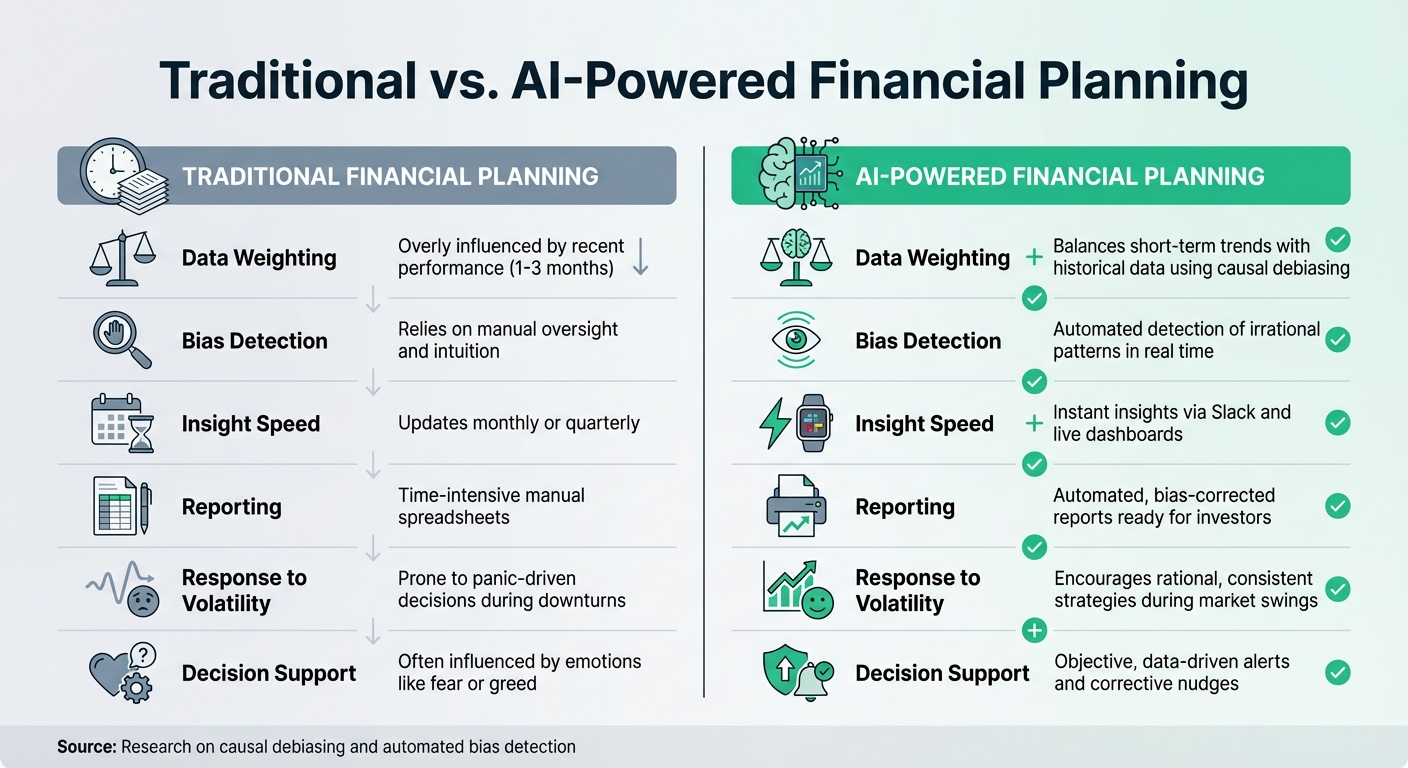
Traditional vs AI-Powered Financial Planning Comparison
AI's ability to detect biases, like recency bias, is proving to be a game-changer in startup financial planning. Startups often struggle with limited historical data and unpredictable markets, which can lead to overreactions based on short-term metrics - like last month’s burn rate or an unusually strong quarter. AI-powered tools step in to balance these fluctuations by weighing recent performance against broader patterns, helping founders make decisions based on logic rather than emotion.
By shifting from traditional spreadsheets to AI-driven systems, startups can now integrate "Bias Detectives" and "Bias Antidotes" into their financial workflows. These tools identify and correct irrational trends in real time using deep financial knowledge. For startups operating with tight cash flows or gearing up for fundraising, this means fewer knee-jerk budget cuts during downturns and more disciplined strategies during periods of rapid growth.
AI-Powered Financial Planning with Lucid Financials

Lucid Financials is one platform bringing AI bias detection directly into the hands of startup founders. Through Slack integration, it provides real-time alerts whenever financial KPIs deviate from historical norms. This acts as a behavioral check, helping founders avoid impulsive decisions driven by short-term data. For instance, if a sudden revenue spike tempts a founder to ramp up hiring, Lucid’s AI can pull in data from past growth cycles to provide context, encouraging more measured decisions.
Lucid also generates investor-ready reports, balancing recent performance with long-term data. This is especially useful during fundraising, where overemphasizing a strong recent quarter can signal instability to potential investors. Research supports this approach: a global investment strategy that corrects for recency bias can achieve an average return differential of 0.91% per month. For startups, this translates into more accurate projections for runway and cash flow, even during volatile periods.
"Prompting LLMs to make rational decisions reduces biases."
- Pietro Bini, Lin William Cong, Xing Huang & Lawrence J. Jin, NBER
Lucid’s AI goes beyond simply correcting recent trends. It uses causal debiasing methods to incorporate historical patterns and long-term probabilities into forecasts. This approach is particularly valuable during turbulent market conditions, when recency bias is most likely to distort decision-making. Founders also gain access to features like clean books in seven days and CFO-level insights, ensuring they maintain a steady perspective even in uncertain times.
Traditional vs. AI-Powered Financial Planning
| Feature | Traditional Financial Planning | AI-Powered Financial Planning |
|---|---|---|
| Data Weighting | Overly influenced by recent performance (1–3 months). | Balances short-term trends with historical data using causal debiasing. |
| Bias Detection | Relies on manual oversight and intuition. | Automated detection of irrational patterns in real time. |
| Insight Speed | Updates monthly or quarterly. | Instant insights via Slack and live dashboards. |
| Reporting | Time-intensive manual spreadsheets. | Automated, bias-corrected reports ready for investors. |
| Response to Volatility | Prone to panic-driven decisions during downturns. | Encourages rational, consistent strategies during market swings. |
| Decision Support | Often influenced by emotions like fear or greed. | Objective, data-driven alerts and corrective nudges. |
In global markets, stocks with higher resistance to recency bias have consistently outperformed those more influenced by short-term trends. For startups, this principle reinforces the importance of considering the full historical picture in financial planning. Decisions grounded in a comprehensive view consistently lead to better outcomes than those driven by recent events alone.
This shift from reactive to proactive planning is where AI truly shines. When founders query Lucid’s AI about runway or spending patterns, it doesn’t just provide numbers - it contextualizes them with historical trends, flags potential biases, and models long-term impacts. This transforms financial planning into a forward-thinking, bias-aware process that supports sustainable growth.
Conclusion
Recency bias remains a persistent challenge, often leading to financial decisions that overvalue recent events while ignoring historical trends. This tendency can result in volatile and, at times, irrational choices. Studies reveal that correcting for recency bias through a global strategy can yield an average return of 0.91% per month, with top-performing stocks consistently outperforming the bottom quintiles in 84% of the countries analyzed.
AI offers a practical solution by identifying irrational patterns and rebalancing strategies with a long-term perspective. Techniques like Chronological Return Ordering are particularly effective after market crashes or during periods of high volatility, where recency bias tends to create significant mispricing. Instead of reacting impulsively to short-term trends, AI helps contextualize recent performance within a broader historical framework, enabling more informed decision-making.
"Overemphasizing recent returns at the cost of distant ones distorts return expectations."
- Nusret Cakici and Adam Zaremba
Lucid Financials takes this concept further by integrating tools like Slack alerts and investor-ready reports that combine recent and historical data. These features, alongside services such as delivering clean books in seven days and providing CFO-level insights, help transform reactive financial planning into strategies driven by foresight and awareness of biases.
For startups looking to scale effectively, tackling recency bias is crucial. AI-powered tools provide the objectivity and perspective needed to make consistent, smarter financial decisions, even in volatile markets. By anchoring strategies to comprehensive long-term data, solutions like Lucid Financials empower startups to navigate uncertainty and pursue steady growth.
FAQs
How can I tell if I’m making a decision based on recency bias?
Recency bias can creep in when you give too much weight to recent events or trends, like overreacting to short-term market changes, while overlooking long-term data or historical patterns. To counter this, take a step back and evaluate the bigger picture. Don’t let recent performance overshadow the broader context in your decision-making process.
What AI signals can flag recency bias in markets or cash flow?
AI identifies recency bias by analyzing recent trading patterns using machine learning, employing natural language processing (NLP) to assess sentiment in news and social media, and applying real-time anomaly detection. These methods enable AI to spot short-term overreactions and shifts in investor behavior driven by this bias.
How can Lucid Financials help reduce recency-driven financial mistakes?
Lucid Financials works to prevent short-sighted financial decisions by providing real-time bias alerts, personalized recommendations, and scenario analysis. These features are designed to spot and counteract cognitive biases, such as recency bias, helping users make more thoughtful and well-rounded financial choices. By leveraging its smart platform, Lucid ensures that your financial strategies are based on solid data rather than fleeting trends.