In today’s unpredictable business environment, relying on static financial forecasts isn’t enough. Multi-scenario financial analysis equips businesses - especially startups and fast-growing companies - with tools to evaluate various potential futures. By exploring best-case, base-case, and worst-case scenarios, businesses can better understand risks and opportunities. Key techniques include:
- Monte Carlo Simulations: Generate thousands of potential outcomes to assess probabilities.
- Cross-Impact Analysis: Analyze how interconnected variables influence financial results.
- Decision Trees: Visualize choices and outcomes to simplify complex decisions.
- Sensitivity Analysis: Identify which variables impact financial results the most.
- Stress Testing: Simulate extreme scenarios to prepare for worst-case conditions.
- Scenario Storytelling: Turn data into narratives that simplify decision-making.
- Multiverse Modeling: Use AI to explore thousands of outcomes simultaneously.
- Excel What-If Scenarios: A simple way to test financial assumptions.
- Probability-Weighted Expected Value: Quantify risk-adjusted financial outcomes.
- AI-Driven Tools: Automate and enhance scenario analysis for faster insights.
These methods, powered by AI tools like Monte Carlo simulations and Lucid Financials, allow businesses to plan for uncertainties, test assumptions, and make informed decisions. Whether it’s preparing for market shifts, optimizing cash flow, or planning a fundraising round, these techniques offer actionable insights to strengthen financial strategies.
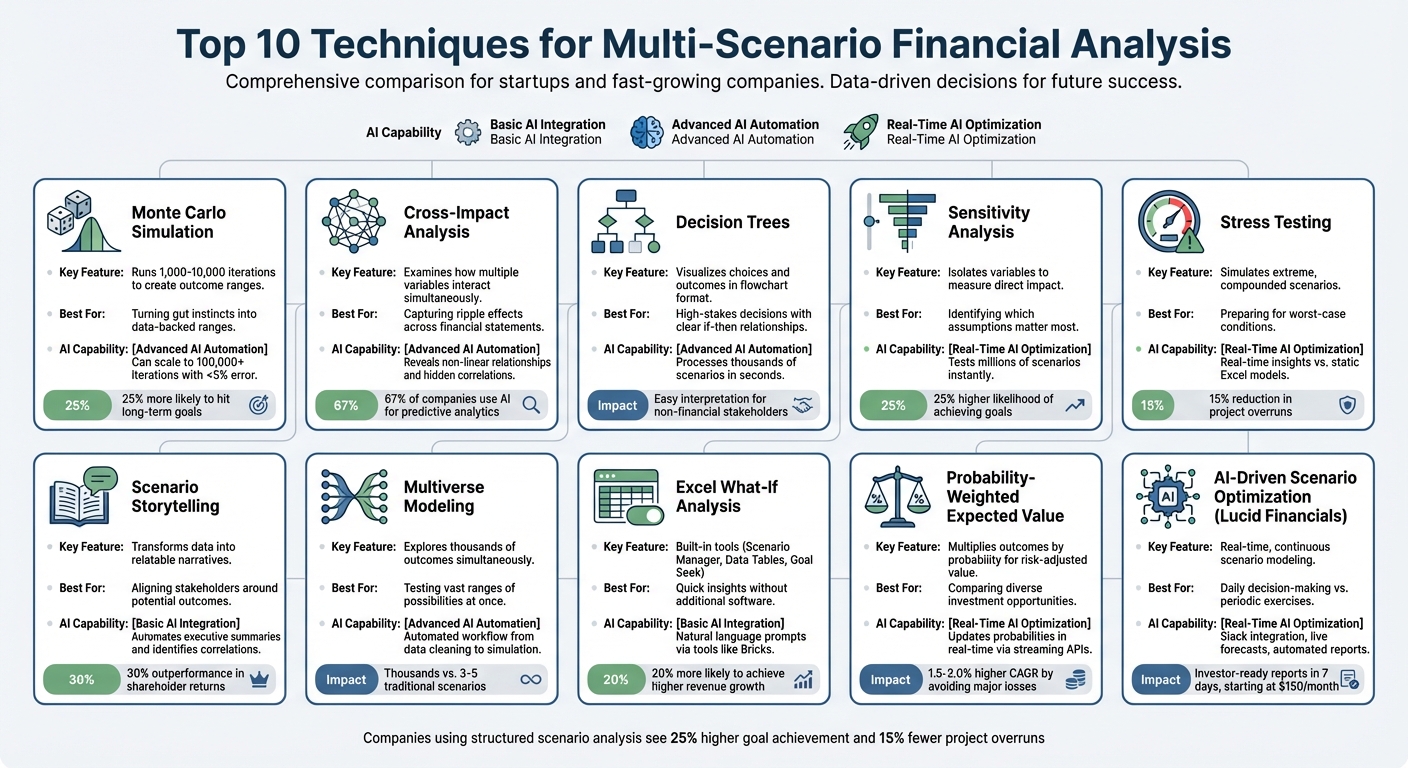
10 Multi-Scenario Financial Analysis Techniques Comparison Chart
Scenario Modelling in Excel Mini-Masterclass (Includes Monte Carlo Simulation)
sbb-itb-17e8ec9
1. Monte Carlo Simulation
Monte Carlo Simulation runs between 1,000 and 10,000 iterations to create a range of possible outcomes rather than a single prediction. For instance, instead of forecasting $2 million in revenue, it might show an 80% chance of landing between $1.6 million and $2.5 million. This approach turns gut instincts into solid, data-backed ranges that are easier for investors to grasp.
Scalability for Multi-Scenario Modeling
Expanding on this concept, AI-powered platforms can handle massive datasets and generate thousands of outcomes almost instantly, removing the need for time-consuming manual processes. While standard simulations typically require around 10,000 iterations for reliable results, AI can scale this up to over 100,000 iterations, keeping error rates under 5%. Companies that integrate scenario planning into their strategies are 25% more likely to hit long-term goals, and those using structured scenario analysis see a 15% drop in project overruns.
Integration with AI-Driven Tools
AI takes scalable modeling a step further by identifying subtle relationships within the data that human analysts might miss. For example, it can link performance drivers like social media trends or weather conditions to financial outcomes. Machine learning automates the creation of probability distributions, helping reduce cognitive biases in forecasts. Predictive analytics is a top use case for AI, with 67% of businesses adopting it for this purpose.
According to the Corporate Finance Institute, "AI-driven scenario analysis replaces static models with real-time insights, improving risk assessment and decision-making."
Applicability to Startups and Fast-Growing Companies
Startups, often lacking extensive historical data, can use the Triangular Distribution method by inputting "Minimum", "Maximum", and "Most Likely" values. This approach turns founder intuition into credible projections. By concentrating on the 2–4 most critical assumptions - like churn rate or sales cycle length - startups can keep their models manageable. Presenting these probabilistic outcomes demonstrates financial discipline to investors and boards.
Ease of Interpretation for Decision-Making
Using percentile frameworks can make simulation outputs easier to understand. For example, P10 can guide downside planning, P50 represents a realistic base case, and P90 outlines ambitious stretch goals. Sensitivity charts, like tornado charts, can pinpoint which inputs - such as unit sales or variable costs - have the most significant impact on results. This shift from fixed forecasts to range-based thinking helps leaders spot potential turning points early on.
2. Cross-Impact Analysis
Cross-Impact Analysis takes financial modeling a step further by examining how multiple variables interact at the same time. Instead of analyzing one change in isolation, it looks at combined shifts - like simultaneous tariff increases, declining demand, and rising supply chain costs. This method captures how a single factor, such as increasing commodity prices, can ripple through your Income Statement, Balance Sheet, and Cash Flow Statement simultaneously. Similar to Monte Carlo simulations, it uses AI to uncover deeper interconnections and potential risks.
Scalability for Multi-Scenario Modeling
Traditional Excel models often hit their limits when tasked with analyzing dozens of interconnected assumptions. AI-powered tools tackle this issue by processing massive datasets to generate thousands of potential outcomes in seconds. These tools also reveal non-linear relationships that manual methods might overlook, such as how interest rate fluctuations might affect supply chain delays. Structured scenario analysis has already shown its value in improving strategic decision-making.
Integration with AI-Driven Tools
AI is particularly effective at identifying hidden relationships between key performance drivers. For example, it can link changes in distribution networks to customer experience metrics or connect social media trends to revenue shifts. As machine learning algorithms continuously incorporate new economic indicators, they refine models dynamically, reducing the need for manual updates associated with static spreadsheets. With 67% of companies now using AI for predictive analytics, this technology has become a go-to resource for financial forecasting. These insights not only reveal unexpected correlations but also help businesses, especially startups, apply them across their operations in a cohesive way.
Applicability to Startups and Fast-Growing Companies
Scenario planning has traditionally been too resource-intensive for many startups, but AI simplifies the process. By integrating data from departments like Sales, HR, Operations, and Finance, AI creates a unified perspective that breaks down organizational silos. This allows smaller teams to turn uncertainty into actionable strategies. For fast-growing companies, this approach makes it easier to adapt to sudden market shifts - whether caused by inflation, new regulations, or emerging competitors. It complements traditional methods by offering a broader view of how changes in one area ripple across the entire business.
Ease of Interpretation for Decision-Making
Cross-Impact Analysis moves finance teams away from relying on single-point forecasts and encourages range-based thinking. Presenting a range of probabilities, rather than a single definitive prediction, helps decision-makers better understand uncertainties and weigh multiple outcomes. To avoid overwhelming stakeholders, focus on 5–7 critical variables during analysis. Standardizing scenarios - like "Base", "Adverse", and "Opportunity" cases - across all business units creates a shared framework. This streamlines modeling efforts and reduces reconciliation time by 15%.
3. Decision Trees
Decision trees use a flowchart-like structure to outline financial decisions and their possible outcomes. Each branch represents a scenario - like deciding to hire immediately versus waiting until the next quarter or choosing between expanding into a new market or focusing on existing customers. This visual method makes it easier to see how one choice leads to another and to anticipate the financial consequences of different paths. It builds on earlier techniques by providing a clear, visual way to map out decision impacts across multiple scenarios.
Scalability for Multi-Scenario Modeling
While tools like Excel are fine for simple decision trees, they struggle with complexity. As decision layers increase, specialized tools like TreeAge Pro or Python's scikit-learn handle these intricate computations more effectively. AI-powered platforms take this a step further, processing thousands of potential scenarios in seconds, eliminating the need to manually update static spreadsheets. For fast-growing companies, this means starting with a basic model and refining it over time.
Integration with AI-Driven Tools
AI integration transforms static decision trees into dynamic forecasting tools. These advanced systems pull data from various departments, creating models that better reflect real-world complexities. For instance, in February 2025, Acme Solar Technologies used AI-driven analysis to assess risks across three areas: government subsidy cuts (potentially reducing revenue by 20–50%), raw material cost changes (fluctuating 10–30%), and shifts in consumer demand (impacting revenue by 15–40%). The analysis showed that reduced subsidies combined with rising material costs posed the greatest risk, prompting the company to diversify its supply chain and explore commercial market opportunities.
Applicability to Startups and Fast-Growing Companies
Startups often face high-stakes decisions, and decision trees are perfect for structuring these choices. For example, they can help determine whether delaying hiring during a market downturn will preserve enough cash or if entering a new market now is the right move. Even for teams with limited resources, decision trees offer a structured way to turn uncertainty into actionable strategies - no need for a large finance team.
Ease of Interpretation for Decision-Making
A major strength of decision trees is their simplicity and visual clarity. Non-financial stakeholders - like marketing managers, operations teams, or board members - can easily follow the flow of decisions without needing advanced statistical knowledge. Each branch clearly shows an if-then relationship with probabilities and outcomes, making it simple to calculate the Expected Value (EV) for each option. For clarity, branches with minimal impact can be trimmed.
As Sebastian Taylor from the Corporate Finance Institute puts it, "Decision trees boost predictive models with accuracy, ease in interpretation, and stability".
4. Sensitivity Analysis
Sensitivity analysis goes beyond decision trees by focusing on specific financial drivers and their direct impact on outcomes. It’s all about isolating variables to see how changes affect profit or cash flow.
For example, a retail business might learn that a 10% boost in customer traffic leads to a 7% rise in sales. Meanwhile, a hospitality company could discover that improving its Net Promoter Score by just 0.2 points results in a 15% increase in repeat customers. These insights help businesses channel resources into areas that genuinely influence results.
Scalability for Multi-Scenario Modeling
When it comes to testing multiple variables, Excel often falls short, especially if you’re handling dozens - or even hundreds - of scenarios. AI-driven tools step in here, processing thousands or even millions of scenarios in seconds. Unlike manual methods, which tend to focus on a few selected combinations, these tools also reveal interaction effects - like how the impact of advertising spend shifts depending on product pricing. For businesses managing multiple units or product lines, this capability is crucial.
Integration with AI-Driven Tools
AI platforms make sensitivity analysis faster and easier. Instead of manually creating formulas, you can use simple prompts like “Run a sensitivity analysis to find the biggest profit drivers”. These tools clean and structure your data, run simulations, and generate Tornado charts that rank variables by their impact.
Tim Vipond from the Corporate Finance Institute explains, “Sensitivity analysis adds credibility to any type of financial model by testing the model across a wide set of possibilities”.
In fact, organizations that adopt this approach report a 25% higher likelihood of achieving long-term goals. This integration of AI tools turns sensitivity analysis into a must-have for companies aiming to grow quickly.
Applicability to Startups and Fast-Growing Companies
For startups navigating uncertainty, sensitivity analysis is invaluable. It identifies which assumptions matter most and quantifies risks. For instance, it might show how a 10% change in customer retention impacts long-term valuation. It’s also a way to test your business plan under different conditions - like a 10% increase in raw material costs reducing gross margins by 3%. Tornado charts make it easy for even small teams to pinpoint high-impact areas, ensuring resources are allocated where they’ll deliver the best return.
Ease of Interpretation for Decision-Making
One of the standout features of sensitivity analysis is how visually straightforward it is. Tornado charts, much like decision trees, rank variables by their influence, creating a clear hierarchy that grabs attention. This simplicity ensures that even team members without a financial background - like product managers or board members - can grasp the findings. By highlighting the key drivers, these charts help decision-makers focus on strategies that are backed by solid data.
5. Stress Testing
Stress testing pushes your model to its limits by simulating extreme, compounded scenarios. Unlike sensitivity analysis, which adjusts one variable at a time, stress testing applies multiple severe conditions simultaneously to pinpoint where your business might falter. This approach works hand-in-hand with techniques like Monte Carlo simulations and sensitivity analysis, offering a deeper view into how your business might perform under significant strain and uncovering potential weaknesses before external pressures do.
Applicability to Startups and Fast-Growing Companies
For startups and companies experiencing rapid growth, stress testing is all about answering critical "what-if" questions. For example, can you maintain enough cash flow if sales drop by 18%? What happens to your debt service coverage ratio if interest rates suddenly spike? These aren’t theoretical exercises - they’re survival strategies. AI-powered stress testing makes it possible to model scenarios like revenue dips, cost increases, or demand shifts, helping businesses prepare by diversifying supply chains or exploring new markets before crises strike.
Integration with AI-Driven Tools
AI takes stress testing to the next level, turning it into a dynamic, real-time tool. Traditional methods, like Excel-based models, require manual inputs and adjustments. In contrast, AI-powered platforms can process massive datasets quickly, identifying hidden correlations and reducing human bias. Instead of focusing on just probability distributions or isolated variables, AI enables stress testing to simulate worst-case scenarios involving multiple simultaneous shocks.
As Kelly Bailey from the Corporate Finance Institute explains, "AI-driven scenario analysis replaces static models with real-time insights, improving risk assessment and decision-making".
These real-time insights allow businesses to create actionable strategies that are both timely and precise.
Ease of Interpretation for Decision-Making
The real strength of stress testing lies in its ability to translate complex risks into clear, actionable data. Instead of vague worries about market volatility, it provides concrete numbers. For example, a company with $500M in floating-rate debt would face an additional $6.25M in annual interest costs if rates rise by 125 basis points. To make stress testing practical, focus on the 3 to 5 variables that have the most significant impact - those that could swing your net present value or internal rate of return by over 10%. Also, calculate the minimum cash reserves needed to survive worst-case scenarios and ensure your runway is sufficient to weather potential shocks.
Companies that integrate stress testing into their core strategic planning report a 25% higher likelihood of achieving long-term goals and a 15% reduction in project overruns. This demonstrates how stress testing isn’t just about managing risks - it’s about setting your business up for sustainable success.
6. Scenario Storytelling
Scenario storytelling builds on quantitative methods like Monte Carlo simulations and decision trees by adding a qualitative layer. It transforms raw data into clear, relatable narratives that illustrate potential financial outcomes. Instead of relying on dense spreadsheets, this method frames complex financial drivers into understandable stories with names like "Green Growth" or "Stagnation". Companies using this approach have reported outperforming competitors by as much as 30% in shareholder returns over a decade.
Applicability to Startups and Fast-Growing Companies
For startups, scenario storytelling helps shift decisions from subjective debates to objective analyses. It provides a shared framework that aligns founders, investors, and employees around potential "what-if" scenarios, which is especially useful during periods of high uncertainty. Fast-growing companies also benefit by pinpointing critical tipping points - like when a price increase could start hurting conversions - allowing them to make adjustments before larger shifts are necessary. Interestingly, the term "uncertainty" appeared in 87% of earnings calls in Q1 2025, underscoring the importance of narrative-driven planning in volatile markets. This approach also sets the stage for AI to further refine and automate scenario insights.
Integration with AI-Driven Tools
AI takes scenario storytelling to the next level by automating tasks that once required weeks of work. Generative AI can draft executive summaries that turn complex data into actionable insights while identifying correlations that human analysts might miss. AI-powered tools move beyond static "Optimistic, Baseline, Pessimistic" scenarios by creating dynamic, real-time narratives that adapt to changing conditions. Collaborative platforms like MURAL and Miro allow remote teams to engage in virtual "war gaming" sessions, while streaming APIs feed live market data directly into dashboards, updating scenario probabilities in real time.
Ease of Interpretation for Decision-Making
The true strength of scenario storytelling lies in its ability to make trade-offs easier to understand. Instead of scattering data across multiple tables, this method uses narratives to foster constructive discussions and minimize groupthink. To keep these stories actionable, focus on five to seven key drivers that carry the most uncertainty and influence over your goals. A helpful strategy is to assign someone to play devil's advocate, challenging assumptions to ensure the analysis holds up. Companies that adopt this approach report 25% higher success in achieving long-term goals and 15% fewer project overruns.
7. Multiverse Modeling
Multiverse modeling takes traditional scenario planning to a whole new level by leveraging AI to explore a vast range of financial possibilities. Unlike the old-school approach of crafting three or so scenarios, this method generates thousands of potential outcomes at once. Using AI, large datasets can be processed in seconds, eliminating the manual effort typically required to create even a handful of scenarios in Excel. At its core, this technique relies on stochastic modeling - a statistical approach that uses probabilities to estimate likely outcome ranges rather than focusing on single, static targets.
Scalability for Multi-Scenario Modeling
One of the standout benefits of multiverse modeling is its ability to scale efficiently. Instead of duplicating spreadsheets for every new scenario, this approach uses "scenario overlays" to record only the changes in assumptions. For example, when testing different pricing strategies, the system saves just the modified pricing variables rather than creating separate files for each variation. This streamlined process makes it possible to test hundreds or even thousands of scenarios without the hassle of endlessly clicking "Save As".
| Feature | Traditional Scenario Analysis | Multiverse Modeling |
|---|---|---|
| Volume | Limited (3-5 scenarios) | Thousands of outcomes |
| Speed | Manual and slow | Automated and real-time |
| Assumptions | Static, human-defined | Dynamic, probability-based |
Integration with AI-Driven Tools
AI plays a key role in automating the entire workflow, from cleaning raw data to running advanced simulations like Monte Carlo analysis and regression forecasting. Machine learning further refines these forecasts in real time, making the process even more precise.
As Michael J. Huthwaite, Director of Product Management at Walmart, puts it, "The next frontier for stochastic modeling is undoubtedly Machine Learning (ML)".
AI tools can also generate narrative summaries, simplifying complex results into actionable insights for stakeholders. This automation not only saves time but also ensures accuracy, making it particularly valuable for fast-moving businesses.
Applicability to Startups and Fast-Growing Companies
For startups or companies growing at a rapid pace, multiverse modeling can be a game-changer. It allows you to test critical variables like cash flow, hiring costs, price elasticity, and market expansion timing. For instance, instead of guessing when to hire a new engineer or enter a new market, you can simulate thousands of scenarios to pinpoint the best timing. By focusing on high-impact factors like customer churn, pricing tiers, and team productivity, startups can make smarter decisions even in uncertain conditions.
Ease of Interpretation for Decision-Making
Although multiverse modeling provides more precise and scientific results, its complexity can make interpretation challenging. Management teams often find it harder to align around probability ranges compared to clear-cut "if-then" scenarios. To address this, AI-generated summaries can distill the data into key outcomes and risks. Additionally, scenarios can be treated as flexible strategic options, allowing teams to toggle between them to identify the best mix of opportunities. By turning statistical insights into actionable strategies, multiverse modeling becomes a powerful tool for navigating uncertainty and making informed decisions.
8. What-If Scenario Analysis in Excel
Excel's built-in what-if analysis tools - like Scenario Manager, Data Tables, and Goal Seek - continue to be a go-to choice for financial teams looking for quick insights without investing in additional software.
Handling Multiple Scenarios in Excel
Excel's Scenario Manager can manage up to 32 variable values, which may not be enough for highly complex models. For simpler analyses involving one or two variables, Data Tables are a good fit. Meanwhile, Solver and the Analysis ToolPak can handle more advanced, multi-variable optimization tasks. If you're working across multiple departments, scenario data from various workbooks can be combined using the "Merge" command. This scalability in Excel provides a strong base for incorporating AI into scenario analysis.
AI Integration for Smarter Analysis
AI tools like Bricks and Excelmatic are transforming how we use Excel. Instead of manually configuring tools like Goal Seek or Data Tables, these platforms let you use natural language prompts. For example, you could ask, "What happens to our break-even point if fixed costs rise by 15%?" and get instant results. These AI-driven tools can calculate thousands of outcomes in seconds and even create narrative reports that break down complex data into actionable insights for decision-makers.
"AI doesn't just speed up the traditional spreadsheet process; it completely redesigns it so you're interacting with a real business and financial analytics process - a 'partner,' not a 'tool.'" - Spencer Lanoue, Product at Bricks
Ideal for Startups and Rapid Growth
Startups can benefit from simplified models, such as a three-case toggle (base, best, and worst scenarios). By focusing on 3–5 key drivers - like customer acquisition cost, churn rate, or unit pricing - analyses stay practical and actionable. Dynamic toggles make it easy to adjust assumptions without reconfiguring the entire model. Companies using dynamic scenario planning are shown to be 20% more likely to achieve higher revenue growth compared to their peers.
Simplifying Decision-Making
Excel's Scenario Summary Reports make it easier to compare different scenarios side-by-side. These reports provide a clear view of how input changes affect outcomes, making them ideal for executive presentations. Use clear labels for cells (e.g., "Revenue_Growth") to improve readability. However, keep in mind that these reports need to be manually updated when values change. To automate data collection and make your models more scalable, consider integrating Power Query.
Excel remains a trusted tool for scenario analysis, but its evolving integration with AI is bridging traditional methods with modern, real-time financial insights. This combination enhances decision-making and aligns perfectly with the shift toward AI-driven optimization.
9. Probability-Weighted Expected Value Calculation
Probability-Weighted Expected Value (EV) Calculation takes financial analysis a step further by incorporating probabilities into outcome estimates. By multiplying each potential outcome by its probability and summing the results, EV provides a risk-adjusted value. For example, if there’s a 70% chance of earning $15M and a 30% chance of losing $5M, the EV would be $9M. This approach is particularly useful for startups and fast-growing businesses that face a wide range of outcomes - from complete failure to massive returns, such as a 20x payoff. EV bridges the gap between qualitative storytelling and quantitative forecasting, highlighting how AI enhances modern financial planning. When paired with AI tools, this method can efficiently process and simulate a vast number of scenarios.
Scalability for Multi-Scenario Modeling
Traditional manual methods limit scenario modeling to just a handful of cases, but AI tools can generate thousands of outcomes almost instantly. This level of scalability ensures a more comprehensive analysis, capturing a full range of possibilities rather than relying on narrow, single-point estimates. Companies that incorporate scenario planning into their strategies have seen a 15% reduction in project overruns.
Integration with AI-Driven Tools
AI revolutionizes EV calculations by identifying hidden patterns in data and updating probabilities in real time through streaming APIs . These tools can directly connect to live market feeds, ensuring that scenario models remain accurate and up-to-date.
Applicability to Startups and Fast-Growing Companies
For high-risk ventures like biotech or AI startups, EV offers a solid framework for justifying bold investments. Consider a 2025 analysis of a $5 million investment in BioNova, a Series B biotech company. Analysts evaluated four scenarios: a 10% chance of an IPO (yielding a 20x return, or $100M), a 20% chance of a small acquisition (3x return, or $15M), a 30% chance of a flat exit (1x return, or $5M), and a 40% chance of failure ($0M). The resulting EV was $14.5 million, giving investors a clear basis for their decisions. That same year, a portfolio optimized using EV calculations limited its maximum drawdown to 5.5%, compared to 21% for portfolios guided by intuition.
Ease of Interpretation for Decision-Making
EV simplifies the comparison of diverse investment opportunities - like a stable utility bond versus a volatile tech stock - by converting them into a single, comparable dollar figure. This helps counteract behavioral biases, such as anchoring or greed. To make the most of EV calculations, it’s essential to document the reasoning behind each probability assignment and conduct sensitivity testing. Adjusting probabilities in small increments (e.g., 5%) can reveal how robust your conclusions are. Avoiding even one major loss every five years through EV-based strategies can increase your portfolio’s Compound Annual Growth Rate by 1.5% to 2.0%. By distilling complex financial decisions into a straightforward metric, EV calculations empower better, more informed decision-making.
10. AI-Driven Scenario Optimization with Lucid Financials

While traditional methods offer reliable analysis, they often fall short in delivering timely insights. Lucid Financials changes the game, turning what used to be periodic exercises into tools you can rely on daily.
Integration with AI-Driven Tools
Lucid Financials integrates seamlessly with Slack, providing real-time, AI-generated scenarios at your fingertips. Founders can quickly query the platform to see how changes in runway, hiring, or pricing might play out, with live forecasts and alerts that keep outdated assumptions at bay. The system automates the creation of forecasts, financial reports, and scenario models using live data. This means you can explore multiple "what-if" scenarios throughout the week - whether it’s tweaking hiring plans, assessing pricing adjustments, or testing different fundraising timelines - without the hassle of rebuilding spreadsheets.
Applicability to Startups and Fast-Growing Companies
Lucid Financials addresses the unique needs of startups and fast-growing businesses. Unlike traditional accounting firms that treat scenario planning as an annual task, Lucid’s AI evolves alongside your growth. It accommodates intricate business structures, equity compensation, R&D tax credits, and founder-specific tax considerations. Plus, it delivers investor-ready reports in just seven days. For startups navigating rapid growth, fundraising, or strategic shifts, keeping clean financial records and having access to continuous scenario modeling ensures you're always prepared - whether it’s for a board meeting, due diligence, or an unexpected market change. This approach highlights how AI can transform financial forecasting into a powerful tool for proactive decision-making.
Ease of Interpretation for Decision-Making
Lucid Financials simplifies complex data into clear, board-ready reports and CFO-level forecasts, making strategic decisions more accessible - even for those without a finance background. Whether you’re deciding to extend your runway or ramp up hiring, the platform lays out scenarios side by side, showing cash flow impacts, runway projections, and hiring implications in an easy-to-digest format. To ensure accuracy, expert reviewers verify all AI-generated outputs, so you can make confident, informed decisions backed by both cutting-edge automation and human oversight.
Conclusion
Financial analysis across multiple scenarios is no longer reserved for large corporations. Startups and fast-growing companies now have access to tools like Monte Carlo Simulation, Sensitivity Analysis, Stress Testing, and Probability-Weighted Expected Value. These methods help quantify risks, test extreme conditions, and map out decision paths, turning financial forecasting into a structured and insightful process. Instead of relying on guesswork, you can approach uncertainty with confidence and clarity.
For founders, time and simplicity are critical. Traditional forecasting methods often demand extensive manual effort, specialized knowledge, and significant time - resources that startups may lack. This is where AI-powered platforms, like Lucid Financials, step in. By automating complex tasks, these tools eliminate the need to rebuild spreadsheets and deliver expert-verified insights almost instantly.
With these capabilities, founders can shift from static forecasting to agile, real-time decision-making. AI-driven tools don’t just save time - they enable smarter, faster responses to changing conditions. By continuously testing key assumptions, businesses can stay ahead of market shifts. Combining automation with human expertise offers a level of analysis that’s both thorough and manageable, removing the hurdles of traditional approaches.
Think about the challenges your business faces today. If you’re gearing up for a fundraising round, probability-weighted scenarios can help you set realistic expectations by modeling different outcomes. Facing market turbulence? Stress testing can show how your business might hold up under pressure. And if you’re ready to move toward continuous planning, AI tools like Lucid Financials make it easier and more affordable, with pricing starting at $150/month and designed with startups in mind. By integrating these techniques, you’ll build a stronger foundation to adapt and thrive.
FAQs
Which scenario method should I start with?
To begin, establish a Base Case scenario. This serves as the anchor point, reflecting the most probable outcome given existing trends and assumptions. By starting here, you create a reliable framework grounded in realistic data. From this foundation, you can then branch out to explore alternative scenarios - like best-case and worst-case outcomes. This approach helps you identify potential risks and opportunities while maintaining a practical starting point for your analysis.
How do I choose probabilities for outcomes?
To assign probabilities in scenario analysis, focus on quantifying how likely each scenario is to occur. You can use methods such as sensitivity analysis, Monte Carlo simulations, or correlation modeling. Start by identifying the key factors and assumptions that influence the outcomes. Then, estimate probabilities for different scenarios - like base case, best case, and worst case.
It’s important to revisit and update these probabilities as new information comes in. This helps improve accuracy and supports better decision-making over time.
What inputs matter most for my model?
To build a reliable financial model, you need high-quality, real-time data from sources like bank accounts, CRMs, accounting tools, and operational metrics. These data points serve as the foundation for your analysis.
Key factors like revenue, costs, market size, and customer behavior also play a major role in delivering accurate scenario analysis and forecasts. Together, these inputs ensure your model stays dependable and provides insights you can act on in a variety of situations.