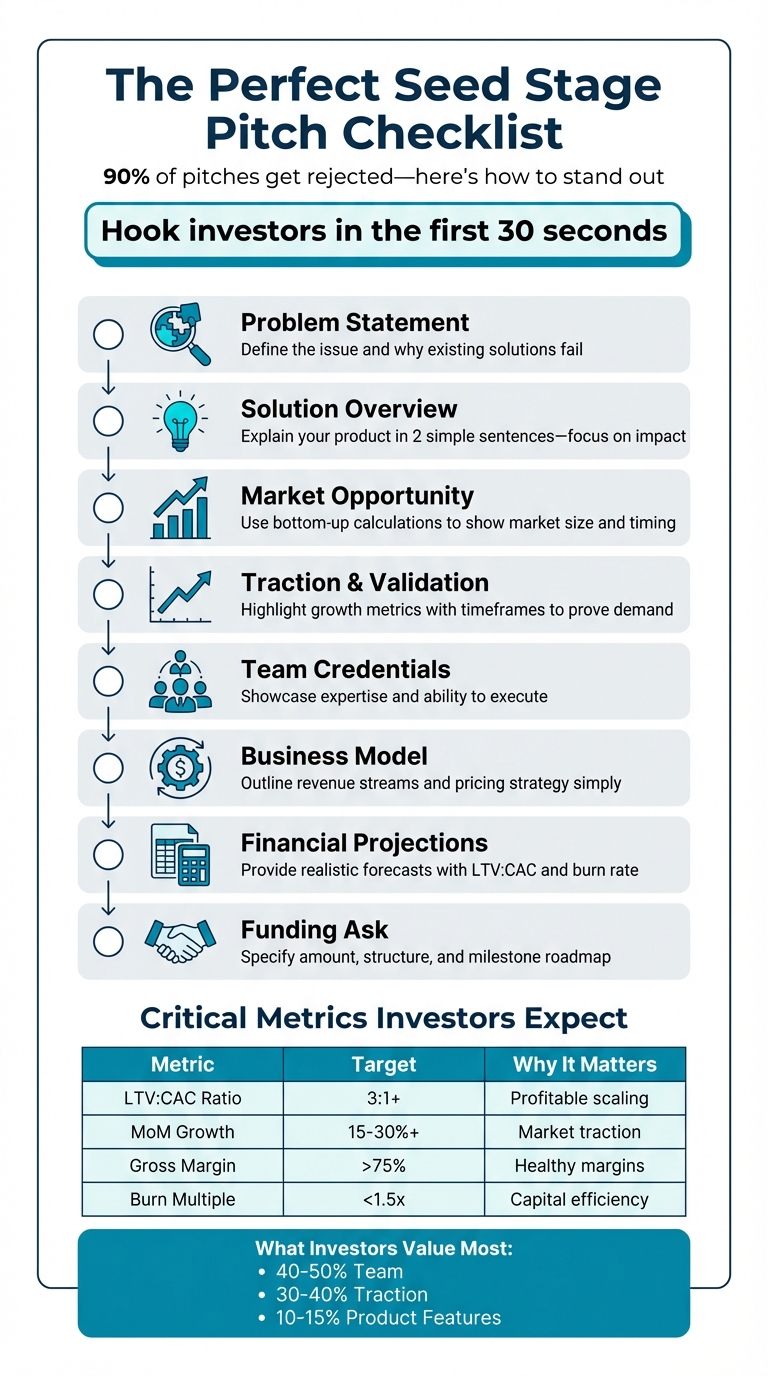
Your seed stage pitch could be the difference between securing millions or walking away empty-handed. With over 90% of pitches rejected, standing out means delivering a clear, engaging story that hooks investors in the first 30 seconds. Here’s what you need to nail:
- Problem Statement: Clearly define the issue your startup solves and why existing solutions fail.
- Solution Overview: Explain your product in two simple sentences - focus on its impact, not technical details.
- Market Opportunity: Use realistic, bottom-up calculations to show your market size and why now is the right time.
- Traction and Validation: Highlight growth metrics or customer validation to prove demand.
- Team Credentials: Showcase your team’s expertise and ability to execute.
- Business Model: Outline your revenue streams and pricing strategy in simple terms.
- Financial Projections: Provide realistic, data-backed forecasts and key metrics like LTV:CAC and burn rate.
- Funding Ask: Specify the amount, structure, and how funds will achieve critical milestones.
Investors today prioritize sustainable growth and clear financials. Prepare a professional data room with clean financials, detailed projections, and a clear funding plan to build trust and close the deal. A polished pitch isn’t just about the deck - it’s about delivering a story investors can’t ignore.
8 Essential Components of a Seed Stage Pitch Checklist
Mastering Your Seed Stage Pitch Deck: The Ultimate Guide
sbb-itb-17e8ec9
Core Components of a Seed Stage Pitch
Every seed stage pitch rests on five key elements. Miss even one, and you might lose investor interest before your pitch is over.
Problem Statement
Your problem statement is the backbone of your pitch. Clearly define the pain point your startup addresses, identify who is affected, and explain why existing solutions fall short. The goal? Make investors feel the urgency of the issue.
Take Airbnb’s 2009 pitch as an example. They spotlighted the high cost of hotels and the lack of authentic local experiences, driving home the need for a better option with a real-world example.
"A unique insight is something that the listener should not be able to guess or find after a quick search. It's an insight from the deep study you've done into the space, your eureka moment." – Jyotsna Pattabiraman, Founder and Investor, Aureolis
Start with the problem, not the solution. Use relatable anecdotes or even customer testimonials instead of abstract concepts. Keep the slide visual and avoid cluttering it with text or technical jargon - clarity is your priority. Once the problem is clear, it’s time to introduce your solution.
Solution Overview
Describe your product in two simple sentences that anyone can grasp. If you can’t, you’re not ready to pitch. Focus on the value your product delivers, not the technical details. Investors care about the impact, not the mechanics.
Tie your solution directly to the problem you’ve outlined. If you mentioned three pain points, show how your product addresses each one. Use visuals like screenshots, mockups, or diagrams to make your product tangible for investors.
"Industry jargon signals insecurity, not expertise." – Michael Seibel, Managing Director, Y Combinator
Your solution slide should focus on one core idea. Investors should be able to explain your product to someone else after a quick glance. With VCs spending just a few minutes on pitch decks, every second counts.
Once your solution is clear, you’ll need to demonstrate the market potential.
Market Opportunity
When presenting your market size, use a bottom-up approach - calculate the number of potential users multiplied by the price. Avoid vague claims about capturing a slice of a massive market. Be specific and realistic.
For example, Airbnb’s pitch broke down their market opportunity: 1.9 billion trips worldwide (TAM), narrowing to budget-conscious and online travel users (SAM). They then asked for $500,000 to hit 80,000 transactions and $2 million in revenue within a year. This level of detail showed investors exactly how their funding would fuel growth.
Back your numbers with credible sources and highlight the "why now" factor. Explain what recent changes - whether technological, regulatory, or market trends - make your solution possible and relevant today.
Traction and Validation
Investors want to see momentum, not just numbers. Always include timeframes with your metrics. For instance, instead of saying "1,000 users", specify, "Grew from 0 to 1,000 users in 8 weeks." This demonstrates velocity, which often matters more than raw figures at this stage.
Tailor your metrics to your business model. For B2B SaaS, focus on early design partners and usage patterns. For product-led growth, showcase activation events and retention rates. For marketplaces, emphasize repeat usage and proof that scaling won’t hurt unit economics.
At the seed stage, traction validates both the problem and your solution’s appeal. If you’re pre-seed, aim to show qualitative validation through 10–30 customer interviews. For seed-stage pitches, highlight early Monthly Recurring Revenue (MRR) and retention signals.
Team Credentials
Investors at this stage are betting as much on the team as the idea. Showcase your team’s experience, skills, and unique qualifications to prove you can execute.
Highlight domain expertise, past startup experience, or insights gained from deep immersion in the problem space. If your team has scaled products before, lead with that. If you’ve uncovered a unique insight through years of research, make it known.
Don’t bury your strongest asset. If your team is your biggest selling point, put it front and center, not on slide eight. Each minute of investor attention is earned - make it count.
Business and Financial Details
Now that you've laid out the core elements of your pitch, it's time to focus on the financial framework that will convince investors your business is built to last. After showcasing your team and traction, this section proves your startup isn't just addressing a problem - it's creating a durable, growth-oriented business.
Business Model
Start by explaining your revenue model in just two sentences. Identify your income streams - whether they come from subscriptions, transactions, or advertising - and highlight the key drivers of their growth. For software companies, keep in mind that investors typically look for gross margins above 75%.
Your pricing strategy should make sense from a value perspective. For instance, if your product saves a customer $100,000 annually, charging $20,000 (capturing 20% of the value) is reasonable. Be transparent about your revenue math. For example, if you have 300 customers with an Average Contract Value of $6,000, that equals $1.8 million in annual recurring revenue.
"If your market opportunity is massive but your unit economics are broken, the deal stops here." – Financial Models Lab
Introduce a wedge strategy - your focused entry point into the market. This demonstrates that you're not just chasing revenue but building a business with a protective moat around it.
Once you've outlined your revenue model and pricing, shift the conversation to forecasting your business's future performance.
Financial Projections
Provide monthly projections for the next 12–18 months and quarterly forecasts for the third year. Use a bottom-up approach based on tangible factors like sales capacity and conversion rates rather than relying on vague market-share predictions.
Prepare three scenarios to address market uncertainties: Conservative (accounting for delays), Base Case (most likely outcome), and Optimistic (faster-than-expected execution). Investors today prioritize realistic assumptions and a clear route to profitability over flashy growth projections.
| Metric | Seed Stage Target | Rationale |
|---|---|---|
| LTV:CAC Ratio | 3:1 or higher | Indicates profitable scaling |
| MoM Growth | 15%–30%+ | Shows strong early market traction |
| Gross Margin | >75% | Reflects healthy software margins |
| Burn Multiple | <1.5x | Demonstrates efficient capital use |
Incorporate a KPI dashboard into your financial model to track key metrics like CAC (Customer Acquisition Cost), LTV (Lifetime Value), Gross Margin, and Monthly Runway. Every financial metric should tie back to specific, strategic decisions. Remember, cash flow issues are the downfall of about 71% of startups.
Finally, detail your capital needs and how you’ll deploy the funds.
Funding Ask and Use of Funds
Be clear about the funding amount you're seeking. Seed rounds in 2026 generally range between $2 million and $5 million. Specify the investment structure - whether it’s a SAFE, a priced round, or a convertible note - and include the valuation cap, if applicable. Aim to give away 15%–25% equity; exceeding 30% could lead to excessive dilution in future rounds.
Your funding request should cover 18–24 months of runway, plus an additional 3-month buffer for contingencies. Every dollar should correspond to a milestone, such as launching a new product feature or hitting a specific ARR target.
| Allocation Area | Typical Percentage | Purpose |
|---|---|---|
| Sales & Marketing | 35%–45% | Drive customer acquisition and market growth |
| Product/R&D | 30%–40% | Enhance features and scale technology |
| Hiring/Ops (G&A) | 15% | Build the core team while managing overhead |
| Working Capital | 10% | Handle contingencies and maintain flexibility |
Focus on hiring "force multipliers", such as engineers and marketers who can leverage AI to amplify productivity. Steer clear of unnecessary expenses like lavish office spaces or vanity metrics that don’t directly contribute to your next growth milestone.
"Clearly articulate what milestones this capital achieves that enable your next fundraise." – Cactus Marketing
Before reaching out to investors, prepare a professional data room that includes your financial model, three-year projections, and a detailed breakdown of how you’ll use the funds. In 2026, due diligence often involves technical audits of your codebase and AI models to ensure scalability.
With these financial details in place, your pitch is complete, giving investors a clear picture of both your vision and your plan for sustainable execution.
Polishing Your Pitch
You've laid the groundwork - now it's time to ensure your delivery is as strong as your content. Even the most well-crafted pitch can flop if it's poorly delivered or if your slides feel cluttered.
Delivery and Storytelling
Start with the basics: write out your pitch as plain text before diving into slide creation. If your ideas don’t flow clearly in three simple paragraphs, no amount of design will save it. Test your pitch against the 2-Sentence Test: two concise sentences anyone can grasp, paired with one vivid example.
Lead with your strongest point using the 60-Second Rule. Whether it’s your traction, team, or a standout insight, don’t bury it on slide eight. Investors spend an average of just 3 minutes and 44 seconds reviewing a deck, so clarity is your best friend.
"Clarity trumps accuracy – Better to be 80% accurate and 100% clear than vice versa." – Michael Seibel, Managing Director, Y Combinator
Make it a conversation, not a lecture. If the investor talks at least half the time, they’re already engaging with your idea. Record yourself practicing to fine-tune your timing and delivery. Better yet, run your pitch by someone outside your industry to ensure it’s effortless to follow.
These storytelling strategies naturally set the stage for creating visuals that pack a punch.
Visuals and Presentation
Keep your slides clean and focused. Stick to the one idea per slide rule to avoid overwhelming your audience. Use clean, sans-serif fonts like Helvetica or Montserrat, with body text at least 24pt and titles between 36–44pt. Align text to the left for easier scanning.
Let visuals do the heavy lifting. Instead of listing technical features, include clear screenshots or short animations. For example, when Uber pitched as "UberCab", they highlighted the problem with "hailing is inefficient" and explained their solution as simply as "1-Click Hailing". That level of clarity leaves no room for confusion.
Test your deck on a smartphone using the Mobile Test. If your text or charts are unreadable on a 6-inch screen, simplify your design. Stick to three core colors and increase white space by 30% to boost readability. The sweet spot for a pitch deck is 11 to 20 slides - decks in this range are 43% more likely to secure investor interest. Keep detailed financials in an appendix for the Q&A section.
Consider tools like Lucid Financials (https://lucid.now) to create clean, investor-ready reports that align with your polished presentation. With a refined pitch and sharp visuals, you’re ready to make a lasting impression.
Ensuring Financial Readiness
Having clear and organized financials does more than just satisfy due diligence - it can make or break your pitch. While a polished deck might get you in the door, clean and well-prepared financials are what seal the deal. Investors often spend 6–9 months on due diligence, and messy financial records can raise red flags. Companies with professional financial guidance are far more likely to secure funding, yet a staggering 90% of startups fail because founders struggle to articulate their financial story clearly. A strong financial foundation ensures you're ready to present a solid case to investors.
Your financial package should include key documents like a profit and loss (P&L) statement with detailed revenue and expense breakdowns, a balance sheet showcasing liquidity and runway, and a cash flow statement that tracks the movement of money. Forward-looking revenue projections are also essential, but they need to be grounded in real data, such as customer acquisition costs (CAC) and conversion rates. Don’t forget to include a clean cap table with vesting schedules and details about your option pool. For a comprehensive view, provide at least 12 months of historical data along with 18 months of forward projections.
"In this market, your pitch deck gets you meetings. Your financials get you funded." – GroundworkCFO
Be prepared to stress-test your assumptions with scenario-based forecasts. For example, create base, aggressive, and conservative models to answer tough questions like, "What happens if conversion rates drop by 20%?" or "What if the sales cycle doubles?". Demonstrating operational discipline is also critical - close your books by the 10th of each month to show you're on top of things. And always use accrual-basis (GAAP) accounting for accuracy and compliance.
Lucid Financials for Startups
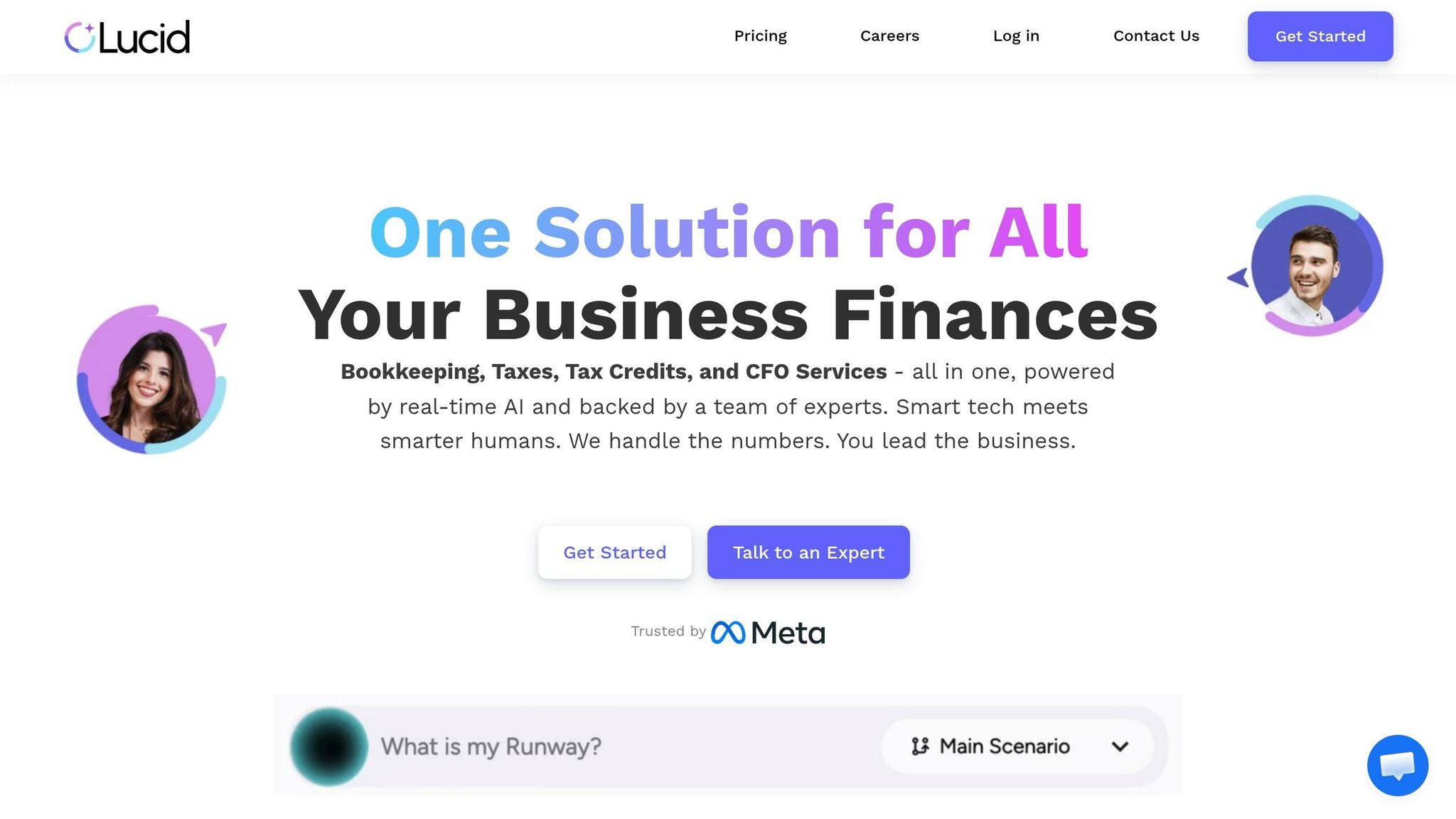
To simplify the process of maintaining clean financials, consider using an automated solution. Relying on manual spreadsheets can lead to version control issues and formatting mistakes, especially during due diligence. Lucid Financials (https://lucid.now) eliminates these risks with AI-powered bookkeeping that delivers investor-ready financials in just seven days. The platform provides P&L statements, balance sheets, and cash flow reports linked to live data, keeping you prepared at all times.
Lucid also integrates with Slack, offering real-time insights into your burn rate, runway, and spending - no need to dig through endless spreadsheets. The AI generates accurate forecasts and scenario models, with a team of professionals reviewing everything for precision. By automating bookkeeping, Lucid Financials ensures your financial story is as compelling as your pitch. With pricing starting at $150/month, the platform offers a full suite of financial services, including bookkeeping, taxes, tax credits, and CFO support, so you can focus on winning investors instead of reconciling accounts.
Conclusion
Creating a strong seed stage pitch takes careful planning and attention to detail. A well-structured checklist not only showcases your organization and dedication but also signals your ability to deliver returns.
When it comes to what investors value most, the numbers tell the story: 40–50% of their decision hinges on the team, 30–40% on traction, and only 10–15% on product features. This means your checklist should focus on proving your team's credibility and showing real market validation - flashy product features alone won't seal the deal.
"Seed fundraising pitches fail most often not because the business is weak, but because founders don't know how to communicate their story compellingly." – River Editor
To refine your pitch, follow the 10-Pitch Rule: start with lower-priority investors to practice, fine-tune your delivery, and address recurring questions. Assess your readiness by scoring yourself on a 0–10 scale across critical areas like problem clarity and go-to-market strategy. If you’re scoring below a 5, consider dedicating 30–45 days to hitting key milestones before approaching top-tier firms. Remember, while an impressive pitch deck opens doors, organized financial records and a well-prepared data room are what help close deals during due diligence.
The fundraising game has changed. Investors in 2026 no longer chase "growth at all costs." Instead, they prioritize sustainable growth, healthy unit economics, and a clear path to profitability. Use your checklist to fine-tune every aspect of your pitch, ensuring it meets the higher standards of today’s investors. Preparation builds trust - and trust turns interest into commitments.
FAQs
What should I say in the first 30 seconds of my seed pitch?
In the first 30 seconds of your seed pitch, you need to explain your startup clearly and concisely in just two sentences. Make sure to include a specific example to drive your point home.
For instance: “Our platform connects freelance graphic designers with small businesses needing affordable, high-quality branding. Last month, a bakery used our service to create a logo that increased their foot traffic by 25%.”
This approach ensures your message is crystal clear and hooks investors immediately.
What traction matters most if I’m early or pre-revenue?
For startups in their early stages or those not yet generating revenue, the key indicators of traction include user adoption, retention, and any evidence of early revenue growth. It's also essential to showcase progress by validating product-market fit, which highlights the startup's potential and direction.
What should I include in my investor data room?
Your investor data room needs to be a well-organized collection of essential documents that investors will want to review. These typically include:
- Pitch Deck: A concise presentation that outlines your business model, market opportunity, and growth strategy.
- Executive Summary: A one-page document highlighting your business's key points.
- Business Plan: A detailed plan that dives into your goals, strategies, and operational details.
- Financials: This includes profit and loss (P&L) statements, financial projections, and your cap table.
- Legal Documents: Items like incorporation papers, bylaws, and shareholder agreements.
- Team Bios: Brief profiles of your leadership team to showcase their expertise.
- Intellectual Property Information: Details about patents, trademarks, or other IP assets.
- Market Analysis: Data and insights about your target market and competition.
- Product Information: This could include your product roadmap, demos, or other relevant materials.
- Prior Funding Agreements: Documents such as SAFEs or convertible notes from earlier funding rounds.
Keeping these materials well-organized and up-to-date will make the review process smoother for potential investors.