Startups face uncertainty daily. Scenario planning offers a way to prepare for multiple possible futures, rather than relying on a single forecast. By considering best, base, and worst-case scenarios, startups can make smarter decisions about resources, hiring, and risk management.
Here’s the process in a nutshell:
- Identify Key Factors: Focus on internal controls (e.g., team size, costs) and external uncertainties (e.g., market trends, regulations).
- Build Scenarios: Create base, best, and worst-case models to prepare for different outcomes.
- Use Data: Leverage historical data and tools like machine learning to validate assumptions and recognize risks.
- Stress Test Finances: Simulate cash flow under challenging conditions to understand limits and plan responses.
- Track Triggers: Monitor specific indicators (e.g., revenue changes, regulatory updates) to know when to adjust plans.
This approach helps startups stay flexible, secure investor trust, and navigate challenges effectively. Tools like AI-powered financial platforms simplify scenario modeling, making it easier to keep plans updated and actionable.
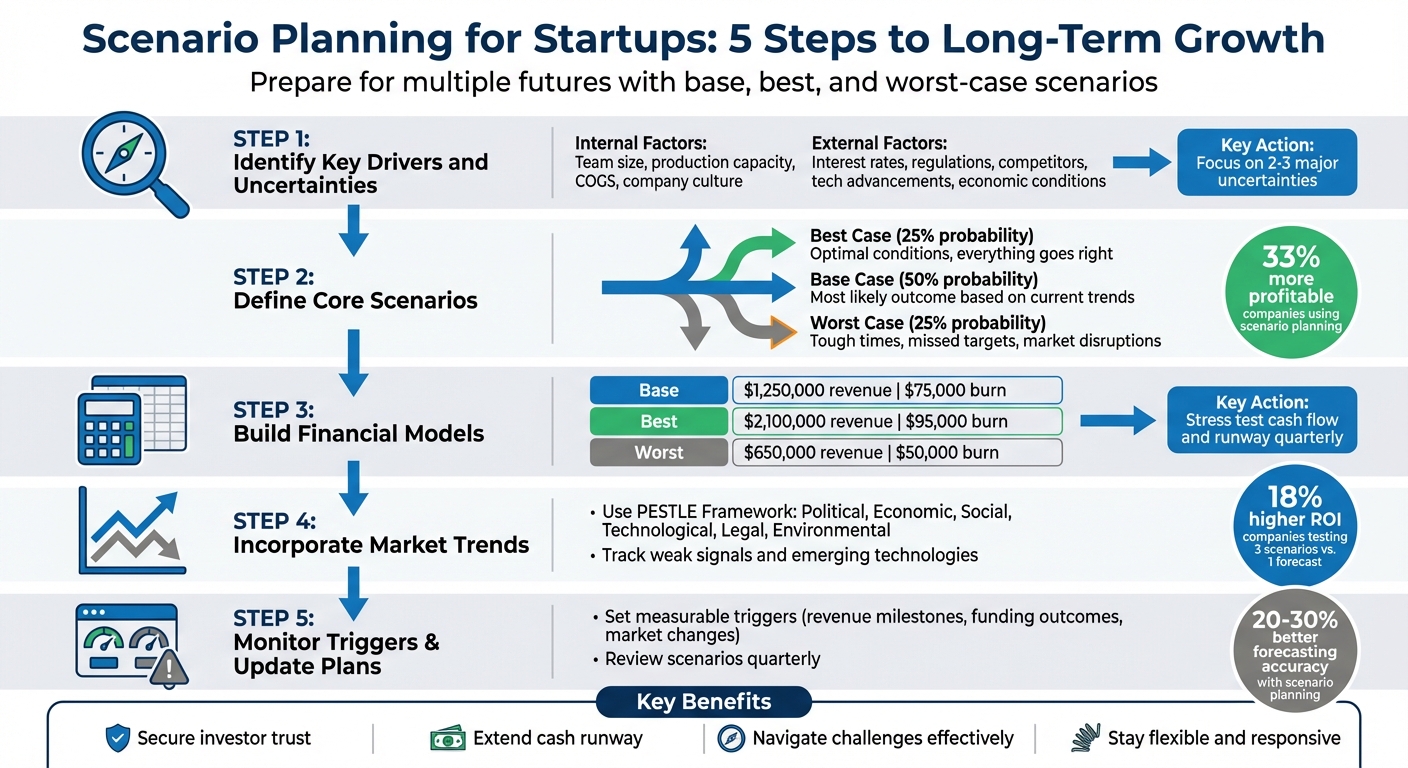
5-Step Scenario Planning Process for Startup Growth
Scenario Planning Explained: Simple 5-Minute Example for Your Business
sbb-itb-17e8ec9
Step 1: Identify Key Drivers and Uncertainties
The first step in scenario planning is figuring out the factors that will have the biggest influence on your startup’s future. It's about separating what you can control from what you can't and zeroing in on the uncertainties that could change your direction.
Recognize Internal and External Factors
Internal factors are the ones you have direct control over - like your team size, production capacity, cost of goods sold (COGS), and even your company culture. External factors, however, are outside your control. These include things like interest rate fluctuations, regulatory changes, competitor actions, technological advancements, or economic downturns. For tech startups, external events like FDA approvals or patent decisions can be game-changers.
Pinpointing which external uncertainties matter most is critical. For example, in early 2025, consumer confidence hit levels not seen since the 2008 financial crisis, and the S&P 500 experienced wild swings - rising 9.5% in one day only to drop 3.5% the next. In such unpredictable conditions, narrowing your focus to two or three major uncertainties can help you avoid getting overwhelmed. The next step is using data to sharpen and validate these insights.
Use Data to Pinpoint Uncertainties
Data is your best ally for making informed decisions. Tap into your ERP system for historical sales data, headcount trends, and actuals from your general ledger to test your assumptions. Bring together a diverse team from marketing, finance, and operations, and include outside input from industry analysts or even customers to reduce bias and uncover blind spots.
Machine learning tools can also help by spotting emerging trends and finding patterns in large datasets. Ask yourself: What could disrupt your revenue model or force a strategic pivot? Set up clear signposts - specific indicators that show which scenario is playing out so you can adjust quickly. For instance, if a regulatory change is on the horizon, keep an eye on legislative updates. If customer behavior is shifting, track usage metrics weekly instead of quarterly.
Step 2: Define Core Scenarios
Once you’ve pinpointed your key drivers and uncertainties, it’s time to map out three core scenarios: base, best, and worst. The goal here isn’t to predict the future but to prepare for a range of possibilities. A suggested probability split is 50% for the base case, 25% for the best case, and 25% for the worst case. This approach helps guide resource allocation while minimizing unpleasant surprises. These scenarios become the foundation for your risk management and strategic planning.
Base Case Scenario
The base case represents the most likely outcome, rooted in current data and trends. Think of it as your "business as usual" scenario. For example, if last quarter’s revenue hit $500,000 with a steady 15% month-over-month growth, you might project similar growth while accounting for seasonal trends or known challenges.
To build this scenario, use a bottoms-up approach. Check if your operational metrics - like sales capacity, production limits, or customer acquisition costs - can support your top-down targets [9,11]. Compare your assumptions to industry benchmarks to ensure they’re realistic. This is the scenario you’ll rely on for routine decisions like budgeting and hiring.
Best Case Scenario
The best case envisions optimal conditions where everything goes right. Maybe your product gains viral traction, your fundraising round surpasses expectations, or regulatory changes open new doors [7,8]. The PESTLE framework (Political, Economic, Social, Technological, Legal, Environmental) can help identify external factors that could drive this scenario, such as rapid tech adoption or favorable policies [8,10].
"Scenario planning is not just about preparing for potential downsides; it is about equipping organizations to act on strategic opportunities and mitigate risks to the long-term strategy and vision."
- Bob Swan, former CEO of Intel
Quantify this scenario with care. For instance, if demand suddenly spikes by 300%, how would that impact revenue and operations? In a "best-case" AI-driven market for 2026, some projections suggest revenue growth could reach 18%, fueled by innovation and low barriers to adoption. The trick is keeping this scenario ambitious but achievable. Use sensitivity analysis - adjusting variables like pricing or conversion rates - to see how they influence metrics like customer lifetime value. Companies that test investments across multiple scenarios report 18% higher returns compared to those relying on a single forecast.
Worst Case Scenario
The worst case prepares you for tough times - whether it’s missed revenue targets, a failed funding round, customer churn, or a broader economic slump [8,13]. Start by identifying risks, both external (market disruptions, regulatory shifts) and internal (like over-reliance on a single supplier or key personnel) [8,13].
Develop a brief narrative that outlines potential failure triggers and response actions. For example, if revenue growth drops below 5% for three months straight or churn exceeds 10% in a quarter, these could act as Key Risk Indicators (KRIs) to signal trouble [12,13]. Anchor your projections with actual cash flow trends and conversion data. Then, outline a response strategy: prioritize essential operations like customer retention and compliance while cutting back on non-critical areas like marketing or hiring [8,12]. This model acts as a guide for quick, decisive action. Research shows that companies engaging in scenario planning are 33% more profitable than those that don’t.
Step 3: Build Financial Models for Each Scenario
After defining your three scenarios, the next step is to translate them into detailed financial forecasts. This means creating projections for revenue, expenses, cash flow, and runway for each case. Instead of sticking to narrative descriptions, you'll assign numbers to your assumptions. These forecasts aren't just theoretical - they directly inform decisions about resource allocation, hiring plans, and when to scale up or pull back. In essence, these models become your decision-making toolkit.
Quantify Scenario Impacts
Start by comparing key financial metrics across your base, best, and worst-case scenarios. For example:
- Base Case: Annual revenue of $1,250,000 with a monthly burn rate of $75,000.
- Best Case: Revenue increases to $2,100,000, but burn rises to $95,000 due to faster hiring.
- Worst Case: Revenue drops to $650,000, while burn decreases to $50,000 through cost-cutting.
Use clear US number formats (e.g., $1,250,000) for consistency. Then, adjust one assumption at a time to see its impact. For instance, how would your cash position change if your sales conversion rate fell from 8% to 5%? Or if customer acquisition costs jumped by 40%? This type of sensitivity analysis helps you identify which variables have the biggest influence on your finances and where to focus your attention.
Once you’ve quantified these impacts, it’s time to test how your projections hold up under stress.
Stress Test Cash Flow and Runway
Stress testing your models is essential, especially for the worst-case scenario. As Bryan Long, Content Marketing Manager at Kruze Consulting, explains, reverse stress testing helps businesses prepare for challenges like losing a major customer, economic downturns, or other unexpected shocks. The goal isn’t to predict disaster but to understand your limits and prepare for them.
To perform reverse stress testing, pinpoint your failure point - the moment your business might run out of cash or hit critical financial thresholds. Then, consider scenarios that could lead to this outcome. For example, what happens if you experience three straight months of 30% revenue shortfalls? Or if infrastructure costs suddenly spike by 50%? Once you’ve identified these risks, create actionable plans to mitigate them. This might include securing a credit line, cutting discretionary expenses, or speeding up collections.
Collaborate with your finance, operations, and leadership teams to ensure your strategies are both practical and executable. And don’t let these models gather dust - update them regularly, at least every quarter, to reflect new data and shifting market conditions. By grounding your decisions in robust financial forecasts, you position your business to weather challenges and seize opportunities for growth.
Step 4: Incorporate Market Trends into Scenarios
Relying solely on internal data paints an incomplete picture. External factors like regulatory updates, technological breakthroughs, and economic shifts can disrupt even the most well-thought-out plans. By weaving real-world market trends into your scenarios, you ensure your strategies remain practical and grounded.
Here’s a compelling fact: companies that test their strategic investments across three different scenarios see an average return on investment that's 18% higher than those using just one forecast. Connecting internal assumptions with external realities strengthens your scenarios and prepares you for market changes.
Track Market Shifts
Anticipating market changes requires a sharp eye for "weak signals" - those subtle, early signs of change that many overlook. These could be anything from policy drafts and competitor announcements to slight shifts in customer preferences.
"Scenario planning forces you to identify weak signals - those early indicators of change - before they become full-blown crises".
The earlier you identify these signals, the more time you’ll have to fine-tune your strategies.
A great tool for this is the PESTLE framework, which examines Political, Economic, Social, Technological, Legal, and Environmental factors. For instance, a SaaS startup might need to account for evolving data privacy laws, which could lead to higher compliance costs. Meanwhile, a logistics company might need to prepare for the impact of persistent interest rates above 5.0%. Once you’ve identified key external forces, set up measurable signposts - specific triggers that signal a shift in the market.
Collaboration is key here. Involve cross-functional teams to gather diverse insights on market dynamics and customer behaviors. This ensures your scenarios are based on actual trends and not just executive assumptions.
Consider this example: in early 2025, a logistics company predicted a severe labor shortage for Q4 2025. By investing $45 million in automation ahead of time, they avoided $70 million in overtime and recruitment costs when the shortage hit. This kind of proactive planning, based on market trends, can save millions and protect your competitive edge.
Adapt to Emerging Technologies
Technology can either propel your business forward or disrupt your plans entirely. Take generative AI, for example. The adoption speed of GenAI remains uncertain, but the market for AI integration services is expected to grow by $150 billion in 2025. If your business operates in a space where AI could automate processes or enhance your offerings, you need scenarios that account for both rapid adoption and slower-than-expected uptake.
Here’s a real-world example: in 2025, a tech firm anticipated delays in AI regulations and launched a compliant GenAI platform five months early. This strategic move helped them capture $1.2 billion in market share by Q3 2025. Their success came from modeling multiple scenarios around regulatory timelines and competitor actions, enabling them to seize the opportunity when it arose.
To stay ahead, identify technologies that could reshape your cost structure or revenue streams. Build scenarios that factor in varying adoption rates, and structure your investments in phases. This phased approach allows you to adjust if a technology doesn’t gain traction as expected - or if a competitor moves faster than anticipated. For example, instead of committing to a single large investment, spread your spending over time. This strategy minimizes risk and keeps your resources flexible.
Step 5: Analyze Implications and Develop Flexible Strategies
Once you've outlined scenarios and factored in market trends, the next step is to evaluate how these scenarios might influence key financial areas like cash flow, revenue, expenses, and capacity. Take, for example, a U.S.-based fintech startup. If they model a worst-case scenario where user acquisition slows down, they would analyze how this affects transaction volume, compliance costs, and overall revenue forecasts. This type of detailed analysis helps guide resource allocation tailored to each potential situation.
Allocate Resources Across Scenarios
To adapt spending to actual conditions, it's important to separate fixed commitments from actions that can be adjusted. For instance, a startup might commit $500,000 to core product development across all scenarios. However, they could reserve an additional $200,000 for accelerated R&D in a best-case scenario, while planning to cut marketing expenses by 40% in a worst-case scenario.
Aligning these resource allocations with your scenario planning is key. A comparison table can be a helpful tool to map out how resources will be managed under different market conditions. Here's an example of how a U.S.-based retail startup structured their holiday sales strategy in 2023, using measurable triggers like sales targets to optimize inventory and control cash flow:
| Resource Area | Base Case (Fixed/Contingent) | Best Case (Flexible Upside) | Worst Case (Mitigation) |
|---|---|---|---|
| Hiring | Core team (fixed) | Expand sales team if growth >20% | Delay non-essential hires if churn >10% |
| Marketing | Baseline budget (fixed) | Increase spend by 50% if high-demand trigger met | Cut 30% if low-sales trigger met |
| R&D | Planned projects (fixed) | Accelerate projects with favorable regulations | Pause expansions if cost overruns occur |
This method ensures financial stability while keeping the door open for growth when conditions allow.
Balance Risk and Opportunity
Once resources are allocated, the focus shifts to striking the right balance between risk and opportunity. Avoid putting too much emphasis on best-case scenarios without preparing for potential setbacks. At the same time, don't be so cautious that you miss out on growth opportunities. Your tolerance for risk will heavily influence how you distribute resources. For example, a well-funded tech startup might allocate 30% of its budget to downside preparation while dedicating 50% to pursuing best-case growth opportunities.
A dual-track strategy can help you manage risks while staying ready to capitalize on opportunities. Identify which initiatives are essential across all scenarios and which are contingent on specific triggers. For instance, you might keep your core product development team intact no matter the scenario, but only hire additional sales and marketing staff if best-case triggers are met. This approach helps you stay financially cautious while maintaining the agility to act on growth opportunities as market conditions shift.
Use AI Tools like Lucid Financials for Scenario Modeling
Scenario planning can be a headache, especially when juggling multiple forecasts, market changes, and updated financial models. But AI-powered FP&A tools are transforming how businesses handle these challenges. They bring dynamic budgeting, real-time forecasting, variance analysis, and scenario modeling to the table - making it easier for startups to test "what-if" scenarios and evaluate financial impacts on the fly.
Enter Lucid Financials. This platform combines AI-driven forecasts, what-if scenario modeling, and real-time cash flow insights into one seamless workflow. With its CFO and Fundraising plan starting at $150 per month, Lucid lets you tweak assumptions - like adjustments to customer acquisition costs or operational expenses - and instantly see how these changes affect your runway, hiring plans, and cash reserves. Even better, it integrates with Slack, so you can ask questions like, “What happens to our runway if we cut marketing spend?” and get immediate, data-backed answers from Lucid's AI.
The magic of effective AI scenario modeling lies in driver-based planning. This approach zeroes in on key metrics like revenue, expenses, and cash flow, automatically updating forecasts when assumptions change. For instance, if you're exploring a worst-case scenario where monthly recurring revenue drops significantly, an AI tool can instantly show how that impacts your burn rate, hiring strategy, and funding needs. Lucid ensures these recalculations are fast and accurate, with finance professionals verifying the results for added reliability.
Before diving into AI tools, it’s essential to set clear objectives. Define SMART goals, such as reducing forecast variance by 15% within six months, and start small with high-impact, low-risk scenarios like regional sales forecasts. Use historical data, market research, and industry benchmarks to build data-driven assumptions, and validate these assumptions regularly to ensure your models stay realistic. This approach keeps your financial planning grounded and aligned with your growth strategies.
One standout advantage of AI tools is their ability to keep your scenario models up-to-date. Traditional planning often becomes irrelevant within weeks, but AI ensures your models stay current as markets shift. Whether you're dealing with supply chain issues, fluctuating demand, or unexpected opportunities, continuous updates ensure you're always ready for what’s next.
Monitor Triggers and Update Plans for Long-Term Growth
Identify Key Triggers
Triggers are measurable events that act as signals for when it’s time to adjust your strategy. These could include hitting revenue milestones, navigating market changes, or securing funding outcomes. For example, a SaaS startup aiming for a Series A round might define a moderate-case trigger as securing a term sheet valued under $3 million or experiencing quarterly revenue growth below 10%. When these triggers occur, immediate actions might include prioritizing critical hires, cutting back on marketing budgets, or delaying beta launches. While moderate-case triggers call for routine course corrections, worst-case scenarios demand more urgent and decisive measures.
In worst-case situations, triggers should drive immediate action. For instance, if you go 90 days without funding commitments or your burn rate exceeds your runway projections, it might be time to pause hiring, slash expenses, or explore alternative financing options like revenue-based funding. Establish these thresholds early and monitor them closely. This proactive approach helps you pivot your strategy before challenges spiral out of control.
Revisit Scenarios Regularly
Once you’ve identified and started tracking key triggers, it’s essential to keep your scenarios up-to-date. Scenarios aren’t static - they need regular updates to reflect current conditions. Schedule quarterly reviews and reassess scenarios immediately after major events like regulatory changes, funding rounds, or shifts in the market. During these reviews, revisit your assumptions using updated data. Ask yourself: Are revenue projections still realistic? Have industry benchmarks shifted? Are your cost estimates staying on track?
Variance analysis can be a powerful tool here. Comparing actual performance against your scenarios can reveal if sales are consistently missing targets or if expenses are climbing higher than expected. If so, adjust your allocations to stay aligned with your goals. Consider using tools that automate the tracking of leading indicators. These tools can flag deviations early, helping you remain agile enough to seize growth opportunities while maintaining the financial stability needed to navigate potential downturns.
Conclusion: Drive Long-Term Growth Through Scenario Planning
Scenario planning reshapes how startups handle uncertainty. By pinpointing key factors, crafting base, best, and worst-case scenarios, and stress-testing your financial runway, you can prepare for a range of potential outcomes instead of relying on a single prediction. This method helps uncover weaknesses early, strengthens your ability to manage risks, and allows for quick adjustments when the market shifts. Companies that embrace scenario planning often see 20–30% better forecasting accuracy and a 25% improvement in their ability to respond to challenges.
Staying proactive by tracking market trends, reallocating resources as needed, and keeping an eye on critical triggers ensures you're ready to act - whether that means addressing a funding gap or seizing unexpected growth opportunities. This readiness not only reassures investors but also helps extend your cash runway during challenging periods. It’s a strategy that stabilizes operations while setting the foundation for flexible, sustainable growth.
Lucid Financials simplifies scenario planning for startups with AI-driven financial modeling, real-time Slack updates, and investor-ready reports delivered in minutes. Plus, with dedicated CFO-level support and clean books in just seven days, you can spend less time buried in spreadsheets and more time focusing on your next strategic move.
FAQs
What assumptions should I model first?
To get started, pinpoint the main variables that heavily influence your business. These might include revenue drivers, customer acquisition costs, operational expenses, and cash reserves. Narrow your focus to 2–3 key assumptions, then use these to build scenarios - such as a base case, an upside case, and a downside case.
Ground your projections in reality by relying on historical data and market trends. For added precision, consider leveraging AI-powered tools. These tools can help you automate scenario testing and fine-tune your assumptions, giving you a more dependable foundation for long-term planning.
How do I choose the right triggers to monitor?
To choose the best triggers for scenario planning, focus on 2–3 critical factors that heavily influence your business. These could include metrics like revenue, costs, or market trends. Use these variables to create scenarios - such as base case, upside case, and downside case - and clearly outline the specific triggers that would prompt action in each situation. By tracking these triggers in real time, you can stay ahead of market changes or operational shifts, adjusting your plans quickly and effectively.
How often should I update my scenarios?
Updating your scenarios on a monthly or quarterly basis is crucial to keep them aligned with real-time data and shifting market conditions. By doing this, you ensure your forecasts remain accurate and useful for decision-making. Regular updates also help your planning stay in sync with changing business dynamics and support your long-term objectives.