Outdated investor reporting methods waste time, create errors, and frustrate investors. Startups relying on static spreadsheets and manual processes risk delays, inaccuracies, and poor communication, which can harm relationships and funding opportunities. Automation and real-time data integration solve these problems by providing up-to-date financial insights, improving decision-making, and building investor trust.
Key Takeaways:
- Manual reporting causes delays and errors: Static reports are outdated by the time investors see them, and manual data entry often leads to inaccuracies.
- Real-time data builds trust: Automated systems sync financial data continuously, ensuring accuracy and transparency.
- AI-powered tools add value: Instant forecasts and alerts help startups anticipate risks and respond quickly.
- Efficiency improves across teams: Automation reduces repetitive tasks, freeing up time for strategic planning.
Solution: Platforms like Lucid Financials offer real-time dashboards, automated updates, and investor-ready reports starting at $150/month. These tools streamline financial operations, strengthen investor relationships, and help startups scale effectively.
Problems with Outdated Investor Reporting Methods
Delayed Reporting Cycles
Relying on manual reporting can slow everything down. When startups spend weeks pulling data from tools like QuickBooks or Excel, the information often becomes outdated by the time investors see it. This not only damages credibility but also gives the impression of poor organization or a lack of respect for investors’ time. Qubit Capital highlights how these delays can harm relationships.
The stakes are high. Startups that regularly communicate with investors are twice as likely to secure follow-on funding. Visible.vc emphasizes the risks of poor communication:
Silence creates uncertainty, and uncertainty erodes confidence.
With the average Series A funding timeline now stretching between 10 and 14 months after a seed round, startups simply can’t afford to disappear while wrestling with spreadsheets. Beyond timeliness, ensuring the accuracy of financial data is just as critical.
Inaccurate Financial Data
Delays are one issue, but manual processes also open the door to errors. Broken formulas, typos, or systems without real-time bank feed integration can lead to inaccurate financial statements. These errors don’t just misrepresent the company’s performance - they can directly misguide investor decisions.
During due diligence, discrepancies between your Management Information System (MIS) and your books of accounts can raise serious concerns. If there are unexplained deviations or a lack of transparency, it signals weak internal controls and governance, as noted by 3one4 Capital. These problems can prolong fundraising efforts and increase investor skepticism. For startups with limited cash reserves, inaccurate reporting on crucial metrics like burn rate can trigger reactive, last-minute decisions - often identifying financial crises only after they’ve started.
Investor Frustration with Static Reports
Static reports, like monthly PDFs or spreadsheets, add to the frustration. These formats only provide a snapshot of past performance, leaving investors unable to quickly assess real-time changes - such as a shortened cash runway after an unexpected expense or a sudden increase in burn rate.
This frustration is driving a shift in expectations. Investors increasingly prefer on-demand access to performance data through secure dashboards rather than waiting for static email updates. With 54% of investors anticipating a rebound in overall investment activity, having real-time insights is critical. Without up-to-date metrics like cash flow and runway, investors are less equipped to offer strategic advice or provide connections that could help startups navigate market changes. Ultimately, the lack of real-time data limits opportunities for guidance and future funding.
sbb-itb-17e8ec9
Creating an AI Agent for Financial Report Analysis
How Real-Time Data Integration Solves Investor Reporting Problems
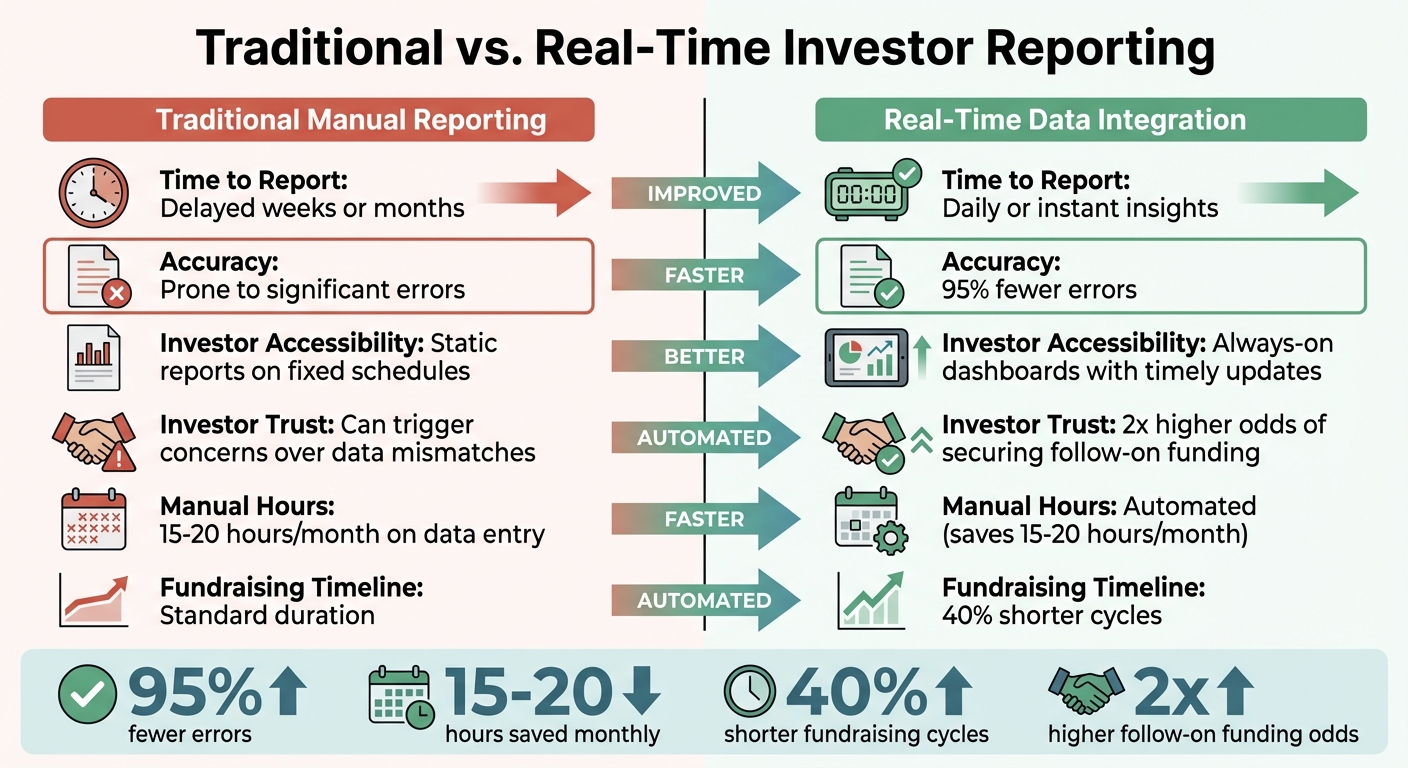
Traditional vs Real-Time Investor Reporting Comparison
Automated Data Syncing for Faster Insights
Real-time data integration takes the hassle out of investor reporting by automating processes that are typically slow and error-prone. Instead of spending weeks manually pulling data from tools like QuickBooks, Stripe, and bank accounts into spreadsheets, automated systems use APIs to sync financial data seamlessly. This means you get daily insights without waiting for month-end closings. The impact? A 95% reduction in errors, saving 15–20 hours each month, and shortening fundraising cycles for startups by 40%. Plus, this automation sets the stage for AI-driven tools that take accuracy to the next level.
AI-Driven Forecasting and Alerts
AI takes real-time data integration a step further by delivering instant forecasts and proactive alerts. Forget manual Excel forecasts - AI uses historical and current data to generate dynamic projections for cash flow, burn rate, and revenue. It doesn’t stop there. Real-time alerts notify founders of critical changes, like a shrinking runway or unexpected expense spikes. This allows them to address risks before they spiral out of control. The result? More reliable insights that enhance investor communication while minimizing human error in forecasting.
Traditional vs. Real-Time Reporting Comparison
Here’s how real-time integration stacks up against traditional manual reporting methods:
| Aspect | Traditional Manual Reporting | Real-Time Data Integration |
|---|---|---|
| Time to Report | Delayed weeks or months | Daily or instant insights |
| Accuracy | Prone to significant errors | 95% fewer errors |
| Investor Accessibility | Static reports on fixed schedules | Always-on dashboards with timely updates |
| Investor Trust | Can trigger concerns over data mismatches | 2x higher odds of securing follow-on funding |
Switching to real-time reporting isn’t just about faster updates - it’s about creating the transparency and trust that investors expect in today’s fast-paced funding environment.
Benefits of Real-Time Investor Reports for Startups
Better Decision-Making and Investor Trust
Having access to real-time financial data allows founders to address cash flow issues immediately and seize opportunities without waiting for the end-of-month reports. With up-to-date insights, you can make strategic decisions based on current conditions rather than outdated information.
This level of transparency also strengthens investor confidence. Real-time dashboards enhance both agility and profitability. According to research from the Association of Chartered Certified Accountants (ACCA), providing real-time financial information improves investor returns and governance. These tools allow for customized, transparent reports that encourage proactive communication. When investors can see accurate, timely data that highlights trends and eliminates surprises, they’re more likely to trust your startup’s financial health. This proactive approach sets the stage for consistent, investor-ready reporting.
Always-On, Investor-Ready Reporting
With live dashboards, your financial data is ready for investor review at any time - whether it’s for a board meeting, an unexpected call, or a new fundraising round. This removes the stress of scrambling to prepare reports last minute and waiting on traditional month-end closings.
While best practices recommend closing books within 10 business days and sharing updates by Day 15, real-time tools go a step further. They provide instant access to profit and loss (P&L) statements and cash flow data. So, when an investor asks about your burn rate or runway during an impromptu conversation, you can provide exact numbers on the spot instead of needing to follow up later. Cloud-based platforms also enable quick budget adjustments and real-time trend analysis, keeping investors informed while drastically reducing preparation time.
More Team Efficiency and Focus
Real-time data doesn’t just build investor trust - it also improves internal operations. Automation reduces the need for manual data entry, allowing your finance team to focus on analysis and strategy instead of repetitive tasks. For instance, a hospitality business that adopted real-time reporting was able to track bookings and expenses live. This helped them optimize staffing and cut unnecessary costs during slower periods - all without increasing headcount.
Implementing Real-Time Data with Lucid Financials

The demand for fast, accurate investor reporting has never been higher, and Lucid Financials steps in with a solution designed to meet this need effectively.
Features of Lucid Financials
Lucid Financials integrates AI-driven automation with professional support to offer real-time financial reporting. It consolidates bookkeeping, tax services, tax credits, and CFO support into a single platform, eliminating the hassle of juggling multiple tools or vendors.
The platform's AI automates tasks like transaction matching and reconciliation, ensuring clean, accurate books within seven days. This allows startups to work with reliable financial data almost immediately, bypassing the long wait times that traditional methods often require.
Lucid also connects seamlessly with Slack, delivering real-time updates on critical metrics such as burn rate and runway. Plus, an expert finance team is just a message away whenever additional support is needed. The platform produces board-ready reports and investor-grade forecasts instantly, helping founders predict trends using up-to-date data. Automated alerts also provide early warnings about potential cash flow issues, giving businesses time to act before problems grow.
All these tools are offered at a fixed, transparent price, making it an attractive choice for startups looking to scale efficiently.
Predictable Pricing
Lucid Financials offers flat-rate pricing starting at $150 per month, with no hidden fees or hourly charges. This straightforward pricing model is tailored to early-stage and growing startups that need financial clarity without unexpected costs. Whether you're looking for basic bookkeeping or advanced CFO-level forecasting, Lucid ensures that all services remain accessible.
Results with Lucid Financials
Lucid Financials transforms how startups manage their finances by streamlining processes and delivering accurate, real-time data. With books finalized in just seven days, founders can address investor questions confidently and without delay. The platform's real-time forecasting and automated alerts allow finance teams to shift their focus from manual tasks to strategic planning. By simplifying financial operations, Lucid Financials empowers startups to navigate critical growth phases with confidence and precision.
Conclusion
Staying on top of real-time data isn’t just a bonus for startups - it’s a necessity. Relying on outdated reporting cycles and manual processes can leave businesses with blind spots, potentially costing them key funding opportunities. Real-time dashboards, on the other hand, allow startups to tackle challenges head-on, making adjustments before small issues snowball into bigger problems.
Startups that adopt real-time investor reporting gain a clear edge. They can quickly adapt to market changes, manage cash flow with foresight, and showcase financial discipline - all qualities investors look for. Regular, up-to-date reporting sends a strong signal that a startup is organized, reliable, and worth backing.
This is where Lucid Financials steps in, offering a tailored solution to these challenges. By combining AI-powered automation with expert insights, Lucid delivers investor-ready reports that are always up to date. With features like clean books in just seven days, real-time Slack updates, and AI-powered forecasting, startups can leave behind tedious manual tasks and focus on scaling their business. And with flat-rate pricing starting at $150 per month, even early-stage companies can access professional-grade financial management without the headaches of traditional accounting firms.
In today’s fast-moving market, agility, transparency, and accuracy are more than buzzwords - they’re the foundation of success. Startups that harness real-time financial data are better equipped to seize opportunities, maintain cash flow, and earn the trust of investors. As industries evolve, the ability to deliver precise, current financial insights will set thriving startups apart from those that struggle to keep up.
FAQs
What metrics should investors see in real time?
Investors need access to real-time metrics to make well-informed decisions and gauge a startup's financial health. Key metrics include:
- Revenue growth rate: Tracks how quickly the startup's revenue is increasing.
- Gross margin: Measures profitability by showing the percentage of revenue remaining after covering production costs.
- Burn rate: Indicates how quickly the company is spending its cash reserves.
- Customer acquisition cost (CAC): Reveals how much it costs to acquire a new customer.
- Customer lifetime value (LTV): Estimates the total revenue a business can expect from a single customer over their relationship.
- Monthly/annual recurring revenue (MRR/ARR): Highlights predictable income streams, crucial for subscription-based models.
- Cash runway: Shows how long the company can operate before running out of cash at its current spending rate.
These metrics provide a clear snapshot of the startup's performance and sustainability, helping investors make strategic decisions.
How do I keep a live investor dashboard secure?
To keep a live investor dashboard secure, implement passcode-protected links, enforce view-only permissions, restrict downloads, and set expiration dates for shared content. These steps help ensure that only authorized users can access the data, minimizing the risk of it being shared without permission.
You should also integrate data using secure APIs and enforce strict access controls. This approach helps safeguard sensitive financial information, keeping it confidential and reducing the chances of breaches.
How do I switch from spreadsheets without breaking my close?
Switching from spreadsheets to an automated financial platform doesn't have to throw off your close process. The key is to plan carefully and use the right tools. Here’s how to make the transition seamless:
- Automate with a real-time platform: Platforms like Lucid Financials can handle data collection and updates automatically, saving time and reducing errors.
- Train your team: Ensure your team is comfortable with the new system by providing thorough training. This helps maintain accuracy and confidence during the shift.
- Keep investors in the loop: Share how real-time reporting enhances transparency and builds trust. Clear communication about the benefits can strengthen relationships with stakeholders.
By focusing on these steps, you can modernize your processes without missing a beat.