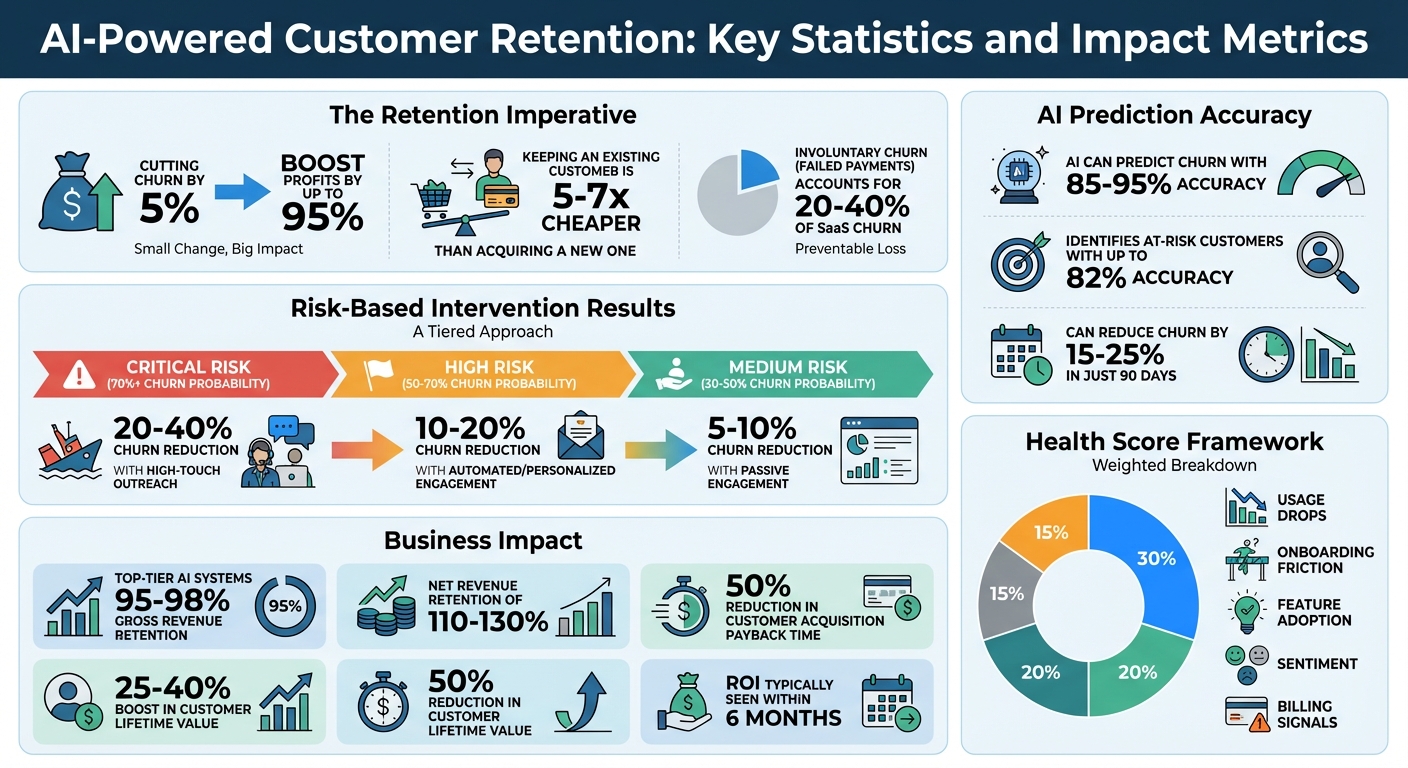
Losing customers is expensive, but keeping them can skyrocket profits. Cutting churn by just 5% can boost profits by up to 95%. Yet, many businesses still focus heavily on acquiring new customers instead of retaining the ones they already have.
AI is changing that. By analyzing data like usage patterns, payment behavior, and customer sentiment, AI can predict churn weeks in advance - giving companies time to act. These tools can reduce churn by 15–25% in just 90 days and identify at-risk customers with up to 82% accuracy.
Here’s what AI does for retention:
- Detects subtle early warning signs of churn.
- Tracks customer behavior, financial trends, and engagement levels.
- Automates personalized outreach to prevent cancellations.
- Helps companies save at-risk accounts and increase lifetime value.
Startups using AI for retention have seen millions in saved revenue and faster growth. Whether it’s spotting a drop in logins or failed payments, AI enables businesses to step in at the right time with the right solution.
AI-Powered Customer Retention: Key Statistics and Impact Metrics
AI for Customer Retention: Reduce Churn and Increase Revenue
sbb-itb-17e8ec9
Data Signals AI Uses to Predict Churn
AI dives deep into data signals related to usage, behavior, and finances to predict which customers might leave. As Atticus Li aptly explains:
The cancellation button is a lagging indicator. By the time a user clicks it, the decision to leave was made days, weeks, or even months earlier.
By analyzing patterns long before a cancellation occurs, AI can pinpoint early warning signs. These signals generally fall into three main categories: usage patterns, behavioral changes, and financial trends.
Customer Usage Patterns
Tracking logins is just the start. Usage data reveals whether customers are still finding value in your product. AI looks for engagement rate changes, such as a drop from daily logins to just a couple of times per week - an early sign of waning interest.
But it’s not just about how often they log in. Depth and breadth of usage matter too. Depth measures how much value users get from each session. For instance, if someone shifts from using advanced features to only viewing basic dashboards, it could mean they’re not finding your product as useful. Breadth, on the other hand, tracks how many features they use. A user who limits their activity to one or two tools may no longer see the overall relevance of your offering.
AI focuses on core features that drive retention. A great example is Sigmoid, which, in 2025, implemented a machine learning model that analyzed both product usage and support interactions. This boosted their ability to identify at-risk customers by 2.5 times and improved retention by 70%. Team engagement also plays a role - accounts where only an admin is active are more likely to churn compared to those with widespread team adoption.
While usage trends offer early clues, behavioral shifts provide even deeper insights into potential churn.
Behavioral Indicators
Behavioral changes often surface before usage patterns shift. For example, incomplete onboarding - like skipping setup, neglecting team invitations, or avoiding data integration - raises churn risk by 60%. AI closely monitors Time to First Value (TTFV), which is the time between signup and when a customer achieves their first meaningful result. If this timeline drags on too long, the account is flagged as at-risk.
Support interactions also reveal a lot. Customers who never submit support tickets - so-called "silent users" - are often more likely to churn because they’re not engaging. On the flip side, an uptick in negative or repeated support tickets is another red flag.
Executive involvement is another key factor. Guy Rubin, Founder of Ebsta, highlights the importance of keeping high-level stakeholders engaged:
If your QBRs are being done below the C-suite, you are four times more likely to churn a customer.
When executive sponsors disengage or a key advocate leaves the company, AI marks these as critical warning signs.
Beyond usage and behavior, financial signals provide concrete evidence of churn risk.
Financial Metrics
Financial trends often paint a clear picture of churn risk. Involuntary churn - caused by failed payments or expired credit cards - accounts for 20% to 40% of SaaS churn.
Other financial signals, such as declining Customer Lifetime Value (CLV), fewer purchases, or plan downgrades, also suggest trouble. Customers who consistently underuse their plan limits are prime candidates for downgrades or cancellations. Additionally, commercial inquiries, like pricing concerns or downgrade requests, are immediate triggers for customer success teams to step in.
| Signal Category | Starting Weight | Risk Indicator |
|---|---|---|
| Usage Drops | 30% | Decline in login velocity or session depth |
| Onboarding Friction | 20% | Uncompleted milestones or high TTFV |
| Feature Adoption | 20% | Plateaued discovery or underutilization |
| Sentiment | 15% | Negative tone in support tickets or declining NPS |
| Billing Signals | 15% | Failed payments or downgrade inquiries |
Source: AI Magicx starting framework for health scores
The best AI models don’t just rely on one category - they combine all three. While product usage decline has the highest predictive weight at 18.2%, integrating behavioral and financial signals provides a fuller picture of customer health.
Spotting these signals early gives companies the chance to take action and fine-tune their strategies to keep customers onboard.
How to Build AI Churn Prediction Models
To turn AI signals into actionable churn predictions, you'll need to gather the right data, train algorithms to spot trends, and refine predictions based on actual outcomes. After deploying the model, ongoing testing ensures it stays accurate over time.
Steps to Create Predictive Models
Start by defining what churn means for your business. Is it a canceled subscription? Thirty days of inactivity? Or something else entirely? Differentiating between voluntary churn (like a user canceling their plan) and involuntary churn (such as failed payments) helps you create more precise models tailored to these scenarios.
Next, collect six to twelve months of historical data from at least 500 customers. Pull data from sources like your CRM, product analytics, support tickets, and billing systems. Many startups rely on tools like Mixpanel or Amplitude for user behavior insights, Stripe or Chargebee for transaction data, and Zendesk or Intercom for support interactions.
Feature engineering is where raw data becomes meaningful. For example, instead of just tracking total logins, you could calculate changes in login frequency over the past 30 days or measure the number of days since a feature was last used. Additionally, encode categorical data (like plan types or industries) so algorithms can process it effectively.
Choosing the right algorithm depends on your needs. Logistic regression is easier to interpret, while methods like random forests or gradient boosting provide better accuracy for complex datasets. Neural networks are great for spotting intricate patterns but require more data and expertise. Since churners are often a minority, address class imbalance early by using oversampling or undersampling techniques.
Divide your data into training, validation, and test sets. Train your model using historical churn data, fine-tune it with the validation set, and evaluate its performance on the test set. Once built, segment customers into risk tiers - Critical (70%+ churn probability), High (50–70%), Medium (30–50%), and Low (below 30%) - to guide your interventions.
| Risk Tier | Churn Probability | Recommended Intervention | Expected Churn Reduction |
|---|---|---|---|
| Critical | 70%+ | High-touch (executive outreach, 1:1 reviews) | 20–40% |
| High | 50–70% | Automated/personalized (email sequences) | 10–20% |
| Medium | 30–50% | Passive engagement (content tips, invites) | 5–10% |
Deploy your model by integrating it into tools like your CRM or Slack. Set up automated alerts for customers crossing risk thresholds, and keep an eye out for data or concept drift. Many companies report seeing a positive return on investment within six months of implementing these systems.
After deployment, focus on validating and refining the model to ensure it performs well in real-world scenarios.
Testing and Improving Model Performance
The work doesn't end once your model is live. Regular A/B testing is crucial - compare intervention groups to control groups and aim for a precision rate of 75% or higher. If accuracy drops below 70%, it's time to retrain.
Set up a closed-loop feedback system that retrains the model monthly based on actual churn outcomes. Adjust the importance of different signals based on their real-world impact. For instance, if billing issues consistently predict churn better than usage drops, recalibrate your model accordingly.
Track how well your interventions are working. A strong system should save at least 30% of at-risk accounts. Use insights from post-churn surveys and exit interviews to identify signals your model might have missed. Retrain the model every 30 days with fresh data to account for product updates and market changes.
When done right, these models can cut churn by 15–25% within 90 days and up to 40% for customers in the critical-risk tier. The secret? Treat your churn prediction model as a dynamic, evolving tool that grows with your business.
Putting AI Retention Strategies into Practice
To make AI insights truly impactful, they need to be woven into your team’s daily routines. This means using predictions to guide action before customers decide to leave. AI-powered systems can predict churn with an accuracy of 85–95%, but those predictions only matter if your team has the right tools and processes to respond effectively.
Setting Up Automated Retention Triggers
Start by building a composite health score (ranging from 0 to 100) that pulls together key data points like usage patterns, onboarding progress, feature adoption, support ticket sentiment, and billing activity. This score should update in real time, reflecting customer behavior as it happens - not just on a weekly or monthly basis.
Once you have this score, define clear thresholds for action. For example:
- 80–100: Customers in this range are healthy and ready for upsell opportunities.
- 40–59: These accounts need immediate attention with personalized outreach to address risks.
- 0–19: These are critical cases requiring executive involvement or an all-hands approach to salvage the relationship.
A major driver of churn is failed payments, which account for 20–40% of all SaaS churn. Tackling this is a great starting point - set up automated dunning workflows to retry failed payments and notify customers before moving on to more complex behavioral triggers. Beyond billing, monitor behavioral signals like a drop in feature usage, reduced login frequency over 30 days, or negative sentiment in support interactions.
Aptive Environmental offers a great example of this in action. In March 2026, the company used Cresta Conversation Intelligence to detect at-risk customers during live calls by identifying signals like price sensitivity or mentions of competitors. Their AI-driven "Agent Assist" tool provided real-time strategies for saving these customers, boosting save rates from 42.2% to 46% and generating over $2 million in retention-driven revenue.
To avoid overwhelming customers with too many messages, implement suppression logic. AI can prioritize the most critical messages while holding back less urgent ones when signs of fatigue appear. For high-value accounts or sensitive issues like billing disputes, route alerts to human agents equipped with full context rather than relying entirely on automation.
After setting up these triggers, focus on continuously measuring and refining your approach to ensure long-term success.
Tracking Performance and Refining Strategies
Once your automated systems are up and running, it’s essential to track how well they’re working and tweak them as needed. Use incremental lift analysis to measure the effectiveness of your interventions. Compare retention rates between customers who received AI-driven actions and those who didn’t. This helps you pinpoint the actual revenue saved, rather than relying on assumptions. Aim for at least a 30% success rate when intervening with at-risk accounts. Top-tier AI retention systems achieve gross revenue retention rates of 95–98% and net revenue retention of 110–130%.
Keep a close eye on your model’s prediction accuracy. If it dips below 75%, it’s time to retrain using fresh data. Set up a feedback loop where the outcomes of your interventions - whether successful or not - feed back into the model to improve its accuracy over time and prevent drift. Break down your retention metrics by customer cohort and lifecycle stage (e.g., onboarding, activation, renewal) to identify where AI is making the biggest impact.
Here’s a practical example: A SaaS company with $10 million in annual recurring revenue and an 8% churn rate could save approximately $240,000 per year by reducing churn by 30%. Beyond that, companies using AI for retention often see a 25–40% boost in customer lifetime value. They can also cut customer acquisition payback time by up to 50%. Another key metric to track is time-to-intervention - your goal should be acting within 48 hours of identifying a risk signal.
How Lucid Financials Supports Retention Analysis

Predicting customer churn requires more than tracking behavior - financial data often uncovers risks before usage patterns shift. For instance, signs like reduced transaction volumes, changes in spending habits, or declining account balances can indicate a customer is likely to leave. Lucid Financials weaves AI-driven financial insights into your retention strategy, helping you act on risks early. By integrating these signals with behavioral data, the platform provides a more complete picture of retention challenges.
AI-Generated Financial Forecasts for Retention
Lucid Financials uses AI to analyze financial data, spotlighting patterns that influence retention. It tracks key indicators such as changes in spending or account balances, which might suggest reduced engagement. On the flip side, it flags accounts nearing plan limits or exploring premium features as potential upsell opportunities. The platform also offers investor-ready reports, focusing on key metrics like churn rate and Customer Lifetime Value (CLV), while emphasizing the cost-effectiveness of retention - keeping an existing customer is 5–7 times cheaper than acquiring a new one. With thousands of data points evaluated, the AI predicts churn risks at scale. A feedback system ensures outcomes are continuously used to fine-tune your retention strategies.
Real-Time Alerts Through Slack
Timely communication is just as important as forecasting. Lucid Financials integrates with Slack to deliver real-time alerts about financial health and retention risks. The AI monitors early warning signs, such as reduced login activity, lower feature usage, or stalled workflows, to identify at-risk customers before they leave. Alerts also highlight negative sentiment in support chats or reviews, as well as signs of friction that suggest a customer might be struggling. These alerts are prioritized, enabling teams to take quick action. For sensitive issues like billing disputes or high-value accounts, notifications are directed to team members trained to handle them with care and expertise.
Conclusion
AI-powered retention strategies give startups the tools to identify churn risks before customers decide to leave. By analyzing usage patterns, behavioral cues, and financial metrics, you can step in at just the right moment with a personalized response. The goal is to shift from reacting to problems after they arise to using data-driven, proactive strategies that keep customers engaged and happy.
The good news? You don’t need a massive data science team to make this happen. Start by defining what success looks like for your customers early on, track the behaviors that lead to long-term loyalty, and let AI automate personalized outreach at scale. This efficient method lays the groundwork for incorporating financial data to fine-tune your approach even further.
Financial insights are a game-changer for retention. Platforms like Lucid Financials combine AI-powered financial data with behavioral analytics, giving you a complete picture of potential churn risks. With real-time alerts sent to Slack and investor-ready reports starting at $150/month, you can act fast when it matters most.
As Aviv Farhi, Founder and CEO of Showcase, shared:
"Lucid has made it easy to track spending, plan ahead, and handle our growth. It's straightforward and effective." - Aviv Farhi, Founder and CEO @Showcase
The most successful startups blend advanced technology with human intuition. AI can handle the heavy lifting - monitoring thousands of data points, generating forecasts, and automating outreach - but human involvement remains crucial for sensitive situations like billing disputes or managing high-value accounts. Striking this balance ensures efficiency while maintaining the personal touch that builds strong, lasting customer relationships. This approach captures the essence of predictive retention strategies that fuel sustainable growth.
FAQs
What data do I need to start predicting churn with AI?
To anticipate customer churn using AI, it's crucial to gather data that captures a comprehensive picture of customer behavior. This includes details like customer interactions, transaction history, usage patterns, and engagement metrics. Additionally, personalization data - such as customer preferences and past interaction records - plays a vital role. These insights allow AI to spot early indications of churn, enabling businesses to implement proactive strategies to retain customers. To make these insights actionable, ensure the data reflects your brand's specific context and goals.
How do I decide which churn signals matter most for my startup?
To pinpoint the key signs of customer churn, concentrate on product-specific behaviors that frequently signal upcoming cancellations. For instance, a noticeable decline in how often a customer uses your product - like shifting from daily to weekly usage - or decreased interaction with essential features can be strong indicators. Dive into your customer data to uncover recurring patterns that typically come before cancellations. By prioritizing these insights, you can take proactive steps to engage at-risk customers and improve your retention efforts.
How can I turn churn predictions into actions without spamming customers?
To address churn predictions effectively without overwhelming customers, prioritize personalized and well-timed actions that align with each customer's risk level. Here's how you can approach it:
- High-risk customers: Offer targeted deals or send personalized messages to re-engage them.
- Low-risk customers: Take a lighter approach, or hold off on immediate outreach.
Leverage automation tools to send the right message at the right time, ensuring your communication feels supportive rather than pushy.