AI is transforming portfolio reporting by saving time, reducing errors, and providing real-time insights. Traditional manual methods are slow, error-prone, and inefficient, often requiring 38 hours per month for data collection and normalization. AI-powered tools streamline this process, cutting reporting time by 95% - from 38 hours to just 3.5 hours. Here's how AI is making a difference:
- Automation: AI pulls data directly from financial systems, eliminating manual entry and errors.
- Standardization: Automatically aligns metrics like EBITDA across portfolio companies for consistent comparisons.
- Error Detection: Machine learning spots anomalies and ensures accuracy.
- Real-Time Updates: Metrics like IRR and cash burn are updated instantly, enabling faster decision-making.
- Investor Dashboards: AI replaces static reports with interactive dashboards, offering transparency and better communication.
Creating an AI Agent for Financial Report Analysis
sbb-itb-17e8ec9
How AI Automation Improves Accuracy
Manual data entry can lead to error rates between 1% and 4%, putting the reliability of investor reports at risk. AI steps in by pulling data directly from source systems through APIs, eliminating copy-paste errors and cutting reporting cycle times by up to 70%. On top of that, automated validation processes catch as much as 95% of common inconsistencies. Let’s dive into how AI enhances data collection and error detection.
Automated Data Collection and Standardization
AI-powered tools streamline accuracy by automating data collection from various financial systems, removing the need for manual exports or reformatting. These tools connect directly to ERP systems, bank feeds, and CRM platforms. Using technologies like OCR (Optical Character Recognition) and NLP (Natural Language Processing), they transform unstructured files - like PDFs or tax documents - into clean, usable records.
One standout feature is how AI standardizes inconsistent naming conventions. For instance, one company might call a metric "Gross Revenue", while another labels it "Total Sales." AI’s machine learning algorithms map these differences to a unified schema, ensuring consistency. Additionally, AI continuously reconciles internal ledgers with external bank statements, flagging discrepancies early. This ensures portfolio reports reflect the most current and accurate financial data.
Machine Learning for Error Detection
Machine learning excels at spotting anomalies, outliers, or suspicious transactions that might escape human oversight. Advanced models accurately interpret financial data, recognizing nuances like parentheses for negative values or differentiating between thousands and millions.
In financial reporting, 70% accuracy might as well be 0% - it's all or nothing.
Modern AI systems employ Retrieval-Augmented Generation (RAG) to link every figure in a report back to its source document. This creates a transparent audit trail, reducing the risk of seemingly correct but inaccurate data. When portfolio companies calculate EBITDA using different methods, machine learning normalizes these variations for consistent comparisons. Every step of the process is meticulously documented, offering full transparency for audits and regulatory compliance. These automated systems ensure error-free, trustworthy reporting that strengthens investor confidence.
How AI Speeds Up Reporting with Real-Time Data
Traditional portfolio reporting typically relies on batch processing, where data is gathered, processed, and shared on a monthly or quarterly basis. AI changes the game by analyzing transactions in real time, updating metrics like IRR, TVPI, and cash burn rates within seconds. This shift from periodic to continuous reporting allows portfolio managers to make decisions based on current data rather than outdated snapshots. Faster reporting also enhances communication with investors, enabling timely and informed discussions with stakeholders. Additionally, real-time processing sets the stage for automated alerts that keep teams updated at all times.
Instant Data Processing
AI doesn't just improve accuracy - it also dramatically increases reporting speed. By using stream processing, AI handles data as soon as it becomes available. Through direct connections to financial systems via APIs, AI categorizes, normalizes, and updates transactions instantly. For instance, when a portfolio company records a new transaction, AI automatically updates the relevant metrics across the platform.
This approach enables live scenario modeling, where fund managers can immediately assess how market changes affect their holdings. Investors gain instant insights into each company's runway by tracking cash balances against spending trends. The result? Reporting that once took days or even weeks now happens in seconds or minutes. Dashboards refresh automatically, providing up-to-date performance metrics in real time.
Automated Alerts and Notifications
Beyond processing data quickly, AI keeps a constant watch over portfolios, monitoring them around the clock. It looks for specific triggers such as covenant breaches, unusual expense patterns, or liquidity concerns. When a KPI moves outside a set threshold - like a 5% drop in asset valuation or a sudden change in debt-to-equity ratio - the system sends immediate alerts. These notifications are customizable to filter out unnecessary noise, ensuring teams only focus on issues that require attention.
Some systems, like Lucid Financials, integrate with tools like Slack to deliver alerts directly into platforms teams already use. For example, Slack notifications can provide real-time updates on portfolio changes, allowing users to access critical insights without leaving their workspace. This exception-based approach frees analysts from constantly monitoring dashboards, enabling them to focus on solving real problems. Advanced AI systems even go a step further with predictive alerts, using trend analysis to flag metrics that are likely to fall short in the future - sometimes detecting risks 9-18 months earlier than traditional methods.
Better Investor Communication with AI Reports
Effective communication with investors hinges on three key principles: clarity, transparency, and timeliness. AI is changing how startups share their financial data by eliminating the delays and uncertainties that often occur between reporting cycles. Instead of waiting for month-end or quarterly reports, investors can now access live updates on a company's financial health. Automated systems, integrated with platforms like QuickBooks or Xero, ensure data is accurate and free from manual errors or manipulation. What’s more, the traditional static PDF reports are being replaced by real-time, interactive dashboards, allowing investors to filter and explore specific data points. This shift not only enhances transparency but also fosters a more dynamic and engaging dialogue between startups and their investors.
Custom Dashboards and Visual Reports
AI takes financial reporting a step further by transforming raw numbers into visual dashboards and charts that are easy to interpret. Instead of combing through endless rows of spreadsheets, investors can interact with customizable KPI modules. These modules allow drag-and-drop functionality for key metrics like IRR (Internal Rate of Return), MOIC (Multiple of Invested Capital), and burn rate. Additionally, modern portfolio tools integrate benchmarking features, comparing performance against anonymized data from thousands of startups. With interactive drill-down options, investors can click on high-level data to uncover detailed transaction-level insights, ensuring complete transparency. AI also standardizes data across multiple portfolio companies, making it easier to compare performance metrics consistently across an entire portfolio.
Always-Ready Investor Reports
AI-driven tools like Lucid Financials redefine the way investor reports are prepared and shared. By syncing with a company's financial systems in real time, these platforms eliminate the stress of the traditional quarter-end "reporting crunch." Investor-grade reports are automatically updated and always ready, giving investors access to secure, self-service dashboards where they can check key metrics whenever they need. This capability also helps founders respond quickly to unexpected inquiries or due diligence requests without scrambling for data. With features like version-controlled data and granular access permissions, AI ensures reports are audit-ready and trustworthy. By providing up-to-date insights, this "always-on" approach empowers both founders and investors to make faster, more informed decisions based on current data rather than outdated reports. The result? Stronger trust, better decision-making, and a more collaborative investor relationship.
How to Implement AI for Portfolio Reporting
You can bring AI into portfolio reporting without completely overhauling your financial systems. The key is to start with integration, add analytics, and then incorporate automation. Using AI enhances accuracy and provides real-time insights. Here's how you can implement it step by step.
Step 1: Connect AI Tools to Your Financial Systems
Start by integrating AI tools with your existing financial systems. These could include platforms like QuickBooks, NetSuite, your bank feeds, or your CRM. Use APIs to sync data either in real time or at scheduled intervals. AI tools rely on data connectors to pull information from multiple sources and standardize it into a unified format for analysis.
Before choosing an AI tool, evaluate your readiness by identifying any data gaps. Make sure the platform you select supports historical data migration - ideally covering 12–24 months of past transactions. This allows you to perform trend analysis right from the start. Security should be a top priority: look for tools that are SOC 2 compliant, offer data encryption, and provide granular access controls. For instance, Lucid Financials simplifies this process by automatically syncing with your financial systems, delivering clean records in just seven days while maintaining high-level security.
Step 2: Use AI for Performance Forecasting
Once your data integration is in place, it's time to tap into AI's forecasting abilities. AI can analyze historical data to predict key metrics like cash runway, EBITDA, and valuation multiples. This goes beyond basic projections - AI can run "what-if" scenarios to explore how different factors, such as market shifts or hiring strategies, could impact future performance. Set up anomaly alerts to quickly identify significant deviations.
Moody's highlights the importance of this approach:
The key differentiator will not be whether firms adopt AI, but how effectively they integrate it into their core decision-making processes.
This step helps shift your focus from reactive reporting to proactive financial planning, enabling you to address potential challenges before they escalate.
Step 3: Create Investor-Grade Reports
The final step is to use AI to produce polished, investor-ready reports. AI tools can automatically calculate key SaaS metrics like CAC, LTV, and churn using standardized formulas, ensuring consistency over time. These tools can also generate reports with interactive dashboards and clear visual representations.
Maintaining real-time dashboards improves transparency with investors. This "always-ready" approach can significantly reduce the time needed for due diligence during fundraising rounds and helps build trust with your investors. Lucid Financials adds another layer of convenience by offering Slack-based support, allowing founders to ask questions about their financials and get instant AI-generated responses, with human experts available when needed. This leads to faster decisions, stronger investor relationships, and more time to focus on growing your business.
Benefits of AI-Powered Portfolio Reporting
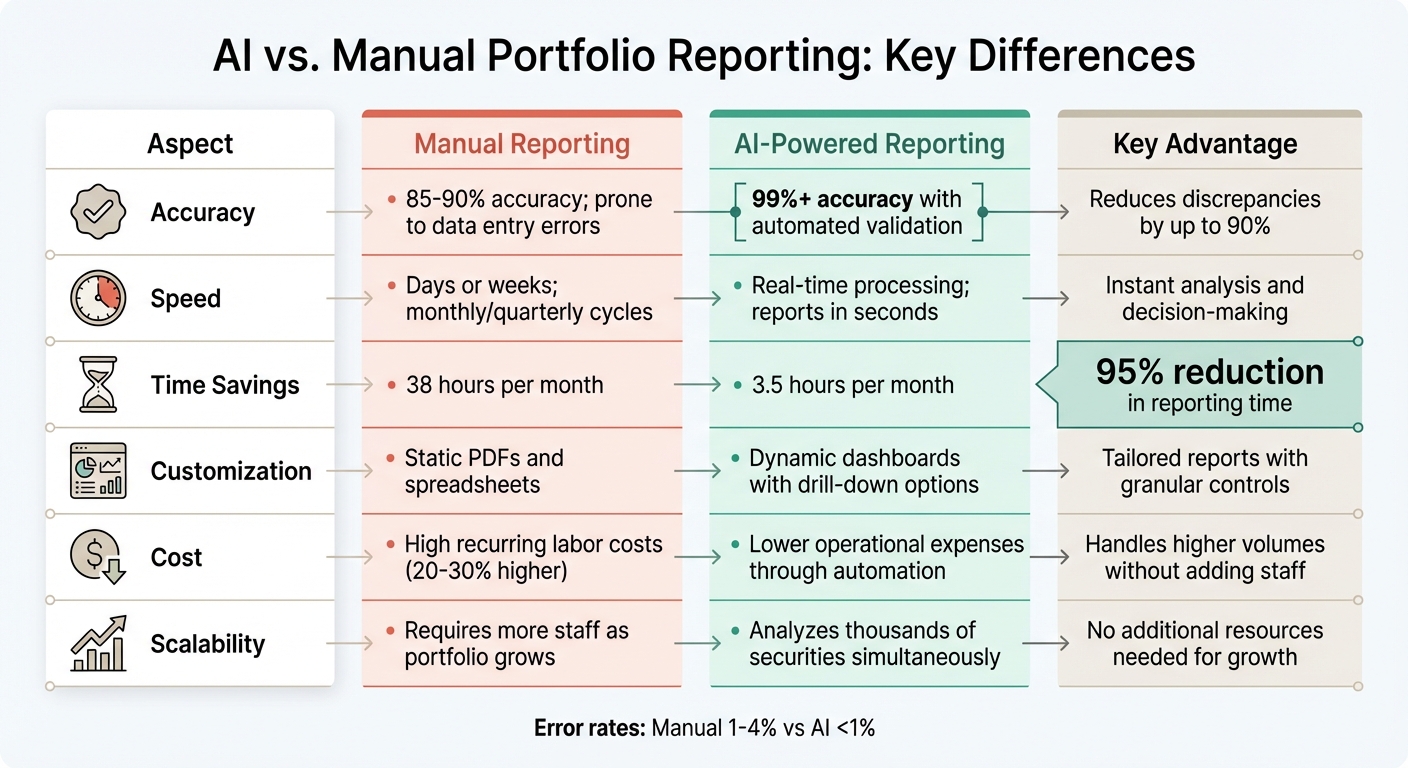
AI vs Manual Portfolio Reporting: Speed, Accuracy and Cost Comparison
AI-powered portfolio reporting brings a host of benefits, including greater accuracy, faster results, and lower costs. By automating tasks that were once manual, these systems deliver audit-level precision through automated data collection and standardization. This shift allows finance teams to dedicate more time to strategic analysis and planning for the future. Here’s a closer look at how AI outshines traditional manual methods in key aspects of reporting.
Unlike manual reporting, which relies on periodic cycles, AI processes data in real time. This means reports are generated instantly, and automated alerts notify users when critical metrics deviate from targets. As a result, portfolio managers can respond to market changes in seconds rather than days, and investors benefit from performance data that’s always up-to-date and transparent.
Another key advantage is scalability. AI systems can analyze thousands of securities simultaneously without requiring additional staff. While the initial setup may require an investment, the long-term savings are notable. Automation reduces operational costs, minimizes penalties from errors, and eliminates the need for repetitive data entry. With these savings, teams can focus on driving strategic growth, aligning with AI’s broader purpose of enhancing investor communication.
AI vs. Manual Reporting Comparison
| Aspect | Manual Reporting | AI-Powered Reporting | Key Advantage |
|---|---|---|---|
| Accuracy | 85-90% accuracy; prone to data entry errors and formula issues | 99%+ accuracy with automated validation and machine learning anomaly detection | Reduces discrepancies by up to 90% |
| Speed | Takes days or weeks; works on monthly/quarterly cycles | Processes data in real time; generates reports in seconds | Enables instant analysis and decision-making |
| Customization | Limited to static PDFs and spreadsheets | Offers dynamic dashboards with drill-down options and personalized views | Provides tailored reports with granular access controls |
| Cost | High recurring labor costs; 20-30% higher due to inefficiencies | Lower operational expenses through automation | Handles higher volumes without increasing headcount |
| Investor Engagement | Delayed updates and limited transparency | Always-available visual reports with proactive insights | Real-time notifications and customized views improve engagement |
| Scalability | Requires more staff as portfolio size grows | Effortlessly scales across thousands of data points | No additional resources needed for growth |
Together, these advantages transform portfolio reporting from a reactive process to one driven by proactive financial intelligence. AI doesn’t just make reporting faster - it changes how portfolio managers and investors interact with financial data.
Platforms like Lucid Financials demonstrate these benefits in action. By using AI to create real-time, investor-ready reports and actionable insights, they enable startups and fast-growing companies to focus on strategic growth instead of getting bogged down by data management tasks.
Conclusion
AI has revolutionized portfolio reporting, offering real-time, accurate data that updates continuously. Gone are the days when finance teams had to wait weeks for manually compiled reports. With AI, they now have access to audit-ready information that eliminates delays and human errors associated with traditional methods.
This real-time functionality allows for more proactive management. Continuous monitoring and instant alerts keep teams informed, while custom dashboards replace static PDFs. These dashboards offer investors personalized views of portfolio performance, complete with drill-down options that traditional reports simply can’t provide.
For startups and rapidly growing companies, keeping investor-ready reports without a large finance team used to feel unattainable. AI-powered platforms now simplify data management and create board-ready reports with just one click. This shift lets founders focus on driving growth instead of being bogged down by spreadsheets.
The move from manual to AI-driven reporting builds a scalable and transparent financial system - one that evolves with your business, provides clarity for investors, and supports data-driven decisions based on up-to-date information.
Leveraging these AI tools can transform your financial operations. By cutting out tedious manual tasks, you can redirect resources toward strategic initiatives. Lucid Financials offers AI-powered bookkeeping, tax services, and CFO support, delivering clean books in just seven days, real-time Slack integration, and always-on investor-ready reporting starting at $150 per month. It’s the financial clarity you need to grow with confidence.
FAQs
What data do I need to connect for AI portfolio reporting?
To set up AI-powered portfolio reporting, link your real-time financial data. This should include current transaction records, account balances, and essential financial metrics. These inputs help deliver precise, timely, and customized reporting that aligns with your specific requirements.
How does AI prove each number in a report is accurate?
AI helps maintain precision in financial reports by automating compliance checks with guidelines such as GAAP and IFRS. It flags unusual transactions for further review and reduces errors through automated validation processes. This not only improves accuracy but also cuts down the need for extensive manual oversight.
How do real-time dashboards change investor updates?
Real-time dashboards change the game for investor updates by offering constantly updated financial insights. They enable quicker decision-making, minimize mistakes, and streamline communication with investors. By presenting a clear and accurate picture of financial performance, these tools help build transparency and trust.