Startups face a constant challenge: balancing daily costs with long-term investments. Operational spending covers essentials like payroll and software, while strategic spending focuses on growth areas like product development and market expansion. Mismanaging these categories can lead to cash flow issues - 82% of startups cite poor resource allocation as a key reason for failure.
AI is transforming how startups manage both spending types:
- Operational spending: AI automates tasks (e.g., invoice processing, HR screening) to cut costs by up to 30%.
- Strategic spending: AI tools forecast trends, optimize investments, and model ROI for growth-focused projects.
However, AI adoption comes with risks like runaway costs and unclear ROI. Tools like Lucid Financials help startups gain real-time visibility, automate bookkeeping, and simulate "what-if" scenarios for smarter financial decisions.
Key insights:
- Companies using AI for automation save 20–30% on operational expenses.
- Startups investing in custom AI solutions grow revenue five times faster than those relying on generic tools.
- Nearly 28% of cloud spending is wasted due to delayed decision-making - real-time monitoring is critical.
Balancing operational and growth-focused spending is essential for survival. AI bridges the gap, offering tools to streamline costs and fuel growth effectively.
1. Day-to-Day Spending
Time Horizon
The way startups manage spending has shifted dramatically. Instead of relying on traditional monthly billing cycles, costs now fluctuate minute by minute, especially with AI usage and GPU pricing changing daily. This makes real-time monitoring essential to keep daily expenses under control.
Top-performing teams aim for a budget variance of less than 5% from month to month. To achieve this, many are moving away from monthly reconciliations and adopting continuous, real-time monitoring. Thanks to AI, anomalies can now be identified in under 10 minutes, which is critical when nearly 28% of cloud spending is wasted due to delays in decision-making. This real-time oversight is no longer optional - it's a necessity.
Budget Allocation
Startups typically divide their operational budgets among product development (30–50%), cloud infrastructure (15–30%), and talent (20–40%). AI is reshaping these allocations. While it reduces the need for larger teams, it increases spending on technology. For instance, the median startup spends about $130 per month on AI tools, while those using advanced APIs or enterprise solutions spend between $5,000 and $6,000 monthly.
This shift toward technology-driven, flexible budgets means startups can no longer set their budgets once a year and forget about them. Budgets need constant rebalancing to adapt to demand. These evolving cost structures also open the door to more advanced AI-driven cost optimizations, which we'll explore next.
AI Optimization Potential
AI has the power to slash operational costs by automating repetitive tasks like invoice processing, HR screening, data entry, and customer service inquiries - cutting manual work by up to 90%. Cost savings also depend on smart decisions, like choosing lower-cost AI models for simple tasks, which can reduce costs by 60–80%.
Other strategies include implementing token governance through prompt compression and limiting context length, which can cut consumption by over 30% without impacting quality. For GPU-heavy workloads, enforcing shutdown schedules and leveraging spot capacity can save 70–90% on training expenses and reduce idle costs by over 60%.
Startup Impact
For early-stage startups, AI is a game-changer. Small teams can now accomplish what once required entire departments. For example, sales reps save about 2 hours daily, while marketing teams save over 3 hours. These efficiency gains not only extend financial runways but also reduce burn rates and errors.
"AI is quietly changing that story. Startups are discovering that AI cost savings are not just a bonus but a practical way to stretch their runway and reduce financial risk in the earliest stages of growth." - Mila Dliubarskaya, Article Author, UpsilonIT
However, without consistent monitoring, variable AI costs can spiral out of control. Tools like Lucid Financials help startups maintain real-time visibility into their spending with AI-powered bookkeeping and forecasting. By keeping books clean and up to date, startups can spot and address cost anomalies early - allowing them to make smarter decisions about which processes to automate next.
sbb-itb-17e8ec9
2. Long-Term Spending
Time Horizon
Strategic spending operates on a completely different timeline compared to day-to-day expenses. While operational costs are typically consumed within the current period, strategic investments aim to deliver returns over a longer horizon, often three to five years. These investments might include assets like on-premises GPU clusters, custom software platforms, or core infrastructure.
For startups, this presents a unique challenge because the return on investment (ROI) for AI initiatives often follows a "J-curve" - meaning significant upfront costs are incurred before any measurable returns materialize. Balancing these long-term expenditures with immediate cash flow constraints is no small feat. The trick lies in identifying which initiatives should remain operational expenses (like experiments) and which warrant classification as long-term investments, such as production systems.
Budget Allocation
The way budgets are structured has shifted, moving from isolated projects to a broader portfolio approach that aligns with overarching company goals, or "North Stars", such as scalability or risk reduction. Strategic budgets focus on funding durable assets that generate value over multiple periods. For AI, this often includes investments in dedicated GPU infrastructure, custom workflow tools, and platform development.
But like operational budgets, strategic allocations require constant assessment and adjustment. Hidden costs are a big factor here - startups should allocate 30% to 50% of total implementation costs to cover data preparation, system integration, and training. On top of that, setting aside 20% to 30% of the initial project budget as a contingency fund helps address unexpected needs, like infrastructure upgrades or extended parallel operations.
AI Optimization Potential
AI transforms strategic planning into a dynamic, real-time process by analyzing market signals and internal data. Startups are increasingly using "executive cockpits" to centralize fragmented data, helping them spot emerging trends and unconventional growth opportunities before they gain traction.
The impact of AI is already visible: 32% of global CEOs report increased revenue, and 34% report higher profits, with nearly half expecting further profitability gains within the next year. Companies leveraging custom AI solutions are projected to scale their revenue five times faster than those relying on generic tools.
"What's needed is an overarching goal for how AI can shape your enterprise - a North Star - that everything drives toward." - PwC
Still, there’s a notable gap between investment and results. A 2026 study found that 90% of senior executives saw no measurable improvement in productivity or employment three years after adopting AI. This "ROI gap" highlights the need for clear governance, defined success metrics, and ongoing tracking of unit economics, such as "cost per workflow" or "cost per ticket resolved".
Startup Impact
AI is helping startups make smarter decisions about allocating resources, particularly when weighing investments in human capital versus AI-driven automation. This is increasingly relevant, as nearly 70% of venture-backed startups were paying for at least one AI tool by August 2024.
The trend is unmistakable: by 2026, more than 54% of business leaders plan to use AI to cut costs, signaling that AI has evolved into a mainstream strategic investment rather than a mere experiment. SaaS companies are leading the charge, with nearly 80% adoption, while industries like biotech and healthcare are slower to adopt due to their specialized R&D needs.
Tools like Lucid Financials are helping startups navigate these decisions by simulating "what-if" scenarios using AI-generated forecasts. These tools offer board-ready reports and clear insights into runway management, empowering startups to make data-driven strategic spending choices.
I tried 100+ AI Tools. These are the Best for Finance
These tools provide the real-time financial insights necessary to scale operations efficiently.
Pros and Cons
Operational vs Strategic Spending: Key Differences for Startups
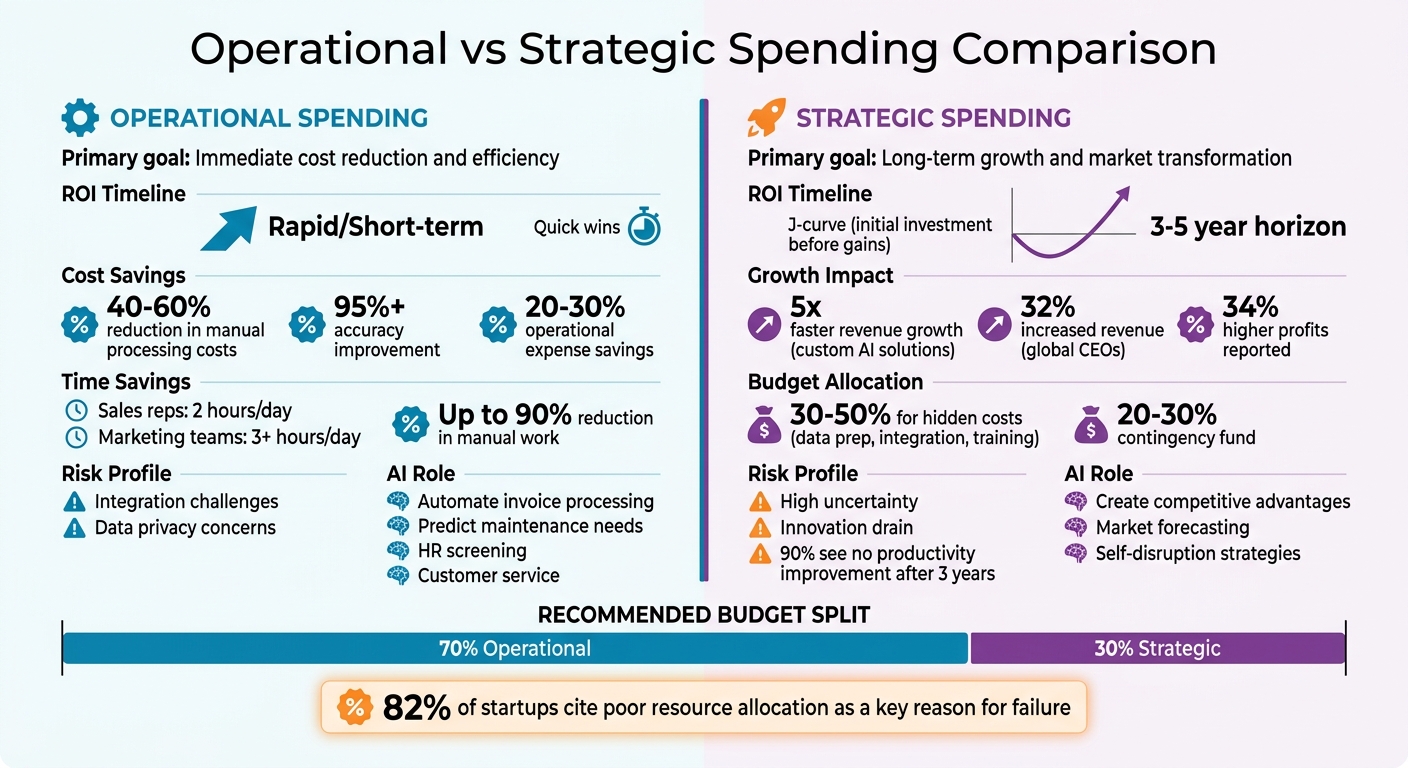
Each spending type comes with its own set of trade-offs. Operational spending focuses on delivering quick wins. For example, automating tasks like invoice processing or customer support can cut manual processing costs by 40–60% while improving accuracy to over 95%. The return on investment (ROI) is typically fast, making it easier to justify and measure. However, challenges like integrating with legacy systems and ensuring data privacy compliance can complicate its implementation.
On the other hand, strategic spending aims to build long-term competitive advantages. This often involves investments in infrastructure, advanced data platforms, and skilled talent, which can help scale revenue up to five times faster compared to generic tools. However, strategic investments usually follow a J-curve, requiring significant upfront costs before any returns are realized. Interestingly, 90% of senior executives reported no measurable productivity improvements even three years after adopting AI, underscoring the gap between investment and tangible results.
| Feature | Operational Spending | Strategic Spending |
|---|---|---|
| Primary Goal | Immediate cost reduction and efficiency | Long-term growth and market transformation |
| ROI Timeline | Rapid/Short-term | J-curve (initial investment before gains) |
| Risk Profile | Integration challenges and data privacy | High uncertainty and "innovation drain" |
| AI Role | Automating processes and predicting maintenance needs | Creating advantages and self-disruption |
AI plays a critical role in optimizing both spending types. It streamlines processes for operational efficiency while also forecasting future needs, creating a stronger link between daily operations and long-term strategic goals.
Bridging the gap between operational and strategic spending requires tools that provide both immediate insights and forward-looking forecasts. AI platforms like Lucid Financials are designed to address this challenge. They automate routine tasks like bookkeeping while also generating detailed forecasts and "what-if" scenarios for strategic planning. This dual functionality helps startups avoid the problem of budget fragmentation, where AI spending becomes siloed across different business units without centralized oversight. Additionally, its real-time Slack integration gives founders instant answers to operational questions while maintaining visibility into long-term resource allocation and runway planning.
While over 54% of leaders currently use AI for cost-cutting, the real edge lies in striking a balance between operational efficiency and strategic investments. As Siddarth Kalasapur from PwC aptly puts it:
"The next 10 years are likely to dramatically reshape industries. But, as always, there will be winners and losers".
Conclusion
Grasping the distinction between operational spending and strategic spending isn't just about keeping the books balanced - it’s about ensuring your startup’s survival. Operational spending handles the essentials: payroll, software subscriptions, and vendor payments - basically, what keeps the wheels turning day-to-day. On the other hand, strategic spending fuels growth, focusing on areas like product development, critical hires, and market expansion. Mismanaging these categories has serious consequences - 82% of startups that struggle with cash flow cite poor resource allocation as a key factor.
AI has become a game-changer in managing both types of spending. For operational expenses, AI simplifies bookkeeping, flags irregularities instantly, and predicts potential cash shortages up to 30 days in advance. On the strategic side, it models different scenarios, estimates ROI for investments, and even identifies hidden savings like R&D tax credits that could add $50,000 or more to your bottom line annually. These tools can improve decision-making speed by 35% and boost forecasting accuracy by up to 50%.
Platforms like Lucid Financials bring these capabilities together. They automate tedious tasks like expense categorization while offering advanced tools for forecasting and scenario planning. Features such as real-time Slack support and investor-ready reports provide both operational clarity and strategic vision - all starting at $150/month.
To stay on track, review your spending quarterly. A good rule of thumb? Allocate about 70% of your budget to operational needs and 30% to strategic investments, adjusting based on AI-driven insights. Use real-time dashboards to keep an eye on your burn rate and experiment with reallocation scenarios. As McKinsey puts it:
"AI doesn't replace financial strategy - it supercharges it, turning data into dollars for agile startups".
FAQs
How do I decide if an AI project is operational or strategic spending?
To make an informed decision, think about the project’s purpose and what it aims to achieve. Operational spending is all about boosting everyday efficiency, cutting costs, or automating repetitive tasks - like optimizing workflows or improving customer service systems. On the other hand, strategic spending focuses on long-term growth, innovation, or gaining a competitive edge, such as launching new products or expanding into untapped markets. Ask yourself: Does this project improve existing processes (operational), or does it open doors to new opportunities (strategic)? Answering this will help you set the right priorities.
What metrics should I track to prove AI ROI and avoid the 'ROI gap'?
To show the return on investment (ROI) for AI and address the 'ROI gap,' it's essential to monitor specific metrics. Focus on revenue impact, cost savings, sales conversion rates, labor cost reductions, and time to value. Additionally, don't overlook less tangible benefits like enhanced customer experience and innovation opportunities. Together, these metrics paint a clear picture of AI's financial and operational contributions.
How can I prevent AI and cloud costs from spiking unexpectedly?
Managing AI and cloud costs can be tricky, especially with how quickly things can change. Relying on periodic audits alone just doesn't cut it anymore. Instead, AI-driven cost management tools offer a smarter way to keep expenses under control.
These tools work by monitoring your usage in real time, spotting unusual patterns, and even predicting potential cost changes before they happen. On top of that, they can automatically adjust resources to match your needs, helping you avoid unnecessary spending. This kind of proactive approach ensures your expenses stay consistent and within budget, even when dealing with the unpredictable nature of cloud environments.