

Before closing the month, check aging balances and trace payments, and give every unresolved item an owner and due date. Set one reporting cutoff, keep collections aging separate from book A/R, and define review limits - for example, a 10% increase in an aging bucket or a $5,000 rise in balances over 90 days.
The month-end review covers:
- Aging and collections: Check totals, explain monthly changes, and prioritize claims nearing filing or appeal deadlines.
- Payments and cash: Match remittances, billing batches, deposits, and ledger entries. Track missing payments, unapplied cash, and timing differences separately.
- Credits and corrections: Review refunds, duplicate charges, write-offs, and posting errors, with records and approvals for each correction.
- Ledger reconciliation: Reconcile A/R by legal entity and accounting basis without forcing balances to agree.
- Close approval: Obtain separate billing and accounting sign-offs, carry unresolved items forward, lock the period, and save the supporting records.
Approval does not mean an issue is resolved. Open items stay on the next month’s log until the work is complete.
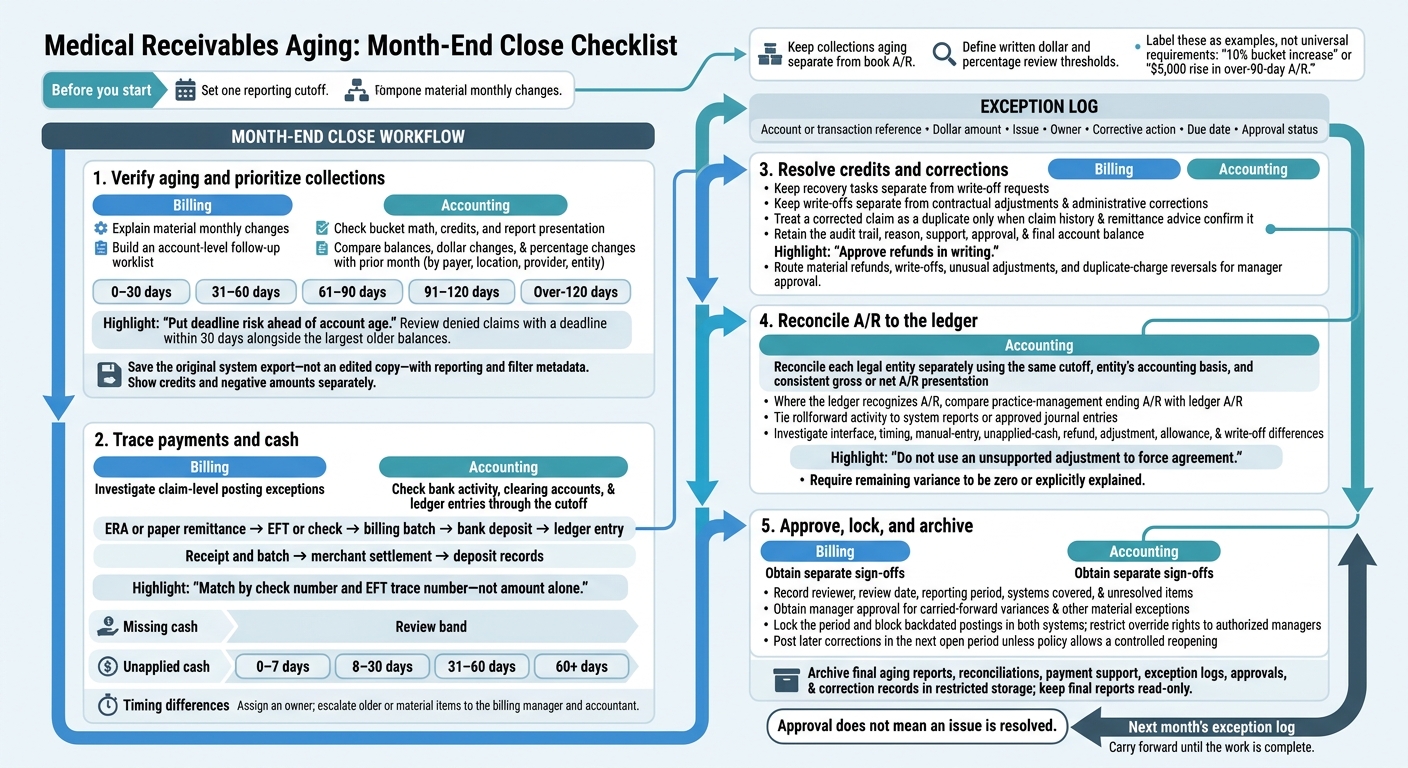
Medical Receivables Aging: Month-End Close Checklist
Aging Buckets, Metrics, and MORE | Medical Billers Network Live
sbb-itb-17e8ec9
Verify Aging Totals and Collection Priorities
Once the cutoff is set, check that the aging report matches month-end activity and shows which accounts need collection follow-up.
Reconcile the report to the month-end cutoff. Save the original system export - not an edited copy - with the report date, export date, user, location, legal entity, payer filter, and patient-versus-insurance filter.
Confirm that the 0–30, 31–60, 61–90, 91–120, and over-120-day buckets add up to the report balance. Show credits and negative amounts separately.
Compare Aging Buckets and Monthly Changes
Compare each aging bucket with the prior month, showing its balance, dollar change, and percentage change. Break out results using multi-dimensional financial reporting by payer, location, provider, and legal entity. Consolidated totals can hide local problems.
Set written thresholds for both dollar and percentage changes:
For example, investigate a 10% bucket increase or a $5,000 rise in over-90-day A/R.
Billing staff should explain material changes and separate payment delays and denials from posting backlogs or reporting changes.
Before accepting the report, accounting should check the bucket math and how credits are shown. Use the variances to build an account-level follow-up list.
Assign Follow-Up for High-Risk Accounts
Identify accounts most likely to affect collections or miss a deadline.
Build a worklist covering high-dollar balances, denied or disputed claims, uncollectible accounts, and filing or appeal deadlines. Sort it by balance, age, status, reason, deadline, and collectability. Include these fields:
- Patient or account ID, payer, claim number, and date of service
- Balance, aging bucket, claim status, and denial or dispute reason
- Last action, deadline, required documents, next action, owner, and due date
Put deadline risk ahead of account age. Review every denied claim with a deadline within 30 days alongside the largest older balances.
Keep recovery tasks separate from write-off requests. Billing staff should document claim corrections, appeals, and patient follow-up. An authorized reviewer must approve any write-off under practice policy.
Save the worklist and variance explanations with the aging export. Accounting should flag unresolved completeness or presentation issues for the later ledger reconciliation. This ensures accurate financial reporting for medical practice owners when making expansion decisions.
Flag unresolved posting gaps and unapplied amounts for the cash-tracing review that follows.
Trace Missing Payments and Unapplied Cash
Billing staff investigate claim-level posting exceptions. Accounting separately checks bank activity, clearing accounts, and ledger entries through the cutoff. Keep missing cash, unapplied cash, and timing differences in separate workstreams.
Match Remittances, Payment Batches, and Deposits
Trace each ERA or paper remittance to its EFT or check, then to the billing batch, bank deposit, and ledger entry. For patient payments, start with the receipt and batch, then check merchant settlement and deposit records. Match by check number and EFT trace number - not amount alone. CMS states that the TRN in the EFT addenda should match the associated ERA’s TRN.
For each remittance, reconcile billed charges, payments, contractual adjustments, denials, and patient responsibility at the claim or service-line level. Include provider adjustments, refunds, recoupments, and payer settlements. Check for duplicate imports and payments assigned to the wrong patient, payer, provider, or location. Correct errors with auditable reversals and repostings, and route unresolved items to the unapplied cash worklist.
Distinguish missing entries from timing differences. Post a confirmed bank deposit that has no billing entry. Keep a remittance without a matching EFT or check on payer follow-up. Use “deposit in transit” only when supporting evidence exists, and label pending merchant settlements separately.
Reconcile Unapplied Cash and Payment Differences
Review unapplied and suspense cash by payer, deposit date, amount, and age: 0–7, 8–30, 31–60, and 60+ days. Assign each item to a named staff member who will obtain missing details and apply the payment. Escalate older or material items to the billing manager and accountant.
Once remittances are matched, isolate cash that still cannot be applied. Use the table to distinguish monthly activity from ending balances, including opening unapplied cash and deposits in transit.
| Source | Period or balance date | Amount | Reconciling difference | Explanation | Owner | Resolution date |
|---|---|---|---|---|---|---|
| Billing-system payment activity | Close-month date range | Posted payments | Difference from matched payments | Missing postings or prior-period cash applied | Billing supervisor | Assigned posting deadline |
| ERA and paper remittance totals | Close-month date range | Remittance total | Difference from matched payments | Pending EFTs or provider-level adjustments | Billing specialist | Payer follow-up deadline |
| Bank and merchant deposits | Close-month date range | Settled deposits | Difference from gross receipts | Fees, refunds, recoupments, or settlement timing | Accountant | Reconciliation deadline |
| Unapplied cash | Month-end balance date | Ending balance | Opening balance + receipts − applications | Unidentified payments awaiting application | Cash poster | Item-specific deadline |
| General-ledger cash activity | Close-month date range | Recorded cash movement | Difference from bank activity | Deposits in transit, merchant settlement timing, bank fees, refunds, recoupments, or missing entries | Accountant | Correction deadline |
Move unresolved credits, duplicate charges, ledger variances, and all remaining exceptions into the credit and ledger review that follows.
Resolve Credits, Duplicate Charges, and Ledger Differences
Review Credit Balances and Refunds
Start with unresolved credit balances and refund exceptions from the cash review.
Billing staff should:
- Review credit-balance reports by patient, payer, provider, location, and entity. Include age, amount, status, source, codes, refund status, and original transactions.
- Prioritize older, high-dollar, repeated, and government-program credits, along with possible duplicate payments or excess contractual adjustments.
- Trace each negative balance through the original charge, claim, remittance advice, payment batch, adjustment, refund, and account history. Determine whether it stems from an overpayment, duplicate payment, excess adjustment, recoupment, reversed charge, misapplied payment, or incorrect patient or payer assignment.
- Keep a credit-resolution log with the account number, source, amount, cause, owner, required action, approval, and resolution date.
Approve refunds in writing. Document the recipient, amount, method, reviewer, and approval date. Keep payment evidence, correspondence, and claim-adjustment records in an investor-ready close package.
Follow payer contracts, state unclaimed-property rules, refund deadlines, and segregation-of-duties controls. Medicare Parts A and B overpayments generally must be reported and returned by the later of 60 days after identification or the applicable cost-report due date. Do not offset unrelated accounts without a documented legal basis and notice.
Use the same exception log to resolve duplicate charges and open balances left by reversals.
Correct Duplicate Charges and Posting Periods
To find duplicate charges and open balances after voids or reversals, billing staff should compare the patient, date of service, code, provider, location, payer, amount, claim number, and encounter ID. Treat a corrected claim as a duplicate only when claim history and remittance advice confirm it.
Check account assignments and posting periods for late charges, reversals, transfers, refunds, and write-offs. Review write-offs by employee, payer, provider, location, account, amount, and reason code. Keep them separate from contractual adjustments and administrative corrections.
Retain the transaction audit trail, reason code, supporting remittance or claim record, user, reviewer approval, and final account balance.
Once posting errors are cleared, tie practice-management A/R to the ledger.
Reconcile Practice-Management A/R to the Ledger
Accounting should reconcile each legal entity separately. Use the same cutoff, the entity’s accounting basis, and a consistent gross or net A/R presentation.
Where the ledger recognizes A/R, compare the practice-management ending A/R with the ledger balance. Investigate interface failures, manual journal entries, timing differences, unapplied cash, refunds, contractual adjustments, allowances, and write-offs.
| Comparison | Practice-management balance | Ledger balance | Reconciling items | Remaining variance | Corrective entry or action |
|---|---|---|---|---|---|
| Ending A/R | Entity ending A/R | Ledger A/R | Interface, timing, or manual-entry differences | Zero or explicitly explained | Correct source entry or approve supported adjustment |
| Gross vs. net | Agreed-basis balance | Same-basis balance | Allowance presentation differences | Zero or explicitly explained | Document basis and approve adjustment |
| Rollforward | Signed activity report | Ledger activity | Supported items counted once | Zero or explicitly explained | Retain approval and unresolved exceptions |
Use one sign convention throughout the reconciliation. For gross A/R:
[ \text{Beginning A/R} + \text{Charges} - \text{Payments} - \text{Contractual Adjustments} - \text{Other Adjustments} - \text{Refunds Affecting A/R} - \text{Write-offs} = \text{Ending A/R} ]
Tie every rollforward line to a system report or approved journal entry. Then reconcile the calculated ending balance to the practice-management balance. Give every unresolved difference an owner and resolution date. Do not use an unsupported adjustment to force agreement.
Conclusion: Approve Exceptions and Close the Month
Obtain Billing and Accounting Sign-Offs
Once every exception has an owner or is documented, collect separate billing and accounting approvals. Billing reviews posted charges, claim status, payment posting, unapplied cash, credits, and support for refunds or write-offs. Accounting reviews aging totals, deposit matching, cutoff, ledger ties, and supporting records for entries.
Each approval should name the reviewer and include the review date, reporting period, systems covered, and unresolved items carried forward.
Before sign-off, check that each exception log entry includes the account or transaction reference, dollar amount, issue, owner, corrective action, due date, and approval status. Require manager approval for material refunds, write-offs, unusual adjustments, duplicate-charge reversals, and carried-forward variances. An approved carryforward is not resolved. Keep it on next month’s log.
Lock the Period and Save Close Records
After sign-off, restrict access and archive the month-end package. Lock the period and block backdated postings in both systems. Give override rights only to authorized managers, and record who locked the period and when.
Post later corrections in the next open period unless policy allows a controlled reopening. Document the original transaction, reason for the correction, correction made, approver, and posting date.
Store the close package in restricted storage. Include final aging reports, reconciliations, payment support, exception logs, approvals, and correction records. Keep final reports as read-only files and follow the practice’s retention schedule.
FAQs
How do I tell missing payments from posting delays?
Reconcile bank deposits, payment summaries, and clearing accounts together. A difference doesn’t always mean a billing problem. Compare remittance totals with bank activity to see whether a payment is waiting to post or is actually missing.
Check for documented processing deductions, settlement timing differences, and deposits in transit. Require bank references or deposit logs to back up the explanation.
Why does my aging report differ from ledger A/R?
Differences often come down to timing or definitions. You might be comparing today’s aging report with last month’s closed books. Or the systems may define aging, responsibility, or balances differently. Accrual-based books may also include supported valuation entries or cutoff adjustments that aren’t in the billing system.
Instead of forcing the numbers to match, billing and accounting teams should document the differences in a reconciliation schedule and bring both systems onto the same reporting basis.
Which unresolved issues should delay month-end close?
Delay month-end close when unresolved material differences, missing source records, or unverified exceptions keep records from agreeing. Examples include unverified balances, billing accounts receivable that exceed the general ledger control balance, or missing required equipment financing statements.
Also hold the close if shared administrative payroll remains unallocated or collectibility estimates await CPA review - unless a provisional reporting agreement is explicitly documented.