Market trends directly influence how investors assess startup valuations. Shifts in interest rates, technological advances like AI, and changing investor priorities - such as a focus on profitability over growth - are reshaping the funding landscape. For example, SaaS revenue multiples dropped from 15x ARR in 2021 to 5-7x ARR by 2024-2025, while AI companies often command much higher premiums, with some reaching 20x–30x revenue multiples.
Key takeaways:
- Interest Rates: High rates compressed valuations in 2023-2024, but recent cuts in 2025 are sparking renewed investor activity.
- AI Dominance: AI startups attract over 50% of VC funding due to their scalability and innovation.
- Profitability Focus: Investors now prioritize strong unit economics and clear paths to profitability.
- Sector Variances: Industries like fintech and e-commerce face valuation challenges, while AI infrastructure companies thrive.
To stand out, startups must align valuation models with market realities, use scenario-based forecasting, and highlight metrics like ARR or LTV/CAC. Tools leveraging AI for real-time data analysis can help refine projections and build investor confidence.
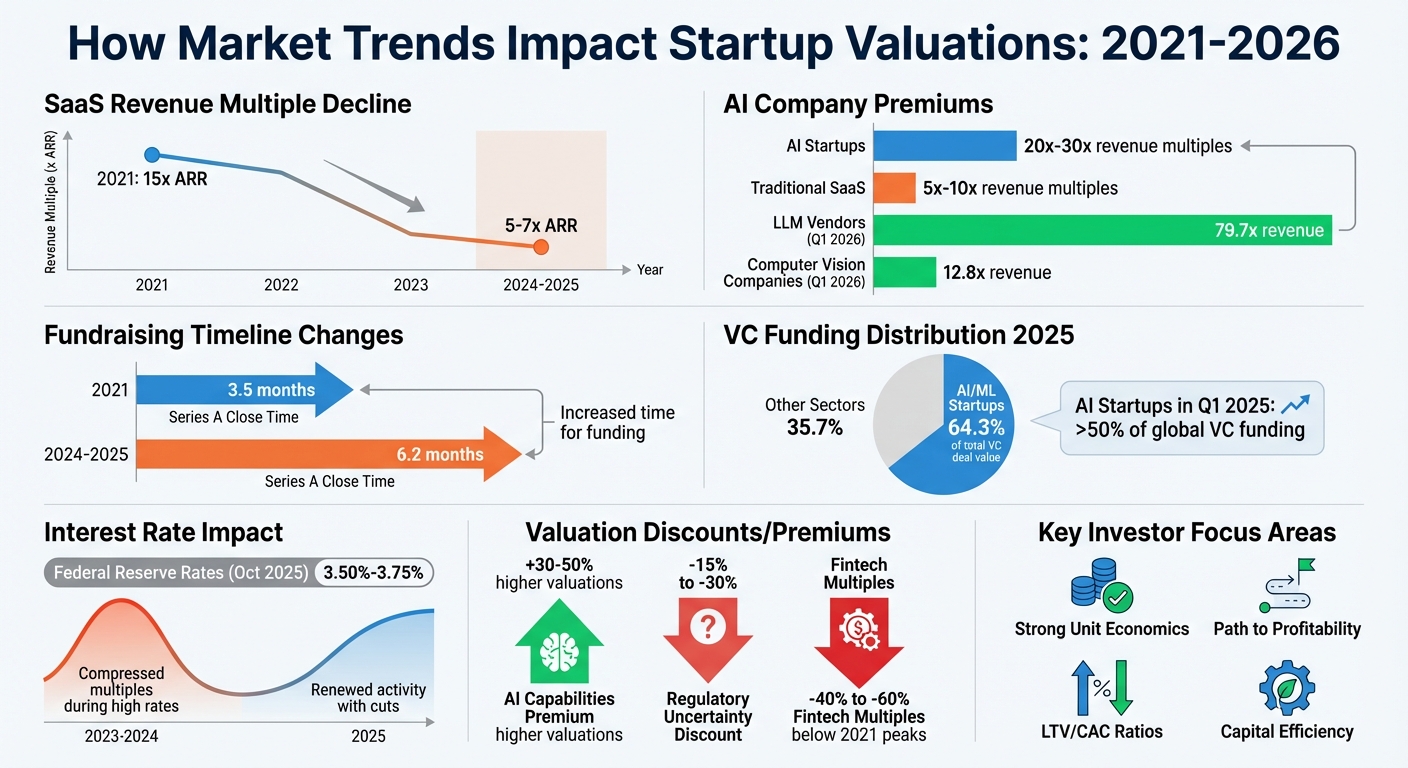
Startup Valuation Trends 2021-2026: Key Metrics and Market Shifts
Venture Capital Crystal Ball: What 2026 Holds for Startups and Investors
sbb-itb-17e8ec9
How Market Trends Affect Startup Valuations
Market trends play a crucial role in shaping how investors determine the value of a startup. For instance, the rising interest rates in 2022 and 2023 led to higher discount rates applied to future cash flows. This shift hit high-growth startups particularly hard since their valuations often depend more on future earnings than current profits. The result? SaaS revenue multiples plummeted from 15x ARR in 2021 to just 5-7x ARR projected for 2024-2025.
The investment landscape has also undergone a striking transformation. During 2020-2021, an abundance of liquidity led to inflated valuations as investors prioritized growth above all else. As Jason Whitmore from Fundreef puts it:
"The 2021 market was the anomaly - zero interest rates flooding risk assets with capital... What you're operating in today is closer to normal."
Now, investors are placing greater emphasis on profitability alongside growth. Startups with strong unit economics are favored over those burning cash to gain market share. This shift demands a deeper understanding of the key market forces at play.
Main Factors That Shape Market Trends
Several factors influence market valuations, but three stand out:
- Economic indicators: Metrics like interest rates, inflation, and GDP growth directly affect investor decisions. A growing GDP often signals increased consumer demand and reduced risk perception, encouraging venture capital investments. On the flip side, high inflation raises operational costs and creates uncertainty, dampening investor confidence.
- Investor behavior: The "growth at all costs" mentality has given way to a focus on "efficient growth." Burn multiples - how much a company spends to generate each new dollar of revenue - are under intense scrutiny. Investors also expect startups to demonstrate clear paths to profitability, even in early stages. This shift has slowed fundraising; the average time to close a Series A round stretched from 3.5 months in 2021 to 6.2 months by 2024-2025.
- Technological advances and regulatory shifts: These factors create industry-specific impacts. For example, by 2026, AI startups with genuine capabilities earn 30-50% higher valuation premiums compared to non-AI companies. However, unclear regulations can hurt AI-focused businesses, with valuation discounts of up to 30% in cases of compliance uncertainty. Thomas Smale, CEO of FE International, highlights the importance of capturing key elements like proprietary algorithms, unique datasets, and scalability when valuing AI businesses:
"An AI business valuation model in 2026 must capture the value of proprietary algorithms, unique datasets, recurring revenue, and scalability factors that increasingly define market leaders and drive premium multiples."
How Different Industries Respond to Market Trends
The effects of these market dynamics vary widely across industries. AI startups have emerged as clear leaders, pulling in over 50% of global VC funding in Q1 2025. These companies often achieve revenue multiples of 20x–30x, with standout players commanding even higher valuations. In contrast, traditional SaaS companies without AI integration struggle to maintain multiples of 5x–10x.
Other sectors face more challenging conditions. Fintech and e-commerce companies have seen sharp valuation declines. By 2025, fintech revenue multiples fell 40-60% below their 2021 peaks. Similarly, e-commerce startups, particularly those in direct-to-consumer models, typically see revenue multiples of just 1x–3x due to inventory challenges and thinner profit margins. Meanwhile, AI infrastructure companies like Databricks have thrived, reaching a $134 billion valuation at 27.9x ARR in 2025.
Sector-specific developments can also create stark contrasts. For instance, a breakthrough in renewable energy could boost valuations for green tech companies while negatively affecting startups focused on older carbon abatement technologies. This highlights the need to go beyond general market trends and analyze the specific technological and regulatory shifts shaping your industry. Understanding these nuances is essential for accurate forecasting and strategic planning.
2026 Market Trends Affecting Valuation Forecasts
Current Economic and Industry Conditions
As we step into 2026, the economic landscape has shifted significantly from the high-interest rate environment of 2023–2024. By October 2025, the Federal Reserve had eased rates to 3.50%–3.75%, while the European Central Bank and the Bank of England followed suit with reductions of 0.75% and 0.50%, respectively. These adjustments are breathing new life into private markets, spurring increased deal activity and exits throughout 2026.
Lower interest rates mean cheaper borrowing, which naturally boosts valuation multiples. During the high-rate years of 2023–2024, SaaS and AI companies experienced compressed multiples of 4x–8x ARR, a far cry from the 10x+ seen during the near-zero rate era of 2021. Now, with rates stabilizing at moderate levels, the flow of capital is picking up momentum. Elena Mazhuha, Partner at Flyer One Ventures, highlights this shift:
"2025 is set to be one of Europe's busiest years for new deals, helped by lower interest rates and the fact that investors finally accept that uncertainty isn't going anywhere."
However, startups still need to demonstrate strong fundamentals to secure favorable valuations. In 2026, factors like defensibility, capital efficiency, and tangible product usage outweigh speculative growth. The S&P 500 entered the year with a forward P/E ratio of 24x, leaving little room for error in valuation forecasts. Meanwhile, a majority of business leaders - 51% - express optimism, dismissing the likelihood of a recession, a sentiment bolstered by the rate cuts of 2025.
These broad economic changes are laying the foundation for sector-specific valuation dynamics, explored further below.
Industry-Specific Trends in 2026
Artificial intelligence continues to dominate the venture capital scene, reshaping how valuations are approached across industries. In the first three quarters of 2025 alone, AI and machine learning accounted for 64.3% of total venture deal value. This surge has created a two-tier market where AI-native companies command much higher multiples compared to traditional startups. On average, revenue multiples for AI startups range from 20x to 30x, with late-stage companies reaching around 25.8x.
A key distinction in 2026 is between "Core AI" and "Applied AI", which has become essential for understanding valuation trends. Core AI companies - those focusing on infrastructure and foundational models - are valued for their platform scalability and distribution potential. For example, in Q1 2026, large language model (LLM) vendors saw private multiples average a staggering 79.7x revenue, while computer vision companies averaged 12.8x due to easier replication of their models. On the other hand, Applied AI companies, which integrate AI into specific industries, are judged on metrics like ROI, customer retention, and ownership of budget. Lior Ronen, Founder of Finro Financial Consulting, explains:
"The market is no longer rewarding 'AI exposure' in the abstract. It is rewarding where value accrues and how reliably it compounds."
Profitability metrics are now taking center stage, even for high-growth AI firms. Investors have shifted their focus from speculative growth to measurable outcomes like repeatable revenue streams, consistent demand, and improving unit economics. The "grow first, monetize later" model is increasingly penalized, with sharp valuation discounts for companies lacking a clear path to profitability. Gartner predicts that by 2027, over 40% of advanced agentic AI projects will be shelved due to unclear value propositions or inadequate controls, pushing investors to prioritize risk-adjusted returns. Regulatory, privacy, and technical challenges are also weighing on valuations, with potential reductions of 15% to 30% for AI businesses in 2026.
Beyond AI, sectors like climate tech and blockchain are also navigating unique valuation pressures. Investors are now favoring companies with proven technology and clear profitability strategies over those relying on speculative future gains. Additionally, an exit bottleneck remains a concern - only 40 out of 1,300 venture-backed companies valued at $500M+ managed successful exits in 2024, driving more cautious and selective investment strategies across all industries. For startups, understanding these evolving trends is crucial to crafting valuation models that resonate with today's investors.
Building Scenario-Based Financial Models with Market Trends
How to Build Scenario-Based Models
To get started, review historical financial data - such as sales, margins, and costs - from the last 12 to 24 months. Pair this with macroeconomic indicators like GDP growth, inflation, and interest rates to refine your projections.
Develop three clear scenarios: a base case (most likely outcome), a downside case (worst-case scenario), and an upside case (best-case scenario). For instance, your base case might assume a 5% revenue growth under stable market conditions. The downside case could factor in tougher conditions, such as inflation surging to 8%, revenue growth dropping to -2%, and costs increasing by 10%. On the flip side, the upside case could project favorable conditions, with revenue growth climbing to around 15%.
Incorporate sensitivity analysis by adjusting key assumptions - like revenue growth by ±5% or discount rates by ±2 percentage points. This helps pinpoint the factors that have the biggest impact on valuation. Use reliable benchmarks from sources like IBISWorld or Big 4 accounting firms to document your assumptions. Demonstrating transparency in your methodology can significantly increase investor confidence.
By tying your projections to both historical data and current trends, these models become valuable tools for navigating market uncertainties. Let’s dive into how AI and data analytics can further enhance this process.
Using AI and Data Analytics for Forecasting
In today’s fast-moving markets, AI has revolutionized scenario modeling by enabling real-time forecasting. By analyzing massive datasets - including economic trends, competitor strategies, and consumer behavior - AI tools provide actionable financial insights instantly. It’s worth noting that 45% of companies now leverage machine learning for real-time financial forecasting, allowing them to adapt quickly as market conditions evolve.
Using AI-powered tools, you can automate the creation of base, downside, and upside scenarios by integrating real-time data from economic, industry, and company-specific sources. Explainable AI (XAI) adds an extra layer of clarity by breaking down the reasoning behind each prediction.
Take Lucid Financials, for example. This platform caters to startups and fast-growing businesses by combining bookkeeping, tax services, and CFO support with real-time scenario modeling. Features like Slack integration, clean books delivered in just seven days, and automated investor-ready forecasts ensure your valuation models stay aligned with the latest market trends.
This AI-driven approach enhances both speed and precision. In volatile markets, companies using AI tools can quickly assess the effects of shifting discount rates or other variables. In some cases, these tools have helped businesses achieve 20% to 30% higher valuation multiples by showcasing their ability to perform well across multiple scenarios. Treating scenario analysis as an ongoing practice, rather than a one-time task before fundraising, can help protect your startup’s valuation against market fluctuations.
These detailed, scenario-based models lay the groundwork for creating compelling, investor-ready valuation narratives.
Preparing Investor-Ready Valuation Forecasts
Adjusting Your Strategy Based on Market Trends
Once you've developed strong scenario models, it's time to fine-tune your strategy to align with market trends and appeal to investors. Your valuation forecast should clearly demonstrate how your business model fits into high-growth sectors. For instance, in 2025, investors heavily funded areas like AI, renewable energy, and fintech, with AI startups alone attracting nearly one-third of venture capital funding.
To position yourself in these sectors, adjust your product roadmap and messaging accordingly. If you're in AI, highlight proprietary technology and data assets, which can increase valuations by 15%–20%. Strengthen this by documenting intellectual property defensibility through third-party audits, which can reassure investors about the security of your competitive edge.
When it comes to financial projections, tailor them to industry-specific metrics. For example, SaaS businesses should emphasize Annual Recurring Revenue (ARR), while fintech companies should focus on Gross Transaction Volume (GTV). Consider this: in 2025, a B2B AI SaaS platform was acquired for $112 million at a 28x ARR multiple. This deal was driven by the company’s 42% year-over-year growth and a remarkably low churn rate of 4%. These examples provide a clear benchmark that investors can use to evaluate your business.
It’s also crucial to address regulatory risks head-on. By 2026, regulatory uncertainties could lead to valuation discounts as high as 30%. Show that you’re prepared by demonstrating compliance with data privacy laws like GDPR and CCPA. Incorporate these compliance costs into your financial models to reflect your commitment to reducing risk and increasing investor confidence.
From here, the next step is crafting a valuation narrative that ties these strategic adjustments together with compelling, data-backed insights.
Creating Data-Backed Valuation Stories
With your adjusted strategy in place, the focus shifts to telling a valuation story that resonates with investors. This story should combine multiple valuation methods for a comprehensive and credible approach.
"Your business valuation is not a number. It is a story. A story about cash flow, growth potential, risk, profitability, and strategic direction." - Celeste Business Advisors LLP
To create a strong foundation, use a mix of Discounted Cash Flow (DCF), market comparables, and precedent transactions to establish a valuation range. This shows investors that your valuation isn’t based on guesswork but on thorough analysis.
Equally important is explaining the "why" behind your numbers. Don’t just present revenue projections - break them down. Highlight key drivers like improved customer retention rates or better unit economics that fuel growth. By 2026, metrics like Lifetime Value to Customer Acquisition Cost (LTV/CAC) are expected to replace traditional user acquisition metrics as the gold standard for valuation. For context, high-performing AI and SaaS companies in 2025 achieved a top-quartile growth rate of 65.4%, compared to a median of 28.3%.
Make your valuation story easy to digest. Replace dense tables with clear, visual charts to help investors quickly understand your logic. Tools like Lucid Financials can help you create real-time, investor-ready reports, turning complex data into a persuasive narrative. Presenting all three scenarios - base, downside, and upside - demonstrates that you’ve accounted for market volatility. Surprisingly, even sharing a worst-case scenario can build trust with skeptical investors by showcasing your preparedness.
Platforms like Lucid Financials simplify this process, offering features like AI-powered insights and real-time data integration. With tools like these, you can maintain up-to-date, investor-ready forecasts that adapt to changing market conditions. This ensures your valuation story remains relevant and credible throughout your fundraising efforts.
Conclusion
Incorporating market trends into your valuation forecasting is crucial for staying investor-ready. As Evan Diaz de Arce explains:
"Your startup's value is constantly changing in response to market conditions. Investors aren't only concerned about what has changed, but what changes are coming".
Aligning your financial models with emerging opportunities can help secure stronger valuations and instill confidence in potential investors. This forward-thinking approach ensures your forecasts remain adaptable to evolving market dynamics.
Keep an eye on trends like cloud collaboration and e-commerce, and consider diversifying your offerings to explore multiple growth paths. Regular customer feedback is another key to identifying shifting preferences early on. By spotting trends early, you can fine-tune your forecasting for greater precision.
Scenario-based models are also essential, demonstrating that you're prepared for both market growth and potential downturns. This transparency in assessing risks builds trust with investors.
Tools like Lucid Financials make this process more manageable by combining AI-driven insights with expert input. With features like real-time forecasting, one-click investor-ready reports, and Slack-based support for immediate answers, Lucid simplifies valuation management. Its AI capabilities automatically update forecasts with live data, ensuring your valuation story stays relevant and accurate - no spreadsheets required.
FAQs
How do interest rate changes affect my startup’s valuation?
Interest rate fluctuations play a major role in shaping your startup’s valuation by affecting both funding dynamics and investor preferences. When rates rise, borrowing becomes more expensive, venture capital activity tends to slow, and investors often gravitate toward lower-risk investments - factors that can push valuations down. On the flip side, lower interest rates make loans more affordable, encourage investor optimism, and drive increased funding, which can result in higher valuations. The impact of these changes can differ depending on your startup’s funding stage, so grasping these nuances is key to crafting effective fundraising strategies.
What metrics matter most to investors in 2026?
In 2026, investors are focusing on several key metrics to guide their decisions: industry growth, financial health, market traction, team strength, and valuation accuracy. These elements are especially important in fast-evolving industries like AI and renewable energy, where staying ahead of market trends and making accurate forecasts can heavily influence outcomes.
How do I build a base, downside, and upside valuation forecast?
To build a strong financial foundation, start with a reliable model grounded in current data and practical assumptions - this will serve as your base case. Next, craft an upside scenario by incorporating optimistic growth projections and favorable market trends. Balance this with a downside scenario, which accounts for potential risks like increased expenses or project delays.
Accuracy is key, so rely on data-driven assumptions to guide your projections. Tools such as Lucid Financials can make the process easier by helping you refine your models and compare different scenarios in real time.