When pitching to investors, your metrics matter more than your words. Here's the bottom line:
-
Key Metrics Investors Expect:
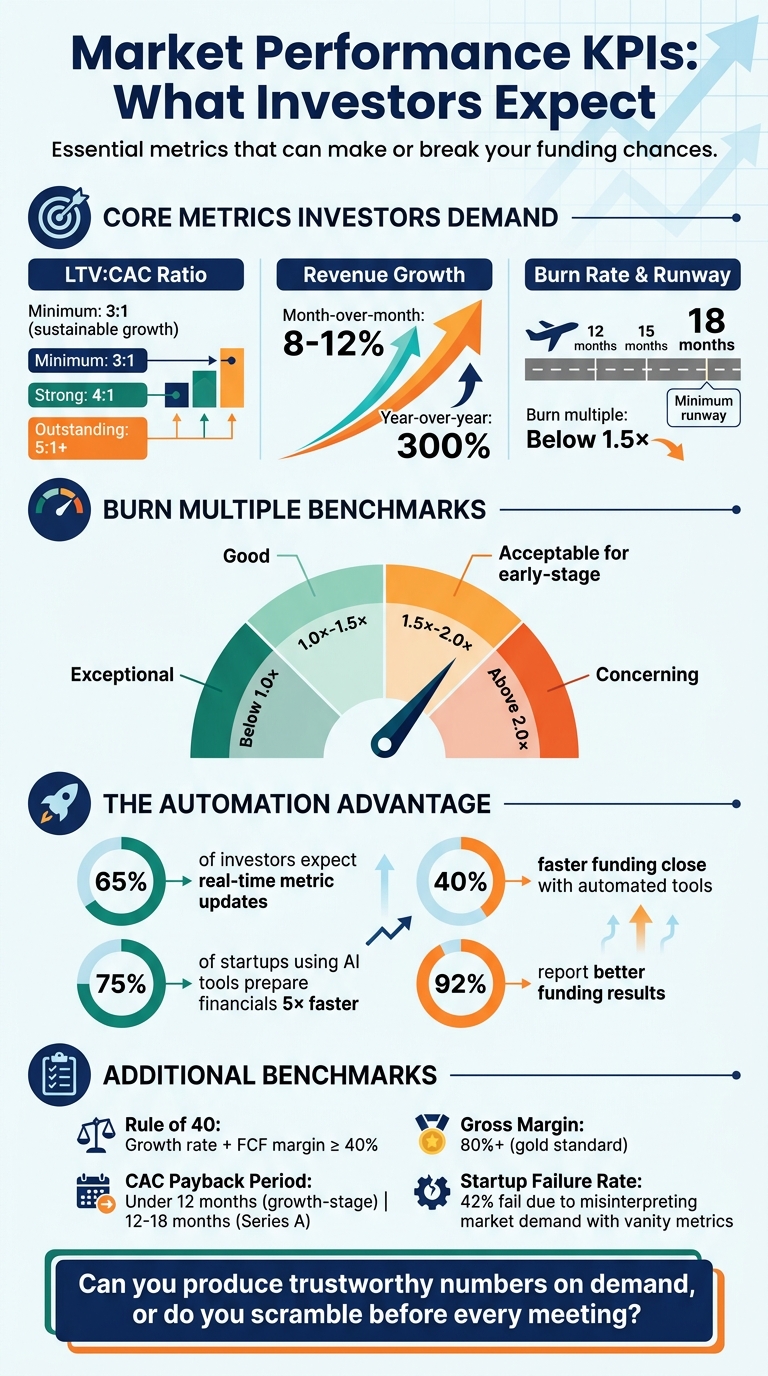
- LTV:CAC Ratio: Minimum 3:1 for sustainable growth.
- Revenue Growth: Consistent 8–12% month-over-month or 300% year-over-year.
- Burn Rate & Runway: At least 18 months of cash runway, with a burn multiple below 1.5×.
-
Automation is Critical:
- 65% of investors now expect real-time updates on metrics.
- Startups using automated tools like Lucid Financials close funding 40% faster.
Tracking and presenting KPIs effectively can make or break your funding chances. Investors prioritize efficient growth, reliable revenue, and clear financial discipline. Tools that automate reporting, like Lucid Financials, simplify this process, ensuring your numbers are always accurate and ready for due diligence.
Investor KPI Benchmarks: Essential Metrics for Startup Funding Success
KPIs That Get Startups FUNDED Fast in Today's Economy
sbb-itb-17e8ec9
1. Startup Metrics Alignment
Getting your startup's metrics in line with what investors expect isn’t about tracking everything - it’s about focusing on the right metrics and showing how they prove your business model works. By 2026, the way investors evaluate companies has shifted. Instead of chasing growth at any cost, they’re prioritizing efficient growth. This means they’re digging deeper into things like unit economics and burn multiples, not just revenue. Even at the Seed stage, metrics that used to be reserved for Series A are now expected. Aligning these numbers not only helps meet investor standards but also streamlines your reporting process.
Revenue Growth Rate
Investors care more about steady, reliable revenue than flashy but unstable growth. As Oluwadamilare Akinpelu from Pitchwise puts it:
A $10k MRR made up of steady, diversified revenue beats a $30k MRR that collapses the moment your biggest customer sneezes.
Consistent growth - say, 8–12% month-over-month - shows stronger product-market fit than unpredictable 40% spikes that aren’t sustainable. Lorenzo Nourafchan, CEO of Northstar Financial, emphasizes:
Investors now demand growth that is efficient, repeatable, and reconciled with your financial statements.
This means your ARR (Annual Recurring Revenue) and MRR (Monthly Recurring Revenue) need to match up with GAAP revenue, with a clear reconciliation process in place for due diligence.
To further impress, aim for the Rule of 40: your growth rate plus free cash flow margin should hit 40% or higher. Also, use a "metric tree" approach to link your ARR to operational drivers like lead volume, conversion rates, and average contract value. This shows you understand what’s fueling your growth.
Next, let’s explore how customer acquisition costs stack up against lifetime value.
CAC vs. LTV
The LTV:CAC ratio is a quick way to measure whether your growth strategy is adding value or just burning cash. Investors typically look for a ratio of 3:1 as a minimum, with 4:1 being strong and 5:1+ considered outstanding. However, as Kishen Patel, founder of Consult EFC, warns:
A strong LTV:CAC ratio isn't a trophy. It's a promise that growth won't keep asking for rescue funding.
To calculate LTV accurately, use (ARPU × Gross Margin) ÷ Churn instead of relying on revenue alone, which can overinflate the ratio. For CAC, include all sales-related expenses - salaries, commissions, tools, and overhead. Investors also expect you to adjust CAC for timing. For example, if your sales cycle is 60 days, match March spending with May closures instead of looking at monthly snapshots.
Payback periods are just as important. Investors prefer CAC payback under 12 months for growth-stage startups and between 12–18 months for Series A. Breaking down these metrics by customer type (e.g., SMB vs. Enterprise) or channel can uncover inefficiencies that blended numbers might hide. And don’t forget gross margin - 80% or higher is often considered the gold standard for efficient operations.
Now, let’s shift to cash management.
Burn Rate and Runway
Burn rate (how much cash you’re losing monthly) and runway (how long until you run out of cash) are critical signs of operational discipline. Investors closely examine these metrics to ensure you’re using capital to hit key milestones. The burn multiple - calculated as net cash burn divided by net new ARR - is a key indicator. Here’s how it’s typically viewed:
- Below 1.0×: Exceptional
- 1.0×–1.5×: Good
- 1.5×–2.0×: Acceptable for early-stage startups
Always know your exact runway. The WePitched Team highlights this with a sharp observation:
I'd much rather own a business valued at $1M that is 'Default Alive' (profitable and growing) than a $10M business that is 'Default Dead' (relying on the next round of funding to pay rent).
In other words, being capital-efficient matters more than chasing a high valuation. No investor wants to back a company that’s 30 days away from running out of cash.
Investor-Ready Reporting
Being able to produce accurate burn and runway numbers on demand shows that you’re running your business with data, not guesswork. Investors are increasingly favoring live, interactive dashboards over static pitch decks to verify numbers in real time. A well-defined semantic layer for metrics - like ensuring "MRR equals successful, non-refunded charges" - adds consistency and makes your data audit-ready.
Always cross-check your metrics with source data. For example, compare the MRR from your reporting tool with Stripe data to catch discrepancies before investors do. As Definite.app notes:
The real meta-signal investors are reading isn't any single metric. It's this: can this founder produce trustworthy numbers on demand, or do they scramble before every meeting?
Automating data syncs between your accounting tools and reporting platforms can eliminate manual errors and keep your numbers accurate and up-to-date. This level of preparation and precision can make all the difference when it comes to earning investor trust.
2. Lucid Financials

Lucid Financials takes the complexity of data management and turns it into a strategic advantage for startups and fast-growing businesses. By focusing on metrics that matter to investors, it ensures your financials are always ready for scrutiny.
Investor-Ready Reporting
Lucid Financials is the first AI-powered full-stack accounting firm designed specifically for startups and scaling companies. It combines bookkeeping, tax services, tax credits, and CFO support into one seamless platform that integrates with Slack. In just seven days, you can have clean, up-to-date books and real-time financial reporting delivered straight to Slack. Whether an investor asks for your latest metrics or you need to review performance, everything is accessible instantly - no more scrambling through spreadsheets.
Revenue Growth Rate
Revenue growth is a top priority for investors, and Lucid Financials simplifies tracking this critical metric. By integrating with platforms like Stripe and QuickBooks, it automatically compiles monthly revenue data and calculates growth rates. For instance, a B2B SaaS startup growing its MRR from $50,000 to $67,500 would see a 35% month-over-month growth rate - a figure benchmarked against Series A standards. Plus, CFOs provide actionable advice through Slack, turning these numbers into strategies for faster growth.
CAC vs. LTV
Understanding unit economics is key to showing scalability, and Lucid Financials automates this process. By pulling marketing spend from tools like Google Ads and HubSpot, it calculates Customer Acquisition Cost (CAC), while Lifetime Value (LTV) is derived from historical data. For example, if your e-commerce startup reports a CAC of $400 and an LTV of $900, the system flags potential imbalances and sends Slack alerts with CFO-backed recommendations. This ensures your metrics align with the 3:1 LTV:CAC ratio that investors expect for scalable businesses.
Burn Rate and Runway
Efficient cash management demonstrates operational discipline - something every investor values. Lucid Financials uses AI-driven forecasts, linked to your bank accounts, to calculate monthly burn rate and project runway. For example, a fintech startup with $2.7 million in cash reserves would see an 18-month runway forecast, with suggestions like identifying $50,000 in tax credits to stretch those reserves further. Investor-ready reports also highlight whether your gross burn rate stays below the 20–25% of revenue threshold that seed-stage VCs typically expect, helping you showcase financial discipline with confidence.
Pros and Cons
Let's dive into how manual and automated approaches to tracking KPIs stack up in terms of speed, accuracy, and investor readiness.
Your choice of method for tracking market performance KPIs has far-reaching consequences. It affects how quickly you can respond to investor questions and whether your numbers inspire confidence. Manual tracking might look like a cost-saving option, but it’s time-consuming and prone to mistakes, often requiring hours of pulling, cleaning, and synthesizing data from various systems. On the other hand, automated solutions like Lucid Financials sidestep these issues by connecting directly to your accounting and ERP systems, delivering updates in real time.
This difference is especially noticeable when preparing for investor meetings. As Vaibhav Totuka from Qubit Capital notes:
Investors will ignore a 'perfect' spreadsheet if the KPI story is fuzzy, inconsistent, or built on vanity metrics.
With automated systems, your data is presentation-ready, making funding conversations smoother and faster. The table below highlights the key differences between manual and automated KPI tracking:
| Feature | Manual KPI Tracking | Automated via Lucid Financials |
|---|---|---|
| Accuracy | High risk of human error; inconsistent across units | High; AI flags discrepancies; consistent data |
| Speed | Slow; requires "cumbersome" mapping; periodic updates only | Real-time; instant performance insights |
| Investor Readiness | Multiple iterations needed; often "fuzzy" or vanity-based | Valuation-ready; clean assumptions; fast review |
| Data Integrity | Prone to manipulation or "gaming" for bonuses | Single source of truth; automated data processes |
The stakes are high. Did you know that 42% of startups fail because they misinterpret market demand by relying on vanity metrics instead of actionable insights? Manual tracking often exacerbates this issue, as different teams may calculate the same KPI in conflicting ways, eroding trust with investors. Automated systems solve this by enforcing consistent definitions for each metric, ensuring everyone is aligned.
For fast-moving startups, the decision is straightforward: automated KPI tracking reduces errors, eliminates guesswork, and keeps your metrics investor-ready at all times. With a single source of truth and real-time updates, you’ll never be caught off guard by investor queries when it matters most.
Conclusion
Making sure your startup's KPIs align with investor benchmarks is non-negotiable for a successful funding pitch. Investors want to see solid revenue growth, a healthy LTV:CAC ratio, and a quick CAC payback period. When your metrics meet these expectations, it shows scalability and market readiness - without the need to justify gaps or inconsistencies.
The tricky part is staying aligned without drowning in endless spreadsheets. Research indicates that 75% of startups using AI-driven accounting tools prepare investor-ready financials five times faster, and 92% report better funding results. Tools like Lucid Financials simplify this process by automating bookkeeping, offering real-time dashboards for key metrics, and delivering instant, investor-ready reports via Slack. They promise clean books within seven days and immediate answers to financial questions.
This kind of precision can make a big difference. Take the example of a fintech startup that initially overstated its LTV by 40%, causing term sheets to be rejected. After switching to Lucid Financials for accurate cohort analysis, the company secured $10 million in funding at a 20% higher valuation. The accuracy of your metrics can directly influence your valuation and funding opportunities.
FAQs
How do investors verify my KPIs are real?
Investors assess your KPIs by examining the data that backs them up. They look for alignment between your financial reports and industry standards, often relying on tools that integrate real-time data to ensure consistency. Keeping your metrics transparent and accurate is key to earning their trust and confidence.
What’s the best way to calculate LTV and CAC?
When calculating Lifetime Value (LTV), it's crucial to use precise retention rates and revenue assumptions. These figures help paint an accurate picture of how much value a customer brings over their relationship with your business.
For Customer Acquisition Cost (CAC), take the total sales and marketing expenses and divide them by the number of new customers acquired. Be sure to include all relevant costs, such as paid advertising, sales team salaries, and any other marketing-related expenses.
Using clear and realistic metrics ensures your calculations align with what investors expect and trust.
How much runway should I have before fundraising?
Experts often suggest maintaining 12 to 18 months of runway before kicking off a fundraising round. Why? It gives you the upper hand in negotiations and can help you secure a stronger valuation. By planning well in advance, you’ll have the breathing room to concentrate on growing your business while getting ready for those critical conversations with investors.