Want to fund your startup faster and smarter? Focus on the right investors.
Instead of sending hundreds of generic emails, targeting a curated list of investors can lead to better results. AI-driven tools analyze behavioral data - like past investments, engagement patterns, and market activity - to identify investors actively looking to deploy capital. This approach saves time, improves efficiency, and increases your chances of meaningful conversations.
Here’s what you’ll learn:
- Why AI outperforms manual methods for segmenting investors.
- Key behavioral data to track, like pitch deck engagement and sentiment analysis.
- A step-by-step guide to using AI for segmentation and predictive modeling.
- Examples of investor types (angels, VCs, corporates) and how to pitch them.
The takeaway? Precision beats volume. AI helps you connect with the right investors at the right time.
Ranking the NEW Ways AI Startups Will Get Funded (Angel Investor Greg Welch)
sbb-itb-17e8ec9
Traditional vs. AI-Driven Investor Segmentation
Traditional vs AI-Driven Investor Segmentation Comparison
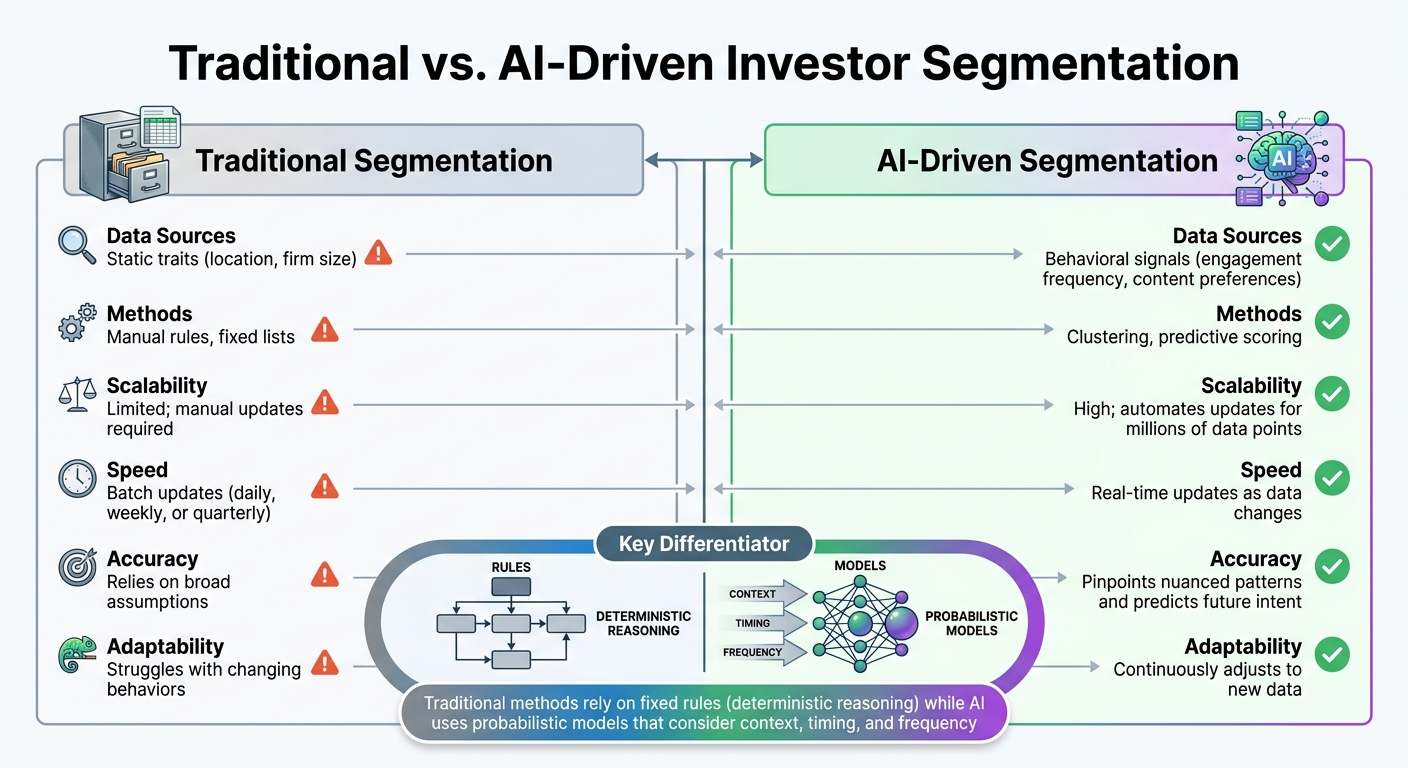
For years, startups have leaned on static criteria to segment investors. Think spreadsheets filtering by factors like location, firm size, check size, and industry focus (e.g., "Series A investors in fintech"). The problem? This approach assumes all investors within a category behave the same way, completely ignoring nuanced behaviors that signal which investors are actively deploying capital.
This is where static methods fall short. They can't account for dynamic behaviors. AI-driven segmentation changes the game by using machine learning to analyze a wide range of signals - like engagement frequency, content preferences, and even sensitivity to discounts. This deeper analysis uncovers patterns that traditional methods miss. For example, two investors might appear identical based on their industry focus, but AI can reveal one is actively scouting deals while the other is not.
The key difference lies in how decisions are made: traditional methods rely on fixed rules (deterministic reasoning), while AI uses probabilistic models that consider context, timing, and frequency.
Speed is another major advantage. Traditional segmentation often involves exporting data, applying filters, and updating lists in batches - sometimes only once a week or quarter. AI, on the other hand, processes millions of data points in minutes, updating segments in real time. This ensures your outreach is always aligned with the latest investor activity.
Comparison of Traditional and AI-Driven Segmentation
| Feature | Traditional Segmentation | AI-Driven Segmentation |
|---|---|---|
| Data Sources | Static traits (e.g., location, firm size) | Behavioral signals (e.g., engagement frequency, content preferences) |
| Methods | Manual rules, fixed lists | Clustering, predictive scoring |
| Scalability | Limited; manual updates required | High; automates updates for millions of data points |
| Speed | Batch updates (daily, weekly, or quarterly) | Real-time updates as data changes |
| Accuracy | Relies on broad assumptions | Pinpoints nuanced patterns and predicts future intent |
| Adaptability | Struggles with changing behaviors | Continuously adjusts to new data |
"AI outperforms traditional segmentation by analyzing far more signals, updating segments continuously in real time, and predicting customer behavior with higher accuracy." – Team Braze
While AI enhances segmentation with precision and speed, it doesn't replace human judgment. For qualitative, high-conviction decisions, expert insight remains indispensable. The real power lies in blending advanced analytics with human expertise to create a more effective investor segmentation strategy.
Key Behavioral Data Sources for Investor Segmentation
AI-driven investor segmentation taps into the digital trails investors leave behind when they interact with your startup. Unlike static factors like location or company size, behavioral data sheds light on who’s actively investing versus those just window shopping.
The most important data sources can be grouped into six main categories. Investment history provides insights into past funding rounds, sector preferences, and typical check sizes, helping AI gauge alignment with your startup’s stage and industry. Engagement analytics monitor email open rates, response times, and pitch deck activity. Tools like DocSend, for example, track how deeply investors engage with your materials - think scroll depth or time spent on specific slides, which signal immediate interest. Sentiment analysis picks up on tone changes in communications, helping you spot cooling interest early on. Market response data captures how investors behave during economic shifts, guiding you toward those still actively writing checks. Network signals map out mutual connections to facilitate warm introductions and boost credibility. Lastly, meeting notes, when processed with natural language processing (NLP), uncover subtle preferences or concerns that may not have been explicitly stated.
Here are some practical examples of these data sources and how they can add strategic value.
Examples of Behavioral Data Sources
Startups can gather behavioral insights at various points along the investor journey. Platforms that track engagement, for instance, can reveal which slides in your pitch deck grab the most attention. If an investor spends extra time on your financial projections, it’s a clear sign of their priorities.
AI-powered CRMs like Affinity automatically log every touchpoint - emails, calls, meeting notes - and track response times. If an investor’s tone shifts from enthusiastic to neutral or their response time slows, it’s a cue for proactive follow-up.
Databases like Crunchbase and PitchBook provide public records of past funding rounds, portfolio companies, and sector focuses. AI tools like Qubit Capital analyze these datasets to spot trends in investment theses and identify investors actively deploying capital.
NLP tools can process meeting transcripts to pick up on subtle cues - comments about risk appetite, preferred deal structures, or timing concerns - that can shape your follow-up strategy. Meanwhile, filings like SEC Form D reveal which investors have recently raised funds, signaling fresh capital ready for deployment.
| Behavioral Data Point | AI Processing Method | Strategic Value |
|---|---|---|
| Pitch Deck Interaction | Engagement Analytics (DocSend) | Pinpoints areas of interest or confusion |
| Email Response Patterns | Sentiment Analysis & Tracking | Detects cooling interest or high-intent leads |
| Investment History | Machine Learning / Pattern Matching | Prioritizes investors with aligned investment theses |
| Meeting Notes | Natural Language Processing (NLP) | Reveals subtle preferences and concerns |
| Market Activity | Predictive Analytics | Identifies investors actively deploying capital |
On average, modern investment deals involve 13 stakeholders per transaction. Consolidating all this behavioral data into a single AI-powered system ensures that no detail slips through the cracks. These insights directly fuel the clustering algorithms and predictive models that drive the segmentation process detailed in the next section.
Step-by-Step Guide to AI Investor Segmentation
Building on the earlier discussion of how AI can enhance segmentation and the importance of behavioral data, here’s a practical approach to turning raw data into actionable investor segments. The aim isn’t just to sort investors into categories - it’s about pinpointing those actively deploying capital and aligning them with your startup’s specific stage, sector, and growth goals. For context, venture capitalists (VCs) typically review 1,000–1,200 pitch decks annually but invest in only 1–2% of them. Without segmentation, your pitch could get lost in the shuffle. With it, you can focus on a curated list of around 50 investors, significantly improving your chances of meaningful engagement.
Step 1: Collect Investor Behavioral Data
Start by gathering investor data through API-driven bulk extraction from platforms like Crunchbase, PitchBook, and SEC Form D filings. Combine this with information from your CRM and meeting notes using the MEHRHOFF Framework. This framework helps categorize critical factors such as market trends, emotional motivators, habitual behaviors, key life moments, objectives, financial constraints, and cognitive biases. Qualitative insights from meeting notes are particularly valuable, revealing unspoken preferences like risk tolerance, favored deal structures, or timing sensitivities.
It’s essential to keep this data up to date - static databases can quickly become outdated. Once you’ve compiled and refreshed your dataset, you can move on to measuring engagement through RFM analysis.
Step 2: Conduct RFM Analysis on Investor Activity
RFM analysis - short for Recency, Frequency, and Monetary - enables you to rank investors based on their engagement. Here’s how it works:
- Recency: Tracks the last time an investor interacted with your startup, such as opening an email or attending a meeting.
- Frequency: Measures how often they engage with you.
- Monetary: Assesses their typical check size or investment amount.
By scoring these dimensions, you can prioritize high-intent leads and group investors into categories like operating, reserve, or strategic, depending on their liquidity and investment timelines. This analysis ensures your outreach efforts are targeted and efficient.
Step 3: Apply Clustering Algorithms for Investor Groups
Clustering algorithms, such as K-means, allow you to group investors based on behavioral similarities instead of basic demographics. AI tools can analyze thousands of investors at once, identifying patterns like sector preferences, funding stage focus, response rates, and risk appetite. This approach often reveals that investors with similar profiles may have vastly different goals.
Specialized CRM systems can automate this categorization, continuously updating investor profiles with new data like transaction history, funding milestones, and shifts in market sentiment.
"Targeted outreach to 50 well-researched investors often produces 10–15 meaningful conversations." – Mayur Toshniwal, Qubit Capital
Once these groups are established, you can use predictive modeling to refine your strategy further.
Step 4: Develop Predictive Models for Investor Propensity
Predictive models help anticipate which investors are most likely to participate in your next funding round. These models analyze historical data, such as past investment timing, sector rotation behavior, and responses to market changes. Each investor is assigned a propensity score, guiding your outreach efforts toward those most likely to engage.
Given that only 0.05% of U.S. startups secure VC funding and less than 1% receive angel investment, focusing on high-propensity investors is a smart way to save time and energy. Regularly refine these models using feedback from follow-ups and investor responses to improve accuracy.
Step 5: Validate and Refine Segments with Lucid Financials Reporting
Finally, validate your segments using real-time insights from Lucid Financials. This tool aligns your financial narrative with investor expectations, providing tailored reports for different audiences - whether it’s conservative projections for risk-averse angels or aggressive growth forecasts for VCs. Lucid’s AI-generated cash flow insights and board-ready reports ensure your financials are clear and accessible. Its Slack integration even allows for instant answers during due diligence, while clean books can be prepared in just seven days.
For example, in 2024, Optimal AI, a San Francisco–based startup, raised $2.25M in a pre-seed round within 30 days of incorporation. CEO Iba Masood credited their success to maintaining investor-ready financials, which streamlined the due diligence process.
"Our investors have marveled at how easy it is for them to pull financials." – Iba Masood
Use Lucid’s reporting to track which segments are converting and which aren’t. For instance, if growth-focused VCs consistently request follow-ups while angel investors disengage after reviewing your burn rate, it signals a need to adjust your strategy. Regularly reassess your segmentation to ensure it aligns with shifting market conditions and investor behaviors, creating a feedback loop that sharpens your approach with every funding cycle.
Common AI Investor Segments for Startups
When raising funds, understanding investor behavior can make all the difference. By using AI-driven clustering and predictive models, startups can categorize investors into three primary groups. Each has unique preferences, risk tolerance, and engagement styles, so tailoring your approach is key.
Low-Risk Angel Investors
This group is all about caution and early-stage opportunities. These investors typically focus on pre-seed and seed-stage startups, with check sizes ranging from $50,000 to $500,000. They value team expertise and early customer validation over aggressive growth metrics. Forget overly formal presentations - what resonates here are personal connections and straightforward communication. Highlight your team’s background and any pilot programs or customer feedback that show market interest. Angels often invest through syndicates, so consolidating smaller commitments into a single round can simplify the process.
Growth-Focused VCs
Growth-focused venture capitalists typically invest at Series A or later, looking for businesses with proven traction. For SaaS startups, this often means $1 million to $3 million in annual recurring revenue. These investors prioritize scalability, strong unit economics, and market leadership. When pitching to this group, let the numbers do the talking. Break down customer acquisition costs, show how you're scaling efficiently, and outline your path to market dominance. For example, Waymo raised $16 billion in 2024 by leveraging AI to identify investors focused on high-growth opportunities, doubling its valuation to $110 billion in just a year.
Corporate Investors Seeking Alignment
Corporate investors are less about financial returns and more about strategic alignment. They focus on startups that complement their core operations or provide an edge in their industries. For instance, some may see your technology as a hedge against inflation or a way to innovate within their market. To win over this group, emphasize how your startup fits into their long-term goals. Swiipr Technologies, for example, raised $7.6 million in 2025 by mapping out corporate backers whose strategic priorities aligned with their offerings . Your pitch should highlight collaboration potential and how your product enhances their existing operations.
| Investor Segment | Check Size Range | Primary Focus | Engagement Strategy |
|---|---|---|---|
| Low-Risk Angels | $50K–$500K | Team expertise & early traction | Personal connections, simple messaging |
| Growth-Focused VCs | $3M–$15M+ | Scalability, unit economics | Data-driven metrics, performance updates |
| Corporate Investors | Varies widely | Strategic alignment, innovation | Long-term collaboration, tailored pitches |
AI tools can help track shifts in investor priorities, making it easier to time your outreach. By targeting these segments with precision, you can focus on high-intent leads and align your pitch with what matters to each group, boosting your chances of success.
Integrating Segmentation with Lucid Financials for Fundraising
Once you've nailed down effective investor segmentation, the next step is tailoring your financial story to each group's priorities. Lucid Financials simplifies this process by combining AI-driven bookkeeping, tax services, and CFO-level support. With their system, you can have clean, investor-ready books in just 7 days and generate customized reports instantly - no more scrambling to pull data when an investor asks. This personalized reporting allows you to focus on the specific metrics that matter most to each type of investor.
Each investor segment has distinct priorities. For example:
- Low-risk angel investors often focus on metrics like burn rate and runway to assess how well you're managing resources.
- Growth-oriented venture capitalists (VCs) want to see numbers like customer acquisition cost (CAC), lifetime value (LTV), and gross margins to gauge scalability.
- Corporate investors are usually more interested in strategic alignment and partnership opportunities.
Lucid Financials makes it easy to pull these specific metrics without the headache of manual data gathering.
When you're actively fundraising, quick access to accurate data is critical. Lucid's Slack integration is a game-changer here. If an investor asks about your monthly recurring revenue or cash position, you can respond in real-time with precise, up-to-date numbers. This immediacy not only showcases your operational efficiency but also keeps the conversation moving forward, which is crucial when different investor groups are evaluating your business. On top of that, Lucid's CFO support helps craft financial narratives that resonate with each segment - highlighting stability for cautious angels and emphasizing scalability for growth-focused VCs.
During due diligence, having clear and well-organized financial records is non-negotiable. Lucid's bookkeeping and tax services ensure everything is in order, whether it's detailed unit economics for VCs or expense tracking for angel investors. Plus, their platform identifies tax credits you might qualify for, adding another layer of value to your discussions about valuation.
Conclusion
AI-powered investor segmentation is changing how startups approach fundraising. The numbers don’t lie: VCs sift through thousands of pitch decks, but reaching out to a carefully selected group of investors leads to far more meaningful conversations.
The real game-changer? Going beyond basic demographics to focus on behavioral segmentation. This means understanding how investors react to market trends, what emotional factors influence their decisions, and the patterns that shape their investment strategies. AI enables this on a large scale, analyzing investor data across factors like stage, sector, geography, and check size while identifying trends that static databases often miss.
These behavioral insights not only make segmentation more precise but also strengthen your overall financial strategy. Lucid Financials helps streamline this process with features like seven-day clean books, real-time Slack updates, and instant investor-ready reports. Whether you're addressing burn rate concerns with cautious angels or diving into unit economics with venture capitalists, having accurate, real-time financial data ensures you’re always prepared to keep the conversation moving.
Start by segmenting your investor pool before pitching. Customize your approach: pre-seed investors often prioritize team expertise and early traction, while Series A investors focus on metrics like customer acquisition costs and revenue growth. AI tools can help keep these investor profiles up to date, ensuring your outreach stays relevant.
FAQs
What data do I need to start AI investor segmentation?
To kick off AI-driven investor segmentation, the first step is gathering detailed data about investor behaviors, preferences, and demographics. Key insights to focus on include:
- Investment patterns: Look at portfolio focus, typical check sizes, and preferred sectors.
- Behavioral signals: Track engagement levels, past interactions, and digital activities like website visits or email open rates.
Incorporating real-time analytics and sentiment indicators can take this process a step further. These tools help refine segmentation by identifying trends and classifying investors into actionable groups. The result? More personalized outreach and stronger engagement efforts.
How do I score investors with RFM for fundraising?
RFM scoring evaluates investors based on three key factors: recency, frequency, and monetary value of their interactions or investments. AI tools make this process easier by analyzing behavioral data and assigning scores - such as Match Scores ranging from 30 to 100. These scores rank investors by their activity and relevance, helping you pinpoint high-value, engaged prospects. This approach streamlines outreach efforts, focusing on those most likely to back your fundraising initiatives.
How can Lucid Financials tailor reporting for each investor segment?
Lucid Financials uses AI to transform investor reporting by analyzing behavioral data and individual preferences. This allows startups to create personalized, real-time reports that resonate with their audience.
By combining financial data with predictive analytics, Lucid Financials provides insights tailored to the specific interests of different investor segments.
With features like Slack integration and real-time updates, reports can be fine-tuned based on factors like investment stage, sector focus, or recent interactions. This not only saves time by cutting down on manual tasks but also boosts transparency and helps build stronger relationships with investors.