
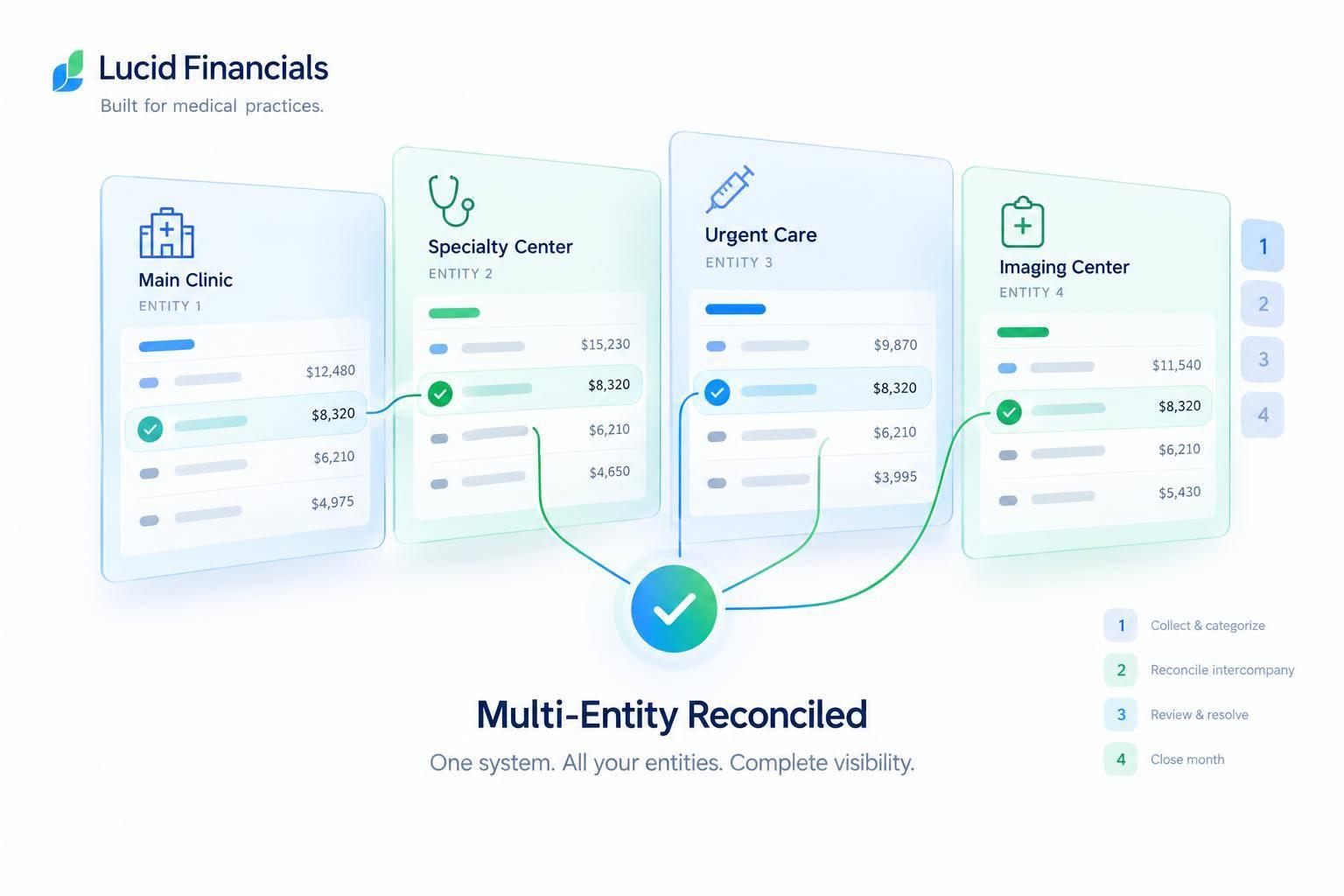
I start with one rule: every transfer needs a clear purpose, approval, support, and matching entries in both entities’ books. Moving cash isn’t enough - the records must show whether it’s a reimbursement, shared cost, loan, contribution, or distribution.
Here’s the process I recommend:
- Map your entities and accounts. Keep separate books for each legal entity and name the person responsible for review.
- Document charges before posting. Use written allocation rules, financing terms, and approvals. Keep patient details out of accounting files.
- Match and review monthly. Compare both sides of each transaction, track unpaid balances, and assign each mismatch an owner and deadline.
- Correct the books before group reporting. Use supported entries - not adjustments made just to force agreement.
For a close schedule, I’d target report exchange by business day 3, mismatch resolution by day 5, and controller review by day 7. The goal is simple: <u>supported balances in each entity</u>, not just group totals that appear right.
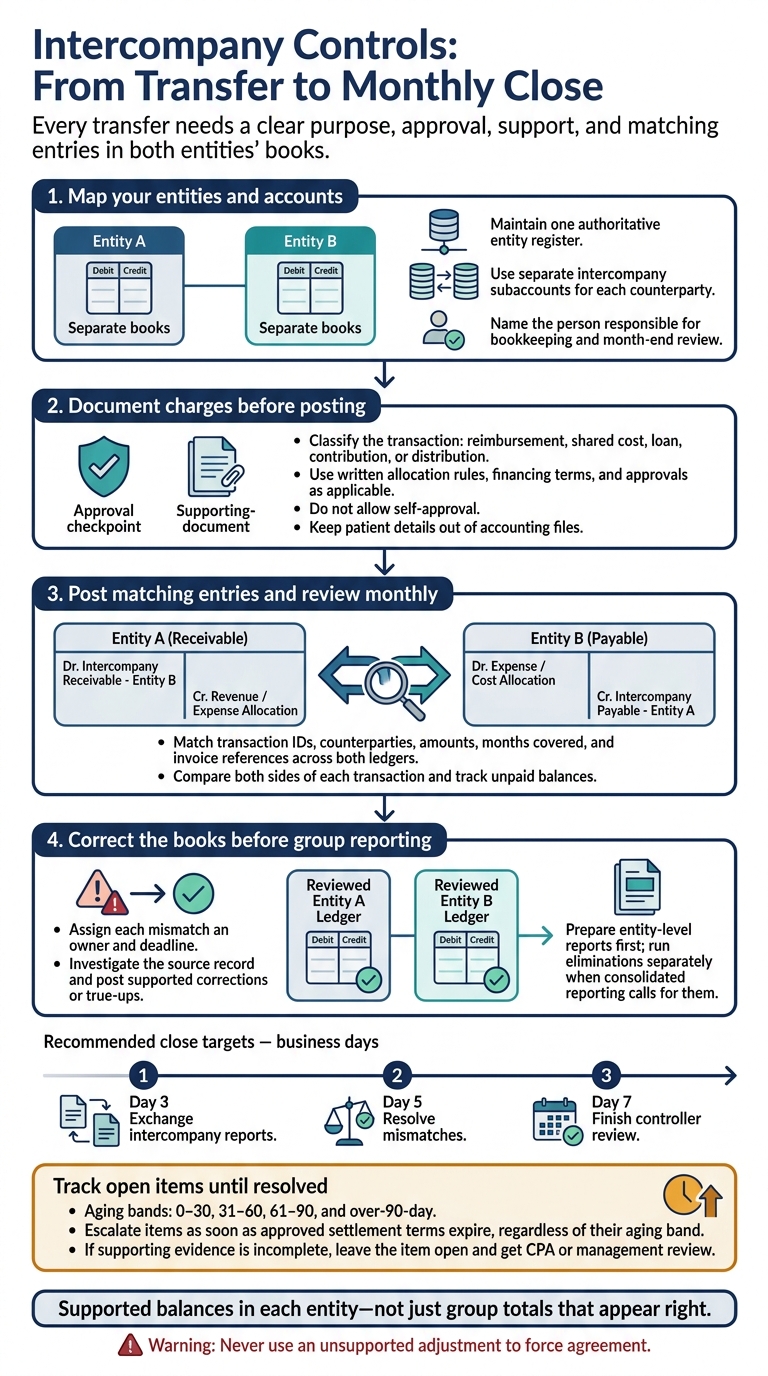
Intercompany Controls: From Transfer to Monthly Close
Intercompany Reconciliation Explained: Eliminate Differences and Resolve Breaks
sbb-itb-17e8ec9
Set Up Entity Accounts and Approval Rules
Once the entity map is defined, create one authoritative entity register before posting any intercompany entries. This helps prevent one entity from recording a transfer the other can’t match. Include every legal entity and related operating business, along with its legal name, EIN, state of formation, tax classification, operating purpose, accounting file, bank and credit-card accounts, and the person responsible for bookkeeping and month-end review.
Also record ownership links, governing agreements, authorized signers, and the effective date of any ownership or structural change. Update the register whenever an entity is formed, sold, merged, or changes ownership.
Standardize Accounts and Counterparty Details
Use consistent account names and numbering for reciprocal activity: Due from/Due to for operating balances, intercompany revenue/expense for shared services, intercompany loan receivable/payable for financing, and intercompany clearing for temporary items. Create separate subaccounts for each counterparty rather than using one broad intercompany account. Keep operating reimbursements separate from loans, capital contributions, distributions, and management fees.
Each entry must identify both legal entities, a distinct transaction ID, amount, transaction date, accounting period, business purpose, preparer, approver, and supporting-document reference. Where applicable, include source and destination accounts, the invoice or bill number, allocation method, and expected settlement date. Restrict who can edit master-data and transaction-code fields to keep intercompany amounts complete and consistent across accounting files.
Define Approvals and Required Records
Set written dollar thresholds based on the group’s size, risk, and governance documents. Require extra approval for new loans, unusual advances, and charges outside approved agreements. Where staffing allows, assign preparation, approval, posting, payment release, and reconciliation to separate people. Do not allow self-approval.
Apply these rules so both entities classify the same transaction the same way. These controls help prevent the three most common intercompany errors: mismatched transfers, misallocated shared bills, and undocumented advances.
| Transaction | Control purpose | Responsible entity | Account treatment | Required records |
|---|---|---|---|---|
| Cash transfer | Confirm authorization, destination, and purpose | Sending entity initiates; receiving entity confirms | Due to/due from, or loan accounts for financing | Transfer request, approval, bank confirmation, transaction ID, repayment terms if applicable |
| Shared bill | Allocate costs consistently without duplicate or omitted expense | Entity that receives and pays the vendor invoice coordinates allocation; entities receiving the benefit approve their shares | Paying entity records expense and reciprocal reimbursement or intercompany expense/revenue | Vendor invoice, allocation worksheet and cost driver, intercompany invoice or journal support |
| Management charge | Verify services and charges under an approved arrangement | Management company bills; receiving entity reviews and approves | Management-company intercompany revenue; receiving-entity intercompany expense | Administrative-services agreement, invoice, service description, calculation, approval |
| Advance | Distinguish temporary funding from contributions, distributions, or loans | Funding entity and recipient jointly approve | Due to/due from for short-term settlement; loan receivable/payable for financing | Purpose, amount, authorization, repayment date, note or terms, bank evidence, settlement record |
Review transactions monthly so small differences don’t linger as unreconciled balances. If one person prepares and posts entries, require an owner, controller, or external CPA to independently review bank transfers, unusual journal entries, aged balances, and supporting records each month. Document exceptions and confirm their resolution in the next close cycle.
Keep patient names, diagnoses, dates of service, and other PHI that accounting doesn’t need out of support files. Use aggregated records and role-based access.
Record Shared Costs, Transfers, and Advances
Once a charge is approved, record matching entries in both entities. The amounts and details should agree so the monthly review can clear them without rework.
Allocate Shared Bills With Documented Allocation Drivers
Choose an allocation driver that reflects how much each entity uses or benefits from the service. Use claim volume for billing services, head count for HR, user counts for software, occupied square footage for facilities, or marketing activity.
Keep the invoice, allocation policy, source data, location codes, calculations, preparer details, and reviewer approval. Review the method at least annually and whenever staffing, locations, contracts, or usage changes. Spread multi-month bills across the months they cover.
| Method | Best use | Limits | Evidence |
|---|---|---|---|
| Actual usage | Software seats, claims, consumption | Requires complete, current data | Usage report, calculation |
| Head count | HR and payroll administration | Support needs vary | Employee roster, allocation date, approved calculation |
| Revenue | Administrative services when revenue tracks usage | May distort costs; seek legal or tax review | Revenue report, approved policy, rationale |
| Fixed percentages | Stable sharing arrangements | Update as entities change | Agreement, annual review, approval |
| Keep at corporate level | Corporate overhead with no direct practice benefit | Don’t recharge to shift profit | Cost purpose, CPA review |
Once the method is set, post the same amount and counterparty in both ledgers.
Post Matching Entries in Both Entities
Hypothetical: $10,000 technology bill, reimbursed without markup. Practice A initially debits Technology Expense and credits Accounts Payable for $10,000. Under the documented arrangement, Practice B receives 40% of the benefit. A then debits Due from B and credits Technology Expense for $4,000; B debits Technology Expense and credits Due to A for $4,000. A retains $6,000 of expense; B records $4,000. When B reimburses A, A debits Cash and credits Due from B; B debits Due to A and credits Cash, each for $4,000.
These entries make the reimbursement easy to trace and reconcile in both sets of books. Use this treatment only for reimbursement arrangements; medical practice management-company structures can differ. Match transaction IDs, counterparties, amounts, months covered, and invoice references across both ledgers.
Keep an exception log for missing entries, duplicates, wrong amounts, and cutoff differences. Carry unresolved items into the month-end review with an owner and due date. Check the source record, then post a supported correction or true-up. Never use an unsupported adjustment to force agreement.
Document Cash Transfers and Financing
Before transferring cash, confirm both entities, the purpose, classification, approval, and expected settlement date. For advances and loans, also document repayment terms and, where applicable, interest, maturity, collateral, and guarantees. Link the bank confirmation to the entries.
Get CPA or legal review before putting related-party financing, management fees, revenue-based charges, or arrangements involving fee-splitting concerns in place. Charges should reflect documented services - not referrals or profit shifting.
Use the transaction type to determine the required records and settlement method.
| Type | Supporting records | Ledger treatment | Approval | Settlement |
|---|---|---|---|---|
| Operating settlement | Intercompany statement, transaction IDs, reconciliation | Clear due-to/due-from balances against cash or approved offset | Finance or controller | Close or treasury schedule |
| Shared-cost recharge | Vendor invoice, allocation driver, calculation, agreement | Receiving entity books expense; paying entity reduces its expense and books due from affiliate | Cost-center owner and finance | Monthly or agreed billing cycle |
| Short-term advance | Purpose, amount, repayment date, approval | Due from/due to affiliate; do not book cash received as revenue | Controller or authorized executive | Repay by the agreed short-term date |
| Loan | Written note, principal, interest rate, maturity, repayment schedule | Loan receivable/payable; interest separately | Board, owner, or governing approval as required | Scheduled principal and interest payments |
| Capital contribution | Ownership records, contribution authorization, entity documentation | Equity or capital account, not revenue | Owners, board, or members as applicable | No ordinary repayment obligation |
| Distribution | Solvency review, ownership allocation, authorization, payment record | Distribution or equity reduction, not operating expense | Owners, board, or members as applicable | Pay according to approved distribution terms |
Reconcile Balances and Review Controls Monthly
Use one close calendar across all entities. Set deadlines for cutoff, reciprocal posting, bank and credit-card reconciliation, exception resolution, and reporting. Exchange intercompany reports by the third business day, resolve mismatches by the fifth, and finish controller review by the seventh. This schedule depends on having standardized accounts and matching entries in place.
Reconcile Each Entity Pair Before Close
Reconciliation puts those matching entries to the test each month. Once entries are posted, use an entity-pair schedule that shows opening balances, new charges, cash transfers, advances, settlements, adjustments, and closing balances for both entities.
Match reference numbers, amounts, dates, periods, and accounts - not just totals. Group differences into timing differences, missing postings, coding errors, duplicates, or bank-clearing items. Confirm that both sides are posted, and keep supporting records with preparer and reviewer sign-off.
Prepare entity-level reports first. Run eliminations separately when consolidated reporting calls for them.
Assign Owners to Unmatched and Aged Balances
Link a transfer register to an open-items log. For each item, record the entities, reference, purpose, amount, cause, owner, corrective action, due date, and status.
Review aging in 0–30, 31–60, 61–90, and over-90-day bands. Escalate items as soon as approved settlement terms expire, regardless of their aging band.
For undocumented advances, rebuild the record using bank statements, emails, invoices, payroll records, and approvals. If the evidence is incomplete, leave the item open and get CPA or management review. Don’t force an unsupported balancing entry or reclassification.
Test Controls and Review Financial Reports
Keep a control matrix that records risks, owners, frequency, transaction population, evidence, exception thresholds, reviewers, and remediation deadlines. Use the open-items log to direct testing toward aged and repeated exceptions.
Sample high-dollar, unusual, manual, late-posted, and corrected items. Check each for accuracy, approval, support, reciprocal posting, and elimination treatment. Review entity profitability, cash exposure, advance schedules, and aging against group results.
Lucid Financials can support entity-level reporting and Slack-based review workflows. Define preparation and review duties in the engagement. Practice leaders retain approval and oversight of transfers, allocations, settlements, corrections, and exceptions.
Conclusion: Keep Intercompany Balances Supported and Reconciled
Monthly close controls have a clear goal: prevent mismatched transfers, shared bills, and undocumented advances from turning into unresolved balances. Reliable group reporting depends on accurate entity books. Unsupported intercompany balances distort entity results, and consolidation alone cannot fix them.
Keep two working tools up to date: an entity register and an aged-balance log by entity pair. Address unsupported items and old balances first when they affect cash, covenants, distributions, or consolidated results.
Trace each item to bank statements, invoices, payroll records, transfer confirmations, and prior workpapers. Then post documented correcting entries instead of forcing balances to agree. Assign recurring preparation, matching, approval, and independent-review duties, and record each owner, deadline, and required record on the close calendar.
FAQs
What if an intercompany mismatch remains at month-end?
Do not create entries just to force a zero balance. Keep the item open, document its impact, and state whether the month-end close can proceed. An accountant must review the facts, decide on the proper intercompany, contribution, or distribution treatment, and approve any corrections.
Include unresolved items in the reporting package, along with assigned owners, follow-up dates, and potential impacts. Do not mark them as resolved.
How should we allocate shared costs when usage changes?
Keep allocation methods consistent across reporting periods when possible so results are easier to compare. If a method needs to change, document the change and provide a bridge schedule showing its impact on the financial statements.
Use an approved policy to guide allocations, back them up with calculation workpapers, and have a finance reviewer check them. When reviewing shared-cost performance, keep each entity’s underlying results visible. This helps separate location-level operating issues from changes caused by allocations.
When should we reclassify an advance as a loan?
Reclassify an advance as a loan or another formal instrument if your accountant determines that the facts call for intercompany, contribution, or distribution treatment - not a simple cash transfer. Matching amounts between separate practice entities don’t, on their own, make a transaction an ordinary internal transfer.
Keep records that support these transactions, and get owner approval for unusual intercompany activity.