Fintech startups often rely on internal data for essential financial metrics, but this approach misses critical external factors like economic trends, market shifts, and real-time signals. Integrating external data - such as GDP, interest rates, and even social media sentiment - into financial models can boost forecast accuracy by up to 30%.
Key takeaways:
- External data sources include macroeconomic indicators, market data, and alternative data like satellite imagery or web traffic.
- AI and machine learning tools, like SAIFIN and FinSrag, combine these data types to improve predictions for credit risk, stock movements, and more.
- Startups can automate external data integration to create dynamic, real-time forecasting systems, reducing errors and improving decision-making.
How to Develop More Accurate Financial Forecasts With ML and AI
sbb-itb-17e8ec9
How External Data Improves Forecast Accuracy
Incorporating external data into financial models can significantly enhance forecast precision. The extent of these improvements, however, hinges on the specific data sets used and how effectively they are integrated with existing models.
Measured Gains from External Data
Studies show that frameworks like GenRiskNet, which combine LLM-extracted financial events, macroeconomic indicators, and ESG profiles with standard market data, deliver notable results. For example, GenRiskNet achieved:
- A 15.8% improvement in AUC for credit-risk prediction
- A 12.6% reduction in VaR forecasting error
- A 19.7% increase in F1 score
Additionally, since 2000, the informativeness (R²) of one-year earnings forecasts has risen by roughly 10 percentage points, climbing from 60% to 70%. This improvement is particularly valuable for fintech startups estimating short-term revenue or cash burn rates.
However, there’s a tradeoff. As Olivier Dessaint of INSEAD explains:
"The availability of short-term-oriented data can induce forecasters to optimally shift their attention from the long term to the short term, decreasing the informativeness of long-term forecasts."
This shift is evident in the decline of five-year forecast informativeness, which has dropped from 40% to 30%. Such findings highlight the importance of balancing short- and long-term modeling in financial forecasting.
These gains also pave the way for AI and machine learning systems to further refine forecasting accuracy.
How AI and Machine Learning Use External Data
Modern machine learning techniques excel at uncovering patterns that traditional methods often overlook. A key advantage lies in their ability to process diverse data types simultaneously.
Take the SAIFIN project (February 2026), a collaboration between Guglielmo Marconi University and Idea-Re S.r.l., as an example. This system uses specialized AI agents to analyze satellite imagery, news sentiment, and market data, all coordinated by a master AI agent powered by GPT-4o and GPT-5-nano. By integrating vegetation indices, water scarcity data, and news sentiment with standard price data, SAIFIN outperformed price-only models in volatile commodity markets. According to the project’s highlights, multimodal, agent-based architectures that combine generative AI with alternative data create more reliable and transparent algorithmic trading systems.
Another promising approach is Retrieval-Augmented Generation (RAG). The FinSrag framework (June 2025), developed by teams at Wuhan University and Columbia University, uses a domain-specific retriever called FinSeer. This retriever analyzes 28 additional financial indicators beyond standard price data and identifies historically relevant market sequences. It then feeds this information into a 1-billion-parameter StockLLM, outperforming traditional similarity-based methods in predicting stock movements. The lesson is clear: providing richer external context to AI models sharpens their predictive capabilities.
Key Types of External Data Fintech Startups Use
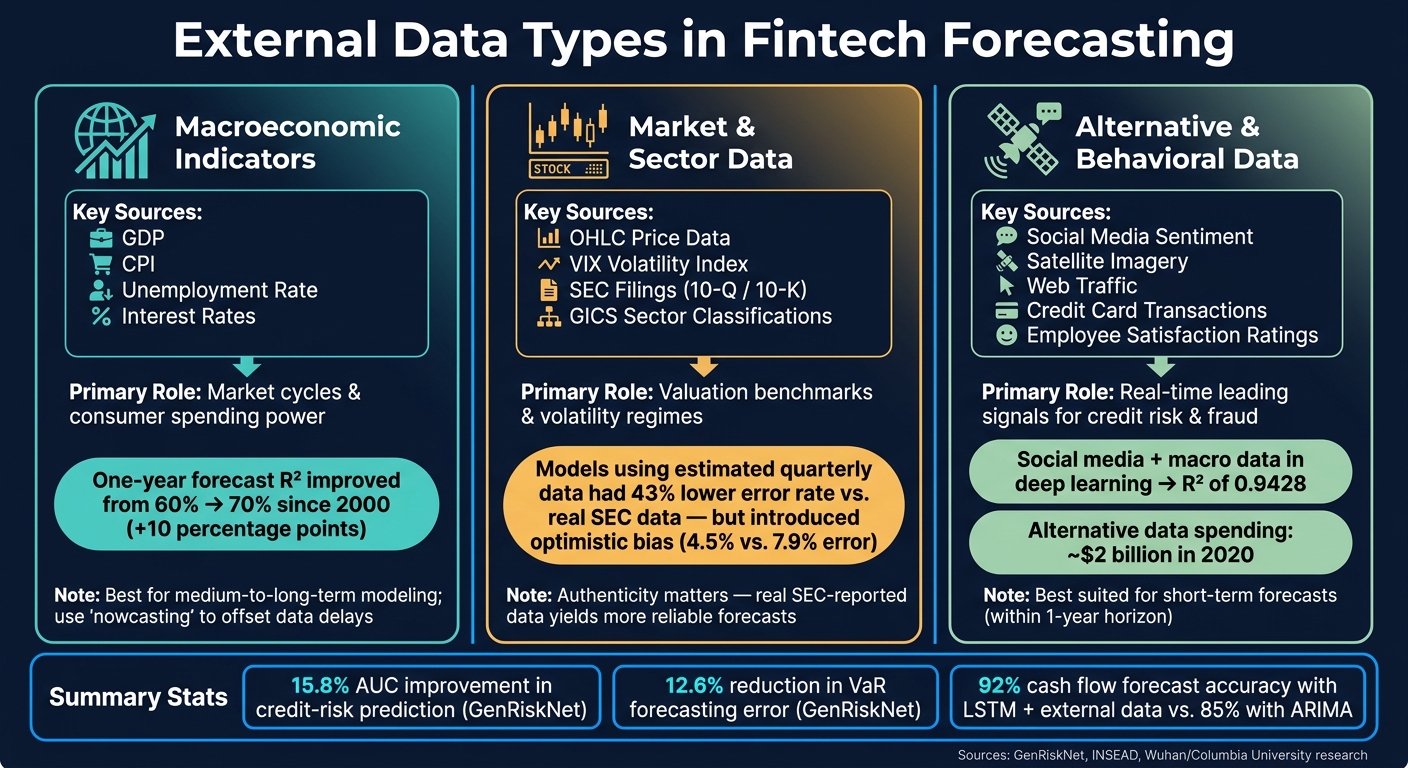
External Data Types in Fintech Forecasting: Sources, Roles & Impact
When it comes to building effective forecasting models, fintech startups rely on three main categories of external data. Each type brings a unique perspective, helping to create a more complete and accurate picture.
Macroeconomic Indicators
Macroeconomic data - think GDP, CPI, and interest rates - helps models assess the broader economic environment. These indicators allow fintech models to identify whether the economy is stable, transitioning, or experiencing turbulence. For example, during unstable periods, models might rely more on short-term sentiment data while scaling back on long-term trends.
However, there’s a challenge: official macroeconomic data is often outdated by the time it’s released. To address this, fintech teams are turning to "nowcasting" - a method that combines traditional metrics with real-time data like news sentiment. This approach transforms slow-moving government data into something closer to a live feed.
"Macroeconomic forecasting is critical for economic stability and informed policy decisions, yet conventional approaches often rely on delayed structured data and ignore real-time public sentiment." - Discover Artificial Intelligence
While macro data sets the stage, market and sector data zooms in on specific assets and industries.
Market and Sector Data
This type of data includes the usual suspects in financial modeling: OHLC price data (Open, High, Low, Close), volatility measures like the VIX, and relationships between stocks. It also covers corporate disclosures such as SEC filings (Forms 10-Q and 10-K) and sector classifications like GICS.
A study from May 2026 focused on five major U.S. tech firms - Microsoft, Apple, Amazon, Alphabet, and Meta - highlighted the importance of using authentic data. Models trained on estimated quarterly figures (derived from annual totals) had a 43% lower error rate than those using actual SEC-reported data. However, these estimates introduced a bias, making forecasts appear easier than they were. When researchers switched to real SEC-reported figures from 244 firm-quarter observations (2011–2024), the error rate rose to 7.9%, offering a more realistic and actionable result.
The lesson? Authenticity matters. Using real, restated data ensures forecasts are more reliable and harder to manipulate.
But there’s more to forecasting than traditional market metrics. Alternative data sources bring fresh, real-time insights into the mix.
Alternative and Behavioral Data
Alternative data comes from unconventional sources like social media activity, satellite imagery, web traffic, credit card transactions, and even employee satisfaction ratings.
"The digitization of information has generated phenomenal growth in 'alternative data' (e.g., social media, web traffic, credit card and point-of-sale, geolocation, satellite imagery, employee satisfaction ratings, etc.), transforming the way investors and information intermediaries forecast future outcomes." - Olivier Dessaint, Professor, INSEAD
Investors have been quick to recognize its value, with spending on alternative data hitting nearly $2 billion in 2020. For example, social media sentiment offers early signals that can complement slower-moving official reports. In fact, combining social media sentiment with traditional macroeconomic data in a deep learning model achieved an impressive R² of 0.9428, showing high predictive accuracy.
Satellite imagery is another game-changer. According to Alberto Garinei of Guglielmo Marconi University:
"Satellite data, in particular, deliver real-time information on physical and economic activities: crop health and yield forecasts, oil storage levels, mining stockpiles, logistics and shipping flows, and infrastructure development."
That said, alternative data is best suited for short-term forecasts - typically within a one-year horizon. While it’s a powerful addition, it doesn’t replace the need for longer-term insights from macro and market data.
To summarize, macroeconomic indicators provide a big-picture view, market data delivers detailed sector insights, and alternative data offers timely, real-world signals. Here’s how each category contributes to fintech forecasting:
| Data Category | Key Sources | Primary Forecasting Role |
|---|---|---|
| Macroeconomic | GDP, CPI, unemployment, interest rates | Market cycles, consumer spending power |
| Market & Sector | OHLC, VIX, SEC filings (10-Q/10-K), GICS | Valuation benchmarks, volatility regimes |
| Alternative & Behavioral | Social media, satellite imagery, credit card data | Real-time leading signals for credit risk and fraud |
How Fintech Startups Can Put External Data to Work
Pinpointing the right external data is just the starting point. The real challenge lies in seamlessly integrating that data into your forecasting models without overwhelming your team or slowing down processes.
Data Integration and Automation
Relying on manual processes for handling data can bog down forecasting efforts. Analysts often spend as much as 80% of their time gathering data, much of which is unstructured. This is where modern, AI-driven platforms step in. These tools can automatically link external data sources - like market trends, macroeconomic updates, and news sentiment - with your internal financial systems. By creating a streamlined pipeline, these platforms ensure your models stay current and eliminate the constraints of traditional spreadsheets.
Take Lucid Financials as an example. This platform combines AI-powered bookkeeping with advanced forecasting tools, offering real-time insights into cash flow, scenario planning, and investor-ready reports. It’s a one-stop solution for startups looking to stay ahead.
Always-On Financial Insights
With automated data pipelines in place, startups can benefit from continuous insights that adapt to real-time changes in the market. Static, once-a-month forecasts can quickly lose relevance when market conditions shift. Continuous monitoring tools address this by flagging potential risks - like market fluctuations, supply chain issues, or changes in consumer sentiment - before they impact financial results. These platforms don’t just identify risks; they also summarize critical indicators and recommend actions.
For startups preparing for fundraising or board presentations, this approach is a game-changer. Forecasts backed by live data and transparent drivers make your financial outlook more credible, helping you build confidence during due diligence and board discussions.
Conclusion: What the Research Shows and Where to Go Next
Studies confirm that incorporating external data significantly enhances the accuracy of fintech forecasts. For example, LSTM models that utilize external data achieve an impressive 92% cash flow forecast accuracy, compared to 85% with traditional ARIMA models. When structured and unstructured data sources are combined, accuracy can improve by an additional 12%. These advancements highlight a major opportunity for startups that refine their data strategies.
However, one risk often overlooked is the "horizon effect". With the increasing availability of short-term alternative data, forecasters may focus too heavily on immediate signals, potentially compromising the quality of long-term predictions. Moreover, data quality remains a central challenge.
For instance, models relying on estimated quarterly data instead of official SEC-reported figures showed a 43% optimistic bias, with error rates of 4.5% versus 7.9%. This demonstrates how a model might seem accurate while downplaying real-world volatility. As researcher Amjed Mohammed Fahad aptly stated: "Methodological advancements cannot compensate for compromised data quality."
With these accuracy improvements and challenges in mind, new tools are paving the way forward. Innovations like regime-aware models and LLM-powered systems are simplifying complex signals, making advanced forecasting tools more accessible to smaller fintech firms. By integrating external data with these cutting-edge techniques, startups can achieve levels of forecasting precision previously out of reach.
The key for startups is to first establish a strong data foundation before implementing AI-driven solutions. As Kelley Lynn Kassa, Senior Analyst at Board, observed: "AI is only as strong as the data ecosystem supporting it. And that ecosystem must extend beyond enterprise boundaries."
FAQs
Which external data sources matter most for my fintech forecasts?
Integrating a variety of external data sources can significantly enhance fintech forecasting by reflecting real-time market changes and economic trends. Some key data types include:
- High-frequency indicators: Web usage patterns and shipping data offer timely insights into market activities.
- Macroeconomic metrics: Factors like interest rates and unemployment figures provide a broader economic context.
- Unique inputs: Social media sentiment and geospatial data add layers of understanding that traditional data might miss.
It's crucial to focus on high-quality data to minimize bias and ensure reliable predictions. Tools like Lucid Financials can help manage these complex financial datasets, allowing you to concentrate on growing your business.
How do I validate external data quality before using it in models?
Validating external data for financial models requires a careful, step-by-step process to ensure everything is accurate and consistent. Here's how you can tackle it:
- Start with schema checks: Verify that data formats, like dates (e.g., ISO-8601), are correct and reject any fields that don't meet the required standards.
- Standardize key metrics: Align metrics such as EBITDA across all datasets to maintain uniformity.
- Apply outlier detection: Identify and address any values that deviate significantly from expected ranges.
- Reconcile data across sources: Cross-check information from different sources to catch discrepancies.
Tools like Lucid Financials can simplify this process by seamlessly integrating dependable data into your system. This ensures your reports are not only accurate but also audit-ready, giving you confidence in your strategic decisions.
How can I use real-time external data without hurting long-term forecasts?
When working with real-time external data, it’s essential to start with a solid foundation: strong data governance and reliable internal data. Think of external signals - like economic trends or social media insights - as tools for fine-tuning your strategy, not as the main drivers of your decisions.
Lucid Financials helps ensure your internal data stays dependable. With real-time, investor-ready reporting and accurate, clean books, you can confidently balance short-term insights with long-term strategic growth.