AI simplifies financial reporting by automating tedious tasks, reducing errors, and providing real-time insights. Startups often struggle with manual processes that are slow and prone to mistakes. AI tools solve this by integrating data from multiple sources, handling transaction matching, automating currency conversions, and flagging anomalies. This ensures faster financial closes and accurate, investor-ready reports.
Key benefits of AI in financial reporting:
- Faster processes: Monthly closes are 60% quicker.
- Error reduction: Accounting mistakes decrease by 40%.
- Real-time insights: Dashboards track burn rate, runway, and cash flow instantly.
- Multi-source integration: AI connects to tools like QuickBooks, Stripe, and payroll systems via APIs.
- GAAP-compliant outputs: Automatically generated statements meet accounting standards.
For startups, AI-driven tools like Lucid Financials streamline tasks like bookkeeping, tax preparation, and reporting, allowing founders to focus on growth instead of manual reconciliations.
AI in FP&A: From Raw Data to Reporting Automation
sbb-itb-17e8ec9
How AI Automates Data Collection and Integration
AI doesn't just make real-time reporting smoother - it also simplifies data collection, which is a major hurdle when consolidating financials.
One of the biggest challenges in consolidated reporting is gathering financial data from numerous, disconnected sources. For example, a startup might rely on QuickBooks for accounting, manage payroll through Gusto or Rippling, and process payments via Stripe, all while juggling multiple bank accounts. Manually exporting CSV files from these platforms not only eats up hours but also increases the risk of errors.
AI platforms tackle this by directly connecting to these systems using APIs and OAuth authentication. Instead of downloading and uploading data manually, these tools pull information automatically. A great example is EY's EY.ai Agentic Platform, launched in March 2025, which deployed over 150 specialized tax agents to assist 80,000 professionals. These agents handle tasks like automating VAT submissions across Europe and generating multinational transfer pricing documentation by constantly updating tax legislation data. For startups, AI agents work similarly by syncing with financial tools to ensure data remains up-to-date without manual intervention.
Multi-Source Data Integration
AI doesn’t just collect data - it integrates it seamlessly from multiple platforms to create a single financial view. For instance, when you connect QuickBooks, bank accounts, and payroll systems, the AI maps data fields to a standardized template. This means revenue from Stripe, expenses from credit cards, and payroll costs from HR platforms are all consolidated into one framework. This saves hours of manual work and ensures consistency.
The secret lies in choosing platforms with pre-built connectors. These connectors allow AI to refresh data hourly for operational reports or daily for executive summaries, bypassing the delays of waiting for month-end exports. A Series A startup demonstrated this in September 2025 when preparing for a funding round. Using AI, they processed 18 months of bank statements and categorized over 10,000 transactions, reducing their data preparation time from three weeks to just two days. This efficiency helped the company secure $5 million in funding.
This kind of integration also sets the stage for accurate transaction matching and consistent account structures across an organization.
Automatic Transaction Matching
Once data is collected, AI simplifies reconciliation by automatically matching transactions. For example, if a parent company invoices a subsidiary $50,000, that transaction will appear twice - once as revenue and once as an expense. AI can identify and categorize these duplicates with 95% accuracy, flagging any exceptions for human review. This is especially helpful for startups managing multiple subsidiaries or international operations, where currency differences can complicate things.
Unified Chart of Accounts
Different entities often use varying labels for similar accounts. One subsidiary might record travel expenses as "T&E", while another calls it "Business Travel." AI addresses this by mapping these variations to a unified chart of accounts. This ensures that when you generate consolidated reports, every dollar is categorized consistently, whether it's from a Delaware parent company or a UK subsidiary.
AI also learns over time. When new accounts are added, the system suggests mappings based on historical data and transaction patterns, saving you from manually aligning charts of accounts. This consistency ensures your consolidated financials are reliable month after month. As Wolters Kluwer puts it:
"What would take a human hours takes Ask AI seconds, leaving finance with more time to focus on taking action and asking questions".
AI Methods for Processing Consolidated Financials
Once data integration is complete, AI steps in to refine financials with advanced processing techniques. It tackles issues like duplicate entries, real-time currency conversion, and error detection, ensuring the final reports are accurate and reliable.
Intra-Group Transaction Elimination
Intra-group invoicing can create duplicate entries that inflate consolidated financials. As Upflow puts it:
"A company cannot generate profit by transacting with itself".
AI streamlines this process by automatically matching reciprocal transactions between entities, even when systems and formats differ. For instance, it can identify a $100,000 sale in one system as a match for a £78,000 purchase in another. Using confidence scores, AI auto-approves high-confidence matches and flags lower-confidence ones for review, refining its accuracy over time.
The results speak for themselves. Automated systems can increase transaction matching accuracy by up to 80% and reduce reconciliation accounts by as much as 81%. Companies leveraging these tools have also shortened their month-end close cycles from over 15 days to fewer than 5 days.
To make this process smoother, standardize your chart of accounts across all subsidiaries. Assign unique codes - like "IC-SALE" or "IC-LOAN" - to internal transactions so AI can quickly identify and tag them. Regular monthly check-ins to compare balances, such as receivables versus payables, can also help resolve discrepancies early.
Once intra-group transactions are addressed, AI moves on to tackle currency variations with precision.
Real-Time Currency Translation
Managing fluctuating exchange rates across subsidiaries is a major challenge when handling manual currency conversions.
AI simplifies this by integrating real-time exchange rate feeds from trusted sources, automating conversions instantly. As soon as a transaction is logged in a subsidiary's local currency, it updates your consolidated financials at the current rate. At period close, the system also adjusts receivables, payables, and cash balances automatically.
Ben Taylor from SoftLedger highlights the importance of this capability:
"Fluctuating FX rates can materially impact margins and the only way to assess the impact is by having the data readily available".
When choosing accounting software, request a live demo of a multi-entity close to confirm that FX conversions happen automatically. Also, ensure the platform supports open APIs for seamless integration with tools like billing and payroll.
Anomaly Detection and Reconciliation
Even with automation, errors like duplicate entries, misclassifications, or timing mismatches can still occur. AI continuously monitors data for anomalies, flagging unusual patterns - such as unexpected expense spikes or vendor names that don’t align with historical records. These alerts enable quick investigation and correction.
This proactive approach significantly boosts efficiency. In fact, 98% of teams report major time savings, cutting tasks from 25 hours down to just minutes. Over time, as AI learns from corrections - like reclassifying a flagged transaction - future reconciliations become even faster and more precise. This allows your team to dedicate more time to strategic initiatives.
Creating Real-Time Reports and Insights
Once AI has cleaned up and organized your data, the real magic begins: instant access to financial insights that you can act on immediately. Forget waiting days - or even weeks - for reports to come through. With AI, you gain live visibility into critical metrics like burn rate, runway, cash flow, and profitability. This shift from static, monthly reporting to dynamic, real-time dashboards changes how startups make decisions. Here’s how AI turns static data into actionable intelligence.
Live Dashboards and Burn Rate Tracking
AI-powered dashboards bring your key performance indicators to life, integrating data from bank feeds, accounting systems, and operational tools. Instead of juggling spreadsheets, you can monitor burn rate, runway, gross margins, and cash flow in real time. For startups, this means identifying potential problems early - like a sudden increase in cloud costs or slower-than-expected collections - before they spiral out of control.
AI-driven tools speed up financial management processes by as much as 100x compared to traditional methods. Tasks that once required hours of manual work in Excel now happen instantly. Imagine pulling up a live dashboard during an investor call or board meeting and having up-to-the-minute financial data at your fingertips. Giorgio Riccio, Founder of Lumino Technologies, shared how using the Lucid platform during a VC meeting made a powerful impression.
Real-time data doesn’t just highlight issues; it helps you act on them. If your burn rate jumps from $50,000 to $75,000 in a month, you’ll know immediately - not weeks later when the books close. This gives you the chance to adjust spending, ramp up revenue efforts, or rethink hiring plans before it’s too late.
GAAP-Compliant Financial Statements
Creating investor-ready financial statements used to be a time-consuming process involving manual work and expert reviews. AI simplifies this by automatically generating profit and loss statements, balance sheets, and cash flow analyses - all while adhering to Generally Accepted Accounting Principles (GAAP).
It starts with smart transaction categorization. Advanced machine learning models can classify thousands of transactions with over 95% accuracy. For instance, an AWS charge might be categorized as infrastructure, while a Salesforce subscription is logged under sales tools - even if both appear as generic "software" charges.
Once transactions are sorted, AI applies proper accounting principles - like accruals, deferrals, and period matching - to generate financial statements. These GAAP-compliant outputs are then reviewed by human experts, such as CFOs or CPAs, who provide oversight and final validation. This hybrid approach combines the speed of automation with professional judgment, ensuring the financials are accurate and ready to share with investors, lenders, or potential acquirers.
Forecasting and Scenario Analysis
AI doesn’t just look at the past; it helps you plan for the future. With its ability to create detailed financial plans in seconds, AI allows you to explore best-case, worst-case, and actual scenarios. Unlike static forecasts, these projections update dynamically based on current burn rates, revenue trends, and growth assumptions.
This is a game-changer for strategic planning. Want to see how hiring more engineers or adjusting revenue goals would impact your finances? AI lets you model different scenarios and understand the outcomes. It even provides instant access to benchmarks like Customer Acquisition Cost (CAC), valuation multiples, and competitor data, helping you see how your metrics stack up against industry standards.
Some platforms take it a step further with Slack integration, letting you interact with forecasting tools through simple questions. Ask, “What’s our runway if burn stays the same?” or “How would 20% revenue growth impact our forecast?” and get instant answers. Whether you’re fine-tuning a pitch deck late at night or addressing investor questions over the weekend, these tools ensure financial insights are always within reach.
With real-time dashboards, GAAP-compliant statements, and dynamic forecasting, founders gain the clarity and confidence needed to navigate their businesses effectively. AI doesn’t just streamline financial management - it transforms it.
Lucid Financials: AI-Powered Consolidated Reporting in Action
Lucid Financials showcases how AI can revolutionize financial reporting by combining automated data collection, intelligent processing, and real-time insights into one seamless platform. This eliminates the need for juggling multiple tools or enduring long delays. Founders can rely on its comprehensive suite of services, which includes bookkeeping, tax services, tax credits, and CFO-level support. Essentially, the platform acts as an all-in-one system for managing workflows like accounting and compliance, powered by AI. Here’s a closer look at how Lucid Financials delivers these advantages to startups.
Clean Books in 7 Days
Traditional methods often slow down consolidated reporting, but Lucid Financials speeds things up significantly. The platform automatically gathers and consolidates financial data from various sources, including multiple bank accounts, credit cards, and even PDF statements, converting them into standardized formats. Advanced AI models categorize transactions with 95% accuracy, distinguishing between expenses like AWS charges and Salesforce costs. This automated categorization eliminates hours of manual effort, delivering reconciled financial books in just seven days.
Slack-Integrated Real-Time Reporting
Lucid Financials transforms Slack into a powerful financial reporting tool. Thanks to natural language processing, its AI assistant can interpret complex questions, allowing users to dive into reporting details instantly. For example, you can ask, "What's our current burn rate?" or "How much runway do we have?" and receive accurate, real-time answers - perfect for last-minute board meetings or weekend due diligence. The platform also simplifies the creation of investor-ready financial statements and forecasts, making fundraising preparation quick and stress-free.
Expert-Reviewed Outputs
While automation is at the core of Lucid Financials, it doesn’t stop there. Every AI-generated report undergoes review by seasoned finance professionals, including CPAs and CFOs, ensuring accuracy and compliance. The platform also keeps automated audit trails and documentation, meeting GAAP standards and ensuring transparency for regulatory reporting. By combining automation with expert oversight, Lucid Financials reduces closing cycles and delivers error-free, reliable financial reports.
Benefits and Best Practices for Startups
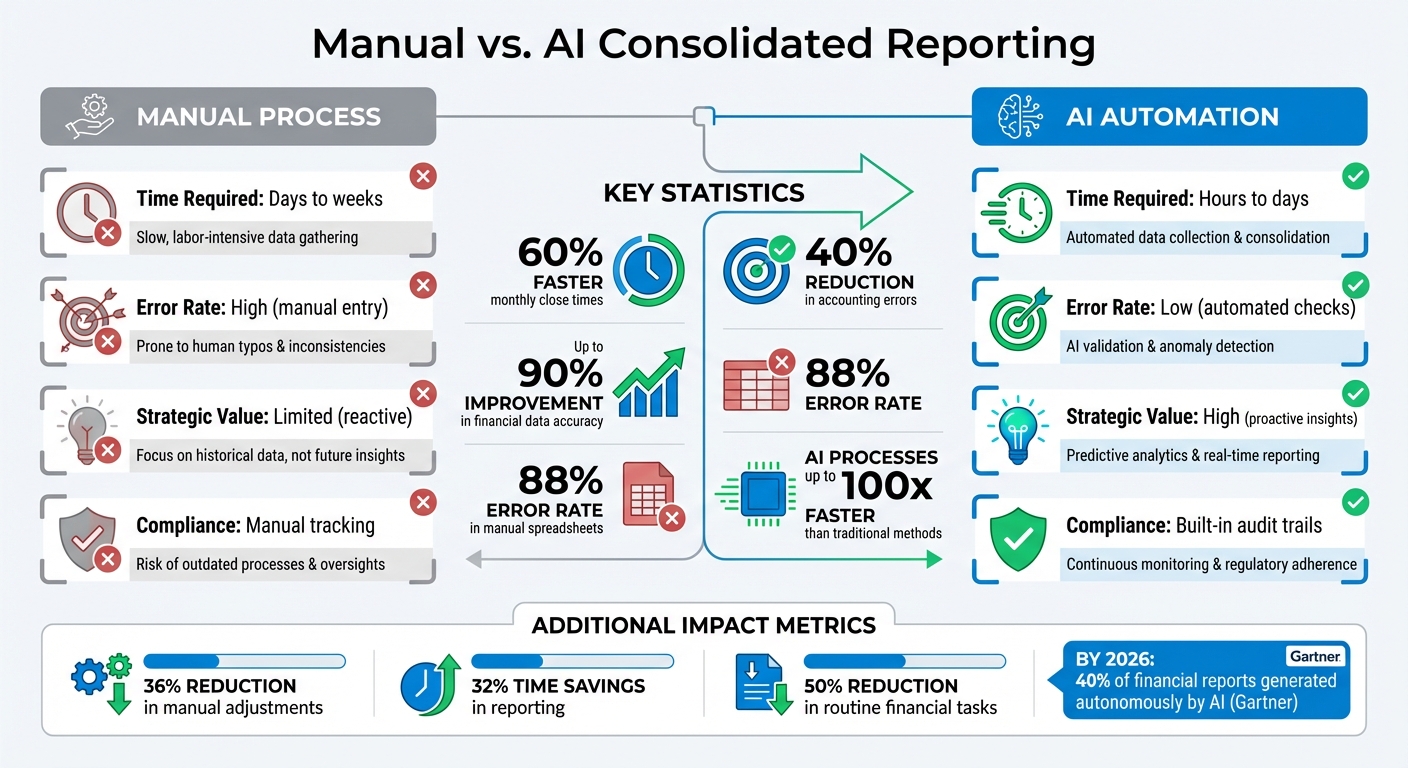
Manual vs AI-Powered Financial Reporting Comparison for Startups
AI-powered consolidated reporting is changing how startups handle financial management, offering faster reporting and improved accuracy. Unlike manual reporting, which can be slow and prone to mistakes, AI automation speeds up the process significantly. Startups using AI accounting tools report monthly close times that are 60% faster, along with a 40% reduction in accounting errors. Automation doesn't just save time - it can improve the accuracy of financial data by as much as 90%. According to Gartner, by 2026, 40% of financial reports are expected to be generated autonomously by AI systems.
Manual vs. AI Consolidated Reporting
Here’s a quick look at how manual processes stack up against AI automation:
| Aspect | Manual Process | AI Automation |
|---|---|---|
| Time Required | Days to weeks | Hours to days |
| Error Rate | High (manual entry) | Low (automated checks) |
| Strategic Value | Limited (reactive) | High (proactive insights) |
| Compliance | Manual tracking | Built-in audit trails |
These improvements highlight why many startups are embracing AI-driven accounting tools.
Implementation Best Practices
To take full advantage of AI-powered financial tools, startups should follow a few key strategies.
Start by adopting AI-first accounting from the beginning. This avoids the challenges of transitioning from outdated legacy systems. A phased approach works best - start with automating a single report or process as a pilot project before scaling up. Make sure to clean and standardize your data beforehand to ensure quality results.
For seamless integration, connect your ERP, CRM, billing, and HRIS data using platforms with robust APIs or pre-built connectors, such as Slack or QuickBooks. Focus on automating high-impact metrics, like burn rate and revenue trends, rather than trying to automate every report at once.
Even with automation, human oversight is essential. AI-generated reports should always undergo validation by financial teams to ensure accuracy. This approach not only reduces manual adjustments by 36% but also saves 32% of reporting time. It allows financial professionals to shift their focus from tedious spreadsheet management to providing strategic advice.
Looking ahead, AI-driven automation is expected to continue growing rapidly. By reducing routine financial tasks by up to 50%, startups can free up valuable time for founders to concentrate on scaling their businesses instead of reconciling transactions.
Conclusion
AI-powered consolidated reporting is changing how startups manage their finances, cutting workloads that once took days or weeks down to just hours. This shift not only improves accuracy but also provides strategic insights and ensures startups are always prepared for investors. By automating tasks like data collection, transaction matching, currency translation, and anomaly detection, founders can focus their energy on growth rather than spending hours reconciling accounts.
This kind of efficiency is exemplified by tools like Lucid Financials, which brings an AI-first approach tailored specifically for startups. The platform delivers clean books in just seven days, integrates with Slack for real-time updates, and generates instant, board-ready reports. It combines automation with expert reviews to ensure precision and reliability.
The impact of AI-driven tools like Lucid is evident in user experiences. Giorgio Riccio, Founder of Lumino Technologies, shared how Lucid impressed investors during a meeting:
"Just want to say props to the whole Lucid team. We pulled up the Lucid platform in a meeting with a VC and they were extremely impressed. His jaw just about dropped when he saw October was even up to date."
Aviv Farhi, Founder and CEO of Showcase, highlighted how Lucid simplified their financial processes:
"Lucid turned our bookkeeping and taxes from a headache into a simple, reliable process. Their CFO insights give us clarity to plan growth with confidence - it feels like having a full finance team on demand."
AI-driven financial tools make processes up to 100 times faster, while addressing the staggering 88% error rate found in manual spreadsheets. They provide startups with real-time insights into essential metrics like burn rate, runway, and cash flow - key data points for making decisions about hiring, scaling, and fundraising. The platform also handles complex needs like multi-entity structures, tax credits, and investor reporting, with professional oversight ensuring compliance and accuracy.
Why waste time on manual processes when AI can handle them in minutes? Start automating tasks like bank reconciliations, investor reports, or scenario modeling today. With real-time insights powered by AI, your startup can accelerate growth and make sharper, more strategic decisions.
FAQs
What data sources can AI pull into consolidated reporting?
AI-powered consolidated reporting brings together data from multiple sources to provide real-time insights. This includes pulling information from financial tools like QuickBooks, bank transactions, invoicing platforms, and expense management systems. By combining these live data streams, platforms such as Lucid Financials ensure reports stay current, cutting down on manual effort and boosting accuracy. This is especially important for startups and fast-growing businesses that rely on timely, well-informed decisions.
How does AI handle intercompany eliminations in multi-entity books?
AI simplifies intercompany eliminations by automatically removing internal transactions between related entities. This ensures that consolidated financial statements represent only external activities, avoiding double-counting and improving accuracy while adhering to standards like GAAP and IFRS.
Additionally, AI handles complex tasks such as currency conversions and timing differences, making the process more efficient. This allows finance teams to generate precise, investor-ready reports faster, giving them more time to concentrate on providing strategic insights rather than dealing with manual corrections.
How do you validate AI-generated GAAP financial statements?
AI-generated GAAP financial statements undergo rigorous validation through automated checks to ensure they meet GAAP standards. These automated systems help catch inconsistencies or errors early in the process. On top of that, AI-driven audit trails provide a clear record of all actions and changes, making it easier to verify the accuracy of the data. To add another layer of reliability, professional reviews are conducted to confirm the statements align with regulatory requirements. This blend of technology and human oversight ensures both accuracy and compliance.