AI is transforming financial due diligence (FDD) by making the process faster, more accurate, and thorough. Traditionally, FDD involved manually reviewing thousands of documents to assess a company's financial health, which was time-consuming and prone to errors. AI changes this by:
- Automating document reviews: AI processes and categorizes financial records, tax filings, contracts, and spreadsheets using advanced technologies like Natural Language Processing (NLP) and Machine Learning (ML). This cuts review time by 60–80%.
- Identifying risks: It flags inconsistencies, hidden liabilities, and revenue issues by analyzing all documents - not just samples - ensuring nothing is missed.
- Simplifying reporting: AI organizes findings into clear, source-cited reports, helping deal teams focus on decision-making.
For example, in a recent $180M healthcare acquisition, AI analyzed 42,000 documents in six hours, uncovering $3.2M in EBITDA adjustments that manual reviews likely would have missed. This saved 120 hours of work and protected $7M in equity value.
AI doesn’t replace human judgment but enhances it by managing data-heavy tasks, allowing analysts to focus on strategic insights. To leverage AI effectively, businesses need clean, organized financial records and tools that integrate seamlessly with their existing systems.
How AI is Revolutionizing Private Equity Due Diligence | ToltIQ's Journey from KKR to Innovation
sbb-itb-17e8ec9
What AI Does During Financial Due Diligence
AI simplifies the due diligence process, delivering faster and more reliable insights to aid decision-making.
Automated Document Processing
AI takes charge of document review using Natural Language Processing (NLP) to interpret unstructured text, Machine Learning (ML) to detect patterns across datasets, and Computer Vision to pull data from scanned tables and charts. It automatically syncs documents from virtual data rooms, categorizes them - like tax returns, general ledgers, and HR records - and organizes key figures into a standardized chart of accounts.
This technology also works seamlessly with live spreadsheets, opening .xlsx files, following formulas across multiple tabs, and generating financial spreads without the need for manual reformatting. This approach reduces processing time by 60–80% and helps deal teams close transactions about 20% faster.
Once the document processing is complete, AI turns its attention to identifying and flagging potential risks.
Risk Identification and Flagging
Unlike traditional sampling methods, AI reviews every document in the data room. It cross-references data from management accounts, audited financials, bank statements, and general ledger extracts to uncover inconsistencies.
AI is particularly adept at spotting issues like revenue manipulation, high customer concentration (e.g., a single customer contributing over 30% of revenue), and hidden debt-like items in footnotes or off-balance-sheet commitments. It also flags churn inflection points, margin fluctuations, and discrepancies between signed contracts and actual billing practices. Each flagged issue is linked directly to its source document, page, and paragraph for easy reference.
"AI handles the 'what' at scale. Humans handle the 'so what' and the 'what now.'" - Andrew Gazdecki, CEO, Acquire.com
Summarization and Reporting
After processing and identifying key data, AI compiles insights into concise reports. These reports highlight trends like multi-year margins, cash flow patterns, working capital shifts, customer concentration risks, and EBITDA adjustments. AI uses "coordinator agents" to break reporting tasks into smaller steps - retrieving files, performing calculations, and analyzing contract terms - to create clear narratives.
Analysts can refine these reports using natural language prompts, such as converting a narrative into a table or adjusting the tone for a specific audience, like an investment committee. High-quality systems ensure that every figure includes source citations, linking insights back to the exact document page or spreadsheet cell, minimizing errors.
"The result is a system that converts fragmented, unstructured data rooms into reliable, structured insights - so analysts can validate outputs rather than manually assemble them." - Don Muir, CEO & Co-Founder, F2
Where AI Makes the Biggest Difference
AI's potential extends far beyond automating document reviews and identifying risks. Its role in financial analysis and contract evaluation is transforming how businesses handle complex data.
Financial Analysis and KPI Monitoring
AI takes raw financial data from sources like PDFs and Excel files and organizes it into a standardized chart of accounts. It resolves inconsistencies in labels - like "direct costs" versus "COGS" - without manual intervention. It also constructs a normalized EBITDA bridge by identifying non-recurring items, related-party transactions, and one-time legal expenses.
AI’s ability to cross-check revenue against bank statements and payment processors ensures discrepancies are caught early. It even calculates TTM working capital averages, factoring in metrics like DSO and inventory turnover, which are critical for accurate deal pricing. Studies show that AI-powered Quality of Earnings tools uncover 23% more EBITDA adjustments compared to manual approaches.
Contract Review and Liability Detection
AI has transformed the traditionally tedious process of contract review. While manual methods often sample just 5–10% of contracts, AI can analyze 100% of them, maintaining consistent interpretation across the board without fatigue or bias.
With natural language processing (NLP), AI doesn’t just search for keywords - it understands the meaning of contractual terms. It can automatically extract and flag important clauses, such as change-of-control provisions, indemnification terms, liability caps, and renewal triggers. By synthesizing data across all documents, AI highlights cumulative risks that might only be apparent when agreements are viewed collectively.
"Traditional due diligence asks, 'What documents do we have?' AI due diligence asks, 'What do these documents mean together?'" - Arpita Chakravorty, SEO Content Strategist, Sirion
This thorough contract analysis also sets the stage for identifying anomalies in historical data.
Anomaly Detection and Historical Performance Analysis
AI doesn’t stop at reviewing historical financials - it dives deeper, using machine learning to analyze transaction-level data. This allows it to detect subtle irregularities that might indicate fraud, revenue manipulation, or unusual accrual behaviors. AI also cross-references revenue recognition timing with contractual milestones, flagging aggressive accounting practices or inconsistencies in deferred revenue.
Another powerful application is churn analysis. By analyzing historical customer data, AI creates predictive models to identify high-risk customer segments that might not be obvious in standard revenue summaries. This provides a clearer, more accurate picture of revenue stability, offering investors critical insights before making decisions.
"AI does not replace human judgment. It amplifies it by handling the data-intensive analysis that consumes 60 to 70 percent of a DD team's time." - Dr. Leigh Coney, Founder, WorkWise Solutions
How to Add AI to Your Due Diligence Process
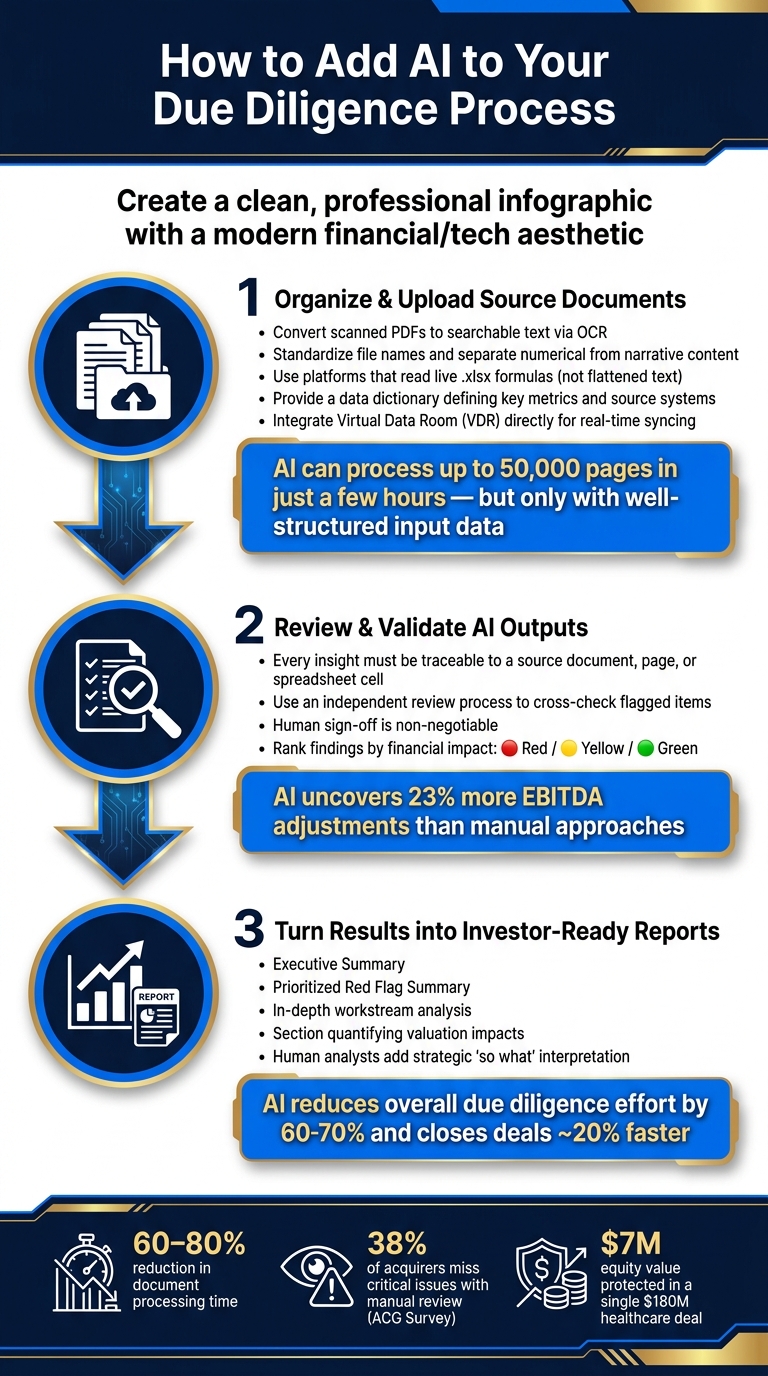
How AI Powers Financial Due Diligence: 3-Step Process & Key Stats
Understanding what AI can do is one thing, but weaving it into your due diligence process is a whole different challenge. Luckily, it boils down to three main steps that build upon each other.
Organizing and Uploading Source Documents
Before AI can work its magic, your documents need to be properly prepared. This means converting scanned PDFs into searchable text using OCR, standardizing file names, and separating numerical data from narrative content. For spreadsheets, opt for platforms that can analyze live .xlsx formulas instead of flattening them into static text. As Don Muir, CEO & Co-Founder of F2, explains:
"A platform that treats Excel as text loses the formula layer entirely, which breaks every downstream calculation."
To make inputs cleaner and reduce errors, provide a data dictionary that defines key metrics, time frames, and source systems. If you're using a Virtual Data Room (VDR), integrate it directly with your AI platform to ensure real-time syncing of new documents, avoiding manual uploads. Properly organized documents are essential for accurate analysis. Modern AI tools can process up to 50,000 pages in just a few hours, but only if the input data is well-structured.
Reviewing and Validating AI Outputs
Once your documents are prepped, the next step is ensuring that AI outputs are thoroughly reviewed. AI can accelerate analysis, but it doesn’t replace human judgment. Every insight must be traceable to its source - whether it’s a document, a specific page, or a cell in a spreadsheet.
Adopt an independent review process where a reviewer validates AI findings by cross-checking source records and exploring alternative explanations for flagged items. Human sign-off is non-negotiable. Andrew Gazdecki, CEO of Acquire.com, emphasizes:
"The goal is not to hand decisions to an algorithm. It is to give buyers better signal, faster, so they can focus their expertise where it matters most."
For efficiency, configure your AI to rank findings by their financial impact - Red, Yellow, or Green - so your team can zero in on issues that truly affect valuation.
Turning Results into Investor-Ready Reports
After validating the findings, the final step is transforming them into polished, investor-ready reports. AI can draft these reports much faster than traditional methods. A comprehensive report should include an Executive Summary, a prioritized Red Flag Summary, in-depth workstream analysis, and a section quantifying valuation impacts.
While AI excels at identifying patterns and extracting data, it’s up to humans to interpret the results and provide strategic insights. This is where the so what comes in - recommendations and implications that add real value to the report. By automating routine tasks, your team can focus on delivering meaningful analysis, setting the stage for investor-ready financials.
Getting Your Financials Ready for AI-Powered Due Diligence
AI tools thrive on organized, up-to-date financial records. Without them, even the most advanced systems can struggle to provide accurate insights. Shayan Ashtiani, Solutions Architect at Cube, explains it well:
"The financial due diligence process is the deep dive that uncovers financial risks, validates financial health, and prevents unwanted surprises."
This makes maintaining accurate and thorough financial records a non-negotiable step before leveraging AI for due diligence.
Keeping Clean and Up-to-Date Books
Messy or outdated records can significantly slow down due diligence. The process itself can take anywhere from 45 to 180 days, depending on the complexity of the business - and missing or incomplete documents are one of the biggest culprits behind delays. To ensure smooth sailing, you'll need the essentials: three to five years of core financial statements, current tax filings, a clean cap table, documented accounting policies, and any active contracts or loan agreements.
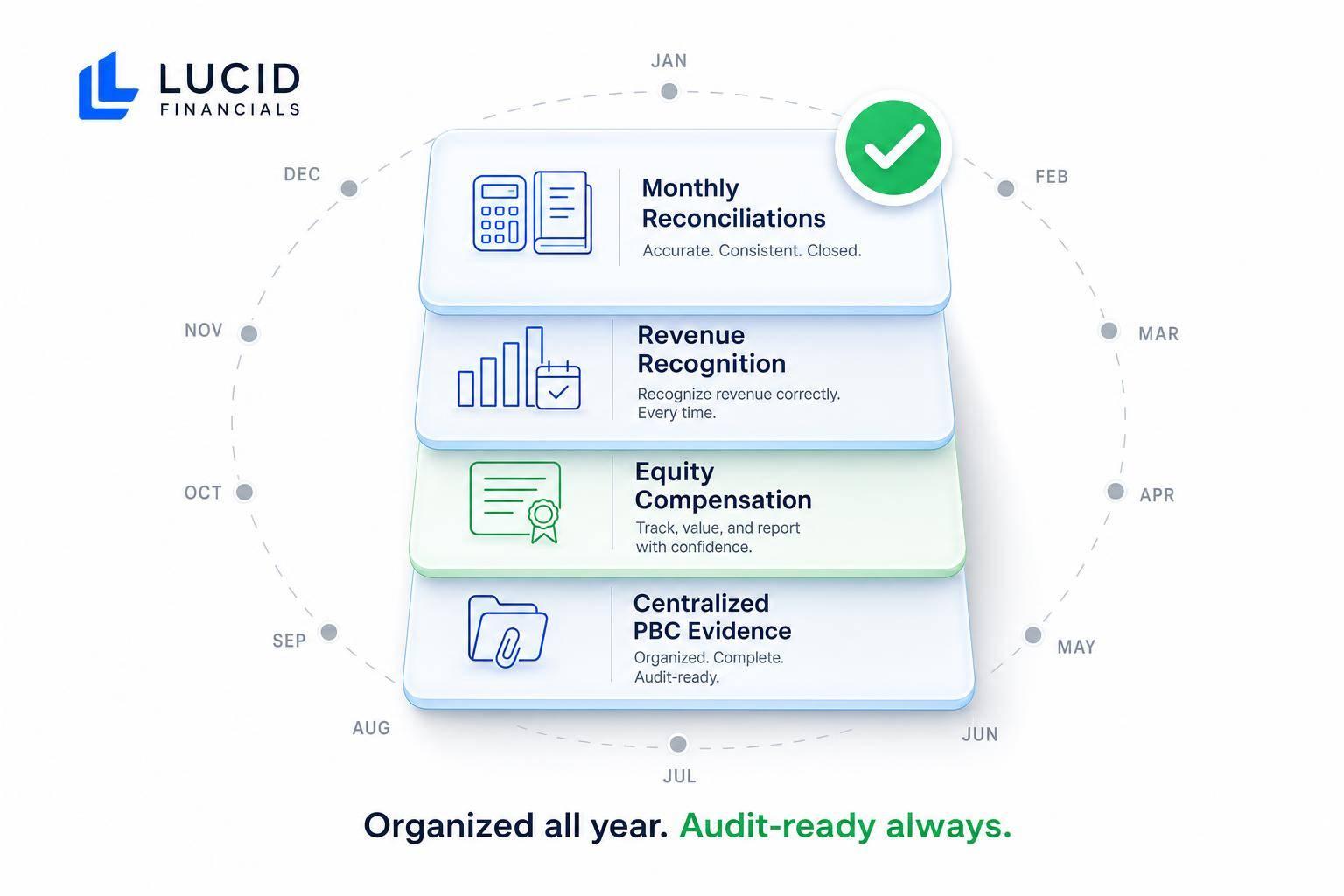
Consistency is key. For example, aligning your revenue recognition policies with GAAP standards prevents AI systems from flagging unnecessary anomalies, ensuring accurate benchmarking results. A proactive approach - such as cross-checking your records with bank statements and tax filings - can help you identify and address gaps early on. Keeping your financials well-organized not only streamlines the due diligence process but also ensures you get the most out of AI-driven tools. Regular maintenance of your financial records lays the foundation for platforms like Lucid Financials to produce investor-ready results at a moment’s notice.
How Lucid Financials Keeps You Diligence-Ready

Being prepared for due diligence isn’t a one-time effort - it’s an ongoing commitment. Lucid Financials simplifies this by offering a comprehensive, AI-powered solution tailored for startups. Combining bookkeeping, tax management, and CFO-level support into one platform, Lucid ensures your financials stay current and organized.
Lucid promises clean books within seven days and can generate investor-ready reports on demand. Whether you're preparing for a potential investor meeting or an acquisition, your financial reports will always be ready. With real-time AI insights and Slack integration, Lucid provides instant updates on essential financial metrics like runway, spending, and overall performance. This continuous clarity ensures AI-powered due diligence isn’t just theoretical - it becomes practical and seamless.
Conclusion: Using AI to Do Due Diligence Better
AI is transforming the way financial due diligence is conducted. By drastically cutting processing time and reducing overall due diligence efforts by 60–70%, it has reshaped how deals are executed, while uncovering meaningful EBITDA adjustments along the way.
But it’s not just about speed - AI delivers deeper insights, too. An ACG Survey revealed that 38% of U.S. acquirers found critical financial issues post-close that had been missed during manual reviews. Unlike traditional sampling methods, AI performs full-population analyses, ensuring every document and anomaly is evaluated. This combination of speed and thoroughness gives AI its edge.
Still, AI isn’t a standalone solution - it works best as a tool to amplify human expertise. The most effective teams use AI to sift through massive data sets and identify risks, leaving the nuanced decision-making to skilled professionals. For startups, this approach is a game-changer, enabling small teams to handle complex tasks without needing a full finance department.
To fully capitalize on these benefits, maintaining clean and up-to-date financial records is essential. AI's effectiveness in due diligence depends on the quality of the data it analyzes. Services like Lucid Financials ensure your financials are accurate, investor-ready, and updated in real time - providing the solid foundation AI needs to deliver actionable insights when due diligence begins.
FAQs
What data should I prepare before using AI for financial due diligence?
To make the most of AI in financial due diligence, start by organizing your data in a structured, digital format. Collect key financial statements, such as income statements, balance sheets, and cash flow statements, covering the past 3–5 years. Break this data down by both month and year for added clarity.
Additionally, include a capitalization table, financial projections, and any operational or legal documents (like contracts and tax filings). Tools like Lucid Financials can simplify this process by integrating your accounts via API. This ensures your records are clean, centralized, and ready for precise analysis and investor-focused reporting.
How can I verify AI findings are accurate and source-cited?
When working with AI findings, it's critical to connect them directly to source documents, specifying exact pages and paragraphs. Think of AI output as a starting point, not the final answer. Always manually verify any anomalies by cross-checking them with financial records and the general ledger. This process allows human judgment to confirm AI-generated insights, ensuring reports are reliable and backed by solid evidence.
Which financial risks does AI catch that teams often miss?
AI has a knack for spotting financial risks that might slip through the cracks during manual reviews. By analyzing massive datasets, it can detect anomalies, inconsistencies, and patterns that stand out. For instance, it can flag issues such as irregularities in revenue recognition, duplicate transactions, or one-off expenses that might raise red flags.
Beyond that, AI shines a light on documentation gaps - like missing signatures on agreements - and structural risks, such as an over-reliance on a few key customers. It can even catch sudden spikes in burn rates that might signal trouble. By continuously monitoring data, AI offers early warnings about potential compliance problems or financial instability, giving businesses the chance to address risks before they escalate.