I use AI to help prepare board reports - not to approve the numbers. My approach: check source data, focus on essential board KPIs, and require human review before sharing the report.
More than 62% of directors in NACD’s 2025 public-company board survey said their boards set aside time for AI discussions. That shows attention, not proof of better reporting.
Here’s what I focus on:
- Preparation: Collect data, check matches, and flag differences across entities.
- Board decisions: Draft source-linked explanations and keep actuals, forecasts, and scenarios separate.
- Controls: Protect sensitive data and retain sources, assumptions, versions, and approvals.
- Outside support: Check provider claims, review duties, and service scope.
- Results: Measure preparation time, errors, and corrections - not just adoption.
My rule is simple: <u>AI can help with the work; people keep responsibility.</u> Management owns the numbers, and directors own the decisions.
The AI-Powered CEO Dashboard: Lead the Whole Business in 20 Minutes a Week
sbb-itb-17e8ec9
Automating Data Collection and Checks
Use integrations, APIs, or scheduled exports to collect ledger transactions, payables, receivables, bank activity, payroll, budgets, CRM data, and operational metrics. When direct connections aren’t available, use RPA for repeatable downloads. Record who owns each source system, how often data updates, which fields are permitted, and transfer logs. AI adds classification suggestions, anomaly detection, and draft analysis.
A study of 320 accounting and finance professionals found that integration and data quality drove gains in real-time reporting, with integration acting as the strongest mediator. Another study linked RPA to timeliness (β = 0.361) and accuracy (β = 0.334). These associations don’t prove causation, and the coefficients aren’t percentage gains.
The distinction matters: integration and data quality drive reporting gains. AI speeds up matching, exception handling, and drafting.
Standardizing Data Across Locations and Entities
Use approved account mappings, department and location codes, fiscal periods, currency rules, and accounting policies. Matching identifiers for intercompany customers, vendors, loans, and transactions help automate eliminations. Keep mapping changes under version control and send unmapped items for review.
Accountants still decide classifications, policy treatment, and whether balances qualify for elimination. For operational feeds, favor aggregated utilization, cancellations, collections, and revenue by location rather than unnecessary individual-level records.
Manual vs. AI-Assisted Reporting
The table shows where AI-assisted checks reduce manual work - and where review is still required.
| Reporting step | Manual process | AI-assisted process | Required review control |
|---|---|---|---|
| Source collection | Staff download files, request schedules, and rekey data. | APIs, integrations, or RPA retrieve files and log transfers. | Confirm source completeness, access permissions, timestamps, and failed feeds. |
| Reconciliation | Staff compare ledgers, bank data, payroll, subledgers, and the general ledger. | Matching rules and AI-assisted tools identify probable matches and route exceptions. | Review exceptions, investigate differences, and approve reconciliations. |
| Variance analysis | Analysts calculate changes and look for explanations. | AI calculates variances, identifies patterns, and suggests drivers. | Validate calculations, benchmarks, materiality, and business explanations. |
| Narrative drafting | Analysts write commentary from reviewed schedules. | AI drafts commentary using approved figures and source references. | Confirm accuracy, context, tone, confidentiality, and board relevance. |
| Approval | Controllers and executives review the completed package. | Workflow tools route reports for approval and retain evidence trails. | Retain signoffs, version history, assumptions, and final distribution approval. |
Before drafting board commentary, run completeness, validity, duplicate-record, reconciliation, and reasonableness checks. Each alert should show the supporting record and the rule or pattern that triggered it. An alert flags an exception; it doesn’t prove an error. Record the reviewer’s decision and any correction.
To measure results, compare data-collection hours, days from period-end to board-package completion, the number and age of unresolved exceptions, and approval-cycle time before and after implementation. Track integration gains separately from gains in AI-assisted analysis and drafting.
Tailoring Reports to Board Decisions
Once data is validated, AI can present the same numbers for different board decisions: business results for directors, drill-down detail for finance leaders, and day-to-day context for management. Customize the view, not the data. Location and entity filters let users dig deeper without changing KPI definitions or consolidated totals. A KPMG survey of 1,800 financial-reporting leaders across 10 countries found broad AI experimentation, along with barriers such as data security, privacy, skills, uncertain return on investment, and integration difficulty.
Defining Board KPIs
Keep the main board view to five to 10 critical measures. Focus on revenue growth, cash and runway, operating margin, expenses, collections, receivables aging, and forecast variance. Add a metric only when it supports a specific board decision. Record each KPI’s definition, source, owner, frequency, target, threshold, scope, and purpose in a finance-approved dictionary. Shared definitions keep every board narrative tied to the same numbers.
Explaining Trends and Variances
After reconciliations and controls are complete, AI can draft variance explanations using the approved KPI set. It can compare actuals with prior periods, budgets, forecasts, and approved drivers, tying each statement to source records.
Reviewers should check calculations, missing evidence, period consistency, and unsupported claims. Correlation does not prove causation. Label possible drivers as hypotheses and disclose missing data. Finance guidance calls for transparency, governance, and the ability for leaders to adjust or override AI outputs.
Historical Reports, Forecasts, and Scenarios
Keep actuals, forecasts, and scenarios clearly separate. Forward-looking reports should pair a rolling forecast with explicit assumptions, a base case, and at least one downside or stress case - not a single forecast that looks more precise than it is.
| Reporting type | Purpose | Inputs | Outputs | Governance requirements |
|---|---|---|---|---|
| Historical | Explain what happened and establish an auditable baseline | Closed-period ledger, billing, payroll, scheduling, bank, and operations data | Actual revenue, cash, margin, expenses, collections, aging, and variances | Reconciliations, period close controls, source citations, consistent definitions, and approval |
| Predictive | Estimate likely future results under expected conditions | Historical trends, current bookings, claims, staffing plans, payer behavior, seasonality, and approved assumptions | Revenue, cash balance, runway, margin, staffing needs, and forecast ranges | Versioned assumptions, back-testing, forecast-error monitoring, confidence ranges, and management review |
| Scenario | Compare possible actions and risks rather than predict one outcome | Baseline forecast plus changes in hiring, demand, reimbursement, wages, financing, or capital spending | Cash-flow paths, break-even timing, liquidity needs, and decision tradeoffs | Clearly labeled hypothetical status, sensitivity analysis, approval of assumptions, and director oversight |
Checks Before Board Distribution
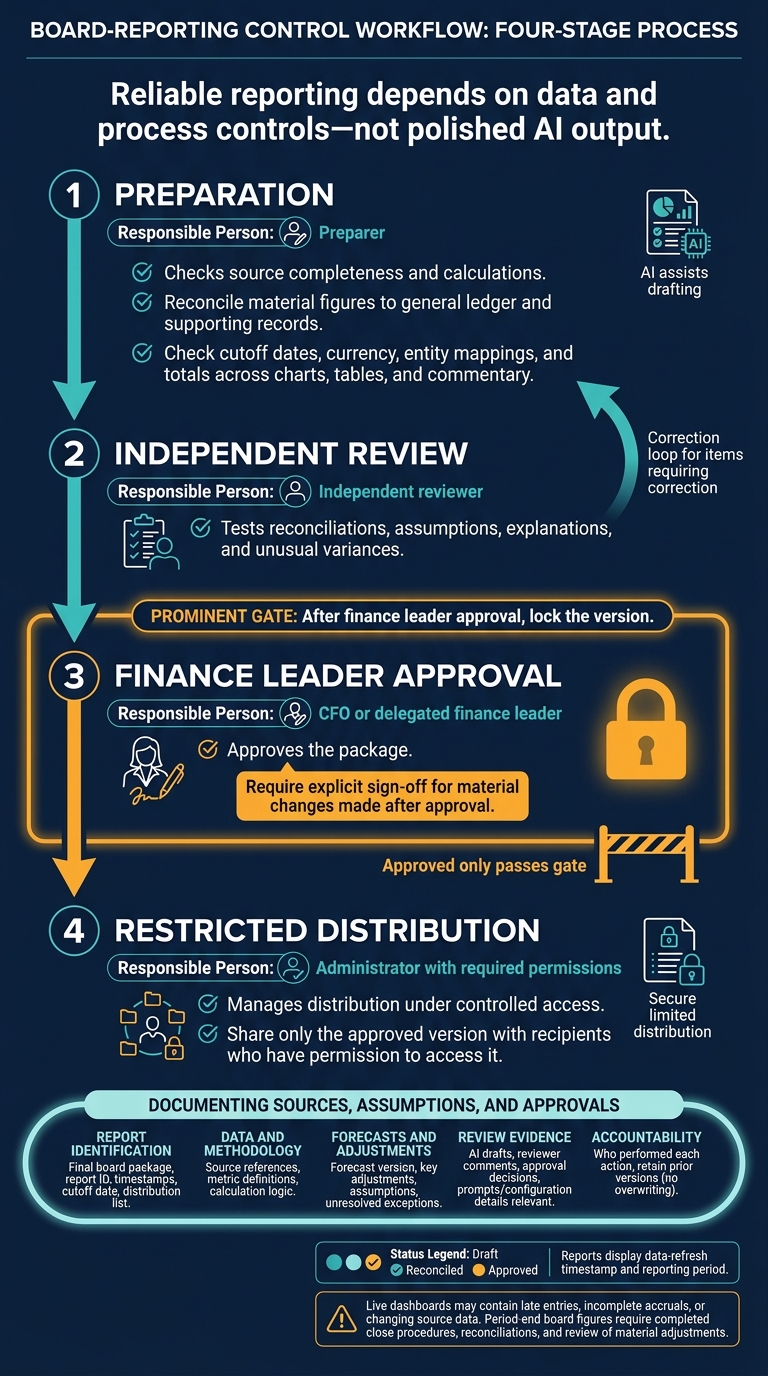
AI Board Reporting: Four Stages of Human Oversight
After AI prepares the board package, run a final control check before sharing it. Reliable reporting depends on data and process controls - not polished AI output. Reconcile material figures to the general ledger and supporting records. Then check cutoff dates, currency, entity mappings, and totals across charts, tables, and commentary.
Reporting Risks and Controls
Use preventive controls to reduce errors and detective controls to catch errors that slip through.
| Risk | Reporting impact | Preventive control | Detective control |
|---|---|---|---|
| Unreconciled inputs | Incorrect board figures or mismatched totals at distribution | Require completed reconciliations and consistent cutoffs | Compare final figures with the general ledger and supporting schedules |
| Hallucinated explanations | Unsupported variance explanations reach directors | Require citations for every material explanation | Finance leaders check material explanations against cited sources |
| Biased outputs | Board comparisons misrepresent entities or segments | Use consistent metrics and documented inclusion rules | Review segment comparisons for unexplained differences |
| Model drift | Outdated analysis reaches the board after data or model changes | Require change approval, version control, and revalidation | Check error rates and reconciliation failures against thresholds |
| Confidential-data exposure | Sensitive information reaches recipients without permission | Apply role-based access, encryption, data minimization, and retention limits | Review access logs, exports, sharing permissions, and security alerts |
| Overreliance on AI | Incorrect output reaches directors without adequate challenge | Assign named reviewers and require sign-off and escalation | Conduct post-distribution reviews and periodic control testing |
Set separate permissions for data ingestion, report preparation, review, approval, board distribution, and administration. Use multifactor authentication and promptly remove former employees’ access. If reports contain protected health information, apply HIPAA’s minimum-necessary access requirements where applicable and complete a business associate agreement when required. Check permitted uses, safeguards, and third-party obligations. Don’t assume the vendor meets these requirements.
Keep an evidence trail showing how the controls were applied.
Documenting Sources, Assumptions, and Approvals
Retain the final board package alongside its report ID, timestamps, source references, cutoff date, metric definitions, calculation logic, forecast version, key adjustments and assumptions, unresolved exceptions, AI drafts, reviewer comments, approval decisions, and distribution list. Preserve prompts or configuration details when relevant. The audit trail should show who performed each action and retain prior versions instead of overwriting them.
Document a four-stage workflow: preparation, independent review, finance leader approval, and restricted distribution. The preparer checks source completeness and calculations. An independent reviewer tests reconciliations, assumptions, explanations, and unusual variances. The CFO or delegated finance leader approves the package, and an administrator with the required permissions manages distribution. Require explicit sign-off for material changes made after approval.
After finance leader approval, lock the version and release it under controlled access. Label reports as draft, reconciled, or approved, and display the data-refresh timestamp and reporting period. Share only the approved version with recipients who have permission to access it. Live dashboards may contain late entries, incomplete accruals, or changing source data. Period-end board figures require completed close procedures, reconciliations, and review of material adjustments.
Using AI-Assisted Accounting Services
Outsourcing part of the finance function doesn’t transfer responsibility for board reporting. Separate the provider’s work from management’s analysis. An AI-assisted accounting provider can prepare the financial section of a board pack, while management remains responsible for operating, strategy, and risk reporting.
Lucid Financials: Vendor-Reported Features
Lucid Financials says it offers AI-supported bookkeeping, tax services, tax credits, forecasting, and CFO support. These are vendor-reported capabilities, not independent research findings. Available evidence does not establish a specific reduction in board-preparation time or improvement in reporting accuracy.
Focus on the board-pack tasks the service covers - not just what it advertises. Before hiring the provider, confirm which entities it supports, how it allocates shared costs, and which consolidation tasks are included.
Lucid states that it offers 24/7 Slack support and Slack-based financial Q&A. Slack access may help you get answers faster during board preparation, but it doesn’t confirm that the figures are reconciled. Ask whether responses identify the reporting period and separate preliminary data from closed-period results.
Also, clarify which work a professional reviews. Transaction classifications, unusual transactions, estimates, tax positions, forecasts, and variance commentary may each call for different expertise. Request sample financial deliverables, a month-end close timetable, details on included CFO hours, and the process for handling exceptions.
Conclusion: Automate Preparation, Keep Human Oversight
The evidence points to a simple model: Automate data handling, not accountability. Use automation to collect data, reconcile figures, check exceptions, and draft commentary based on standardized KPIs and reporting periods. Shape the report around board decisions, and require documented review before distribution.
This model depends on a complete audit trail covering sources, assumptions, versions, reviews, and approvals. Unresolved exceptions should block distribution.
Research links automation to faster, more efficient reporting, but weak oversight can amplify errors. Keep research findings separate from vendor claims and proposed workflows. Measure time savings against a baseline, alongside error rates and corrections made after distribution. Directors should assess both the report’s usefulness for decisions and the quality of its controls. AI speeds preparation; management still owns the numbers, and directors still own the decision.
FAQs
How do I start using AI for board reporting?
Connect your accounting, payroll, and banking systems to one central platform to keep financial data clean and in one place. Then identify 8 to 20 key business drivers, such as burn rate, revenue, and headcount.
Use AI to automate board reporting templates for P&L summaries, cash flow forecasts, and KPI dashboards. Have finance leadership review AI-generated insights before sharing them, and use integrations like Slack to provide real-time access.
When should an AI-flagged exception delay my board report?
Delay your board report if an AI-flagged exception points to a major variance or a data integrity issue that needs explanation or correction before the board receives it.
Set a clear data freeze deadline - for example, noon on Day 6 of the reporting cycle. Treat changes or anomalies found after that deadline as exceptions and investigate them. Review AI flags and add context: real-time data alone isn’t enough to guide board decisions.
How can I measure AI’s reporting ROI?
Measure AI-powered reporting’s return on investment (ROI) by tracking less manual work, faster reporting, and better accuracy. Most organizations reach full ROI within two to three reporting cycles.
Track these key measures:
- Reporting cycle time: A 25% to 40% reduction.
- Data preparation time: Less time spent on a task that often takes up to 75% of finance teams’ time.
- Accuracy: Up to 99%, with fewer manual errors than spreadsheet-based reporting.