AI is transforming financial reporting, saving businesses time and reducing errors. Here's how it works:
- Automated Data Integration: AI connects directly to tools like QuickBooks, Xero, and Stripe, pulling data in real-time and eliminating manual entry.
- Data Validation and Cleaning: AI identifies duplicates, flags anomalies, and ensures accuracy with audit trails.
- Real-Time Metrics Analysis: Key metrics like burn rate, revenue growth, and cash runway are calculated instantly, with insights delivered via natural language queries.
- Visual Reporting: AI creates clear graphs and charts, turning numbers into easy-to-understand visuals tailored for investors.
- Customizable Reports: Generate polished, audience-specific reports that meet compliance standards and adapt to different needs, like fundraising or board meetings.
Switching to AI-driven platforms means faster, more accurate financial reporting, allowing you to focus on scaling your business instead of wrestling with spreadsheets.
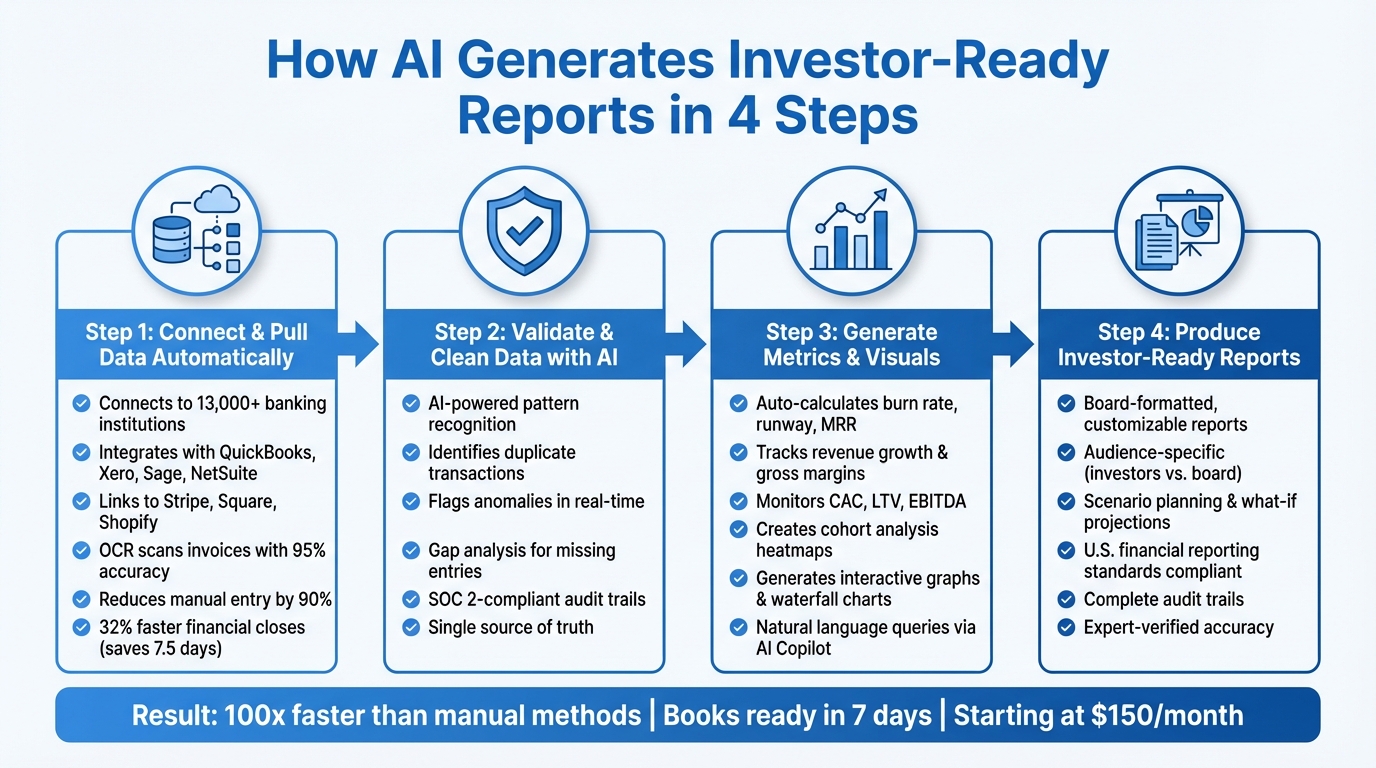
4-Step AI Financial Reporting Process: From Data Integration to Investor-Ready Reports
How to Generate Monthly Financial Reports using AI Agent
sbb-itb-17e8ec9
Step 1: Connecting and Pulling Financial Data Automatically
AI-powered financial reporting starts with smooth and efficient data integration. By leveraging API-first connectivity, these systems eliminate the need for manual downloads, data copying, or re-entry. Instead, they connect directly to key accounting platforms like Oracle NetSuite, QuickBooks, Sage, and Xero, allowing for a unified view of all your financial data.
Integration with Financial Tools
Modern AI platforms go beyond simply linking to accounting software. They connect with over 13,000 global banking institutions, enabling real-time transaction imports instead of waiting for end-of-day batch updates. Payment platforms such as Stripe, Square, and Shopify feed order and revenue data directly into your financial system, while tools like Salesforce and Brex supply customer and spend information. This creates a continuous and automatic flow of financial data from every part of your business.
Additionally, Optical Character Recognition (OCR) technology scans invoices, receipts, and handwritten documents from PDFs or images, extracting data with an accuracy rate of up to 95%.
As Vadivel CMA, Founder of Vadivel & Co, shared, "The Tally integration with AI Accountant has been transformative. What earlier took hours of manual entry now syncs seamlessly in minutes, and the best part is how it connects directly with our dashboards."
This comprehensive data integration not only simplifies reporting but also lays a strong foundation for accurate AI-driven analysis.
Removing Manual Data Entry
The efficiency gains here are game-changing. AI reduces manual data entry by up to 90%, ensuring faster, error-free data collection with a detailed, SOC 2-compliant audit trail. Businesses using AI for financial closes complete the process 32% faster, saving an average of 7.5 days in the monthly close cycle. For busy founders, this time savings is invaluable.
Beyond speed, automation eliminates the transcription errors often associated with manual processes. Every transaction pulled via APIs or processed through OCR leaves behind a detailed audit trail, which is crucial for investor-ready reporting. Daily reconciliation matches bank feeds to your ledger, keeping your data accurate and up to date while preventing bottlenecks.
This seamless integration and error reduction create a reliable, real-time data flow, setting the stage for AI-powered data cleaning and analysis in the next step.
Step 2: Validating, Cleaning, and Analyzing Data with AI
Once data flows into Lucid Financials, the next step is all about making sure it’s accurate, consistent, and ready for investor scrutiny. AI takes the reins here, validating and cleaning records in real time. This process not only ensures data integrity but also catches errors that could otherwise slip through manual reviews - avoiding potential red flags during fundraising.
AI-Powered Data Reconciliation
Lucid Financials uses AI-driven pattern recognition and historical comparisons to tackle common issues like duplicate transactions. For example, it matches transaction IDs, amounts, and dates to identify and merge duplicates or flag them for review. It also conducts gap analysis, comparing actual transactions against expected recurring patterns to spot any missing entries.
By validating data as it comes in, the system quickly identifies anomalies - like an unexpected spike in expenses or a sudden drop in recurring revenue. This eliminates the need for manual CSV uploads or tedious reconciliation spreadsheets. Instead, you get a single, reliable source of truth in real time. No more guesswork, just clean, actionable data.
Once the data is validated, Lucid Financials shifts its focus to analyzing it on the spot.
Real-Time Analysis of Key Metrics
After cleaning, the platform dives into real-time analysis of the metrics that matter most to investors - burn rate, revenue growth, cash runway, and monthly recurring revenue (MRR). Machine learning algorithms uncover trends, such as rising costs or changing revenue drivers, while anomaly detection flags unexpected variances that might need further investigation.
Lucid Financials' AI Copilot takes this a step further by answering natural language queries like, "What’s driving our burn rate?" It delivers detailed insights, complete with confidence indicators, to help you understand the root causes without sifting through complex spreadsheets. Plus, it auto-suggests metrics tailored to your business model, ensuring you’re always tracking the right indicators for your growth stage. This way, your investor reports reflect up-to-the-minute performance, not outdated snapshots.
Step 3: Generating Key Metrics and Visual Insights Automatically
Once your data is validated and analyzed, AI steps in to craft a financial narrative by calculating essential metrics and creating clear visuals - no more tedious manual spreadsheet work.
Key Metrics Investors Care About
Investors expect to see specific metrics that paint a clear picture of your company’s financial health. AI platforms like Lucid Financials calculate these metrics directly from your integrated financial data. These include:
- Revenue growth: Tracks percentage changes over different periods.
- Burn rate: Measures your monthly cash outflow.
- Runway: Shows how many months of cash you have left.
- Gross margins: Reflects the profit percentage of your revenue.
Lucid Financials simplifies this process by updating these calculations automatically as transactions are recorded. Beyond these, it also monitors metrics like customer acquisition cost (CAC), lifetime value (LTV), and EBITDA - critical numbers that evolve with your business’s growth. For example, if you ask the AI Copilot in Slack, “What’s our current runway?” you’ll get an immediate response, complete with confidence indicators, so you’re never left guessing.
The platform also supports scenario planning, allowing you to explore projections. Want to know how hiring additional developers would impact your runway? AI uses both historical and real-time data to provide dynamic forecasts, helping you anticipate investor questions and prepare with confidence.
Once you’ve got these key numbers, the next step is to turn them into visuals that communicate your story effectively.
Turning Financial Data into Visuals with AI
Numbers alone rarely tell the full story. Investors need to see trends, patterns, and context - quickly and clearly. That’s where AI-driven visuals come into play.
Lucid Financials doesn’t just calculate metrics; it transforms them into intuitive visuals tailored to your business model. Whether it’s cohort analysis heatmaps to showcase retention or funnel charts for CAC and LTV, the platform provides industry-specific visualizations that make your data easy to understand.
It also generates interactive visuals like line graphs for revenue trends or waterfall charts for profitability, while annotating anomalies for quick reference. These visuals are accessible through Slack or can be included in board-ready reports, ensuring you’re always prepared. By turning raw data into a narrative investors can follow without needing a finance background, AI helps you communicate your financial story in a way that truly resonates.
Step 4: Producing Investor-Ready, Board-Formatted Reports
Once your metrics are calculated and visuals are polished, the final step is turning all that data into a professional, ready-to-present narrative. This is where AI steps in to transform raw numbers and visuals into a refined, investor-focused report. It handles everything from formatting to compliance checks and even allows for customization.
Customizable, Investor-Focused Reports
After your data has been integrated and cleaned, the next priority is tailoring the report to suit different audiences. Investors and board members often have very distinct needs. For instance, a potential investor might want a detailed breakdown of unit economics and cash flow projections, while board members may prefer concise executive summaries that focus on high-level KPIs and strategic insights. AI platforms can automatically adjust reports to meet these varying expectations.
With Lucid Financials, you get board-ready, customizable reports designed specifically for your target audience. For a Series A pitch, the platform emphasizes essential financial metrics like revenue growth. Preparing for a quarterly board meeting? It generates executive summaries featuring key performance indicators, runway calculations, and variance analysis - all formatted to look polished and professional. You can even tweak the fonts, colors, and design elements to align with your brand’s identity, ensuring every report feels intentional and cohesive.
The platform doesn’t stop there. It also supports scenario planning within your reports. For example, if you’re discussing expansion plans or hiring strategies, Lucid can include what-if projections that illustrate how different decisions might affect your runway and burn rate. These dynamic forecasts help you anticipate and address investor questions, showing that you’ve carefully considered various outcomes.
Accuracy and Compliance
Having a visually appealing report is important, but accuracy and compliance are non-negotiable. Investor reports must not only look professional but also be backed by reliable and defensible data. AI ensures every figure can be traced back to verified sources, with built-in safeguards to catch errors and inconsistencies.
Lucid Financials provides audit trails for every transaction and calculation, making it easy to explain the origin of any number. The platform adheres to U.S. financial reporting standards, including proper formatting for currency (like $), dates (MM/DD/YYYY), and number formats (using commas for thousands). On top of that, it offers enterprise-grade security features such as SOC 2 compliance and GDPR adherence, ensuring your data stays protected.
To top it off, Lucid combines AI automation with reviews by experienced finance professionals. Every report is audited for accuracy before it’s finalized, giving you confidence that your data is reliable and presentation-ready.
How Lucid Financials Delivers Always-On Investor-Ready Reporting

Lucid Financials provides an all-in-one platform designed to simplify financial management and deliver investor-ready reporting, combining automation, real-time analytics, and expert oversight.
Integrated Full-Stack Financial Management
Lucid Financials brings together bookkeeping, tax services, tax credits, and CFO-level forecasting into a single, intelligent platform. Instead of juggling multiple vendors, you have everything you need in one place. The platform extends its capabilities to handle tax services, equity compensation, and other financial complexities, ensuring a seamless experience. To guarantee accuracy, experienced finance professionals verify all outputs, blending the speed of automation with the reliability of expert oversight.
Lucid also takes on intricate tax scenarios like equity compensation, R&D tax credits, and multi-entity structures. By identifying tax-saving opportunities early, it eliminates the last-minute scramble during filing season. This comprehensive approach not only simplifies bookkeeping but also transforms financial data into clear, visual narratives. The result? Instant, actionable insights that set the stage for smarter decision-making.
Real-Time Insights and Slack-Based Support

Lucid integrates directly with Slack, turning your workspace into a real-time financial hub. Need to check your burn rate or runway before a meeting? Simply ask in Slack, and the AI will provide instant answers. For more complex needs, Lucid's team of financial experts is just a message away - no waiting around for emails or scheduling calls.
"Lucid has made it incredibly easy to track spending, plan ahead, and handle our growth. It's straightforward and effective." - Aviv Farhi, Founder and CEO @Showcase
The platform also enables instant what-if scenario modeling, allowing you to evaluate best-case and worst-case outcomes before making critical decisions like hiring or expanding. This level of visibility ensures you're always prepared to address investor questions or boardroom discussions without the hassle of manual spreadsheets.
Fast, Accurate, and Always Investor-Ready
Lucid ensures your books are clean and ready in just seven days. The platform automates data integration and reconciliation, while finance professionals verify compliance with U.S. accounting standards. Once set up, Lucid maintains continuous investor-ready reporting, keeping your financials up-to-date for fundraising rounds, board meetings, or any other critical moments. The result is a steady flow of polished, compliant reports tailored to investor needs.
"As our company grows, budgeting and cash flow management have become crucial. The features provided are essential and have greatly streamlined these processes for us." - Luka Mutinda, Founder and CEO @Dukapaq
With pricing starting at $150/month, Lucid offers transparent, flat-rate plans - no hourly fees or hidden costs. Backed by AI, it makes financial tasks 100x faster than traditional manual methods.
Conclusion
AI is reshaping how startups and growing businesses approach financial reporting. By automating tasks like data integration, reconciliation, and formatting, it speeds up decision-making, minimizes errors, and ensures you always have investor-ready financials at your fingertips.
Switching from manual processes to AI-driven solutions allows teams to focus on growth rather than wrestling with data. Features like real-time data validation, automated reconciliation, and instant visual reports take the stress out of preparing for board meetings or fundraising discussions. When investors ask about critical metrics - burn rate, runway, or unit economics - you’ll have accurate, audit-ready answers backed by reliable data. This shift not only improves day-to-day efficiency but also strengthens the foundation for strategic decisions.
Lucid Financials simplifies this transition, offering clean books in just seven days, real-time Slack support, and flat-rate pricing starting at $150/month. It’s a solution designed to grow with your business.
AI has already revolutionized financial reporting. The real question is: are you ready to leave outdated manual processes behind and embrace a system that keeps you ahead?
FAQs
How long does setup take?
Setting up AI-powered investor reporting platforms, such as Lucid Financials, usually takes around seven days. This timeframe allows for ensuring your financial records are precise, free of errors, and fully prepared for investor review.
How does AI prevent reporting mistakes?
AI takes the guesswork out of reporting by automating key processes like data collection, analysis, and validation. This reduces the chances of human error and ensures greater precision. It can flag unusual patterns or anomalies instantly, helping businesses catch issues early. Plus, AI ensures compliance with standards such as GAAP and IFRS while continuously monitoring transactions for discrepancies. The result? Faster reporting, real-time insights, and a lower risk of missed details.
Will investors trust AI-generated numbers?
Investors are showing growing confidence in AI-generated numbers, largely because of their precision and clarity. AI minimizes errors, automates compliance reviews, and offers real-time updates alongside anomaly detection, which strengthens trust. On top of that, tools like visual storytelling, tailored templates, and live dashboards simplify complex data, making it easier to understand. Combined with expert oversight and rigorous validation processes, AI-powered reports are crafted to meet investor needs and maintain reliability.