
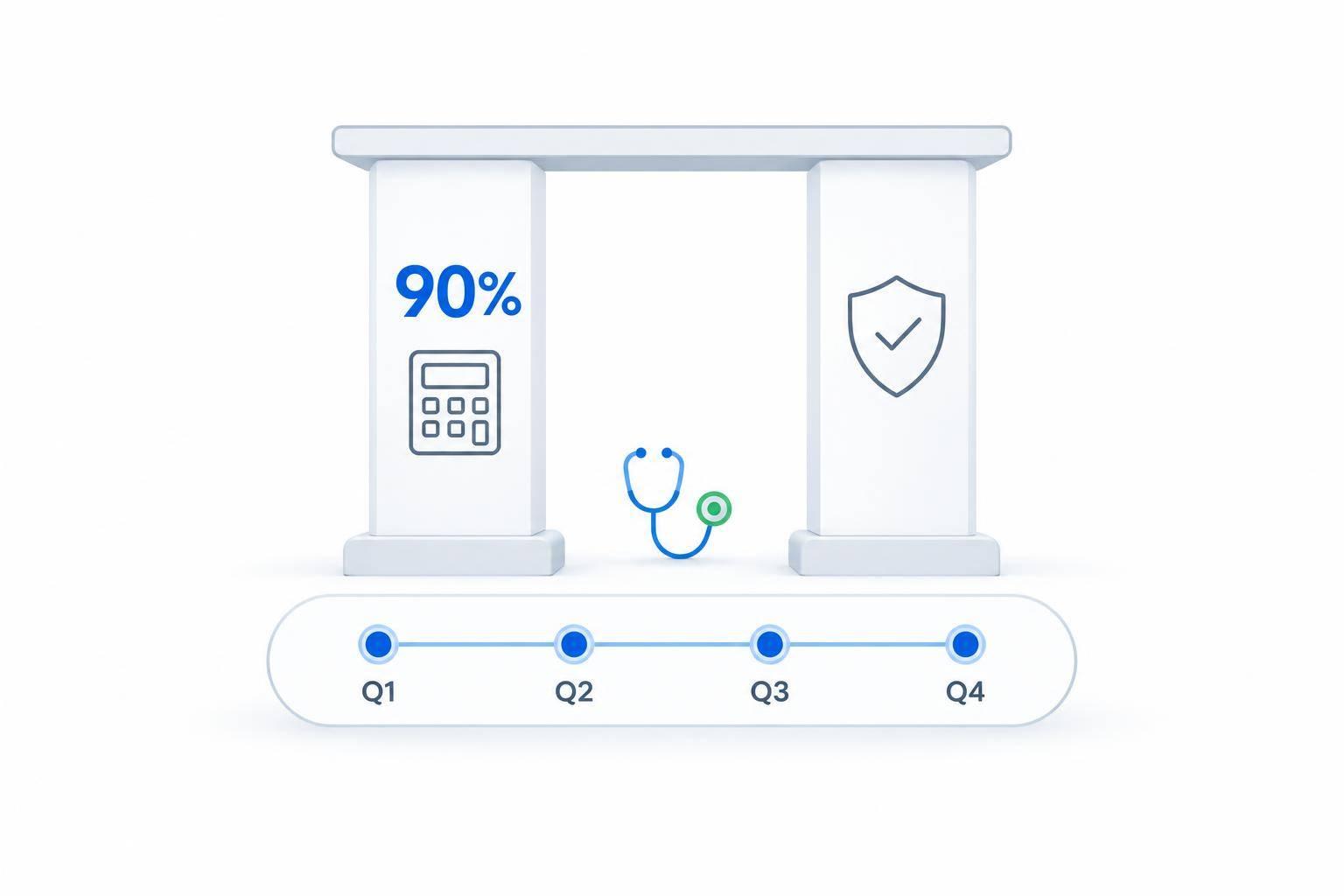
My starting point: a tax safe harbor can prevent an underpayment penalty - not reduce your tax bill. For 2026, I’d compare 90% of this year’s tax with 100% of 2025 tax, or 110% if your 2025 AGI exceeded $150,000 ($75,000 if married filing separately). The smaller applicable amount generally sets your annual payment target.
Then I’d check three things:
- Timing: Payments must cover each installment on time. The final 2026 installment is due January 15, 2027; a late estimated payment won’t erase earlier shortfalls.
- Income and withholding: Uneven practice income may call for annualized installments. Extra year-end withholding may also help because withholding is generally treated as paid evenly throughout the year.
- Cash reserves: I’d forecast practice and household income, subtract payments and credits, and set aside the expected balance due - separate from practice payroll-tax funds.
<u>My next step this November:</u> have a CPA check the forecast, payment history, and remaining withholding before year-end.
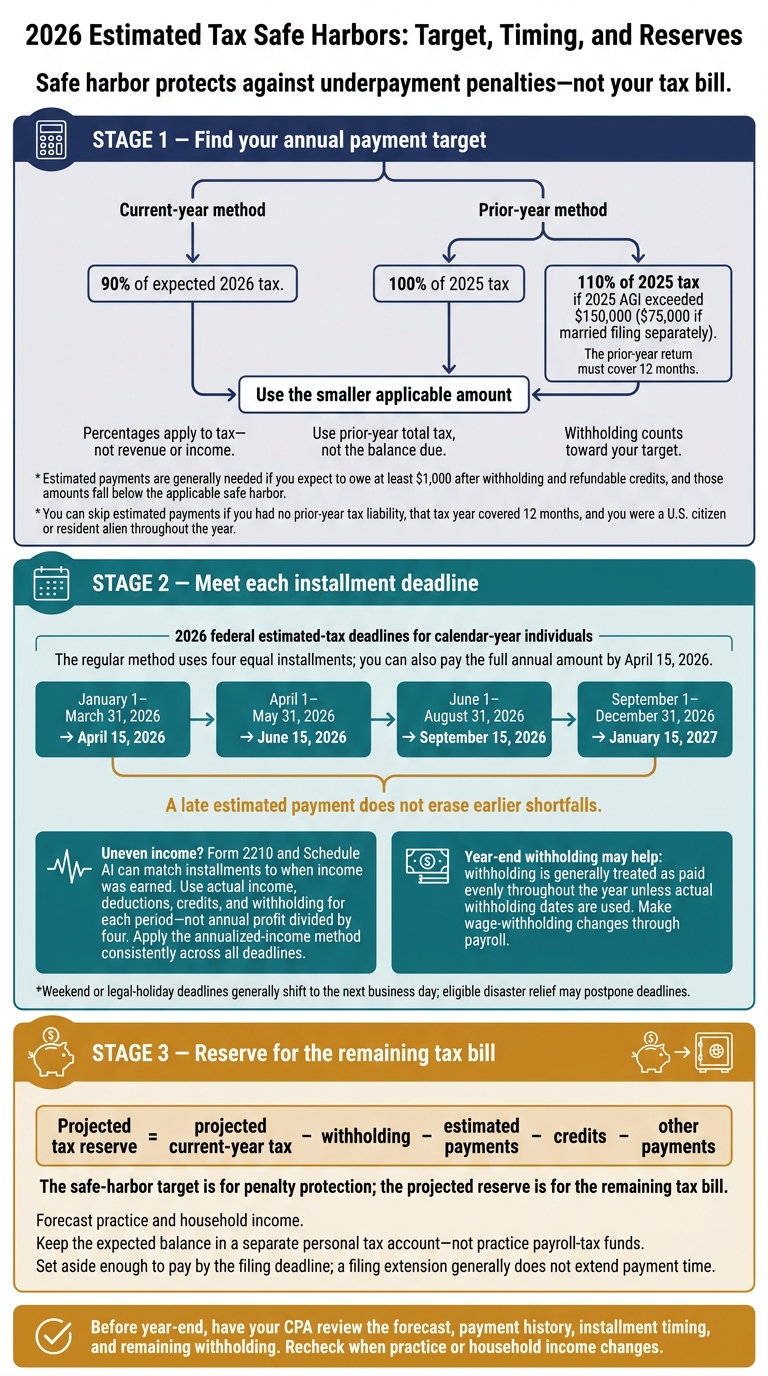
2026 Estimated Tax Safe Harbors: Target, Timing, and Reserves
The Safe Harbor Rule Explained
sbb-itb-17e8ec9
Federal Estimated Tax Rules and Safe Harbors
Estimated payments cover federal taxes that withholding doesn’t pay. For practice owners, these can include income tax, self-employment tax, alternative minimum tax, and other Form 1040 taxes. Use the 2026 Form 1040-ES instructions to calculate your required payment, account for credits and exceptions, and find your safe-harbor target for penalty protection. Then check when those payments are due.
When the $1,000 Payment Threshold Applies
You generally need estimated payments if you expect to owe at least $1,000 after withholding and refundable credits, and those payments and credits fall below the applicable safe harbor. You can skip estimated payments if you had no prior-year tax liability, that tax year covered 12 months, and you were a U.S. citizen or resident alien throughout the year.
Count pass-through profits, sole-proprietor earnings, spouse income, retirement income, and taxable investment or sale gains. Distributions don’t determine tax: allocated profit can be taxable even if the cash stays in the practice. Distributions, meanwhile, may be tax-free to the extent of your basis.
How the 90%, 100%, and 110% Safe Harbors Work
Your required annual payment is generally the smaller of 90% of current-year tax or the applicable prior-year amount shown below. These percentages apply to tax - not revenue or income. Withholding counts toward your target. When using the prior-year rule, look at last year’s total tax, not the balance due after payments and credits.
Choose the rule that fits your income pattern and prior-year tax.
| Basis | Calculation and eligibility | Advantage | Limitation |
|---|---|---|---|
| Current year | 90% of expected current-year tax | May lower required payments when income falls | Requires an accurate forecast |
| Standard prior year | 100% of 2025 tax; prior return covers 12 months and the higher-income rule does not apply | Uses a known tax amount | May leave a large balance when income rises |
| Higher-income prior year | 110% of 2025 tax when 2025 AGI exceeded $150,000, or $75,000 if married filing separately; prior return covers 12 months | Provides a known target even when income changes | Requires more than the standard prior-year amount |
Personal Income Taxes vs. Practice Payroll Taxes
Use the right payment channel for each tax obligation. S corporation distributions don’t replace reasonable wages, and pass-through profits generally remain taxable even without a distribution. Sole-proprietor and partnership earnings may also trigger self-employment tax.
| Income or obligation | Payment mechanism | Does individual Form 1040-ES apply? |
|---|---|---|
| S corporation wages | Payroll income-tax withholding | For remaining individual liability; withholding reduces estimates |
| S corporation profits and distributions | Individual withholding or estimates based on taxable income | Generally yes if withholding is insufficient; distributions are not the tax base |
| Partnership or sole-proprietor earnings | Individual estimates or withholding elsewhere | Generally yes, including applicable self-employment tax |
| Payroll withholding and employer employment taxes | Practice payroll deposits and employment-tax filings | No; these are separate employer obligations |
| C corporation income tax | Corporate estimated payments | No; separate from the owner’s individual tax |
Next, map these targets to the 2026 payment dates and uneven-income rules.
Payment Timing, Uneven Income, and Withholding
Once you know your annual target, schedule each installment for the IRS due dates to keep safe-harbor protection against underpayment penalties. Paying in full at year-end doesn’t fix earlier shortfalls.
2026 Federal Estimated Tax Deadlines
The regular method calls for four equal installments. You can also pay the full annual amount by April 15, 2026. For calendar-year individuals, the standard 2026 deadlines are:
| Income period | Standard payment deadline |
|---|---|
| January 1–March 31, 2026 | April 15, 2026 |
| April 1–May 31, 2026 | June 15, 2026 |
| June 1–August 31, 2026 | September 15, 2026 |
| September 1–December 31, 2026 | January 15, 2027 |
Deadlines that fall on a weekend or legal holiday generally shift to the next business day. Federally declared disaster relief may postpone them further for eligible taxpayers.
If your income varies throughout the year, match your payments to when you earn it.
Annualize Payments When Practice Income Varies
If income spikes late in the year or comes in unevenly, use Form 2210 and Schedule AI to match installments to when you earned the income. Calculate payments using actual income, deductions, credits, and withholding for each period - not annual profit divided by four.
Use the annualized-income method consistently across all deadlines, and follow the filing instructions for Form 2210 and Schedule AI. If a payment is late, pay it right away. That stops further penalty accrual on the amount paid, but it doesn’t erase the earlier underpayment.
Coordinate Owner and Household Tax Withholding
You can cover estimated-tax shortfalls through federal withholding from owner wages, a spouse’s wages, retirement distributions, or other household income. The IRS generally treats withholding as paid evenly throughout the year unless actual withholding dates are used. That means a year-end withholding increase can work better than a late estimated payment.
Make wage-withholding changes through payroll, not an informal distribution. The practice’s employer payroll-deposit obligations are separate and must still be met on time. After paying, document the payment so IRS records match your forecast.
Make Payments and Save Confirmations
Pay through IRS Direct Pay, an IRS Individual Online Account, or another approved method listed in Form 1040-ES. Before submitting, check the taxpayer ID, amount, tax year, and payment type. The January 15, 2027 installment is the final estimated-tax payment for 2026.
Save the confirmation number, payment date, amount, and source. Then reconcile those details with IRS records and your tax workpapers.
Forecast the Final Tax Bill and Set Aside Cash
Compare the Safe-Harbor Target With Total Tax
Meeting the safe harbor protects against underpayment penalties. It doesn’t mean your tax bill is paid in full. Higher practice profits, smaller deductions or credits, changes in income allocations, or earnings from another business can leave you owing more.
| Item | Calculation | Purpose | Limitation |
|---|---|---|---|
| Safe-harbor target | Applicable percentage of prior-year or current-year tax, reduced by eligible withholding and estimated payments | Identifies payments needed for penalty protection | Requires timely installments; does not cap total tax |
| Projected tax reserve | Projected current-year tax minus withholding, estimated payments, credits, and other payments | Estimates cash to set aside | Changes as the forecast changes |
| Final balance due | Tax shown on the return minus total payments and credits | Establishes the remaining amount payable | A filing extension generally does not extend payment time |
Set aside enough to pay the projected balance by the filing deadline - even if you extend the return.
Build an Owner Tax Forecast From Practice Books
Use your practice books to move from a safe-harbor target to a tax reserve estimate. Follow accounting workflow best practices to close the books for each entity separately, project full-year profit, and add other household income. Then estimate owner-level tax and reconcile withholding, estimated payments already made, and available credits.
Keep the projected balance in a separate personal tax account, not in cash needed to cover practice obligations. Review the reserve whenever profits, deductions, or household income change.
Support Tax Planning With CPA-Reviewed Books
Lucid Financials provides medical practice owners with CPA-reviewed books and reporting to help guide tax forecasts and cash-reserve planning.
Conclusion: Pay on Time and Reserve for the Balance
Compare your forecast with the safe-harbor target, then finalize your payment plan. If withholding and refundable credits fall short, make estimated payments. The prior-year safe harbor increases to 110% when 2025 AGI exceeded $150,000, or $75,000 if married filing separately.
For calendar-year filers, the final 2026 installment is due January 15, 2027. That payment won’t fix earlier missed installments. Coordinate personal income-tax withholding with estimated payments. Withholding can still help, but timing matters.
Before the final installment, have your CPA review the owner-level projection, installment timing, and withholding - especially if practice income changed during the year. Recheck the plan whenever practice or household income changes. Set aside the expected balance due; safe harbor protects against penalties, not the tax bill.
FAQs
Which safe harbor should I use if my practice profits drop?
If your practice’s profits drop, you can use the estimated tax safe harbor based on last year’s tax. This bases your required estimated payments on your prior-year tax bill, even if this year’s profits are lower.
Safe harbor protection can reduce or prevent underpayment penalties, but you’ll still need to pay any remaining tax you owe.
Can my spouse’s withholding cover taxes from all my businesses?
Generally, no. Each taxpayer and business entity must meet their own tax obligations. Withholding and tax payments generally can’t be shared or swapped across a household.
Keep personal and business finances separate. Work with a licensed tax adviser to review estimated tax requirements based on each taxpayer’s and entity’s income and tax status.
Do federal safe harbors also protect me from state penalties?
No. Federal safe harbors don’t protect you from state tax penalties. Federal and state tax rules work independently. Meeting federal requirements doesn’t automatically mean you’ve met your state obligations.
Check with state or local tax authorities about the requirements and safe harbors that apply to you. Consult your qualified adviser to confirm filing and payment rules wherever your practice operates.