Equity is often misunderstood but plays a critical role in startups. It’s more than just ownership; it’s a tool to attract talent, retain employees, and align everyone with the company’s success. However, most employees don’t fully understand how equity works, leading to confusion, disengagement, and even financial mistakes.
Here’s why equity education is essential:
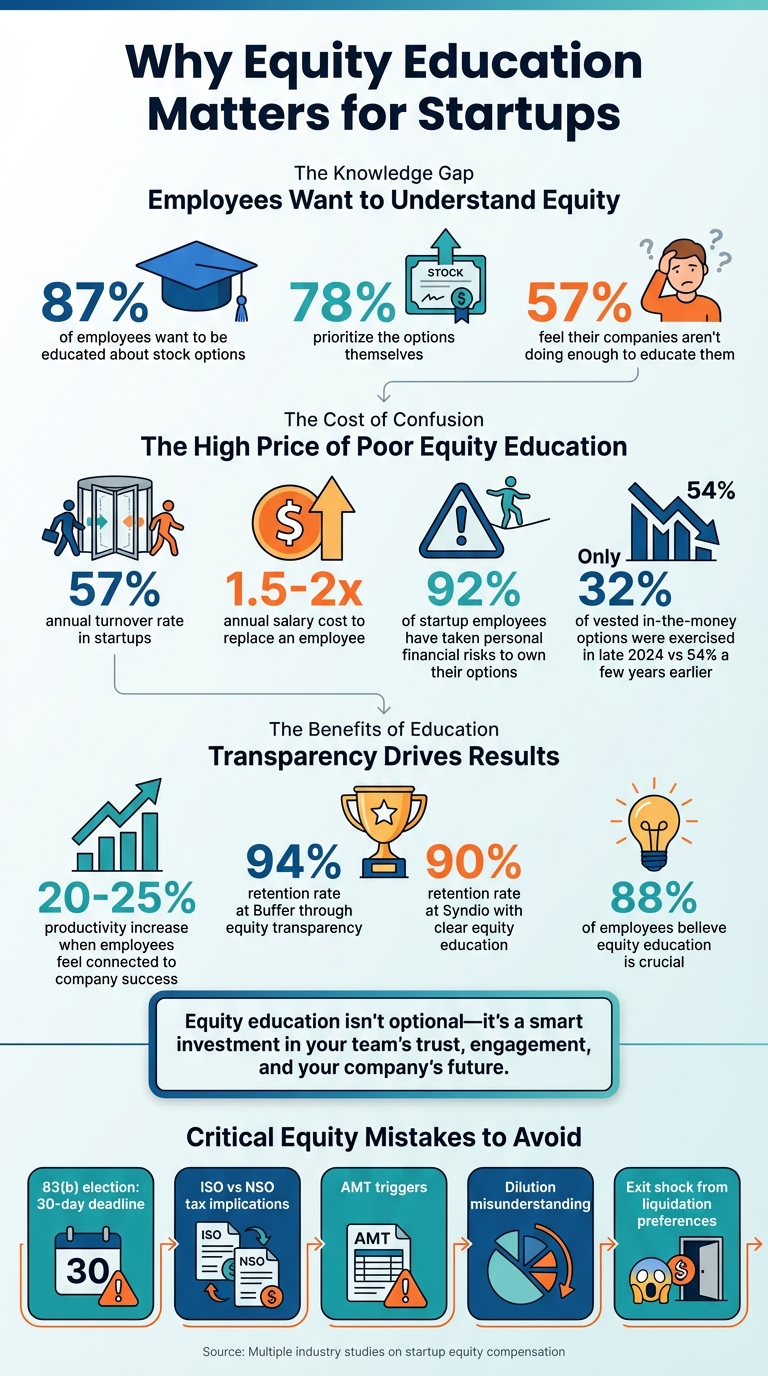
- Employees value education over equity itself: 87% want to understand stock options, while only 78% prioritize the options alone.
- Misunderstandings hurt retention: Poor equity knowledge contributes to a 57% annual turnover rate in startups.
- Financial risks abound: From tax traps like the 83(b) election deadline to dilution, employees often face unexpected challenges.
Clear, ongoing education helps employees see equity as a meaningful benefit, boosting loyalty and productivity. Startups that invest in transparency and tools to explain equity - like onboarding sessions, regular updates, and accessible resources - create stronger, more committed teams.
Takeaway: Equity education isn’t optional. It’s a smart investment in your team’s trust, engagement, and your company’s future.
Equity Education Impact on Startup Retention and Employee Engagement Statistics
How to Win the War on Talent With Equity Education
sbb-itb-17e8ec9
The Problem: Employees Don't Understand Their Equity
Despite the potential of equity as a motivational tool, many employees simply don't understand it. This lack of understanding undermines its impact. In fact, a significant 57% of startup employees feel their companies aren't doing enough to educate them about their equity. Even more revealing, employees value being educated about stock options (87%) more than the options themselves (78%). This disconnect between what employees are offered and what they actually comprehend creates confusion and missed opportunities.
The issue isn't just about grasping abstract ideas - it's about avoiding costly mistakes that could harm both employees' finances and your company's retention efforts. Without a clear understanding of equity, employees often disregard it entirely or make poor decisions, seeing their ownership as worthless "paper gains" rather than meaningful compensation.
Common Areas of Confusion
Equity compensation is riddled with technical details that can easily trip employees up. For instance, many struggle to differentiate between Incentive Stock Options (ISOs) and Non-qualified Stock Options (NSOs) - especially when it comes to taxes. ISOs can qualify for capital gains treatment but might trigger the Alternative Minimum Tax (AMT) on the bargain element, potentially leaving employees with tax bills larger than their savings. On the other hand, NSOs are taxed as ordinary income upon exercise, which can catch employees off guard.
Another common pitfall is the "30-day trap" tied to Section 83(b) elections. Joe Wallin, Principal at The Startup Law Blog, highlights the severity of this deadline:
"The 83(b) election deadline is the most punishing deadline in startup law. Miss it by one day and you cannot cure the failure".
Missing this deadline - even by a single day - can result in steep, unavoidable tax bills on shares that may not yet be liquid.
Strike prices and 409A valuations add further layers of complexity. Rising 409A valuations increase the cost of exercising options, but employees often focus solely on the number of shares they own, like 50,000, without considering their percentage ownership or the impact of future dilution. Then there's the issue of liquidation preferences - investors' rights to be paid before common shareholders. This can lead to a harsh reality known as "exit shock", where a company sells for what seems like a great price, but employees walk away with little to nothing.
These misunderstandings not only harm employees financially but also reduce their engagement with the company's future.
How This Affects Retention and Morale
When employees don't understand the value of their equity, its effectiveness as a retention tool diminishes. Misinterpretations make decision-making stressful and erode morale. For example, only 32% of vested in-the-money options were exercised in late 2024, compared to 54% a few years earlier. This decline suggests employees either doubt the worth of their equity or can't afford to exercise it. Such skepticism breeds disengagement, contributing to a staggering 57% annual turnover rate in startups.
The financial impact of this turnover is immense. Replacing an employee can cost 1.5 to 2 times their annual salary. Compounding the issue, 92% of startup employees have taken personal financial risks to own their options. When these risks result in unexpected tax bills, missed deadlines, or undervalued equity, trust erodes. Employees who feel misled or financially hurt by their equity decisions don't just leave - they share their experiences, making it harder to attract new talent.
These challenges highlight the importance of addressing equity education. In the next section, we'll dive into actionable ways to close this knowledge gap.
Why Equity Education Improves Retention and Engagement
Helping employees understand equity turns a confusing concept into a powerful reason to stay with a company. When equity education is clear, it transforms from a mysterious line in an offer letter into a motivator for long-term loyalty. In fact, 88% of employees believe it's crucial for companies to provide equity education. By making equity information accessible, companies not only reduce misunderstandings but also strengthen the bond between employees and the organization.
Equity as a Motivator
When employees fully understand equity, they stop seeing themselves as just workers and start seeing themselves as true stakeholders. Knowing how their shares tie into the company’s success encourages decisions that support long-term growth. This sense of psychological ownership has tangible benefits: employee productivity jumps by 20–25% when workers feel connected to the company’s success.
Real-world examples back this up. Buffer, for instance, achieves a 94% employee retention rate by being transparent about equity and compensation. Similarly, Syndio boasts a 90% retention rate by clearly explaining equity's value to its team. As Global Shares aptly puts it:
"If employees don't understand what a reward does or what it's worth, it's hard to feel rewarded".
This shows that understanding equity matters more than the size of the grant itself. Tools like personalized dashboards, scenario planning, and modeling features make equity feel less abstract and more like a concrete asset. This deeper understanding not only motivates employees but also builds a foundation of trust through clear communication.
Building Trust Through Transparency
Equity education isn’t just about motivation - it’s also about trust. Transparent communication around equity fosters accountability. When leadership openly explains how funding rounds, company valuations, and performance affect equity, employees can clearly see how their efforts impact their financial future. As Lindsay-Rae McIntyre, Chief Diversity Officer at Microsoft, explains:
"Transparency creates built-in accountability".
This approach shifts the employer-employee relationship from a transactional one to a genuine partnership. For example, Salesforce’s quarterly "State of the Stock" updates and personalized equity dashboards connect equity to the company’s growth. These practices highlight that leadership values employees’ long-term financial security alongside immediate results.
How to Implement Equity Education at Your Startup
Equity education is a cornerstone of building trust and transparency within your startup. But it doesn’t happen on its own - it requires careful planning from the very beginning and must remain a continuous effort throughout an employee’s time with the company.
Step 1: Introduce Equity Education During Onboarding
The onboarding process is the perfect time to lay the foundation for equity education. Start by creating a clear and straightforward explanation of equity concepts that avoids technical jargon. For instance, explain "strike price" as the fixed price an employee will pay to buy shares in the future, and describe "vesting" as the schedule over which they earn ownership.
Tailor the depth of training to the individual. New hires who are unfamiliar with equity may need a more detailed introduction, while seasoned employees might only require a brief refresher. Use a mix of formats - emails, videos, and interactive webinars - to cater to various learning styles. Make sure every employee receives their Equity Plan Document and their personalized Equity Grant Agreement as part of this process.
Step 2: Build a Library for Continuous Learning
Equity education shouldn’t stop after onboarding. Set up an accessible library of resources that employees can use whenever they have questions. Include guides, videos, FAQs, and scenario tables that show the potential value of equity under different exit outcomes, such as a $50 million versus a $1 billion exit. These examples help employees better understand the financial potential of their equity.
Additionally, provide timely education around key milestones. For example, if an employee is approaching their one-year cliff - the point when 25% of their equity vests on a standard four-year schedule - send them a reminder along with resources explaining what this means and any actions they might need to take.
Step 3: Keep Employees Informed About Equity Updates
Transparency is key when it comes to equity. Regularly communicate updates about significant equity-related events. Consider quarterly "State of the Stock" meetings to explain how factors like market conditions, funding rounds, or company performance may influence equity. Share 409A valuation results to clarify the relationship between strike price and fair market value.
It’s also helpful to model dilution early on. Show employees how future funding rounds, from Seed to Series B, could impact their ownership percentage. As Matt Rowe puts it:
"You're buying in early at the lowest possible price".
This approach helps employees see dilution as a natural part of the company’s growth rather than a negative outcome. Use digital tools to ensure these updates are communicated clearly and effectively.
Step 4: Leverage Tools for Clarity and Engagement
Modern equity administration platforms can simplify tracking and make equity information more accessible. By offering a real-time cap table, employees can easily view their ownership percentage and understand how potential dilution might affect them. These platforms also provide visibility into vesting schedules and tax obligations, reducing confusion.
Interactive modeling tools can further enhance understanding. Let employees simulate different growth scenarios to see how their equity might grow in value over time. Additionally, providing access to startup-savvy CPAs or tax professionals can help employees navigate the financial and tax implications of exercising their options. While the company shouldn’t offer direct legal or financial advice, connecting employees with experts can make the process smoother and more transparent.
With consistent communication, accessible resources, and the right tools, equity education can become a seamless part of your startup’s culture, keeping employees informed and engaged.
How Lucid Financials Supports Equity Education
Equity management can feel like a maze - from keeping track of cap tables to navigating tax requirements. For founders aiming to establish transparency, it’s no small task. Lucid Financials takes the complexity out of the process, blending AI-powered automation with expert guidance to simplify record-keeping and streamline equity communication. Here’s how Lucid Financials makes equity management, tax compliance, and investor reporting more accessible for your team.
Managing Equity with Lucid Financials
Lucid Financials delivers real-time insights into crucial financial metrics like burn rate and runway - key data points that guide decisions about equity and growth. With instant access to equity details through Slack, teams can make informed decisions quickly, while employees benefit from timely and accurate responses.
The platform’s AI-driven tools make managing finances up to 100x faster than traditional methods. This efficiency allows founders to dedicate more time to educating employees about the value of their equity. And with always-on, investor-ready reporting, financial transparency becomes a natural extension of equity education.
Tax and Compliance Support for Equity
Taxes are a major hurdle when it comes to equity compensation. Whether it’s equity grants, stock options, or multi-entity structures, the tax landscape can be daunting. Lucid Financials simplifies these challenges, using AI to identify potential tax risks and opportunities upfront. Every output is reviewed by experts to ensure accuracy and compliance, giving you confidence in the platform’s reliability.
This level of precision is especially helpful when employees have questions about the tax implications of their equity. While you can’t provide direct tax advice, Lucid Financials equips you with the tools to guide your team toward the right resources.
Investor-Ready Equity Reporting
For fundraising and investor relations, accurate equity records are non-negotiable. Lucid Financials creates board-ready reports and investor-grade forecasts instantly, keeping your cap table and equity data current and audit-ready. This level of precision helps employees see how their equity fits into the broader financial picture of the company. Clear, transparent reporting not only builds investor confidence but also deepens employee engagement with their equity benefits.
Conclusion
Equity education is more than just a perk - it's an investment in your startup's long-term success. When employees clearly understand equity, it transforms from a vague benefit into a tangible stake in the company's future. This understanding builds trust, encourages ownership, and leads to smarter decision-making.
The numbers back this up. Companies like Buffer and Syndio have achieved impressive retention rates of 94% and 90%, respectively, by prioritizing equity transparency. Research also shows that connected teams can see productivity gains of 20–25%. As Deidre Salisbury, author of Infinite Equity, wisely notes:
"Equity only becomes meaningful when employees understand it".
To make equity education effective, start by integrating it into onboarding and ensure it remains an ongoing conversation. Provide regular updates and create opportunities for continuous learning. Equip managers with the knowledge and confidence to discuss equity during one-on-ones, and use visual tools to help employees better understand the potential value of their ownership.
With equity grants shrinking by an average of 37% between November 2022 and January 2024, clear communication about equity's value has never been more important. Companies that prioritize education, transparency, and the right tools are not only retaining top talent - they’re strengthening their teams for the future.
FAQs
What’s the difference between ISOs and NSOs?
The main distinction between Incentive Stock Options (ISOs) and Non-Qualified Stock Options (NSOs) lies in how they are taxed and who can receive them.
ISOs are reserved for employees and come with potential tax benefits, such as long-term capital gains rates. However, they can also lead to complications like triggering the Alternative Minimum Tax (AMT). On the other hand, NSOs are more flexible in terms of eligibility - they can be granted to employees, contractors, and others. But they are taxed as ordinary income when exercised, which typically results in a higher tax burden.
When do I need to file an 83(b) election?
When you receive restricted stock, it's crucial to file an 83(b) election within 30 days. Doing so can lock in favorable tax rates and potentially save you from paying much higher taxes as your stock vests over time. If you miss this 30-day window, you could face significantly larger tax bills in the future.
How can I estimate my equity value after dilution?
To figure out your equity value after dilution, start by determining your ownership percentage following the issuance of new shares (like during a fundraising round). Once you have that percentage, multiply it by the company's valuation after dilution. This will provide an estimate of the worth of your equity stake.