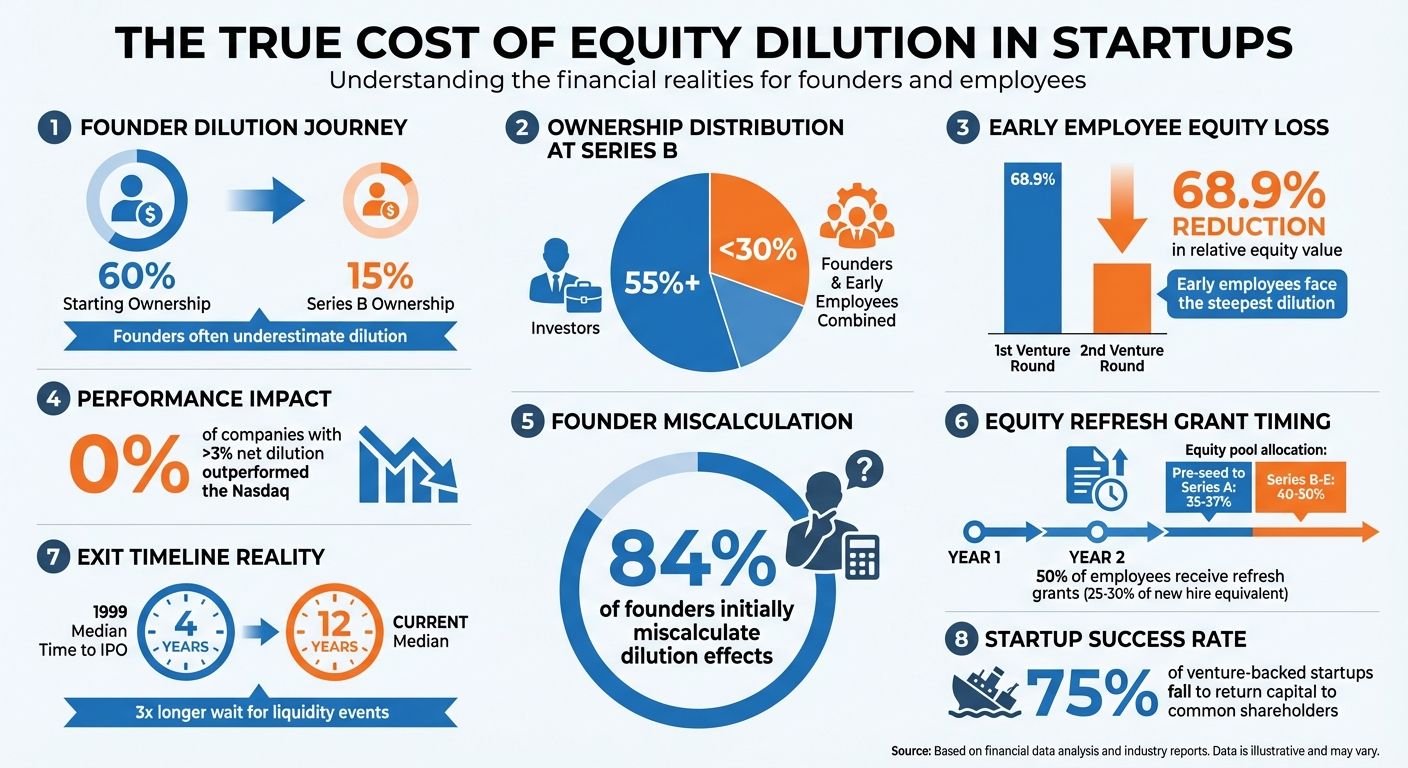
When startups raise money, they issue new shares, which reduces ownership percentages for founders and employees - a process called dilution. Founders often underestimate dilution: starting with 60% ownership can drop to just 15% by Series B. For employees, equity dilution can feel like a broken promise, especially if they joined for equity over salary. This frustration often leads to retention problems, as employees may leave once their equity vests or if they feel undervalued.
Key Takeaways:
- Dilution Explained: Issuing new shares during funding rounds reduces ownership percentages, even if the company’s value grows.
- Impact on Employees: Early employees face shrinking equity stakes, which can harm morale and lead to departures.
- Retention Challenges: Without additional equity grants or clear communication, employees may leave after vesting milestones.
- Solutions:
- Offer equity refresh grants to offset dilution.
- Balance cash and equity compensation to reduce financial stress.
- Communicate equity value clearly to align expectations.
- Explore alternative equity structures like extended vesting schedules or phantom equity.
Startups need to address these issues early to retain top talent and maintain growth momentum.
Equity Dilution Impact on Startup Founders and Employees
Protecting Startup Employee Stock Options From Dilution, Explained
sbb-itb-17e8ec9
How Equity Dilution Affects Employee Loyalty
Employees often focus on their shrinking ownership percentages rather than the growing value of a larger company. This mindset can create challenges, especially when companies fail to clearly explain the reasons behind changes in equity. Let’s break down how these perceptions and timing factors shape employee decisions.
How Employees Perceive Dilution
Many employees mistakenly believe their initial equity percentage is set in stone. They may not realize that funding rounds and option pool expansions reduce their ownership percentage, even if their total number of shares stays the same. This misunderstanding can lead to frustration when the value of their equity doesn’t match their expectations.
When new shares are issued without corresponding growth in valuation, share prices drop. This can push stock options "out of the money", making them less financially rewarding. Research supports this concern: companies with more than 3% average net dilution from stock-based compensation consistently underperformed the Nasdaq. Excessive dilution often aligns with weaker stock performance, which can erode employee satisfaction.
Early employees face unique challenges. They frequently accept lower salaries in exchange for larger equity stakes. However, as the company grows and risks decrease, the relative value of those initial equity grants can shrink significantly - by as much as 68.9% between the first and second venture rounds. This can breed resentment, especially when newer hires receive smaller but less-diluted equity packages.
"If employees see their equity ownership percentages diluted too much, it might affect their motivation or loyalty to the company." - DigitalOcean
This disconnect between expectations and reality becomes especially critical during key vesting milestones.
Vesting Cliffs and Employee Departures
Misunderstandings about equity value often come to a head during major vesting milestones. The one-year vesting cliff, for example, is a natural point for employees to reevaluate their commitment. If dilution has significantly reduced the perceived value of their unvested equity during that first year, they may decide to leave. This can be particularly costly for companies, as they’ve already invested considerable time and resources in training and integrating these employees into important roles.
Full vesting is another critical moment. Without additional equity grants or clear communication about future opportunities, employees often see this milestone as a logical exit point. By the time a company reaches its Series B funding round, founders and early employees typically own less than 30% of the company combined, while investors hold over 55%. Faced with a reduced stake, employees may start questioning whether staying makes financial sense - especially if they don’t fully grasp how much the company’s overall value has grown.
Excessive dilution can also raise red flags. If a company repeatedly raises capital on unfavorable terms, employees might interpret this as a sign of deeper issues. This perception can lead to a talent exodus at precisely the time when experienced team members are most crucial for driving growth. To prevent this, companies need proactive strategies that balance equity value with transparent communication and alternative compensation options.
Strategies to Reduce Dilution's Impact on Retention
If companies wait too long to address dilution, they risk losing top talent. A combination of fresh equity grants, competitive cash pay, and open communication can go a long way in keeping key employees on board. Below, we break down practical approaches like equity refresh grants, balanced cash offers, and clear equity discussions to tackle these retention challenges head-on.
Offer Equity Refresh Grants
Equity refresh grants are a way to counteract dilution and keep employees motivated, especially after their initial four-year vesting period. By the second year, nearly half of startup employees receive an additional equity grant, typically about 25–30% of what a new hire would receive for the same role today.
Time-based refresh grants are often given around the two- or three-year mark, when the initial grant is about 50–75% vested. For example, Wealthfront offers annual refresh grants starting in the second year, equal to 25% of the employee’s initial grant. GitLab ties equity refreshes to its annual pay reviews, making employees with at least six months of tenure eligible based on their performance.
Boxcar grants are another option. These don’t start vesting until the original four-year grant is fully vested. This avoids overlapping vesting periods and locks in a lower strike price, ensuring a smoother incentive transition.
Performance-based grants reward employees based on their contributions. Between 2024 and 2025, companies offering these grants to non-executives increased from 5% to 6%.
"We typically recommend earlier-stage companies provide refresh grants on an 'as needed' basis, and for those with formal programs, every other year. Only the more mature companies would grant refreshers on an annual basis."
– Jin Tan, Compensation Expert, Sequoia Consulting
How much equity companies set aside for refresh grants often depends on their stage. Pre-seed to Series A companies allocate about 35–37% of their equity pool for refresh grants, while Series B–E companies bump that to 40–50%. It’s smart to review the impact of these grants on the equity pool over 12-, 24-, and 36-month periods to manage dilution effectively.
While equity refreshes are helpful, they work best when paired with competitive cash compensation.
Balance Cash and Equity Compensation
Equity isn’t enough to keep employees who are struggling to pay their bills. Dilution can reduce the perceived value of equity, making a solid cash base essential. The "salary floor" rule suggests that cash compensation should at least cover living expenses, debt payments, and a modest savings goal of around 10%.
"Never accept a salary that creates financial stress. If you are worried about paying rent... you will not do your best work."
– ICanPitch
With roughly 75% of venture-backed startups failing to return capital to common shareholders, relying solely on equity can be risky. Using real-time benchmarking data helps ensure cash pay stays within the 50th–75th percentile for critical roles. As companies grow, they should adjust the balance between cash and equity. Early employees who accepted lower salaries for larger equity stakes need to see their cash compensation increase as the company matures.
Communicate Clearly About Equity
Clear communication about equity is essential to combat misunderstandings about dilution. Sharing specific data - like the current 409A valuation, strike price, and the total number of fully diluted shares - helps employees understand their stake’s value and the effects of dilution.
"When it comes to equity, communication is what wins."
– John Toth, former CFO, BARK
Companies that explain equity well often see higher retention rates. Hosting quarterly equity workshops or live Q&A sessions can make complex topics like taxes, vesting, and dilution easier to grasp.
Providing tools like equity modeling software allows employees to project potential future values under various exit scenarios. Additionally, creating an equity mission statement that outlines the program’s goals - whether it’s encouraging entrepreneurial behavior or rewarding long-term commitment - can help align employee expectations.
"Most startups are really bad at explaining compensation to their teams. Many founders default to obfuscating details hoping their team won't realize. This approach is short-sighted."
– Tyler Morris, Principal & Senior Wealth Advisor, Compound
With the median time to IPO now stretching to 12 years (compared to just 4 years in 1999), employees often have to wait longer for liquidity events. Regular updates about the path to liquidity and how individual efforts impact share value can keep employees engaged during these extended timelines.
Equity Structures That Support Long-Term Retention
Proactive equity refresh grants and clear communication are essential, but the way equity is structured can also play a huge role in keeping employees engaged for the long haul. Moving beyond the standard four-year vesting schedule, companies are experimenting with creative equity structures that align employee incentives with company growth. Let’s dive into how extended vesting schedules and alternative equity designs address retention challenges.
Extended Vesting Schedules
Back-weighted vesting schedules, where a larger chunk of equity vests in later years, are one way to encourage long-term commitment. Amazon, for example, uses a 5%/15%/40%/40% model over four years, rewarding employees who stay the course. To balance the lower initial vesting, Amazon also offers substantial sign-on bonuses during the first two years.
Some companies take it a step further by introducing six-year vesting periods, aligning equity rewards with longer-term goals or project timelines. Others, like Stripe, have shifted to annual sequential grants instead of a single four-year grant. This method ensures flexibility, allowing companies to adjust grants based on individual performance and market conditions. It also prevents employees from holding "underwater" options when company valuations drop.
"Equity is full of nuance. Unlike cash, there are so many levers you can pull from vesting length to refresh strategies to cliffs and everything in between."
– Morgan Melo Barrett, Strategic Initiatives, Pave
Alternative Equity Designs
Companies are also exploring fresh equity structures to address challenges like dilution and employee flexibility. One popular approach is extending post-termination exercise periods (PTEP). Instead of the standard 90-day window to exercise options after leaving a company, organizations like Pinterest and Gusto now offer extended periods - seven years and ten years, respectively. As of February 2024, about 20% of terminated options on the Carta platform include a PTEP longer than 90 days.
Early exercise provisions are another option, allowing employees to exercise unvested options immediately. This starts the capital gains tax clock sooner, potentially lowering their tax burden. It also converts option holders into shareholders faster, fostering a stronger sense of ownership. Similarly, net settlement strategies - where companies use their cash to cover employees’ tax obligations - help reduce dilution by eliminating the need for employees to sell shares.
"Some employees will feel forced to remain at a company they would otherwise have left... which in reality, can lead to a demotivated and inefficient workforce."
– Liquid Stock
For companies wary of issuing shares right away, phantom equity and performance stock units (PSUs) provide flexible alternatives. Phantom equity mimics the financial benefits of stock ownership without issuing actual shares, while PSUs tie vesting to specific milestones like revenue or user growth. These approaches ensure dilution only happens when meaningful goals are achieved.
Conclusion
When handled thoughtfully, equity dilution can drive growth; when mismanaged, it risks alienating key talent. Consider this: 84% of founders initially miscalculate the effects of dilution, and no company with over 3% net dilution has ever outperformed the Nasdaq. If employees see their ownership stakes decrease without a clear explanation or added benefits, their commitment to the company can waver.
The strategies discussed - such as equity refresh grants, clear communication, back-weighted vesting, extended schedules, and alternative equity approaches - are critical for maintaining a motivated team. These approaches address a pressing challenge: startups now face exit timelines nearly twice as long as before. A standard four-year vesting schedule often ends well before liquidity events, leaving employees in limbo. Without proactive planning, your top performers may start looking elsewhere.
This evolving landscape highlights a key truth for every startup:
"Control and wealth can be mutually exclusive in a startup. Understand that dilution is necessary and losing control over time can be positive towards achieving financial success."
– Carolyn Deng, Wharton MBA and CFA
Bringing these strategies to life requires precision and real-time insights. Tools like Lucid Financials make this possible by offering AI-powered forecasting, cap table modeling, and investor-ready reporting in one integrated platform. Whether you're preparing for a Series A, structuring equity refresh grants, or explaining dilution to your team in Slack, Lucid equips you with accurate, actionable data to keep your best talent engaged and your company on track for success.
FAQs
How much dilution is normal by Series B?
By the time founders reach a Series B funding round, they often see their equity diluted by 15% to 30%, with the average falling between 15% and 25% after the round is completed. This range aligns with industry norms but can shift based on factors like the deal terms and the company's structure.
How can I estimate my equity’s real value after dilution?
To figure out the actual value of your equity after dilution, you can use tools designed to model changes in ownership. These tools take into account factors like funding rounds, the issuance of new shares, and valuation shifts. They’re a practical way to see how dilution affects your stake and what it might be worth, giving you a clearer picture of your equity's standing.
When should startups give equity refresh grants?
Startups can benefit significantly from offering equity refresh grants to retain their best employees and acknowledge those who stick with the company over the long haul. These grants are a way to counteract equity dilution and are often tied to specific milestones, such as completing one or two years with the company, receiving a promotion, or achieving standout performance.
In fast-paced startup environments, where competition for top talent is fierce, these grants play a key role in maintaining loyalty and morale. They ensure employees feel valued, especially as their initial equity grants vest and the company continues to grow and change.