Financial storytelling is evolving fast in 2026. Startups and finance teams are using AI to turn complex data into clear, actionable insights. Here’s how:
- AI-Driven Visualizations: These tools explain trends and anomalies instantly, turning raw data into meaningful insights.
- Agentic AI: Autonomous systems monitor metrics, detect issues, and generate reports without human intervention.
- Personalized Reporting: Tailored insights for different roles, like CFOs or department heads, help streamline decisions.
- Interactive Data Stories: Dynamic narratives replace static dashboards, offering real-time answers to "what-if" questions.
These trends reduce manual work, speed up reporting, and help startups make faster, smarter decisions. Tools like Lucid Financials integrate these capabilities into a single platform, making CFO-level insights accessible for lean teams.
AI Trends Finance Leaders CAN'T Ignore in 2026 [with Rillet’s Stephen Hedlund]
sbb-itb-17e8ec9
1. AI-Driven Visualizations
AI-driven visualizations go beyond static charts, turning raw data into actionable insights. Instead of just presenting a bar graph of monthly expenses, these tools can connect spending spikes to specific business actions - like a hiring spree or the launch of a marketing campaign. Dan Meshkov from Brex sums it up perfectly:
"The future of reporting is insights, not charts. AI that finds anomalies and summarizes what matters is a step change from dashboards that display data. The chart is the artifact. The insight is the product."
This process hinges on semantic understanding. With a well-built semantic layer, an AI can accurately interpret queries like "What was our Q1 spend?" by identifying the right accounts, departments, and time frames to deliver precise answers.
Automation Level
AI now handles the entire process - from analyzing data to presenting it. It generates SQL queries, detects anomalies, picks the best chart types, and creates natural language summaries, all in one streamlined workflow. For instance, in early 2026, Scale AI used Brex's AI-powered platform to close its books five days faster than traditional methods. Similarly, SeatGeek automated almost all of its accounting entries and cut Travel & Expense costs by 50%. While traditional analysis might take days, AI-powered platforms deliver insights almost instantly.
Speed
The speed advantage of AI tools goes beyond quick queries. These platforms provide live updates on key performance indicators like profit margin, revenue growth, and cash runway - all automatically. Imagine running a "what-if" scenario, such as adjusting your runway projections based on hiring 10 engineers instead of 5. The AI instantly updates financial models and provides narrative explanations. For example, ILT Academy cut the time spent on treasury management by a factor of 8 after adopting an AI-native platform.
Startup Applicability
For startups that lack large data teams, these tools are a game-changer. Platforms like Lucid Financials act as virtual financial analysts, delivering real-time insights directly into tools like Slack. These AI systems learn the nuances of your business while being validated by experienced experts. By turning raw data into strategic narratives, these innovations redefine financial storytelling and make advanced analytics accessible for startups.
2. Agentic AI for Autonomous Reporting
Agentic AI takes financial reporting to the next level by actively managing insights rather than just visualizing data. It moves reporting from a reactive process to a proactive one by autonomously monitoring business metrics, spotting anomalies, and investigating their causes. Unlike traditional automation, which depends on fixed, pre-set rules, agentic AI makes decisions on the fly. It adjusts to new data patterns as they emerge, all without requiring human input.
Automation Level
Agentic AI achieves autonomy by leveraging advanced workflow techniques like prompt chaining, dynamic routing, and evaluator loops. These allow the system to independently handle structured tasks while maintaining quality control.
Between January 2024 and June 2025, a striking 73% of investment-related startups funded by Y Combinator centered their efforts on agentic AI. The impact is clear: users of Moody's Research Assistant, for example, consume 60% more research and complete tasks 30% faster. Additionally, AI-powered financial analytics can cut variance analysis time by as much as 80%, shrinking the process from several days to same-day reporting. This level of autonomy enables faster, more decisive financial reporting.
Speed
Agentic systems offer more than just quick query responses. They eliminate the traditional delays between analyzing data and creating narratives. For instance, variance data can be instantly transformed into executive-level commentary. By combining data analysis with narrative generation, agentic AI slashes reporting cycles to under a week. This capability is particularly valuable for startups, providing continuous monitoring that can flag budget risks mid-quarter - when corrective action is still possible.
"Agentic AI refers to artificial intelligence systems that go beyond passive data retrieval... autonomously determines what actions to take, plans multi-step workflows, and adapts based on real-time data." - Moody's
Startup Applicability
For startups, implementing agentic AI typically takes about 8–12 weeks. Tools like Lucid Financials bring real-time financial insights directly into platforms like Slack. These systems are designed to adapt to your business needs while ensuring audit trails for compliance - an essential feature for companies gearing up for due diligence or board meetings. With agentic AI, founders can automate tasks like variance decomposition and narrative generation, gaining CFO-level insights without needing a full finance team. By integrating seamlessly with financial storytelling tools, agentic AI delivers context-rich, real-time insights, making financial communication more proactive and impactful.
3. Personalized Financial Reporting
Personalized financial reporting offers insights tailored to specific roles within an organization. Whether it’s a CFO needing high-level summaries, a department head monitoring budgets, or a board member assessing strategic risks, AI now customizes reports to meet these unique demands. By analyzing a company’s data and comparing it to industry benchmarks, AI transforms raw numbers into plain-English explanations that address the priorities of each stakeholder.
Automation Level
AI takes over repetitive tasks, significantly reducing the manual work that still burdens many finance teams. For instance, 60% of finance teams rely heavily on manual reconciliation processes like closing monthly finances, and 18% of accountants admit to making daily errors in manual reporting. Spreadsheet-based data entry alone has an error rate of 1% to 4% per cell, with poor data quality costing organizations an average of $15 million annually. Personalized reporting builds on AI automation by delivering outputs tailored to the unique needs of different users, further streamlining these processes.
Personalization
AI doesn’t just automate - it adapts. Using Narrative Intelligence, it creates role-specific insights by linking overall performance to individual team contributions. Instead of a one-size-fits-all report, AI produces customized versions: concise summaries for CFOs, detailed operational insights for business leaders, and strategic analyses for board members. This ensures consistency while addressing the specific concerns of each role.
Speed
AI transforms reporting timelines, delivering insights in seconds rather than days. Real-time reporting offers immediate visibility into metrics like cash flow, burn rate, and runway, enabling quick, informed decisions without waiting for traditional month-end processes. While conventional reporting cycles often require 14 days - 40-60% of which is spent on manual commentary - AI-powered tools compress this to just 4-5 days. For startups, these time savings are invaluable.
Startup Applicability
For startups, personalized reporting shifts the focus from deciphering complex spreadsheets to strategic decision-making. Without a dedicated data team, AI acts as a scalable financial analyst, growing alongside the business. The "1-10-100 rule" underscores the importance of accuracy: it costs $1 to verify an error, $10 to fix it after entry, and $100 to correct it after final reporting. Starting with clean data and leveraging AI-driven normalization minimizes costly mistakes. Tools like Lucid Financials integrate seamlessly with platforms like Slack, providing instant updates on metrics such as runway, spending, and overall performance.
4. Interactive Data Stories
Interactive data stories are transforming static dashboards into dynamic narratives that clarify the "why" behind financial changes. Instead of static visuals, stakeholders can now dive into key drivers such as price, volume, or product mix with ease. By combining AI-driven visualizations with actionable insights, these stories provide tailored narratives that enhance decision-making.
Automation Level
AI agents are taking over repetitive tasks, monitoring performance, spotting anomalies, and investigating root causes autonomously. With AI-powered financial analytics, variance analysis time can shrink by as much as 80% - cutting a 3–5 day process down to same-day results. The system can generate SQL queries and deliver actionable insights in mere seconds.
Personalization
Interactive data stories go beyond personalized financial reporting by offering dynamic, drill-down narratives tailored to individual stakeholder needs. Using semantic layers, the AI encodes company-specific business contexts, such as department structures, compliance thresholds, and expense policies. Acting like a specialized analyst, it allows stakeholders to refine views with natural language commands - filtering by date, zooming into specific segments, or comparing periods - without writing a single SQL query.
Speed
What once required days of detailed chart analysis now happens in seconds. This speed is especially crucial for startups, where immediate clarity on cash flow, burn rate, and runway can make or break decisions.
Startup Applicability
AI-native platforms are a game-changer for startups, offering implementation timelines of just 8–12 weeks, compared to the 6–12 months typically required for enterprise analytics. For lean finance teams, these tools enable high-quality board preparation - similar to what you’d expect from top consulting firms - without needing outside help or large internal teams. Platforms like Lucid Financials integrate directly with tools like Slack, letting founders ask questions and get instant, contextualized answers about their financial performance. This makes turning complex data into actionable insights quick and efficient, without added overhead.
Advantages and Disadvantages
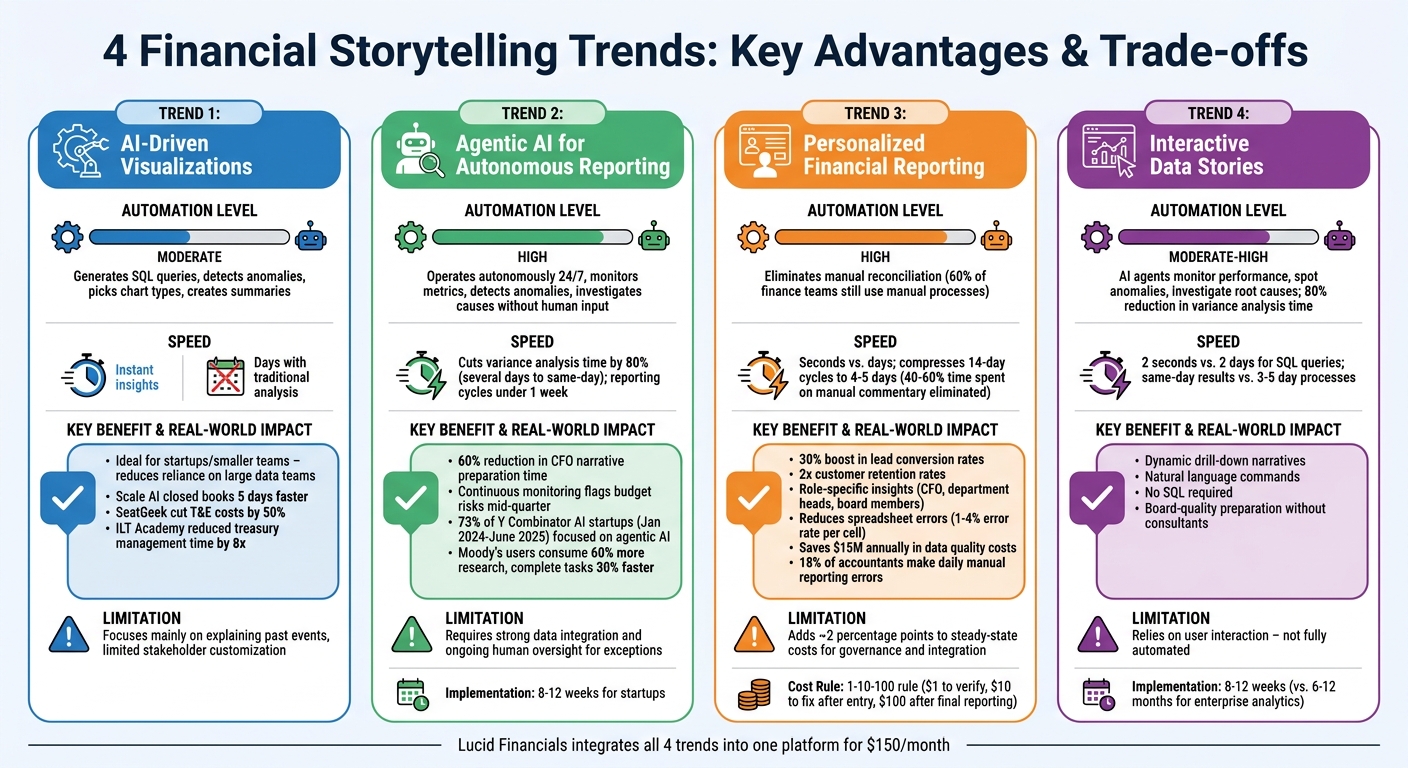
Comparison of 4 Financial Storytelling Trends: Automation, Speed, and Startup Applicability
Every trend in financial reporting brings its own strengths and trade-offs, creating opportunities and challenges for businesses.
AI-driven visualizations shine when it comes to speed and scalability, making them ideal for startups or smaller teams. They simplify reporting processes and reduce reliance on large data teams. However, their focus is mainly on explaining past events, limiting their ability to provide tailored insights for specific stakeholders.
Agentic AI for autonomous reporting stands out for its high level of automation. Operating around the clock, it can detect anomalies and investigate root causes without needing human intervention. Finance teams using this technology have reported cutting the time needed for preparing CFO narratives by over 60%. On the flip side, implementing agentic AI requires strong data integration systems and ongoing human oversight to manage exceptions effectively.
Personalized financial reporting takes customization to the next level by tailoring insights to meet the needs of specific department leaders or investor profiles. This level of personalization has been linked to a 30% boost in lead conversion rates and a doubling of customer retention rates. The downside? It typically adds about 2 percentage points to steady-state costs due to the need for governance and integration.
Interactive data stories offer a combination of personalization and speed. These tools allow users to ask "what-if" questions in plain English and get narrative-driven answers almost instantly. For example, while traditional SQL queries might take two days to process, AI-powered platforms can deliver results in just two seconds. However, these tools rely on user interaction, which means they don't achieve full automation.
Together, these trends are transforming how financial reporting is done. Lucid Financials is setting a new benchmark by incorporating all four of these trends. The platform combines AI-driven visualizations, agentic monitoring, personalized narratives, and interactive tools to provide real-time, investor-ready reporting. With clean books delivered in just seven days, it empowers lean finance teams to access CFO-level insights without the usual overhead.
Conclusion
Financial storytelling has evolved far beyond polished charts and routine monthly reports. Today, it’s about shifting the focus from simply asking, “Did we hit the plan?” to digging deeper and evaluating, “Did the plan work?”. The trends discussed - AI-driven visualizations, agentic AI, personalized reporting, and interactive data stories - are transforming how startups share their performance, make financial decisions, and earn the trust of investors.
While speed and automation remain important, the real game-changer lies in the ability to craft meaningful narratives. As Julio Martínez, Co-Founder & CEO at Abacum, insightfully explains:
A model is just a calculator until you wrap a story around it.
For startups navigating fundraising, scaling, or board presentations, adopting these trends quickly is key - but accuracy cannot be compromised. The best tools seamlessly integrate all four capabilities into one workflow, removing the need to manually piece together dashboards, forecasts, and reports. This unified approach turns raw data into actionable insights, making decision-making more intuitive.
One example of such an integrated solution is Lucid Financials. This platform combines AI-powered visualizations, real-time monitoring, tailored narratives, and interactive forecasting into a single system. With features like clean books in just seven days, live Slack-based support, and always-on investor-ready reporting for $150/month, Lucid is designed specifically for founders who need CFO-level insights without the overhead. It exemplifies how streamlined tools can simplify financial storytelling.
The future of financial storytelling is about enabling faster, smarter decisions. Startups that embrace these trends now will position themselves to communicate their value more effectively, manage risks efficiently, and scale with confidence.
FAQs
What data is needed for accurate AI financial insights?
Accurate financial insights powered by AI rely heavily on access to detailed, high-quality data. This includes key documents like income statements, balance sheets, cash flow statements, and general ledger entries. Adding real-time updates and contextual details - such as industry benchmarks and historical trends - further sharpens these insights.
The foundation for dependable results lies in having clean, well-organized data. Tools like Lucid Financials make this process easier by automating financial reporting and delivering real-time updates. This ensures that businesses can access precise, actionable insights when they need them.
How do you keep an agentic AI system trustworthy and auditable?
Creating a trustworthy and auditable AI system starts with transparency and monitoring. To achieve this, focus on making the AI's decision-making processes explainable - users should be able to understand how and why the system produces specific outputs.
Key practices include:
- Regular audits: These help identify and address any biases or errors in the system.
- Continuous oversight: Ongoing monitoring ensures the system remains aligned with its intended purpose.
- Detailed activity logs: Comprehensive logs provide a clear record of the AI’s actions, supporting accountability and traceability.
By implementing these measures, organizations can ensure their AI systems are reliable, meet compliance standards, and align with critical goals, such as those in financial reporting.
Which financial metrics should startups monitor in real time?
Startups need to keep an eye on critical metrics like cash flow, burn rate, and runway to maintain financial health and ensure they can sustain operations. Beyond liquidity, tracking revenue growth, gross margin, and customer acquisition costs is essential for assessing overall performance and growth potential.
Platforms like Lucid Financials make this process easier by using AI to automate tracking. These tools offer real-time insights and generate investor-ready reports, enabling startups to adapt quickly to challenges and seize new opportunities while driving long-term growth.