When deciding between custom KPI dashboards and pre-built solutions, it comes down to cost, time, and specific needs. Pre-built platforms like Geckoboard or Databox are quick to set up (minutes to hours) and cost around $75/month. They’re ideal for internal reporting and startups with limited resources. Custom dashboards, built with tools like Tableau or Google Sheets, provide tailored solutions for unique metrics but require significant time (weeks to months) and budget (over $1,000/day for developers). Choose pre-built for speed and simplicity; opt for custom if you need specialized, customer-facing analytics.
Quick Comparison
| Factor | Pre-Built Solutions | Custom Dashboards |
|---|---|---|
| Setup Time | Minutes to hours | Weeks to months |
| Cost | ~$75/month | $1,000+/day for developers |
| Maintenance | Vendor-managed | Internal team responsibility |
| Flexibility | Limited customization | Full control over design/logic |
| Best Use Case | Internal reporting | Customer-facing analytics |
Key takeaway: If you're short on time or technical resources, pre-built solutions are practical and efficient. For startups with complex or proprietary needs, custom dashboards offer flexibility but come with higher costs and maintenance demands.
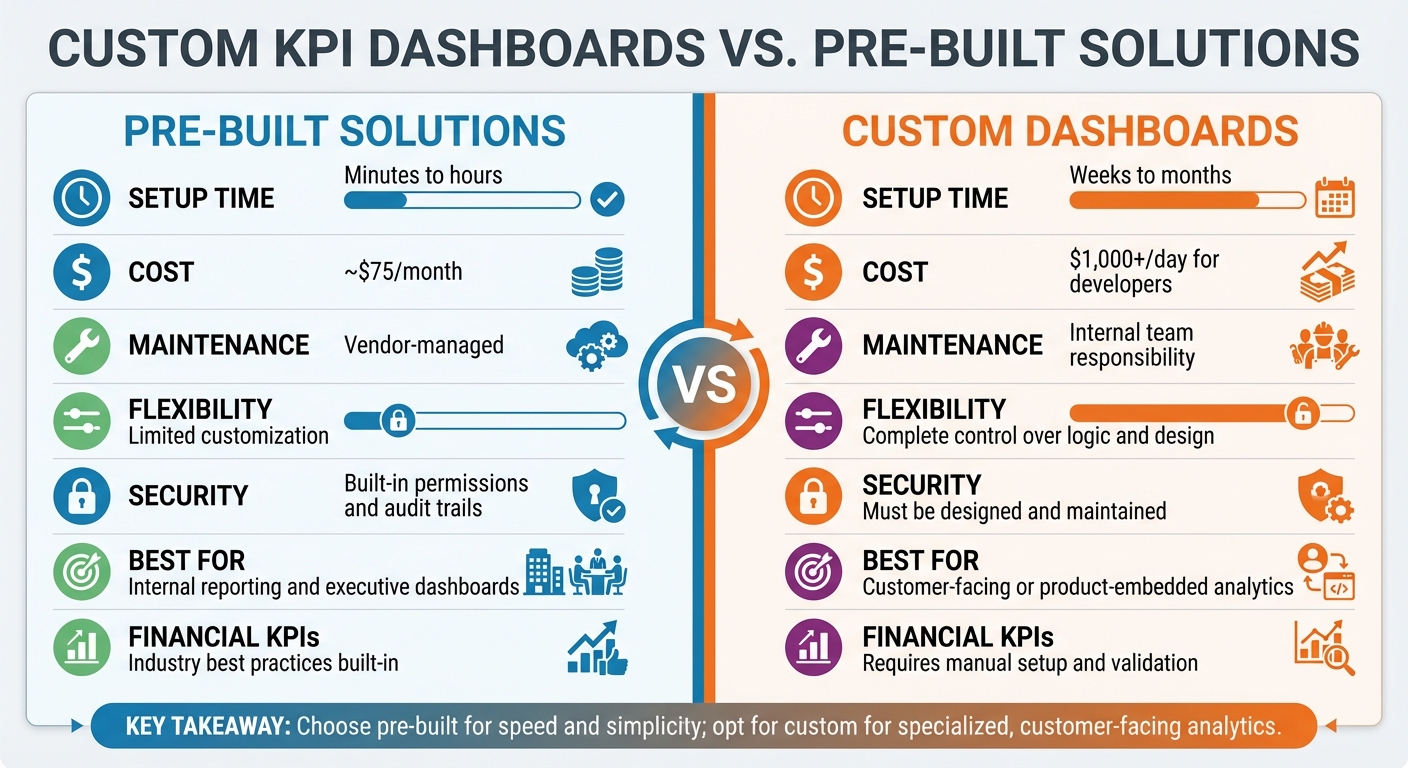
Custom KPI Dashboards vs Pre-Built Solutions: Cost, Time, and Features Comparison
Custom KPI Dashboards: Features, Benefits, and Challenges
Features of Custom Dashboards
Custom dashboards give you complete control over how data is displayed and used. You decide how metrics are calculated, how data is structured, and how your team interacts with it all. They also integrate data from a variety of internal and legacy systems that off-the-shelf tools might not support. For instance, if your business needs to track multi-entity financial data or break down expenses into highly specific categories, a custom dashboard lets you design an interface tailored to those needs - all while maintaining strong governance and security measures. These capabilities make custom dashboards highly adaptable to unique business requirements.
Benefits of Custom Dashboards
Custom dashboards are all about precision. When your analytics are customer-facing or embedded in a SaaS product, the dashboard becomes a critical part of the user experience. These dashboards provide exact, actionable insights and can incorporate proprietary logic that strengthens your competitive position. They’re also built to handle raw API data, applying complex filtering, aggregation, and backfilling processes to ensure the metrics your team relies on are accurate and dependable.
Challenges of Building and Maintaining Custom Dashboards
While custom dashboards have clear advantages, they come with significant challenges. For starters, they’re expensive and time-intensive to develop. A senior developer’s daily rate can exceed $1,000, pulling resources away from other essential projects. Geckoboard estimates that over 250,000 hours have been spent over 15 years on building and maintaining data integrations alone. Beyond the initial build, ongoing maintenance is a necessity - API changes, rate limits, and schema updates all need to be managed. Security is another concern; many custom dashboards lack detailed audit trails and granular access controls, which can leave sensitive data vulnerable. As Ashleigh McCabe of Hurree points out:
Building a dashboard is not a build it and forget it job... Like all software, regular maintenance and updates will be needed to ensure it runs smoothly and efficiently.
sbb-itb-17e8ec9
Pre-Built Solutions: Features, Benefits, and Limitations
Features of Pre-Built Solutions
Pre-built dashboards take care of the technical hurdles that typically consume engineering time. They handle tasks like managing paginated data, dealing with inconsistent schemas, navigating rate limits, and converting time zones. Security is also baked in, with features like audit trails, permission management, and access controls. On top of that, these platforms allow users to tweak filters, time ranges, and KPIs without touching a single line of code. They also transform raw API data into accurate metrics using built-in tools for filtering, aggregation, and backfilling. These capabilities make it easier to deploy and manage dashboards quickly.
Benefits of Pre-Built Solutions
The standout benefit? Speed. With these tools, you can turn raw data into a functional dashboard in just hours, compared to the weeks or months it might take to build one from scratch. Starting prices are around $75 per month - far less than a developer's daily rate, which can exceed $1,000. This makes pre-built solutions a cost-effective choice for many businesses.
Geckoboard highlights another perk:
"Buying dashboard software does not remove responsibility for security, but it does provide constraints out-of-the-box that are difficult to reproduce reliably when building a custom setup".
In other words, pre-built solutions handle much of the grunt work, freeing up your engineering team to focus on your core product rather than internal reporting tools. But, as with most things, there are trade-offs.
Limitations of Pre-Built Solutions
While great for internal reporting, these solutions may not meet the needs of startups with complex or customer-facing analytics requirements. Customization is often limited to selecting KPIs or adjusting time ranges - you won’t have control over the underlying infrastructure. If your business depends on unique datasets, integration could be an issue since many platforms only work with specific partners.
Plus, as your business grows and demands for detailed, real-time analytics increase, costs can rise significantly - potentially negating the initial savings. For customer-facing dashboards or analytics embedded directly into your product, pre-built tools usually aren’t the best option.
Comparing Custom and Pre-Built Dashboards
Setup Time and Cost
Pre-built dashboards are a quick fix, often ready to use within minutes or hours. On the other hand, creating a custom dashboard can take weeks - or even months - of development and testing. For startups with tight deadlines, this difference can be a game-changer. Cost is another big factor: pre-built solutions usually run about $75 per month, while hiring a developer can cost over $1,000 per day.
As Geckoboard points out:
Most teams underestimate how long builds take. They also underestimate how much effort goes into maintaining something that depends on external systems.
Every hour your developers spend troubleshooting APIs or fixing schema issues is time they’re not spending on your core product. Next, let’s dive into scalability and flexibility.
Scalability and Flexibility
Once you’ve looked at setup time and cost, the next thing to consider is how well the dashboard can grow and adapt with your business. Custom dashboards give you full control over data modeling, custom calculations, and visualization options. However, pre-built solutions excel at scaling quickly for standard metrics. They might hit a wall when it comes to more complex, real-time analytics.
Pre-built tools are designed for ease of use, allowing non-technical team members to make changes without needing code. In contrast, custom dashboards often require a developer for even minor tweaks, which can create bottlenecks. Security is another area where pre-built platforms shine, as they come with built-in permissions and audit trails - features that can be both time-consuming and costly to replicate in a custom setup.
Customization vs. Standardization
Custom dashboards are all about control, giving you the ability to tailor every calculation and visual to your needs. This makes them ideal for tracking proprietary metrics. Pre-built solutions, on the other hand, rely on standardized templates designed for common use cases. While you can adjust filters and choose which KPIs to display, you’re working within a predefined framework that’s been optimized for efficiency and best practices.
Financial KPI Support
Another important distinction lies in how well these dashboards handle financial metrics. For startups focused on keeping investors informed and running efficiently, this is crucial. Pre-built dashboards come with ready-to-use templates for essential financial metrics like runway, burn rate, and cash flow. These templates are designed to meet investor expectations. Custom dashboards, however, require manual setup and validation to achieve the same level of functionality.
Comparison Table: Custom vs. Pre-Built
| Factor | Pre-Built Solutions | Custom Dashboards |
|---|---|---|
| Setup Time | Minutes to hours | Weeks to months |
| Initial Cost | Low (around $75/month) | High (exceeding $1,000/day for developers) |
| Maintenance | Managed by vendor | Internal team responsibility |
| Flexibility | Standardized templates with adjustable filters | Complete control over logic and design |
| Financial KPIs | Industry best practices built-in | Requires manual setup and validation |
| Security | Built-in permissions and audit trails | Must be designed and maintained |
| Best For | Internal reporting and executive dashboards | Customer-facing or product-embedded analytics |
Choosing Between Custom and Pre-Built Dashboards
After understanding the features and trade-offs of custom and pre-built dashboards, the next step is deciding which option fits your startup's needs.
When to Choose Custom Dashboards
Custom dashboards work best for customer-facing analytics and embedded product insights. These scenarios often require complete control over the design and logic behind the dashboard. Startups at the Series A stage or beyond, particularly those dealing with specialized data like proprietary metrics or intricate financial models, may find custom-built dashboards more suitable.
Industries with strict regulatory requirements may also lean toward custom solutions to meet unique compliance standards. However, keep in mind that custom dashboards require ongoing engineering support to manage API updates and ensure security. If your team has limited technical resources, pre-built solutions might be a better fit.
When to Choose Pre-Built Solutions
For startups with limited technical bandwidth and a need for quick implementation, pre-built solutions offer a practical alternative. These tools are especially helpful for pre-seed and seed-stage startups that need to track KPIs without pulling engineers away from core product development. Pre-built dashboards excel at internal reporting, executive summaries, and investor-ready financials, delivering results in a fraction of the time it takes to build a custom solution.
From a cost perspective, pre-built platforms are often more affordable. With software costs typically ranging from $75 to $100 per month, they provide a stark contrast to the expense of a fully loaded developer, which can exceed $1,000 per day. Additionally, pre-built platforms come with built-in features like security, permissions, and managed data integrations - features that could take months to replicate in a custom solution. For teams without dedicated technical resources for ongoing maintenance, pre-built dashboards are a safer and more efficient choice.
How Lucid Financials Supports Startups

Lucid Financials offers a pre-built solution tailored specifically for startups that need fast, reliable financial tracking without the burden of custom development. Designed to align with the needs of growing businesses, Lucid delivers quick and cost-effective insights. The platform integrates seamlessly with Slack, providing real-time updates on crucial metrics like runway, burn rate, and cash flow. With clean books ready in just seven days and always-on investor-ready reporting, Lucid eliminates the need for an engineering team.
Starting at $150 per month, Lucid combines AI-driven bookkeeping with expert oversight to ensure accuracy and compliance. Whether you're preparing for fundraising or managing daily operations, Lucid provides board-ready reports and forecasts, letting founders focus on scaling their business while keeping financial data accurate and actionable.
Conclusion
Summary of Key Differences
Let’s break down the main contrasts between custom and pre-built KPI dashboards. The choice often comes down to factors like setup time, cost, maintenance, and your specific use case. Pre-built dashboards are quick to deploy - taking just minutes to hours - and typically cost between $75 and $100 per month for general tools. On the other hand, custom dashboards demand a significant investment of time and money, often taking weeks or months to develop and costing over $1,000 per day for developer expertise. For example, Lucid Financials offers a flat-rate solution for financial management starting at $150 per month.
Maintenance is another major point of difference. Custom dashboards require ongoing developer involvement to manage API updates, validate data, and address security concerns. Pre-built platforms, however, handle these technical challenges automatically. A great example is Geckoboard, which has dedicated over 250,000 hours across 15 years to ensure reliable data integrations. This highlights how custom solutions can drain engineering resources that could otherwise be used for core product development.
The debate also extends to customization versus standardization. Custom dashboards shine when analytics need to be customer-facing or involve proprietary logic that off-the-shelf tools can’t replicate. On the flip side, pre-built solutions are perfect for internal reporting, executive summaries, and investor-ready financials. They make use of industry best practices to deliver trusted insights quickly and efficiently. This comparison makes it easier to determine which approach aligns with your startup’s requirements.
Next Steps for Startups
Armed with this comparison, you’re in a better position to decide. Start by evaluating your audience and available resources. If your focus is on internal KPIs, team performance tracking, or executive reporting, a pre-built solution is a cost-effective choice that frees up your engineers to concentrate on your core product. However, if your dashboards are part of your product or require unique logic, a custom build may be the better route.
Before diving into a custom solution, weigh the opportunity costs. Think about the product features that might be delayed if engineering time is tied up with dashboard maintenance. For most early-stage startups - particularly those in the pre-seed and seed phases - a pre-built platform like Lucid Financials offers a fast and practical way to gain actionable financial insights. With features like clean bookkeeping in just seven days, real-time Slack notifications, and investor-ready reports, all starting at $150 per month, Lucid Financials eliminates the need for custom development while keeping your financial data accurate and accessible.
FAQs
How do I know if I’ve outgrown a pre-built dashboard?
If your pre-built dashboard is holding you back, it might be time to reassess. Struggling with limited customization? Unable to scale as your business grows? Or maybe it just doesn’t integrate smoothly with your systems? These are clear signs that your dashboard isn’t keeping up.
You might notice issues like difficulty accessing real-time insights, a lack of personalized data views, or standard features that no longer align with your business goals. When these challenges start interfering with decision-making, it’s worth considering a custom solution designed specifically for your needs.
What hidden costs should I expect with a custom dashboard?
Custom KPI dashboards might seem straightforward at first, but they often carry hidden costs that can pile up over time. After implementation, you'll likely face ongoing expenses for maintenance, support, and addressing any complexities that arise. These could include dedicating time and resources to updates, fixing issues, or managing technical debt.
On top of that, you may need to bring in specialized personnel to handle these tasks effectively. Whether it's a developer or a technical support team, their expertise doesn't come cheap, and this can push the long-term costs well beyond the initial development budget.
Can a pre-built dashboard handle strict access controls and audit trails?
Many pre-built dashboards come equipped with tools to enforce strict access controls and maintain detailed audit trails. They typically offer features such as comprehensive security audits, historical access records, and user activity tracking. These capabilities are designed to enhance accountability, monitor system events, and prepare for audits. This makes them a solid choice for businesses prioritizing security and compliance.