Creating a data room for investors is about organizing, securing, and sharing key business documents to streamline the due diligence process. A well-prepared data room builds trust, reduces delays, and demonstrates your readiness to manage investor capital. Here’s what you need to know:
- Platform Selection: Use a virtual data room (VDR) with strong security features like encryption, role-based access, and activity tracking. Avoid general storage solutions like Google Drive.
- Organization: Structure your data room into clear categories (e.g., Financials, Legal, Product) with a numbered folder hierarchy for easy navigation.
- Key Documents: Include financial statements, cap tables, legal agreements, and business metrics. Ensure all files are current, accurate, and in PDF format.
- Security: Protect sensitive data with multi-factor authentication, watermarking, and controlled access levels.
- Investor Access: Grant access in stages, track activity, and update documents regularly to maintain transparency.
A clean, secure, and organized data room can reduce due diligence time to 2-3 weeks, helping you close funding faster and on better terms.
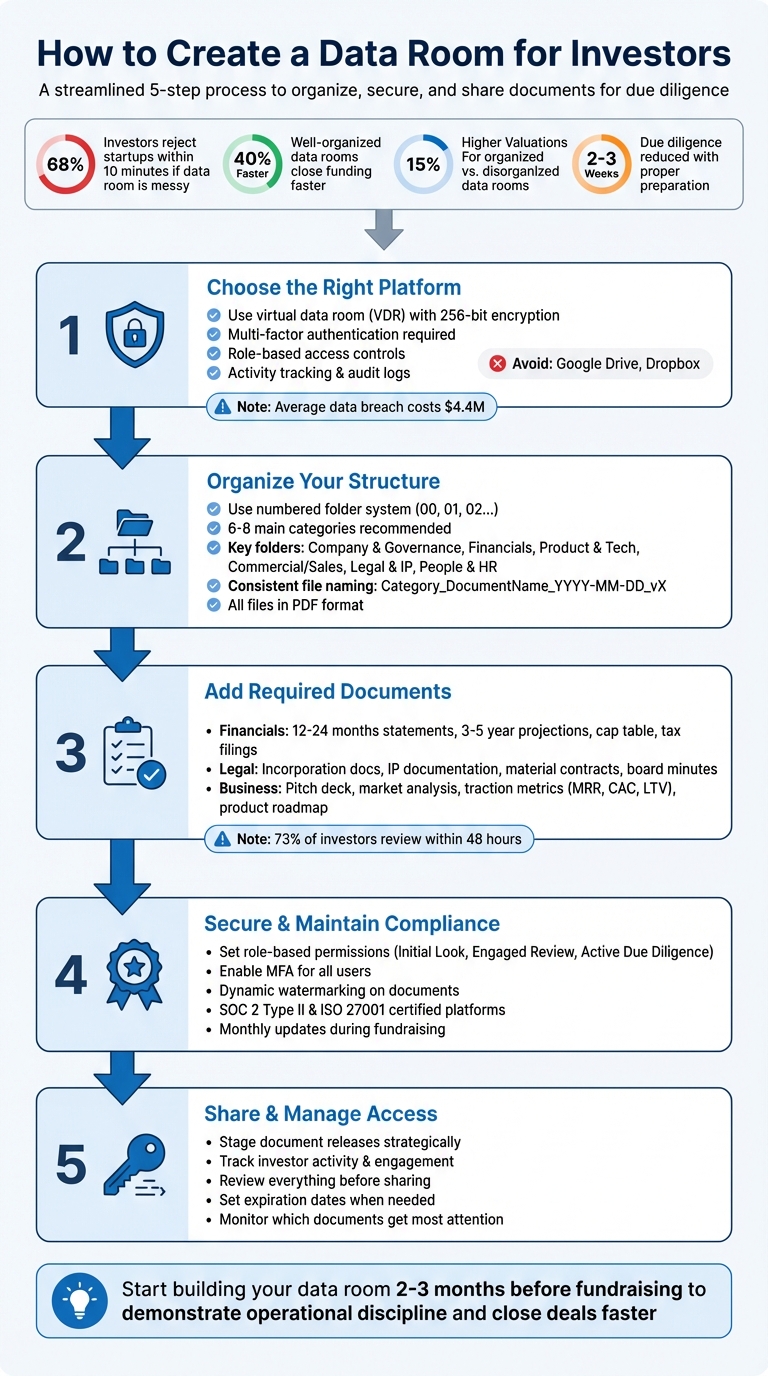
5-Step Process to Create an Investor Data Room
How To Build A Data Room For Angels and VCs
sbb-itb-17e8ec9
Step 1: Choose the Right Data Room Platform
Your data room platform is the backbone of your fundraising process. While tools like Google Drive or Dropbox might seem convenient, they fall short when it comes to the advanced security and audit features investors expect. Professional virtual data rooms are specifically built for investor due diligence, offering features like bank-grade encryption, detailed activity tracking, and document protection - things general storage platforms just can’t provide. These capabilities help ensure a smoother and more secure due diligence process.
Data breaches can be devastating, with the average cost estimated at $4.4 million. Even more concerning, stolen credentials are responsible for 22% of all breaches. For investors, thorough due diligence isn’t just about reviewing financials - it’s also about assessing how well you protect sensitive data. Companies that take security seriously are more likely to attract investors, who, in turn, enjoy a 15% higher chance of achieving a 5x return on their investment.
Key Platform Features to Consider
Security should always take center stage. When evaluating platforms, prioritize those offering 256-bit SSL/AES encryption for both stored and transmitted data. Multi-factor authentication (MFA) is another must-have, as it helps prevent unauthorized access. Role-based access controls allow you to decide who can view, edit, or download certain files, while dynamic watermarking embeds viewer details directly onto documents to discourage leaks.
Efficiency is equally important. Features like full-text search, auto-indexing, and version control make it easier for investors to navigate your documents and ensure they’re always looking at the most up-to-date versions. Detailed activity tracking and audit logs can also provide insights into investor interest, showing exactly who accessed which files and for how long. For streamlined communication, look for built-in Q&A modules that organize investor inquiries into threaded discussions, eliminating the chaos of scattered email chains.
Connecting Financial Tools to Your Data Room
A well-organized data room isn’t just about security - it’s about keeping your financial information accurate and current. Outdated financial reports can derail due diligence efforts, so real-time updates are key. Integrating financial tools directly into your data room can eliminate manual uploads and ensure precision.
One standout solution is Lucid Financials, which simplifies the process by delivering clean books in just seven days. Its AI-powered platform generates investor-ready reports and integrates seamlessly with tools like Slack, allowing you to pull updated financials instantly. This not only keeps your data room current but also highlights your operational readiness, building investor confidence from the very first interaction.
Step 2: Organize Your Data Room Structure
Disorganization can ruin your chances with investors. In fact, 68% of investors reject startups within the first 10 minutes of reviewing their data room if it looks messy. On the other hand, startups with well-organized data rooms close funding rounds 40% faster and at 15% higher valuations compared to their disorganized peers. A clear structure doesn’t just make your operations smoother; it also builds trust with investors. When they can quickly find what they need, it speeds up due diligence and can lead to better funding terms.
"A startup data room builds investor trust." - BOSS Editorial
Your data room reflects how you manage your business. If an investor can locate your cap table or runway model in seconds rather than sifting through a chaotic mess of files, it shows you’re disciplined and detail-oriented.
How to Set Up Your Folder Structure
Start with a numbered hierarchy to ensure your folders appear in a logical order. Use "00" for your index folder, followed by numbered categories like 01, 02, 03, and so on. This method keeps everything organized and helps investors navigate with ease.
Most effective data rooms stick to six to eight main categories. Common top-level folders include:
- Company & Governance
- Financials
- Product & Technology
- Commercial/Sales
- Legal & IP
- People & HR
You can also add an "Archive" folder (e.g., "99") for outdated documents. This keeps older files accessible but out of the way.
For file names, use a consistent format like Category_DocumentName_YYYY-MM-DD_vX. This avoids confusing labels like "Final_final_v2.pdf" and makes it clear which version is current. Always include an "as of" date, especially for financials, to ensure investors know how recent the data is.
Here’s a real-world example: In 2024, TechFlow, a B2B SaaS startup, struggled for eight months to attract investors due to a cluttered Google Drive with 47 unlabeled files. After CEO Sarah Chen restructured it into six clear categories with standardized naming, they secured three term sheets within 60 days and closed a $2.1M seed round at a 20% higher valuation than expected.
| Folder Number | Category | Typical Contents |
|---|---|---|
| 00 | Read Me & Index | Table of contents, upload schedule, key contacts |
| 01 | Company & Governance | Incorporation docs, cap table, board consents |
| 02 | Financials | P&L, balance sheet, runway model, tax IDs |
| 03 | Product & Tech | Roadmap, architecture, demo videos, IP/patents |
| 04 | Commercial/Sales | Pipeline summary, top customer list (redacted), churn |
| 05 | Legal & IP | Key contracts, litigation statements, IP assignments |
| 06 | People & HR | Org chart, hiring plan, employee contracts |
| 99 | Archive | Old versions and superseded documents (locked) |
Convert all files to PDF to ensure consistent formatting and security. Avoid overwhelming investors by including only high-quality, relevant documents that support your case.
Once your folder system is in place, make navigation seamless by creating a master index.
Create a Master Index or README File
The README file should be the first thing investors see when they access your data room. Place it in the "00_Read Me & Index" folder at the very top. This document acts as a roadmap, guiding investors through the contents and setting clear expectations for the due diligence process.
"A well-organized index is the backbone of a strong data room. List all the documents that could be useful to investors, even if some items are not yet applicable, so there's a full view of potential information." - Kevin Eckenrode, Marion Street Capital
Your README should include:
- A one-page company overview
- A list of key contacts and their roles
- A clear explanation of your folder structure
Mark any documents or categories that are incomplete with labels like "Coming Soon" or "Not Applicable" to give investors a full picture of what’s available. Add a change log and a brief FAQ to address updates and common questions. This proactive approach reduces repeated inquiries and shows you’re on top of things.
Here’s a quick test: ask someone unfamiliar with your company to find three specific items, like your cap table, runway model, and top customer list. If they can’t locate all three in under 10 minutes, you need to refine your structure.
"Investors appreciate a well-organized and easily navigable data room because it saves them time. ... If an investor can quickly locate the information they need, they are more likely to stay engaged." - Jay Bozman, Investment Associate, WGU Labs
Step 3: Add the Required Documents to Your Data Room
Your data room needs to be stocked with essential documents to keep your fundraising efforts on track. Missing or incomplete files can slow things down or even derail the process entirely. Focus on three main categories: financials, legal and governance, and business overview. Each category serves to build trust and provide clarity for investors.
Financial Documents
Investors will dive deep into your financials, so make sure everything is in order. Include 12–24 months of historical Income Statements, Balance Sheets, and Cash Flow Statements. Beyond that, prepare a 3-to-5-year financial model with detailed monthly projections for the first year and quarterly projections for the following years.
Your capitalization table (cap table) is critical. It should clearly outline shares outstanding, option pool allocations, SAFEs, convertible notes, and vesting schedules. Don’t forget to add tax filings and your Tax ID to demonstrate compliance. If you're using tools like Lucid Financials, you can simplify this process. Their AI platform can generate clean financial reports in just seven days and produce board-ready documents with a single click.
Legal and Governance Documents
Investors need to verify your company’s legal foundation. Include documents like Articles of Incorporation, bylaws, business licenses, and a Certificate of Good Standing. These provide proof of your company’s structure and compliance.
If you own intellectual property, include documentation for patents, trademarks, copyrights, and IP assignment agreements to establish ownership of your core technology. Also, add material contracts such as founder agreements, partnership MOUs, vendor terms, and customer LOIs. Don’t overlook governance documents like board minutes, past board decks, and voting agreements.
Include employee-related documents, such as contracts, offer letters, and equity/vesting agreements. If applicable, add regulatory certifications like GDPR, SOC 2 Type II, or ISO 27001. Lastly, include insurance policies for key person coverage, general liability, and business interruption.
"A clean, structured data room suggests strong internal operations." - Capwave AI
Business and Market Overview
This is where you tell your story. Start with a short pitch deck (under 15 slides) and a more detailed version that dives into technical and operational specifics. Back up your pitch with a TAM/SAM/SOM analysis to show market potential and include a competitive analysis matrix to highlight your edge and pricing strategy.
Show traction with metrics like Monthly Recurring Revenue (MRR), Customer Acquisition Cost (CAC), Lifetime Value (LTV), and retention rates. Add a product roadmap that outlines key milestones and upcoming features, along with a clear Go-To-Market strategy. Customer case studies, testimonials, and LOIs can help validate demand and product-market fit.
Lastly, include the past six months of investor updates to showcase transparency. Keep in mind that 73% of investors review data room materials within 48 hours of gaining access, and they typically spend about 2.3 hours reviewing documents before making decisions. Every document should serve a purpose and add value.
Step 4: Secure Your Data Room and Maintain Compliance
Security is a key indicator of how prepared and reliable your operations are. For investors, secure digital access is a must-have. A single data breach can be devastating, costing your company an average of $4.4 million. The way you handle sensitive information shows investors that you’re ready to manage their capital responsibly.
Set Up Security Measures
Managing permissions effectively is crucial. Instead of assigning access individually, create role-based groups. For example:
- Initial Look: Non-confidential materials
- Engaged Review: Detailed projections
- Active Due Diligence: Full financials and cap tables
To further protect your data, require multi-factor authentication (MFA) for all users. Stolen credentials are a major cause of breaches. Dynamic watermarking - embedding viewer details on each page - can discourage unauthorized sharing. Limit sensitive documents to view-only access and disable downloading and printing where necessary.
Choose a platform with SOC 2 Type II and ISO 27001 certifications to meet high-security standards. Use audit trails to track who accesses your documents and when. For added control, set expiration dates on documents, especially for investors who exit the process.
"A well-managed VDR demonstrates operational maturity and respect for your own IP." - Glencoyne
By prioritizing security, you not only protect your data but also streamline the due diligence process for investors. Once your security measures are in place, the next step is to ensure your data room stays up-to-date.
Keep Your Documents Current
A secure data room is only as good as the accuracy of the information it holds. Outdated documents can quickly undermine investor confidence. Add an "as of" date to every financial and performance document so investors can see how recent the data is. During fundraising, update these documents monthly, and switch to quarterly updates afterward.
To maintain organization, convert files to PDF, use clear naming conventions (e.g., YYYYMMDD_Filename_v1), and archive outdated versions in a restricted subfolder. This approach keeps everything centralized and easy to navigate. Automated alerts can also notify investors when new or updated documents are added, ensuring they stay informed.
Lucid Financials offers tools that simplify this process, providing real-time financial updates and investor-ready reporting to keep your data room accurate and professional.
Step 5: Share Your Data Room and Manage Investor Access
Now that your data room is secure and well-organized, it's time to focus on managing access for investors. First impressions matter, and the way you control access and monitor engagement can play a big role in your fundraising progress. With your data room ready, the next step is to decide who gets access, when, and to what extent.
Assign Permissions and Track Activity
Set up clear access levels based on the role of each stakeholder. For example:
- Lead investors might need both viewing and downloading permissions for specific folders.
- Associates or analysts should typically have view-only access.
- External counsel might require access to legal documents but not technical details.
Release documents in stages to maintain control. Start with key items like governance documents, summary financials, and your pitch deck. As discussions progress and a term sheet is signed, you can provide deeper access to detailed financials and customer contracts. Reserve highly sensitive materials - such as customer lists or technical security information - for the final stages of negotiation.
| Stakeholder | Default Access | Download Policy | Notes |
|---|---|---|---|
| Lead Investor | View + Download | Limited; watermarking on | Expand access after term sheet progress |
| Associate/Analyst | View-only | No downloads | Keep navigation simple |
| External Counsel | View + Download | Allowed for legal folders | Restrict to legal and governance documents only |
| Potential Co-investors | View-only | No downloads | Limit access until allocation is confirmed |
Use activity monitoring tools to track which documents investors view, how much time they spend on each, and what they revisit. These insights can help you identify serious interest and know when to follow up - or when to revoke access.
Review Everything Before Sharing
Before granting access, take time to review the data room thoroughly to ensure a smooth experience for investors. Ask a team member or advisor to go through the data room as if they were an investor. This can help you catch navigation problems, broken links, or missing files. Make sure every document opens correctly and is up-to-date.
Remove any internal notes, comments, or outdated versions that shouldn’t be visible to investors. Double-check that your security measures are active - enable watermarking, set audit trails to monitor activity, and use expiration dates for access if needed. Lastly, confirm that your master index or README file is easy to find and navigate.
An organized and secure data room not only streamlines the fundraising process but can also leave a strong impression on investors.
Lucid Financials helps keep your financial documents ready for investors at all times, offering real-time updates and seamless integration into your data room workflow.
Conclusion
A well-prepared data room does more than just house your files - it showcases your operational discipline and readiness. By following the steps outlined earlier, you can create a data room with a clear structure, up-to-date financials, and strong security measures. This not only speeds up fundraising efforts but also improves the chances of closing deals. On the other hand, 68% of failed deals point to incomplete or poorly organized documentation as the main culprit.
Start building your data room 2–3 months in advance to sidestep last-minute hurdles and show your commitment to detail. Keep the layout intuitive and easy to navigate. Use tools like role-based permissions, watermarking, and audit trails to safeguard sensitive data while remaining transparent.
Ensure your financials, forecasts, and cap table are current and accurate to instill confidence in potential investors. Considering that 73% of investors dive into data room materials within 48 hours of gaining access, making a strong first impression with well-prepared documents is crucial.
FAQs
When should I start building my investor data room?
You should start creating your investor data room well before kicking off your fundraising efforts. Getting it ready early means all the required documents are neatly organized and easy to access. This not only simplifies the due diligence process but also shows investors that you’re well-prepared. The best approach? Set it up well ahead of contacting potential investors to keep things running smoothly and efficiently.
What should I share first, and what should I hold back?
When approaching potential investors, begin by sharing key documents that highlight your company's credibility and financial stability. This could include financial statements, a concise business overview, and essential legal documents. These materials help establish trust and offer a solid understanding of your company's foundation.
However, it's wise to withhold sensitive details - such as customer lists, proprietary technology, or strategic plans - until investors demonstrate genuine interest or during the due diligence phase. This approach safeguards your competitive edge while still providing enough information to engage potential backers.
What’s the minimum security setup investors expect?
Investors look for a data room with strict access controls and reliable security protocols as baseline requirements to protect sensitive information. These safeguards are essential to keeping confidential documents secure during fundraising or due diligence processes. Having well-organized files and following security best practices helps ensure a seamless review experience while protecting critical data.